



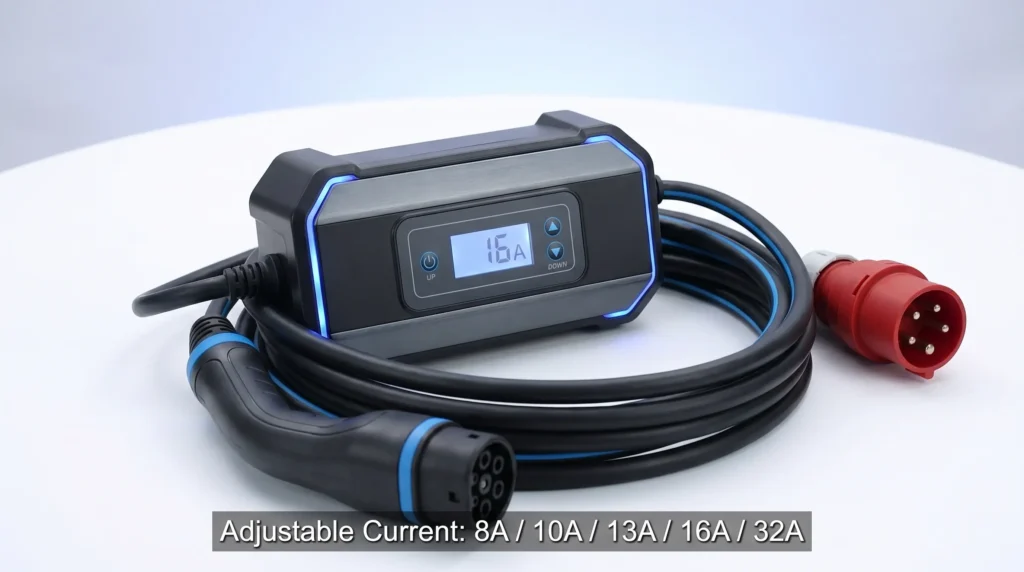
An adjustable-current portable EV charger is a portable AC EVSE that lets the user select a maximum current for a defined plug, circuit, cable, and vehicle. It offers flexibility across documented settings, but it does not make an unsuitable outlet safe. Buyers should approve each setting and the complete configuration, not just advertise the highest amperage.
This distinction matters to distributors, importers, private-label brands, fleets, and accessory buyers. A charger sold as “8A–32A adjustable” may still have separate plug versions, cable limits, connector options, protection behavior, and market documents. A buyer needs to know what changes when the current setting changes, what stays fixed, and which evidence supports the claim.
The useful buying path is therefore practical: define the electrical boundary, translate amperage into real input power, separate portable EVSE from a wallbox, map the applicable market documents, and test the supplied configuration at every advertised setting. That creates a product customers can use and a specification a supplier can reproduce.
Table of Contents
- What Is an Adjustable-Current Portable EV Charger?
- How Do You Choose a Safe Current Setting?
- What Do 8A, 10A, 13A, 16A, 24A, and 32A Mean in Practice?
- Does Adjustable Current Make a Household Outlet Safe?
- How Does the Control-Pilot Signal Communicate the Current Limit?
- What Is the Difference Between IEC 62752 and IEC 61851-1?
- Should You Buy an Adjustable Charger, a Fixed Portable Charger, or a Wallbox?
- What Evidence Should a Supplier Provide?
- Which Market Documents Must Match the Exact Model?
- How Should You Test and Approve an Adjustable-Current Charger?
- Conclusion: Sell a Defined Configuration, Not a Maximum Amp Number
- Frequently Asked Questions
- References
What Is an Adjustable-Current Portable EV Charger?
An adjustable-current portable EV charger is a portable AC EVSE with selectable current limits. The control box communicates a permitted current to the vehicle, while the supply plug, cable, circuit, connector, vehicle, and local electrical rules impose their own limits.
The adjustment is usually manual. The user selects a setting such as 8A, 10A, 13A, 16A, 24A, or 32A, and the EVSE communicates that limit during the charging session. That is different from dynamic load management, which measures other site loads and changes the available charging current automatically.
For buyers, “adjustable” is a feature only when the range is defined. Record the setting steps, voltage and frequency, phase, input plug, vehicle connector, cable length and construction, protection functions, temperature behavior, display or control method, and derating or shutdown conditions. A related portable EV charger guide helps separate the complete EVSE product from a cable, adapter, or wall-mounted installation.
The product boundary also affects customer support. A user may blame the control box for slow charging when the vehicle has a lower onboard AC limit, or blame the vehicle when the plug is overheating. A clear specification names the limit at each point instead of promising that one portable unit works identically in every location.
How Do You Choose a Safe Current Setting?
Choose the current by comparing every limit in the charging path. A useful decision rule is:
> Selected current ≤ the lowest applicable limit for the charger, circuit, outlet, plug, cable, vehicle, and local electrical rules.
Use this sequence before a charging session:
- Confirm the voltage, phase, socket type, breaker, and other loads on the circuit.
- Identify whether the outlet is dedicated, shared, indoor, outdoor, old, damaged, loose, wet, or used with an adapter.
- Check the continuous-load requirement that applies in the installation jurisdiction. EV charging may be treated as a continuous load under local rules, but the exact requirement must be confirmed for the site. 5
- Select the lowest-rated component in the approved configuration.
- Confirm the vehicle’s onboard AC charging limit and the energy needed before departure.
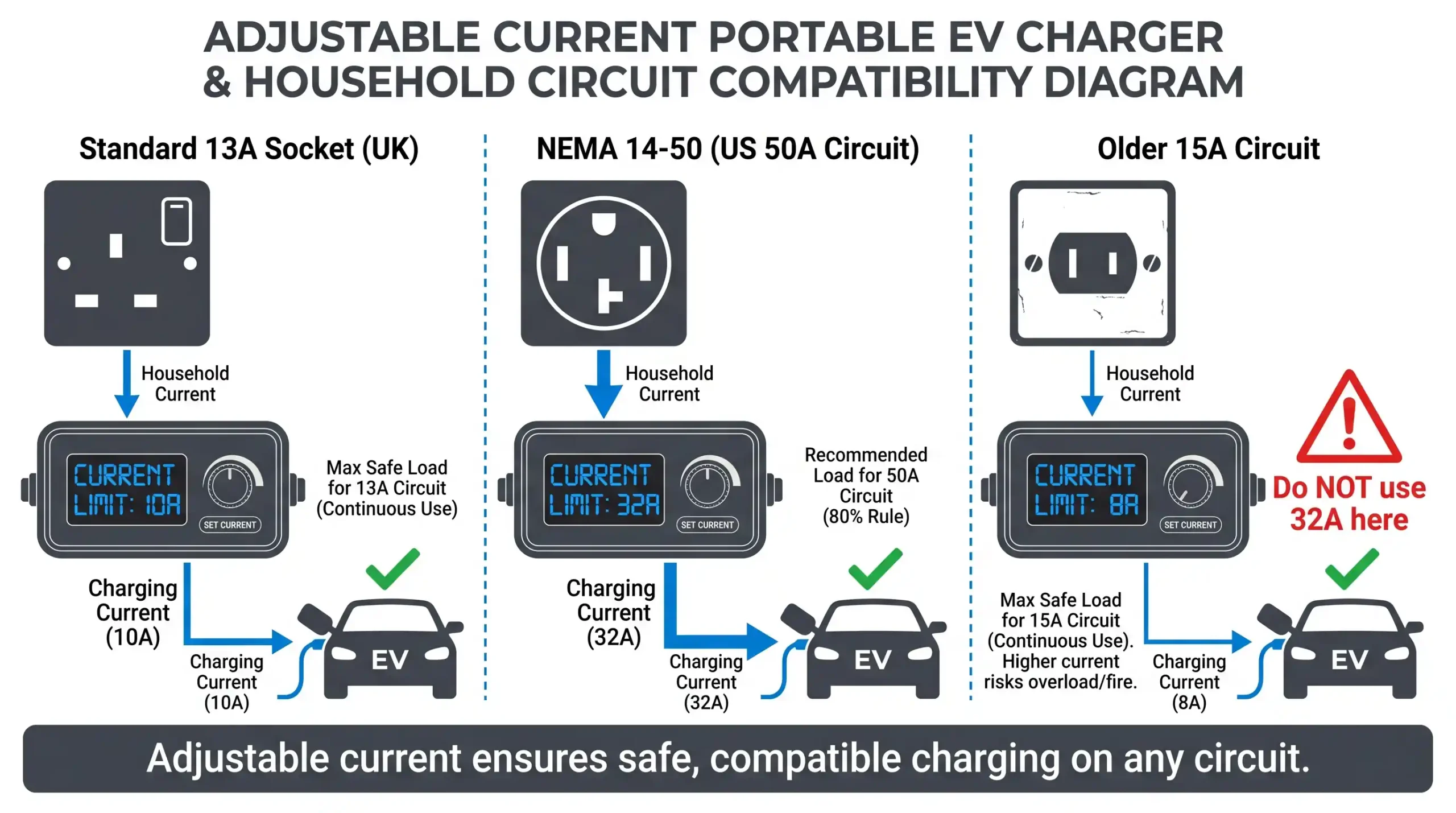
Starting at a lower setting is a reasonable diagnostic step when the installation is known and suitable but the available capacity is uncertain. It is not permission to use a damaged socket, a poor adapter, an unsuitable extension cord, a coiled cable, or a circuit that was never intended for sustained EV charging.
For a product specification, define what “safe” means operationally: the current setting is communicated correctly, the supplied plug and cable remain within the tested boundary, protection responds as specified, and the instructions identify the installation limits. Do not turn a lower amp number into a universal safety claim.
What Do 8A, 10A, 13A, 16A, 24A, and 32A Mean in Practice?
Amperage is not charging speed by itself. Approximate AC input power is voltage multiplied by current; the battery receives less after vehicle and charging-system losses, and the vehicle may draw less than the EVSE limit.
| Current setting | Approx. input power at 120V | Approx. input power at 230V | Practical question |
|---|---|---|---|
| 8A | 0.96 kW | 1.84 kW | Is low-load overnight charging more important than speed? |
| 10A | 1.20 kW | 2.30 kW | Is the outlet shared or is the installation older? |
| 13A | 1.56 kW | 2.99 kW | Is the regional plug and circuit suitable for sustained use? |
| 16A | 1.92 kW | 3.68 kW | Does the known circuit support the intended session? |
| 24A | 2.88 kW | 5.52 kW | Is a dedicated circuit and suitable connector available? |
| 32A | 3.84 kW | 7.36 kW | Do every component and the vehicle support the maximum? |
At 230V, 32A is about 7.36kW of input power before losses. That does not mean every EV charges its battery at 7.36kW; the vehicle’s onboard charger, battery condition, temperature, state of charge, and site limits still control the result.
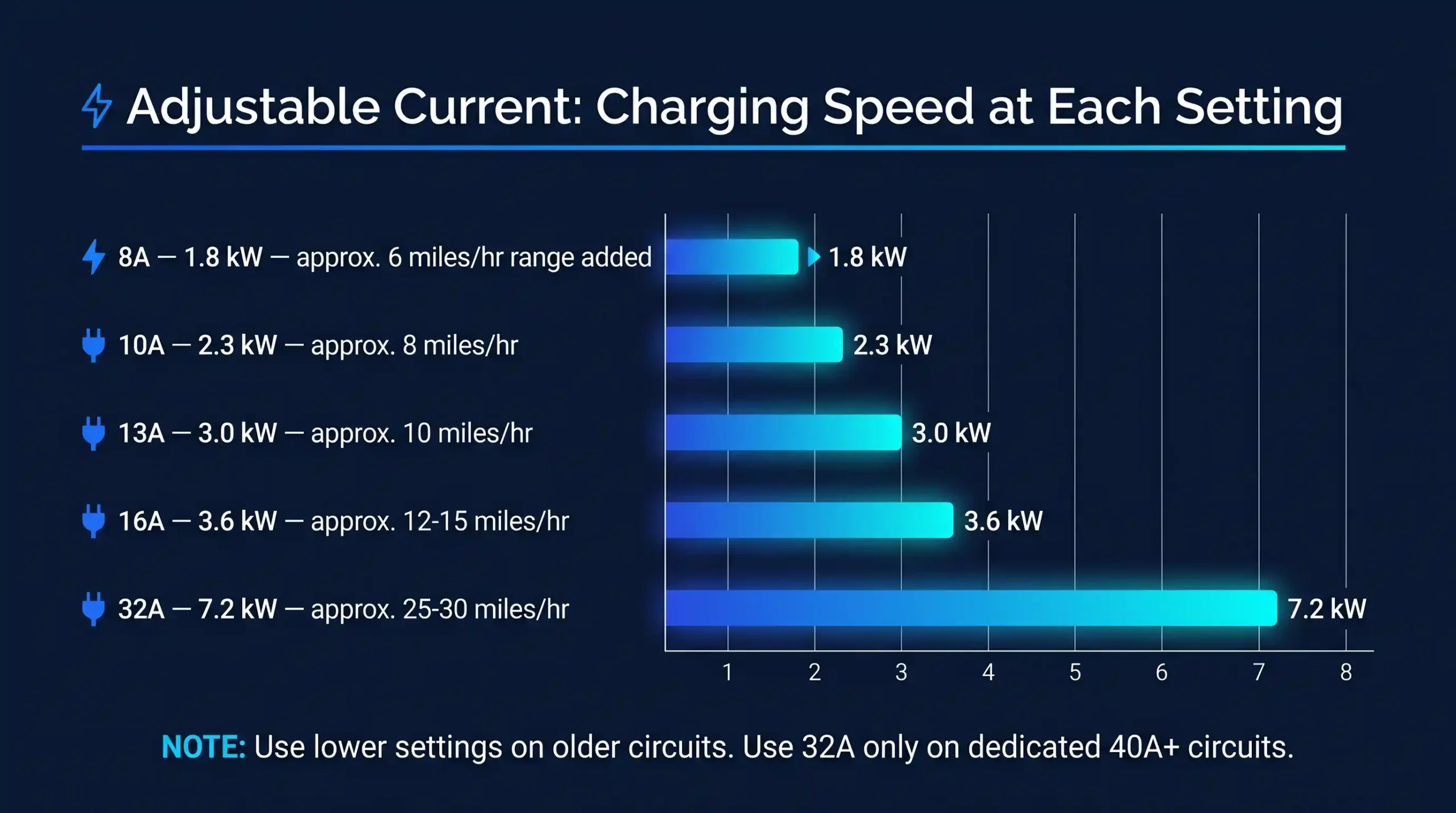
For a catalog or retail listing, show the setting, voltage, phase, plug type, and maximum input power together. “32A charger” is incomplete if the listing does not say which plug and voltage variant was tested. It also invites customers to compare a portable product with a fixed installation using only one number.
Does Adjustable Current Make a Household Outlet Safe?
No. Current adjustment can reduce the EVSE’s permitted load, but it cannot inspect conductor size, terminal tightness, contact resistance, grounding, moisture, heat damage, shared loads, or the condition of an adapter.
This is the most important boundary for customer-facing instructions. A 10A setting may still be unsuitable for a damaged socket, a long extension lead, a poor connection, an outdoor setup without the required protection, or a circuit already carrying heavy loads. A charger’s display cannot see those conditions.
The supplier should explain:
- which current settings are allowed for each plug and voltage variant;
- whether the current selection remains fixed for the session or can be changed during charging;
- how overtemperature, residual current, protective-earth, and pilot faults are handled;
- whether the product derates, stops, or requires a manual reset;
- which extension cords, adapters, and installation methods are prohibited.
The related portable EV charger safety standards resource can support the broader safety discussion. Keep the claim narrow: adjustable current provides a configurable limit; it does not certify the customer’s building wiring.
How Does the Control-Pilot Signal Communicate the Current Limit?
The EVSE does not simply force a chosen number of amps into the vehicle. The control pilot communicates the available current, and the vehicle’s onboard charger draws within that limit. IEC 61851-1 is the broad reference for conductive charging system requirements. 1
A useful supplier record keeps three values separate:
- User-selected current: the value shown or chosen on the control box.
- EVSE pilot limit: the current limit encoded and communicated to the vehicle.
- Measured vehicle current: the current actually drawn during the test.
Those values should be checked at every advertised setting. If the user selects 16A but the pilot communicates a different limit, the product is not behaving as specified. If the pilot is correct but the vehicle draws less, that may be a vehicle-side limit rather than an EVSE failure.
Avoid publishing a shortcut such as “a certain PWM percentage equals 32A” without the formula, standard edition, implementation, and measurement method. The buyer needs an analyzer capture or equivalent test record tied to the exact model revision. The control signal also does not prove that the plug, cable, or circuit is suitable; communication and physical capacity are separate checks.
Connector fit belongs in the same boundary review. The related EV charging cable and connector types resource helps separate vehicle compatibility from the control-box and protection assessment.
What Is the Difference Between IEC 62752 and IEC 61851-1?
IEC 61851-1 is a broad conductive charging-system reference. IEC 62752:2024 specifically addresses in-cable control and protection devices for Mode 2 charging of electric road vehicles, including the in-cable control and protection functions used in applicable products. 2
The practical purchasing question is not “Which logo is on the brochure?” It is “Which standard and edition apply to this exact product classification, and does the evidence cover the supplied plug, cable, connector, current range, and protection architecture?”
If a portable charger is sold as a Mode 2 product with an IC-CPD in the cable, a document that names only a broad charging-system standard may not answer every in-cable protection question. Request the full report scope, model number, revision, voltage, plug, connector, and current range.
Do not treat an IEC standard reference as a universal market certificate. Standards, national adoption, listing requirements, and importer duties vary by market. The product claim must stay inside the evidence scope.
Should You Buy an Adjustable Charger, a Fixed Portable Charger, or a Wallbox?
Adjustable current is useful when one product must serve several documented electrical environments. It is not automatically better than a fixed portable EVSE or a wallbox; the decision depends on portability, installation consistency, daily energy needs, and the buyer’s ability to control user instructions.
| Option | Main advantage | Main limitation | Best fit |
|---|---|---|---|
| Fixed-current portable EVSE | Simple operation with fewer user choices | Can be a poor match for different outlets or regions | One known outlet and vehicle configuration |
| Adjustable-current portable EVSE | Several defined settings in one portable product | Users can still select an unsuitable setting | Travel, backup charging, multi-market ranges |
| Wall-mounted EV charger | Fixed installation, organized cable management, and possible load management | Requires site installation and is not portable | Daily home, workplace, apartment, or fleet charging |
Use the wall-mounted EV charger guide when the customer needs a permanent installation. A 32A portable unit is not automatically equivalent to a 32A wallbox because the installation, controls, cable management, protection, and site design can differ.
For distributors, adjustable models can reduce the number of product families only when the variants are controlled. Separate the plug, cable length, connector, display, firmware, protection, and label variants in the catalog. Otherwise one “universal” listing creates more returns than it prevents.
What Evidence Should a Supplier Provide?
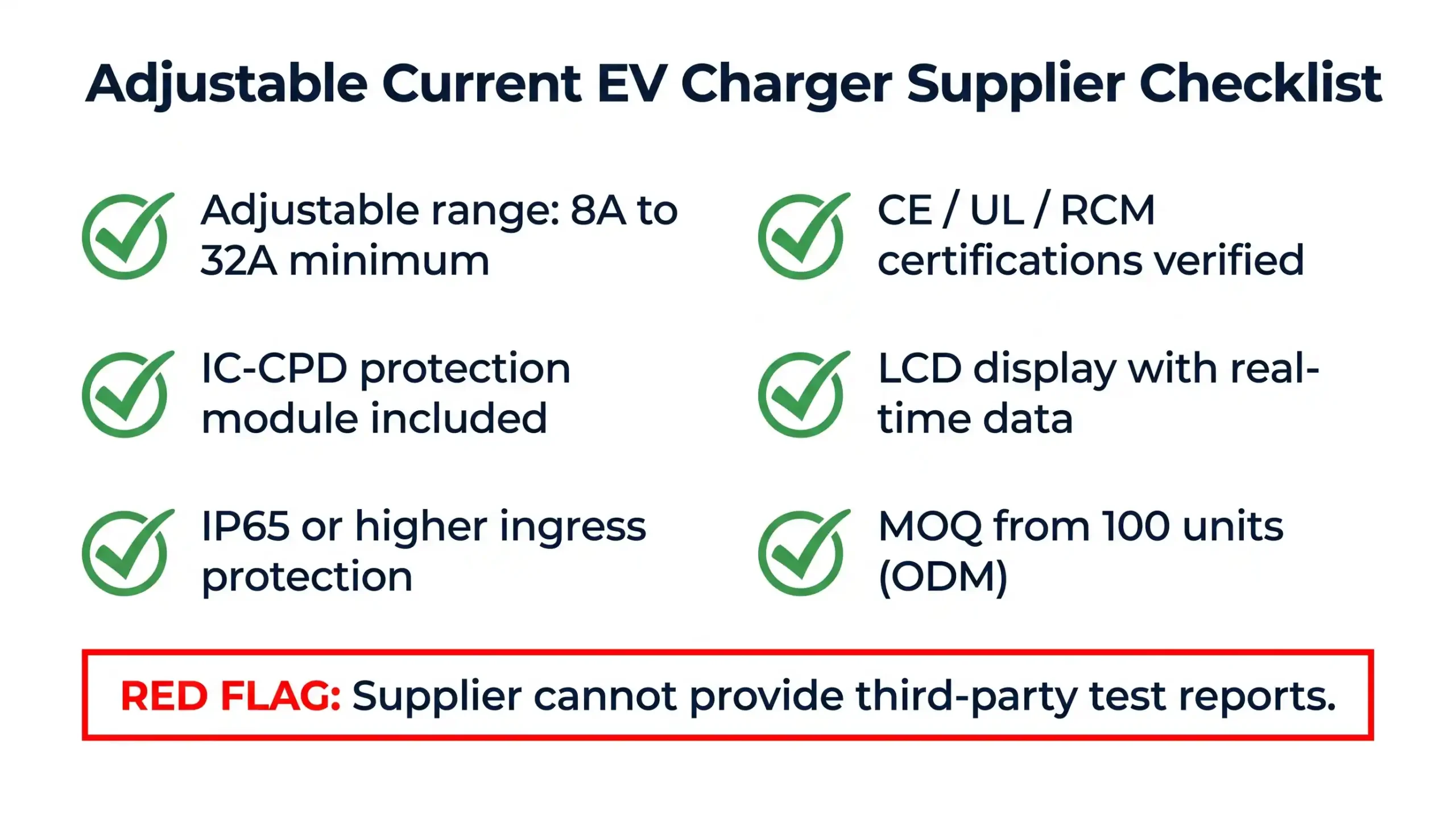
Ask for a claim-to-evidence matrix, not a page of certification logos. Each claim should identify the exact model, revision, variant, test conditions, measurement equipment, acceptance limit, and result.
| Evidence area | What to request | Why it matters |
|---|---|---|
| Electrical | Voltage/frequency, phase, current steps, tolerance, plug, connector, and cable data | Defines the actual configuration being sold |
| Pilot control | Pilot limit at each setting and analyzer or oscilloscope record | Shows that the EVSE communicates the selected limit |
| Thermal | Plug pins, terminals, body, cable, control-box entry, and connector temperatures | Reveals heating that a current display cannot show |
| Protection | Residual-current, PE fault, overtemperature, pilot interruption, unplugging, and recovery tests | Shows the response to defined fault conditions |
| Market scope | Model number, variant, standard edition, declaration or listing, manual, and labels | Prevents a similar model from being used as evidence |
| Traceability | Serial/batch, BOM, calibration record, report ID, photos, and golden sample | Connects test evidence to repeat production |
The EV charging accessories supplier checklist is a useful next step when the charger will be sold alongside cables, holders, adapters, or other EV accessories. The same rule applies: product claims must match the exact item, not merely the supplier’s category.
When evaluating a portable EV charger manufacturer, ask how model revisions, plug variants, firmware, labels, and test records are controlled between the approved sample and repeat production. A factory capability statement is not a substitute for a traceable evidence pack.
If the next step is reviewing related product families, browse the EV charging accessories range only after the voltage, connector, current settings, and market route are defined.
Which Market Documents Must Match the Exact Model?
There is no single global document that proves every adjustable-current portable charger is ready for every market. Use the following as a verification map, then confirm the current route with the responsible importer, authority, or compliance professional.
| Market route | Evidence to request | What not to assume |
|---|---|---|
| EU/EEA | CE route, EU Declaration of Conformity, applicable legislation, standards, plug, and manual | CE marking alone does not tell the buyer which model variant or tests are covered |
| Great Britain | Applicable UK route, importer information, model-specific documents, plug, and manual | The presence of CE or UKCA alone does not define the full evidence scope |
| United States/Canada | Applicable EVSE standard, accepted listing where required, plug configuration, and installation information | A standard number alone is not the same as approval for every sales channel |
| Australia/New Zealand | RCM pathway, applicable electrical requirements, importer obligations, and plug configuration | One mark does not describe every test or local duty |
| China | Current CCC scope, catalogue status, plug, marking, and importer requirements where applicable | Do not claim one universal CCC route for every portable charger |
The European Commission describes CE marking as the manufacturer’s declaration that the product meets applicable EU requirements; it is not automatically a third-party certificate. 3 For North American projects, request the exact listing or evaluation evidence required by the authority and sales channel. UL Solutions identifies UL 2594 in its EV charging infrastructure services, but the buyer still needs evidence for the actual model and configuration. 4
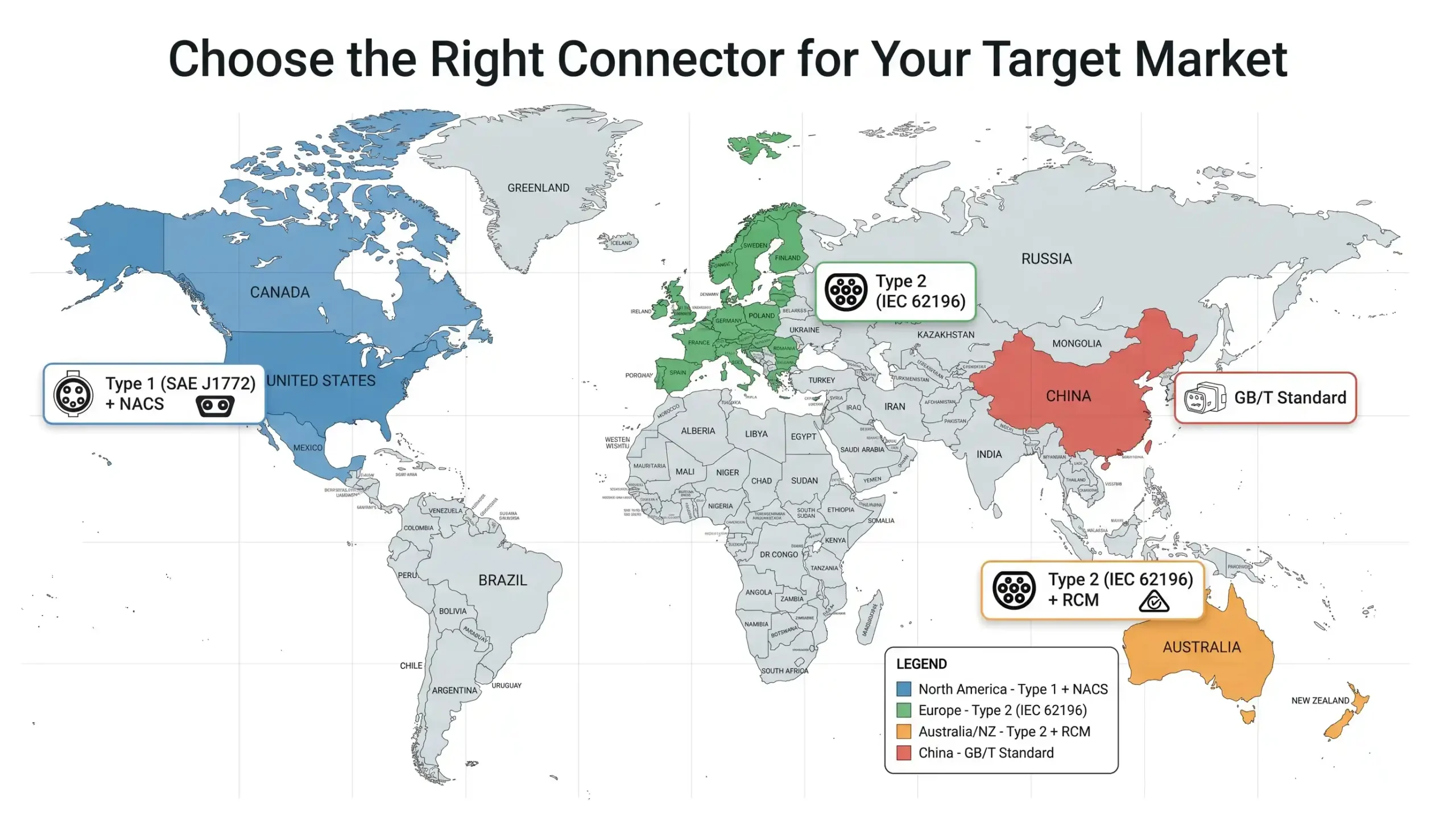
Every document should name the voltage, frequency, plug, connector, cable length, current range, model revision, and market. If one of those changes, ask whether the report, declaration, label, and manual remain valid. A similar-looking charger is not enough.
How Should You Test and Approve an Adjustable-Current Charger?
Test the complete supplied configuration at every advertised current setting before approving production. The control box alone is not enough; use the intended input plug, cable, vehicle connector, protection device, and a defined EV simulator or vehicle.
| Check | Executable test | Evidence to retain |
|---|---|---|
| Current selection | Set every advertised step under stable voltage | Setting photo, model/revision, measured current, and test log |
| Pilot limit | Read the pilot signal with an EVSE analyzer or equivalent | Duty-cycle capture, analyzer ID, setting, and simulator response |
| Plug temperature | Run the supplied plug at steady load and measure pins, terminals, body, and entry | Ambient, duration, sensor locations, readings, and thermal photos |
| Cable temperature | Measure supply cable, control-box entry, vehicle cable, and connector | Cable data, hottest point, duration, and raw readings |
| Fault response | Simulate defined residual-current, PE, overtemperature, pilot, unplugging, and recovery events | Trigger, trip/reset behavior, setup, and report or video |
| Variant boundary | Repeat for each plug, cable length, connector, voltage, and regional version | Variant matrix, BOM, labels, and report scope |
| Traceability | Match sample, nameplate, manual, declaration, report, and label | Serial/batch, report ID, photos, calibration, and signed result |
Do not fill a report with blank “passed” cells. A usable record includes raw readings, instrument identification, ambient conditions, test duration, acceptance limits, sample photos, and a clear disposition. Define in advance whether an out-of-limit result causes a pass, hold, retest, or rejection.
The product specification should also state the IP boundary, protection architecture, current tolerance, cable length, connector, operating instructions, labels, and prohibited accessories. If those details are omitted, the customer service team will eventually turn an engineering assumption into an unsafe answer.
Approve the exact sample and pack that will be shipped. Reopen approval when the plug, cable, connector, control box, firmware, protection component, label, manual, or market route changes. The sample record is the bridge between a first quotation and a repeat order.
If you are selecting an adjustable-current charger, share the input voltage and phase, plug, vehicle connector, current steps, cable length, target market, vehicle range, intended use, test reports, and packaging requirements. We can help prepare a configuration comparison and sample test matrix. You can request an adjustable-current charger review with the information already available.
Conclusion: Sell a Defined Configuration, Not a Maximum Amp Number
The strongest product claim is not “one charger is safe everywhere.” It is: this model provides defined current settings for a defined voltage and plug configuration, with documented pilot control, protection behavior, market evidence, and test results.
The reliable sequence is to identify the installation boundary, calculate the real input power, separate adjustable current from dynamic load management, compare portable and fixed options, match standards to the exact model, and test every setting with the supplied configuration. That gives distributors a product they can explain and gives end users a safer decision.
Frequently Asked Questions
Does adjustable current protect my home from overload?
It can reduce the EVSE’s permitted current, but it cannot inspect wiring, socket condition, other circuit loads, moisture, or contact resistance. Those installation limits still determine whether the setup is suitable.
What current should I use for overnight EV charging?
Use the lowest current that meets the required energy while staying below the most restrictive limit in the charging path. If the outlet, circuit, or plug condition is uncertain, stop and have the installation checked.
Is a 32A portable charger the same as a 32A wallbox?
Not automatically. A portable EVSE and a wallbox can have different installation methods, protection, cable management, controls, and load-management functions. The circuit and vehicle must support the claimed current in either case.
Does IEC 62752 apply to every adjustable-current charger?
It is relevant to applicable Mode 2 products with in-cable control and protection devices, but the route depends on product classification, configuration, market, and standard edition. Ask why the evidence applies to the complete model.
Can I use an extension cord at a lower current setting?
Do not assume so. A lower setting does not correct poor contacts, cable damage, coiling, outdoor exposure, an unsuitable plug, or a circuit that is not intended for EV charging. Follow the product instructions and local requirements.
What is the most important supplier document?
Request the model-specific test report and the applicable declaration, listing, or conformity documents. They should match the current range, voltage, plug, cable, connector, protection functions, label, manual, and approved sample.
References
[1] International Electrotechnical Commission. “IEC 61851-1:2017 — Electric vehicle conductive charging system, Part 1: General requirements.” 2017.
[2] International Electrotechnical Commission. “IEC 62752:2024 — In-cable control and protection device for Mode 2 charging of electric road vehicles.” 2024.
[3] European Commission. “CE marking.” 2026.
[4] UL Solutions. “Electric vehicle charging infrastructure services and UL 2594.” 2026.
[5] NFPA. “NFPA 70, National Electrical Code.” 2026.