




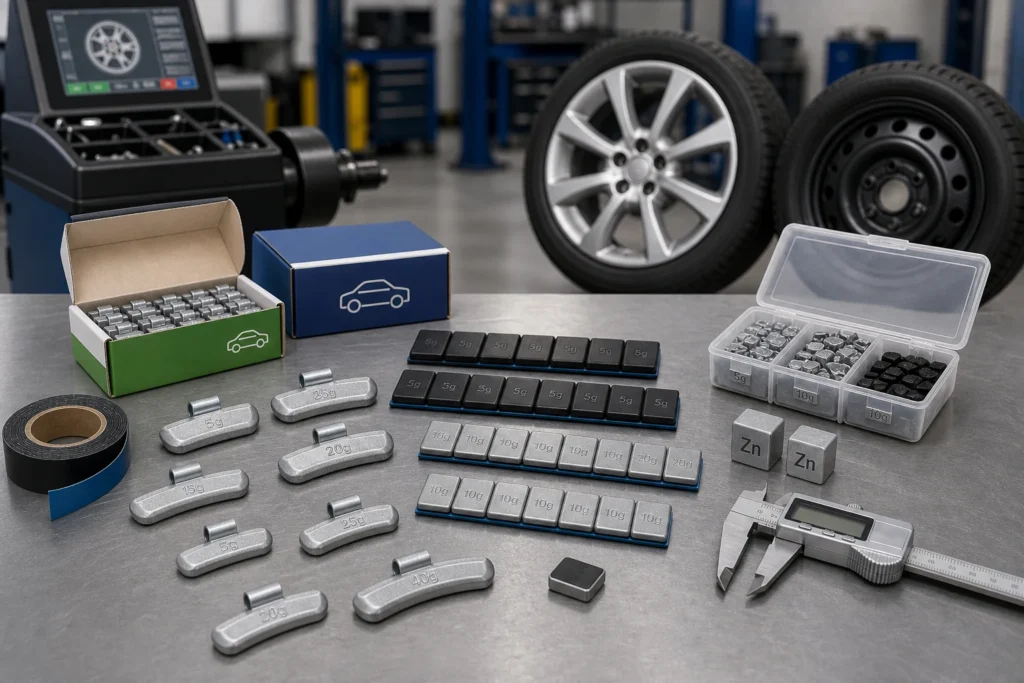
Passenger car wheel weights are small balancing weights used on alloy and steel wheels to correct tire and wheel imbalance after mounting or service. Buyers should choose them by wheel type, attachment format, size increment, material, coating, tape, box label, and the vehicles their tire shops or distributors actually support.
For passenger car programs, the buying challenge is usually not extreme weight range. It is fitment breadth, clean installation, fast shop use, and low complaint risk. The wheel-weight range planning framework helps buyers connect passenger car weights with material, size, attachment, coating, and packaging decisions before requesting samples.
Table of Contents
- What are passenger car wheel weights?
- Why do passenger car wheel weights need fitment planning?
- Which passenger car wheel weight types are commonly used?
- How do alloy and steel wheels affect fitment?
- Which sizes and specifications matter for passenger cars?
- What should buyers check before ordering passenger car wheel weights?
- Which applications need extra caution?
- Conclusion: match passenger car weights to real shop use
- Frequently Asked Questions
- References
What are passenger car wheel weights?
Passenger car wheel weights are clip-on or adhesive weights used to balance light-vehicle wheel and tire assemblies. A technician applies the required amount of mass after a balancing machine identifies where correction is needed, helping reduce vibration, steering shake, uneven tire wear, and customer comebacks.
Wheel balancing is only one part of tire and wheel care, but it is closely tied to service quality. NHTSA's tire information emphasizes the importance of tire maintenance and safe tire use for drivers 1. For buyers, that means passenger car wheel weights should support consistent installation and repeat service, not just meet a low unit price.
Most passenger car programs include both adhesive stick-on weights and clip-on weights. Stick-on weights are common for alloy wheels because they can be placed behind spokes or on inner barrel surfaces where the appearance of the outer rim matters. Clip-on weights are common where the wheel flange accepts the correct clip profile, especially on many steel wheel applications.
Passenger car buying also differs from truck or commercial vehicle buying. The weights are usually smaller, the sizes turn faster across many repair shops, and box labeling needs to be easy for technicians to scan. A distributor may need a broad light-vehicle range, while a tire shop may prefer fewer high-turnover SKUs with clear gram or ounce labels.
| Buyer context | Main need | Common risk |
|---|---|---|
| Passenger tire shop | Fast installation and common sizes in reach | Missing everyday 5g or 0.25oz increments |
| Alloy-wheel service channel | Clean appearance and reliable adhesive tape | Tape lifting or visible weight placement complaints |
| Steel-wheel repair channel | Correct clip profile and coated finish | Poor flange fit or chipped coating |
| Distributor | Balanced SKU mix and clear packaging | Overstocking slow sizes while missing core boxes |
| Export buyer | Material, size, label, and carton consistency | Mismatched units, labels, or market expectations |
Why do passenger car wheel weights need fitment planning?
Passenger car wheel weights need fitment planning because alloy wheels, steel wheels, wheel clearances, rim flange shapes, and shop installation habits vary. A weight that balances correctly on the machine can still be a poor buying choice if it does not fit the wheel cleanly or stay attached in service.
Fitment starts with the wheel. Alloy wheels often require adhesive placement because the outer appearance matters and the wheel design may not suit a visible clip-on weight. Steel wheels may accept clip-on weights, but only when the clip profile matches the rim flange. Some passenger car wheels have tight brake caliper clearance, making weight height and placement important.
Fitment also includes the shop process. Adhesive weights need surface preparation, pressure, and reasonable application conditions. Clip-on weights need the right installation tool and a profile that seats without damaging the wheel. If buyers skip fitment testing, technicians may create their own workarounds, which can lead to inconsistent service.
The safest buying process is to define the wheel applications first, then request samples. A tire shop serving mostly modern alloy wheels should not stock the same mix as a steel-wheel repair channel. A distributor serving multiple customers should separate alloy, steel, coated, adhesive, and clip-on demand before finalizing cartons.
Which passenger car wheel weight types are commonly used?
Passenger car wheel weights are commonly supplied as adhesive stick-on weights for alloy wheels and clip-on weights for suitable wheel flanges. Buyers may also choose steel, zinc, coated, or lead-free options depending on market expectations and customer requirements.
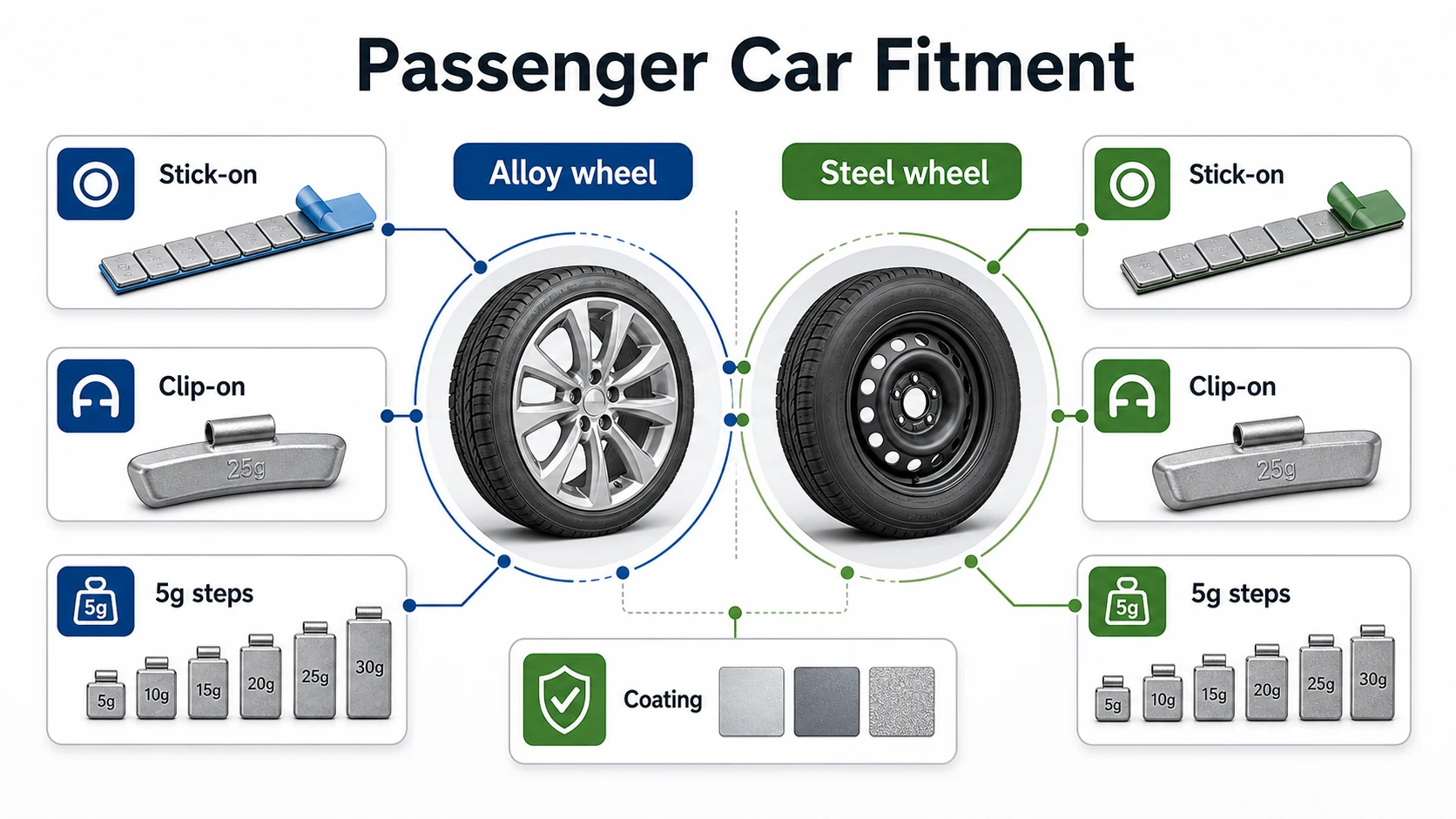
Adhesive stick-on weights are usually supplied as segmented strips. Common passenger car formats include 5 g and 10 g segments in metric markets or quarter-ounce style segments in ounce markets. They are popular for alloy wheels because the strip can be placed on the inner barrel, but buyers must check tape quality, liner release, segment height, and storage conditions.
Clip-on weights are individual weights with a clip designed to grip a wheel flange. They can be fast for service shops when the correct profile is used. The risk is assuming one clip fits every wheel. Buyers comparing formats can use the attachment choice for passenger car wheel weights to separate the attachment decision from the material decision.
Coated weights are common because appearance and corrosion complaints matter in passenger car service. A clean gray, black, or silver coating can help protect the part and improve the look of the installation. Lead-free material choices are also common as markets and customers move away from lead; EPA guidance has encouraged reducing lead wheel weights and using alternatives where practical 2.
| Type | Where it fits | Buyer focus | Main caution |
|---|---|---|---|
| Adhesive stick-on weights | Alloy wheels and hidden placement areas | Tape, segment size, height, liner release | Poor surface preparation can cause lifting |
| Clip-on weights | Wheels with suitable flanges | Clip profile, retention, coating | Wrong clip can damage or loosen |
| Coated steel weights | Lead-free passenger car service ranges | Coating, size range, price | Coating damage can create visible complaints |
| Zinc weights | Zn-specified customer or market programs | Material label, cost, availability | Not every range needs zinc |
| Mixed shop assortments | Tire shops and distributors serving many wheels | SKU logic, box labels, fast-moving sizes | Too many variants can weaken stock depth |
How do alloy and steel wheels affect fitment?
Alloy and steel wheels affect fitment because they use different surfaces, flange shapes, appearance expectations, and installation routines. Buyers should not order passenger car wheel weights by mass only; the attachment style must match the wheel design.
Alloy wheels often lead buyers toward adhesive weights. The reason is not only appearance. Many alloy wheel designs have no suitable outer flange for a traditional clip-on weight, or the customer may reject visible marks on the wheel face. For alloy-wheel programs, buyers can use adhesive weight checks for alloy wheels to evaluate strip height, tape quality, liner behavior, surface preparation, and packaging before ordering.
Steel wheels often support clip-on weights, especially where wheel covers or utilitarian appearance reduce concern about visible weights. Even then, clip profile matters. A clip that fits one steel wheel flange may not fit another. Buyers serving steel-wheel service channels can use steel wheel clip-on fitment checks to connect rim flange size, clip style, coating, and use case before approving samples.
Some shops carry both formats because passenger car service is mixed. A car with alloy wheels may need adhesive strips; another with steel winter wheels may need clip-on weights. The best range reflects the shop's actual wheel mix rather than one attachment preference.
| Wheel application | Better starting point | What to verify |
|---|---|---|
| Modern alloy wheels | Adhesive stick-on weights | Tape, strip height, clearance, surface prep |
| Steel wheels | Clip-on weights | Rim flange profile, clip retention, coating |
| Painted or premium wheels | Hidden adhesive placement where possible | Appearance, residue, and safe removal expectations |
| Mixed repair shop | Both clip-on and stick-on SKUs | Core sizes, box labels, installer habits |
| Export assortment | Market-specific units and wheel mix | Gram/ounce labels, material, carton format |
Which sizes and specifications matter for passenger cars?
Passenger car wheel weight specifications usually focus on smaller increments, clear unit systems, and fast-moving box sizes. Buyers should confirm grams or ounces, segment layout, clip profile, coating, tape, pieces per box, and carton labels before comparing prices.
In metric markets, 5 g increments are common for passenger car service. Adhesive strips may use repeated 5 g or 10 g segments, while clip-on weights often appear as individual sizes such as 5 g, 10 g, 15 g, 20 g, 25 g, and higher values. In ounce markets, quarter-ounce increments are common. The exact range depends on market practice, wheel applications, and service equipment.
Before setting an assortment, buyers can use passenger car wheel weight size planning to compare grams, ounces, segment layouts, and box labeling. This is especially useful for importers who must prevent confusion between metric and ounce markets.
The most important specification is not always the maximum size. For passenger car programs, core turnover often comes from everyday smaller sizes. A distributor may need deep stock in common increments and lighter stock in less frequent sizes. A tire shop may prefer boxes that are easy to identify from a balancing station.
| Specification | Why it matters | Buyer question |
|---|---|---|
| Unit system | Prevents gram/ounce confusion | Which unit does the market and box label require? |
| Segment size | Affects adhesive strip flexibility and correction precision | 5 g, 10 g, 0.25 oz, or another layout? |
| Clip profile | Determines fit on steel or flanged wheels | Which rim flange is the clip designed for? |
| Strip height | Affects clearance behind spokes and brake components | Is the strip low enough for common alloy wheels? |
| Tape | Controls adhesive reliability | What tape, liner, shelf life, and surface prep are needed? |
| Box label | Helps shops pick sizes quickly | Are size, material, barcode, and quantity clear? |
What should buyers check before ordering passenger car wheel weights?
Buyers should check wheel type, attachment format, weight range, clip profile, tape, coating, material, box label, and carton plan before ordering passenger car wheel weights. A clear RFQ helps suppliers quote the right product, not just the lowest box price.
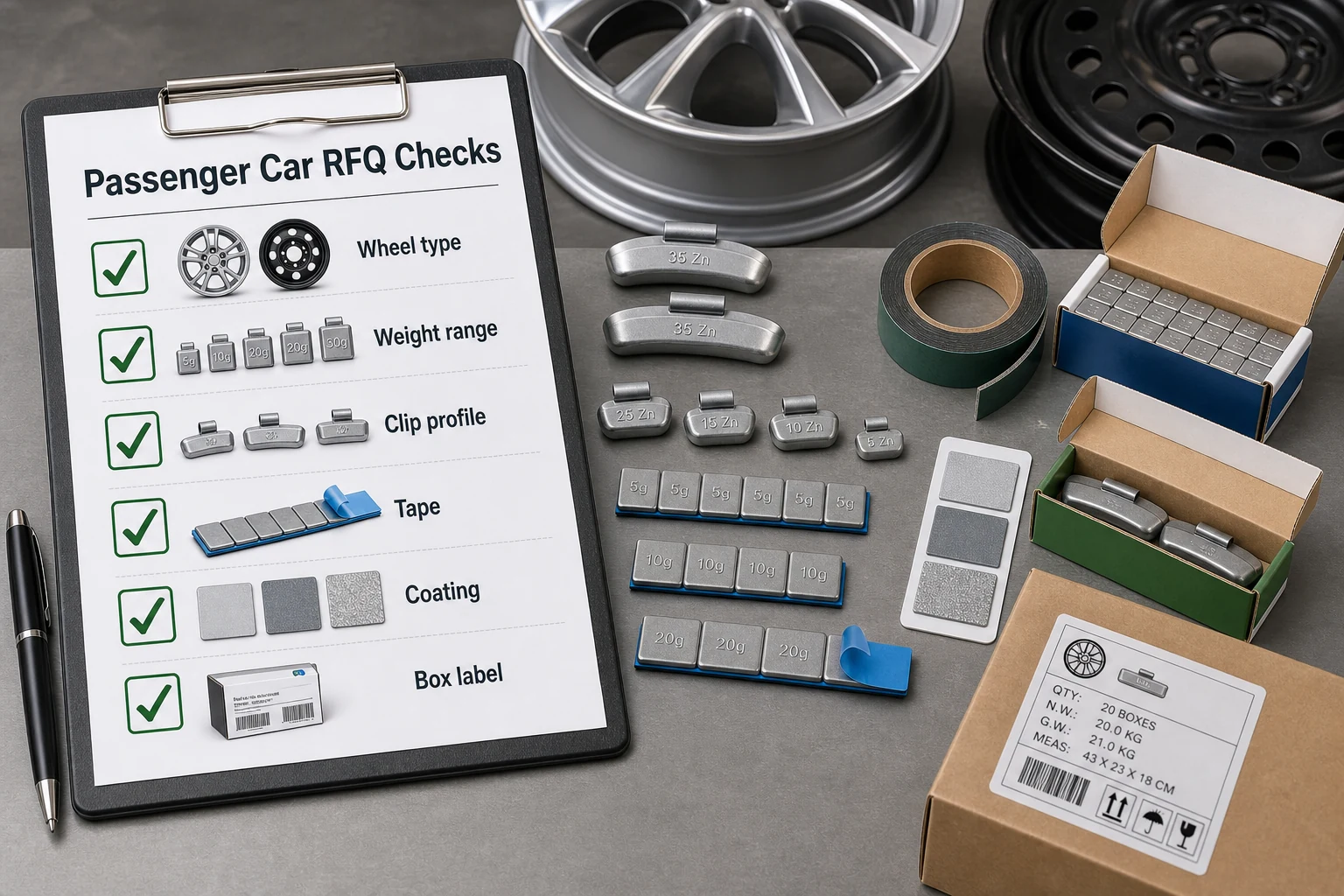
Start with wheel application. State whether the program is mainly alloy wheel adhesive weights, steel wheel clip-on weights, or a mixed passenger car assortment. Then list the expected unit system and sizes. If the buyer says only "standard passenger car wheel weights," two suppliers may quote very different ranges.
For adhesive weights, ask for tape construction, strip width, strip height, liner release, shelf-life guidance, and surface preparation recommendations. Adhesive bonding depends on clean surfaces, pressure, and application conditions; 3M's surface preparation guidance for VHB tapes is a useful reminder that surface cleanliness and application pressure matter to bonding performance 4.
For clip-on weights, request the clip profile, intended wheel type, coating, and sample fitment. A visual sample is not enough; buyers should test the clip on representative wheels. For coated weights, ask for coating type, color, visual standard, and corrosion expectations. ASTM B117 describes a standard practice for operating salt spray apparatus, which buyers often reference when comparing coating systems under controlled exposure 3.
Packaging and labels deserve attention because passenger car weights are used quickly in shops. Buyers should specify pieces per box, inner box layout, carton quantity, gross weight, barcode, and whether the label shows grams, ounces, material, and product type. Buyers building larger tire shop ranges can use box and carton planning for passenger car service ranges to connect SKU mix, carton quantity, and reorder behavior before committing to a bulk order.
Buyers also need coating review before sample approval. A clean finish reduces customer complaints and improves shop confidence. The coating checks for passenger car wheel weights help purchasing teams convert vague finish requests into inspection points for paint, plating, corrosion appearance, and carton abrasion.
| RFQ field | What to specify | Why it protects the buyer |
|---|---|---|
| Wheel type | Alloy, steel, or mixed passenger car service | Prevents the wrong attachment format |
| Weight range | Gram or ounce sizes, increments, strip layout | Aligns stock with shop demand |
| Clip profile | Intended wheel flange and clip design | Reduces poor fitment and installer rejection |
| Tape | Tape type, liner, shelf life, surface prep | Reduces adhesive lifting complaints |
| Coating | Finish color, corrosion expectation, visual standard | Reduces rust or chipped-finish claims |
| Box label | Size, unit, material, barcode, quantity | Makes shop picking faster |
| Samples | Fitment wheels, tape test, coating review, label check | Finds issues before MOQ commitment |
Which applications need extra caution?
Passenger car wheel weight applications need extra caution when wheels have tight clearance, premium finishes, unclear rim flanges, mixed unit systems, or poor surface preparation. These are the cases where a low-cost box can become an expensive complaint.
Low-clearance alloy wheels are the first caution. Some wheels have tight spacing near brake calipers or spokes. Adhesive strips that are too tall or too long may interfere or appear visible from the outside. Buyers should check strip height and segment flexibility before ordering bulk quantities.
Premium or painted wheels need careful installation expectations. Some customers reject visible marks, residue, or scratches. Adhesive placement may be preferred, but tape removal and surface cleaning should still be handled correctly. Clip-on weights should not be used where the wheel finish or flange design makes damage likely.
Mixed gram and ounce markets are another risk. A warehouse carrying both metric and ounce products needs clear labels, barcodes, and carton separation. If shop staff pick the wrong unit system, balancing work slows down and complaints become harder to trace.
Finally, adhesive weights should not be judged by tape name alone. Surface cleaning, temperature, application pressure, and storage affect performance. If shops skip preparation, even a good strip can lift. Buyers should include installation guidance and sample tests in the approval process, especially when changing suppliers.
If you are selecting passenger-car wheel weights, tell us the wheel types, clip or adhesive format, size coverage, coating, tape, and packaging you need to stock. We can help you request samples matched to real shop fitment instead of a broad assortment.
Conclusion: match passenger car weights to real shop use
Passenger car wheel weights should be selected around the wheels and service habits your customers actually handle. Alloy wheels, steel wheels, adhesive strips, clip-on profiles, gram or ounce sizes, coating, tape, labels, and cartons all affect whether a range works smoothly in daily tire service.
The practical buying path is simple: define the wheel mix, choose the attachment formats, confirm the size range, test samples, then finalize packaging. Buyers preparing a light-vehicle assortment can review passenger car wheel weight samples for alloy and steel wheel checks once wheel type, size range, tape, clip profile, coating, and box label requirements are clear.
Frequently Asked Questions
What are passenger car wheel weights used for?
Passenger car wheel weights are used to correct imbalance in light-vehicle wheel and tire assemblies. A technician adds the required weight after balancing equipment identifies the correction point, helping reduce vibration, steering shake, uneven tire wear, and service comebacks.
Are stick-on or clip-on weights better for passenger cars?
Neither is always better. Stick-on weights are common for alloy wheels and hidden placement, while clip-on weights can work well on suitable steel or flanged wheels. The correct choice depends on wheel type, appearance expectations, fitment, tape, clip profile, and installer routine.
What sizes are common for passenger car wheel weights?
Passenger car wheel weights often use 5 g increments in metric markets and quarter-ounce increments in ounce markets. Common ranges vary by shop and market, so buyers should confirm gram or ounce labeling, segment layout, box quantity, and high-turnover sizes before ordering.
Can passenger car wheel weights be lead-free?
Yes. Passenger car wheel weights are commonly available in lead-free materials such as coated steel or zinc. Buyers should verify the target market's material expectations, documentation needs, coating quality, and size availability before switching from older lead-based ranges.
What should be included in a passenger car wheel weight RFQ?
A passenger car wheel weight RFQ should include wheel type, attachment format, gram or ounce range, clip profile, tape specification, coating, material, pieces per box, carton quantity, barcode, label format, and sample approval requirements.
References
[1] National Highway Traffic Safety Administration. “Tires.” 2026.
[2] United States Environmental Protection Agency. “Best Management Practices for Lead Wheel Weights.” 2015.
[3] ASTM International. “ASTM B117-19 Standard Practice for Operating Salt Spray Apparatus.” 2019.
[4] 3M. “3M VHB Tape Surface Preparation Technical Bulletin.” 2019.