



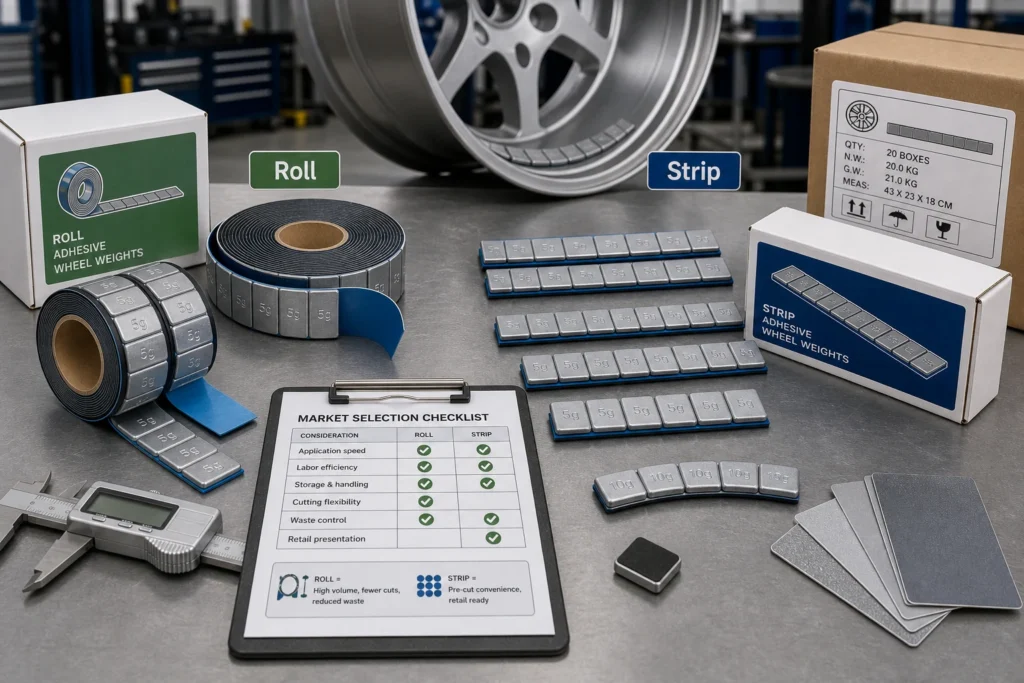
Wheel weight rolls and strips are both adhesive balancing formats for attaching correction weight to a wheel surface. Rolls are continuous and can be cut to length, while strips are pre-cut and ready to use. The better choice depends on shop workflow, segment size, tape, packaging, SKU planning, and local market habits.
For buyers, the format decision is bigger than product shape. A high-volume tire shop may value cutting flexibility and lower SKU pressure, while a distributor may prefer retail-ready strips with clear labels and easy picking. The wheel-weight range planning framework helps connect adhesive format with material, size range, fitment, packaging, and stocking decisions.
Table of Contents
- What are wheel weight rolls and strips?
- What is the difference between wheel weight rolls and strips?
- When should buyers choose adhesive wheel weight rolls?
- When should buyers choose pre-cut strips?
- How do wheel applications affect roll or strip choice?
- Which specifications matter for rolls and strips?
- What should buyers include in a rolls vs strips RFQ?
- Conclusion: choose the format that matches your market
- Frequently Asked Questions
- References
What are wheel weight rolls and strips?
Wheel weight rolls and strips are adhesive wheel weights supplied in different formats. A roll is a continuous adhesive weight line that can be cut to the required length, while a strip is a pre-cut piece with fixed segment layout, tape, liner, and box packaging.
Both formats are used to balance wheel and tire assemblies after mounting or service. Tire maintenance and correct wheel service support safe vehicle use, and NHTSA's tire information gives drivers and service providers a broader safety context for tire care 2. For sourcing teams, adhesive wheel weights must still be evaluated by tape, segment size, wheel surface, unit system, and packaging.
The core product is similar: small metal segments, usually coated steel or zinc, backed with adhesive tape and release liner. The difference is how the shop handles the weight. Rolls give the installer a continuous supply that can be cut to the balancing machine's required correction. Strips give the installer pre-cut units that are easy to pick, peel, and place.
Buyers comparing formats should first understand the adhesive weight category itself. The adhesive wheel weight format and tape checks article helps buyers review tape, surface preparation, segment size, and installation basics before deciding whether rolls or strips fit their market better.
| Format | Basic meaning | Typical buyer reason |
|---|---|---|
| Roll | Continuous adhesive wheel weight supplied on a roll | Flexible cutting, lower SKU count, workshop efficiency |
| Strip | Pre-cut adhesive weight piece in fixed segment layout | Ready-to-use handling, retail box, standardized installation |
| Mixed range | Rolls and strips both offered | Serves different shop habits and customer channels |
| Low-profile strip | Thin adhesive strip for tight clearance | Alloy wheels with limited space |
| Retail strip box | Pre-packed strips for resale or shop shelves | Easier picking, labeling, and presentation |
What is the difference between wheel weight rolls and strips?
The main difference is handling. Rolls give the installer flexible length control, while strips give the buyer a standardized, pre-cut product that is easier to box, label, display, and train around.
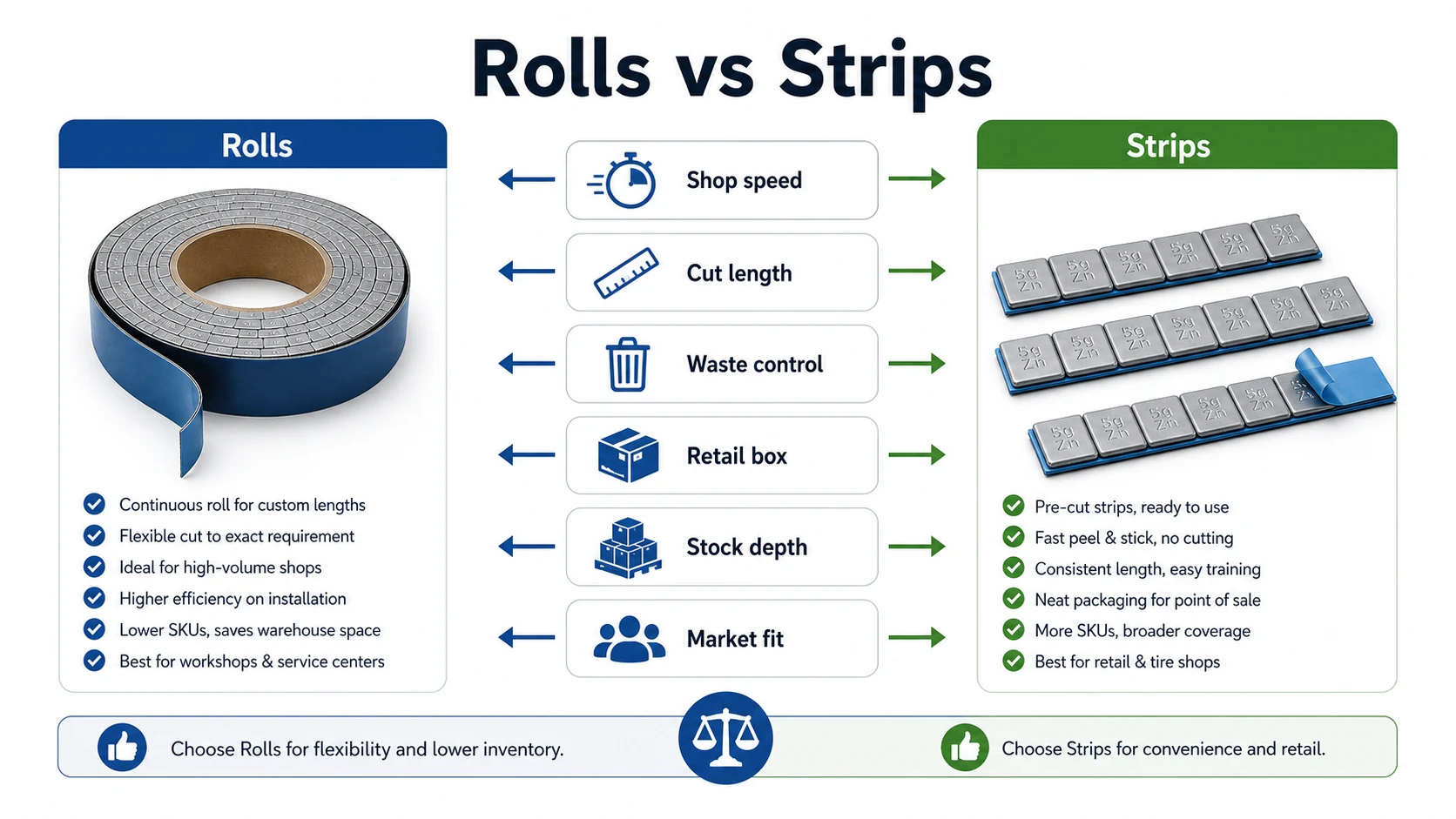
Rolls are efficient when shops apply adhesive weights frequently and want to cut only the length required. They can reduce the number of separate strip SKUs because one roll can cover many correction values. The trade-off is that technicians need a clean cutting routine, a predictable way to measure segments, and packaging that protects the roll and liner.
Strips are efficient when shops or distributors value convenience. A strip may be supplied in common layouts such as 5 g segments, 10 g segments, ounce segments, or mixed segment patterns. The installer can pick a strip, remove the liner, and apply it without cutting. The trade-off is that the buyer may need more SKUs, more box types, and more careful inventory planning.
| Decision point | Rolls | Strips |
|---|---|---|
| Installation workflow | Cut to required length | Pick a pre-cut piece |
| SKU count | Often lower | Often higher |
| Training | Requires cutting and length control | Easier to standardize |
| Retail display | Less retail-friendly unless packed well | Stronger retail and shelf presentation |
| Waste control | Good when cuts are precise | Good when pre-cut layout matches demand |
| Distributor handling | Fewer formats, larger units | More labels and box variants |
| Market fit | High-volume service centers | Tire shops, retailers, mixed distributors |
When should buyers choose adhesive wheel weight rolls?
Buyers should choose wheel weight rolls when their market values flexible cutting, high-volume workshop use, and lower SKU complexity. Rolls fit service centers that install adhesive weights often and can control cutting, storage, and technician training.
The strongest roll use case is a busy shop that wants to cover many correction values without opening many boxes. Instead of stocking multiple pre-cut layouts, the shop can cut the required amount from the roll. This can simplify purchasing and reduce shelf clutter, especially when a market already accepts roll handling.
Rolls also make sense when the distributor wants fewer item codes. If the sales channel is trade-focused rather than retail-focused, roll packaging may be acceptable. A roll can be easier to reorder as a bulk service item, provided the box label clearly shows segment size, material, total roll length or total weight, tape type, and carton quantity.
The risk is process variation. If technicians cut inconsistent lengths, damage the liner, contaminate the tape, or leave rolls exposed to dirt and moisture, the format advantage can disappear. Tape performance depends heavily on clean surfaces, application pressure, and proper surface preparation; 3M's surface preparation guidance is a useful reminder that bonding depends on the installation environment, not just the tape label 1.
Choose rolls when these conditions are true:
| Good roll-fit signal | Why it matters |
|---|---|
| High adhesive-weight consumption | Rolls reduce frequent box picking |
| Trained shop technicians | Cutting and application are more consistent |
| Trade channel, not retail shelf | Packaging can be functional rather than display-focused |
| Limited SKU space | One roll can cover many correction lengths |
| Clear storage process | Tape and liner stay clean before use |
When should buyers choose pre-cut strips?
Buyers should choose pre-cut strips when the market values convenience, retail-ready boxes, simple technician training, and consistent strip length. Strips fit tire shops, distributors, and resale channels that need predictable handling more than cutting flexibility.
A pre-cut strip is easier for many shops to understand. The box can show the total strip weight, segment size, material, quantity, barcode, and product format. The technician opens the box, takes one strip, peels the liner, and applies the weight. This is useful where labor routines need to be fast and repeatable.
Pre-cut strips are also easier to present in a catalog or retail setting. A distributor can sell 5 g x 12 segment strips, 10 g x 6 segment strips, ounce strips, low-profile strips, or other formats as separate SKUs. That creates more product lines, but it also gives sales teams a clearer way to match customer habits.
Buyers who need deeper detail on strip layouts can use pre-cut wheel weight strip specifications to compare segment size, tape options, strip layout, carton quantity, and bulk buying logic before deciding whether strip packaging is the right default.
Choose strips when these conditions are true:
| Good strip-fit signal | Why it matters |
|---|---|
| Shops prefer ready-to-use pieces | Less cutting and easier training |
| Distributor needs clear SKUs | Boxes can be labeled by segment layout |
| Retail or resale channel matters | Packaging presentation is stronger |
| Mixed customer base | Different strips can match different applications |
| Lower training control | Pre-cut format reduces technician variation |
How do wheel applications affect roll or strip choice?
Wheel applications affect roll or strip choice because adhesive weights must fit the available mounting surface, clearance, tape requirement, and shop process. A market serving alloy wheels may care more about strip height and tape than whether the weight arrives as a roll or pre-cut strip.
For alloy wheel programs, adhesive placement is often inside the barrel or behind spokes. Buyers should check whether the weight has enough clearance from brake components and whether the strip bends cleanly along the wheel surface. The alloy-wheel adhesive placement requirements help buyers connect tape, surface preparation, strip height, and installation location before approving either format.
Low-clearance applications create a separate question. A thick roll or strip may be easy to use, but it may not fit behind certain spokes or brake calipers. Buyers serving premium alloy wheels can use low-profile adhesive weight clearance checks to decide whether a thin strip format should be included alongside standard rolls or strips.
The market channel also matters. A high-volume workshop may prefer rolls for quick custom lengths. A retail tire shop may prefer strips because every box is easy to identify. An exporter may need both: rolls for workshop customers and strips for retail or mixed distributors.
| Application or market | Better starting format | What to verify |
|---|---|---|
| High-volume tire workshop | Rolls | Cutting routine, tape protection, storage |
| Retail tire shop | Strips | Box label, common segment layout, barcode |
| Alloy wheel service | Strips or low-profile strips | Height, flexibility, tape, surface prep |
| Trade distributor | Rolls plus core strips | SKU count, carton plan, customer habits |
| Export mixed market | Both formats | Units, labels, language, carton strength |
Which specifications matter for rolls and strips?
The key specifications for rolls and strips are segment size, total length or strip layout, tape type, liner, material, coating, unit system, box label, and carton plan. Buyers should compare format specifications before comparing price.
Segment size is the first practical item. Rolls may be built from repeated segments that can be cut at 5 g, 10 g, or ounce-style intervals. Strips may be supplied in common layouts such as 5 g x 12, 10 g x 6, 0.25 oz segments, or market-specific combinations. Buyers should not assume that two "adhesive strips" have the same segment pattern.
Before setting a range, buyers can use segment size and unit planning for adhesive weights to compare grams, ounces, segment layouts, and labels. This helps prevent a common export problem: the right physical product shipped with the wrong market unit or confusing carton label.
Tape and liner are equally important. The tape must bond to a properly prepared wheel surface, and the liner must release cleanly without tearing or contaminating the adhesive. Coating also affects appearance and customer complaints. Buyers comparing coated steel or zinc adhesive weights may reference corrosion exposure methods such as ASTM B117 when evaluating coating systems under controlled test conditions 4.
Material choice should be confirmed before shipment. Many markets prefer lead-free steel or zinc wheel weights, partly because lead wheel weights have been discouraged or replaced in many programs. EPA guidance encouraged reducing lead wheel weight use and considering alternatives where practical 3. Buyers should still verify their target-market requirements instead of assuming one rule applies globally.
| Specification | Roll question | Strip question |
|---|---|---|
| Segment size | What is each cut unit? | What is each pre-cut segment? |
| Total format | Total roll length or total roll weight? | Total strip weight and segment count? |
| Tape | What tape and thickness are used? | Same tape on every strip batch? |
| Liner | Does it protect the roll during storage? | Does it peel cleanly from each strip? |
| Material | Steel, zinc, or other lead-free option? | Same material and marking by box? |
| Coating | Finish color and corrosion expectation? | Consistent appearance across segments? |
| Packaging | Roll box and carton strength? | Retail box, inner box, barcode, carton? |
What should buyers include in a rolls vs strips RFQ?
Buyers should include target market, roll or strip preference, segment size, tape, liner, material, coating, box label, carton quantity, sample plan, and expected service channel in a rolls vs strips RFQ. The goal is to make format choice visible before price comparison.
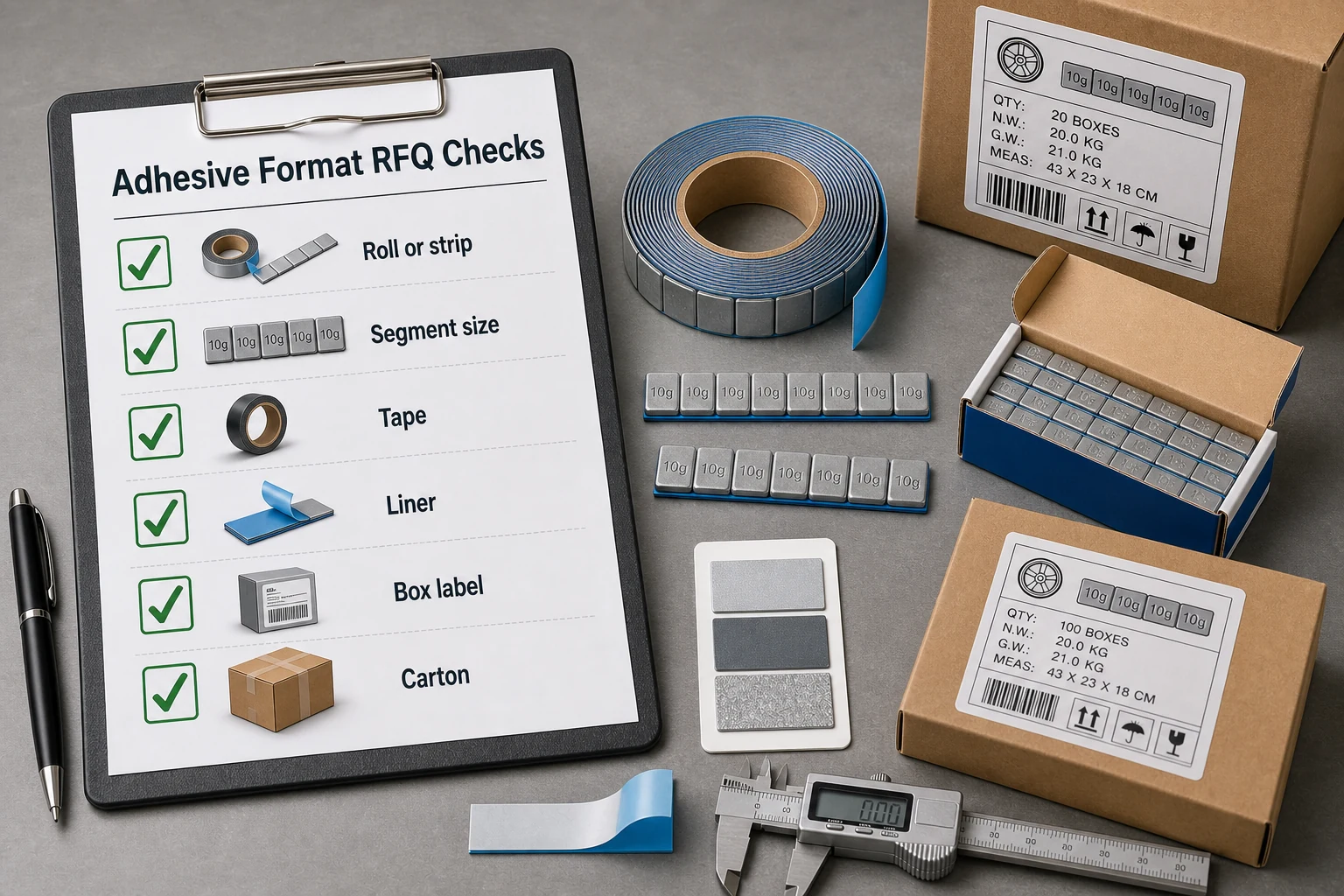
Start the RFQ with the market channel. A quote for workshop roll supply is different from a quote for retail strip boxes. If the buyer serves both, request both formats as separate lines instead of asking for "adhesive wheel weights" and letting suppliers guess.
Next, define the segment system. State grams or ounces, segment size, strip layout, roll length or roll weight, and whether labels need dual units. Then define tape and liner requirements. If the buyer has a known tape preference, specify it. If not, ask the supplier for tape construction, liner behavior, shelf-life guidance, and surface preparation recommendations.
Packaging should be handled early. Rolls may need stronger boxes that protect shape and liner. Strips may need retail boxes, inner boxes, barcode labels, and carton plans. Buyers preparing larger orders can use bulk packaging logic for adhesive weight programs to align MOQ, carton quantity, SKU count, and reorder behavior before final negotiation.
For a wholesale adhesive program, use wholesale adhesive format checks for tape, liner, packaging, and samples to connect the roll-or-strip decision with the tape system, sample approval, carton presentation, and repeat-order requirements.
| RFQ field | What to specify | Why it matters |
|---|---|---|
| Market channel | Workshop, retail, distributor, export, or mixed | Determines whether rolls, strips, or both fit |
| Format | Roll, strip, or both as separate lines | Prevents format confusion |
| Segment system | 5 g, 10 g, 0.25 oz, or custom layout | Controls installation and box labels |
| Tape and liner | Tape type, thickness, liner release, shelf life | Reduces lifting and handling complaints |
| Material and coating | Steel, zinc, color, finish expectation | Supports lead-free and visual requirements |
| Packaging | Roll box, strip box, inner box, carton, barcode | Protects warehouse and resale handling |
| Samples | Test quantity, wheel application, tape test, label review | Finds issues before MOQ commitment |
If you are choosing between adhesive wheel-weight rolls and strips, share your service volume, dispenser or hand-application process, segment sizes, packaging, and storage needs. We can help you compare formats with representative samples before you standardize the range.
Conclusion: choose the format that matches your market
Wheel weight rolls and strips are not competing in only one way. Rolls fit markets that value cutting flexibility, fewer SKUs, and high-volume shop use. Strips fit markets that value convenience, retail boxes, clear labels, and standardized installation.
The best buying decision starts with the customer channel, then moves to segment size, tape, liner, coating, material, packaging, and samples. Buyers comparing both formats can review adhesive wheel weight roll and strip samples for market testing once the target market, unit system, tape requirement, box label, and carton plan are clear.
Frequently Asked Questions
Are wheel weight rolls and strips the same product?
They use the same adhesive balancing concept, but the supply format is different. Rolls are continuous and cut to length by the installer. Strips are pre-cut pieces with fixed segment layout, tape, liner, and packaging.
Are rolls cheaper than strips?
Rolls may reduce SKU count and packaging complexity, but the better cost choice depends on labor, waste, packaging, freight, and market habits. A roll can be efficient in high-volume workshops, while strips may reduce training time and picking errors.
Which format is better for tire shops?
Many tire shops prefer strips because they are ready to use and easy to identify by box label. High-volume service centers may prefer rolls if technicians are trained to cut consistent lengths and keep tape and liner clean.
Which format is better for distributors?
Distributors often prefer strips for retail-ready boxes and clear SKUs, but rolls can work well for trade customers who buy workshop supplies. A mixed distributor may carry core strip SKUs plus roll options for high-volume customers.
What should buyers test before ordering adhesive rolls or strips?
Buyers should test tape adhesion, liner release, segment size, strip height, roll cutting behavior, coating appearance, box labels, carton strength, and fitment on the intended wheel applications before confirming bulk orders.
References
[1] 3M. “3M VHB Tape Surface Preparation Technical Bulletin.” 2019.
[2] National Highway Traffic Safety Administration. “Tires.” 2026.
[3] United States Environmental Protection Agency. “Best Management Practices for Lead Wheel Weights.” 2015.
[4] ASTM International. “ASTM B117-19 Standard Practice for Operating Salt Spray Apparatus.” 2019.