


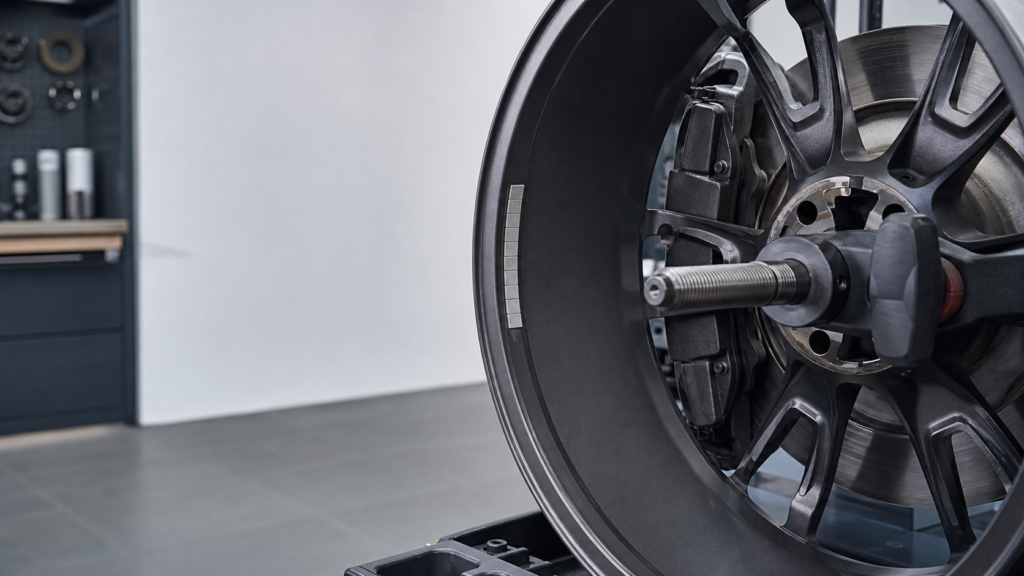
Wheel weights for EV wheels are usually selected around alloy-wheel appearance, inner-barrel clearance, and the balancing machine’s approved correction locations. Low-profile adhesive formats can help where space or visibility is limited, but the actual wheel, brake package, rim shape, tape bond, and balancer program must be checked before installation.
EV does not automatically mean one universal wheel-weight design. Many EVs use alloy wheels with intricate spoke patterns, styled outer faces, varied barrel geometry, and vehicle-specific brake packages. Those details can make the familiar balancing choice—where to place a correction mass and how much profile it can occupy—more sensitive. The practical question is not “Which weight is for an EV?” but “Which approved correction format fits this wheel without compromising placement, adhesion, appearance, or clearance?”
Table of Contents
- Why do EV wheels need an application-specific weight check?
- Why are adhesive wheel weights common on EV alloy wheels?
- How do low-profile adhesive weights help with EV wheel clearance?
- Why must the balancer program determine the weight location?
- What clearance and installation checks protect the final result?
- What should buyers validate before ordering EV wheel weights?
- Conclusion: Choose the profile only after validating the wheel
- Frequently Asked Questions
- References
Why do EV wheels need an application-specific weight check?
EV wheels need an application-specific check because an EV label does not define the available weight location, rim contour, or clearance envelope. The same model family can use different wheel diameters, castings, finishes, tire sizes, and brake configurations. A suitable correction location must therefore be verified on the actual wheel-and-vehicle combination.
The goal is the same as for any vehicle: balance the tire-and-wheel assembly accurately with an approved weight in an approved location. What often changes is the decision context. A highly visible alloy face may make a rim-flange clip undesirable. An inner barrel may have a deep contour, a sound-insulation feature, or a limited continuous landing surface. A large brake assembly can make it especially important not to assume that a visibly convenient position has adequate clearance once the wheel is installed.
For buyers building an assortment for modern alloy wheels, the wheel-weight range planning for alloy-wheel service helps separate the linked decisions: attachment method, material, segment format, balancing approach, and the wheel applications the service team actually sees. That prevents a low-profile specification from becoming a substitute for fitment verification.
This article does not claim that EV wheels always need more weight, a particular material, or a specific thickness. Imbalance depends on the individual tire-and-wheel assembly. The EV-specific consideration is often packaging: whether the requested correction can be installed on a clean, suitable surface while preserving the wheel’s intended appearance and adequate clearance.
Why are adhesive wheel weights common on EV alloy wheels?
Adhesive wheel weights are common on EV alloy wheels because they can be placed on an appropriate inner-barrel surface rather than clipped to a visible outer flange. That can support a cleaner exterior appearance, but it still requires the selected strip to conform to the rim and the tape to contact a prepared surface fully.
Adhesive formats are not exclusive to EVs. They are used across alloy-wheel applications where a shop needs a discreet location or where the rim design does not suit a clip-on profile. The attachment choice for a finished alloy rim depends on the wheel’s actual flange and barrel geometry, not only the vehicle’s powertrain.
The potential advantages are practical:
| Consideration | Why an adhesive format may help | What still needs verification |
|---|---|---|
| Visible wheel face | The correction can be placed inside the barrel rather than on the outer lip | Approved balancing plane and appearance requirements |
| Rim geometry | Segmented strips can follow some continuous curves | The strip must not bridge a ridge, recess, or abrupt transition |
| Profile | A slim format may occupy less radial space at the landing surface | Actual clearance to wheel and vehicle components |
| Service process | Cut-to-weight or segmented formats can match the balancer request | Clean, dry preparation and uniform application pressure |
| Assortment | A flexible adhesive range can reduce some individual SKUs | Representative-rim trials and supplier guidance |
3M describes service-market wheel weights in multiple profiles, including a 4 mm × 23 mm low-profile product and a 6 mm × 29 mm option; its product listings also describe flexible, conformable tape-attached systems.1 Those examples illustrate why nominal dimensions should be part of a specification. They do not establish a universal clearance requirement for every EV wheel.
How do low-profile adhesive weights help with EV wheel clearance?
Low-profile adhesive weights can help when a selected correction plane has limited radial room and a thinner strip can sit flush on a clean, continuous landing surface. Their benefit comes from physical fit at the intended location—not from the “low-profile” label alone.
A lower height may reduce the chance that a weight extends unnecessarily into nearby space. It can also make an inside-barrel installation less conspicuous. 3M lists one flexible wheel-weight product at 5.8 mm thick and describes it as conformable; other product profiles in the same service range are listed with different dimensions.2 This is a useful reminder that width, thickness, segment construction, and curvature behavior all belong in the comparison.
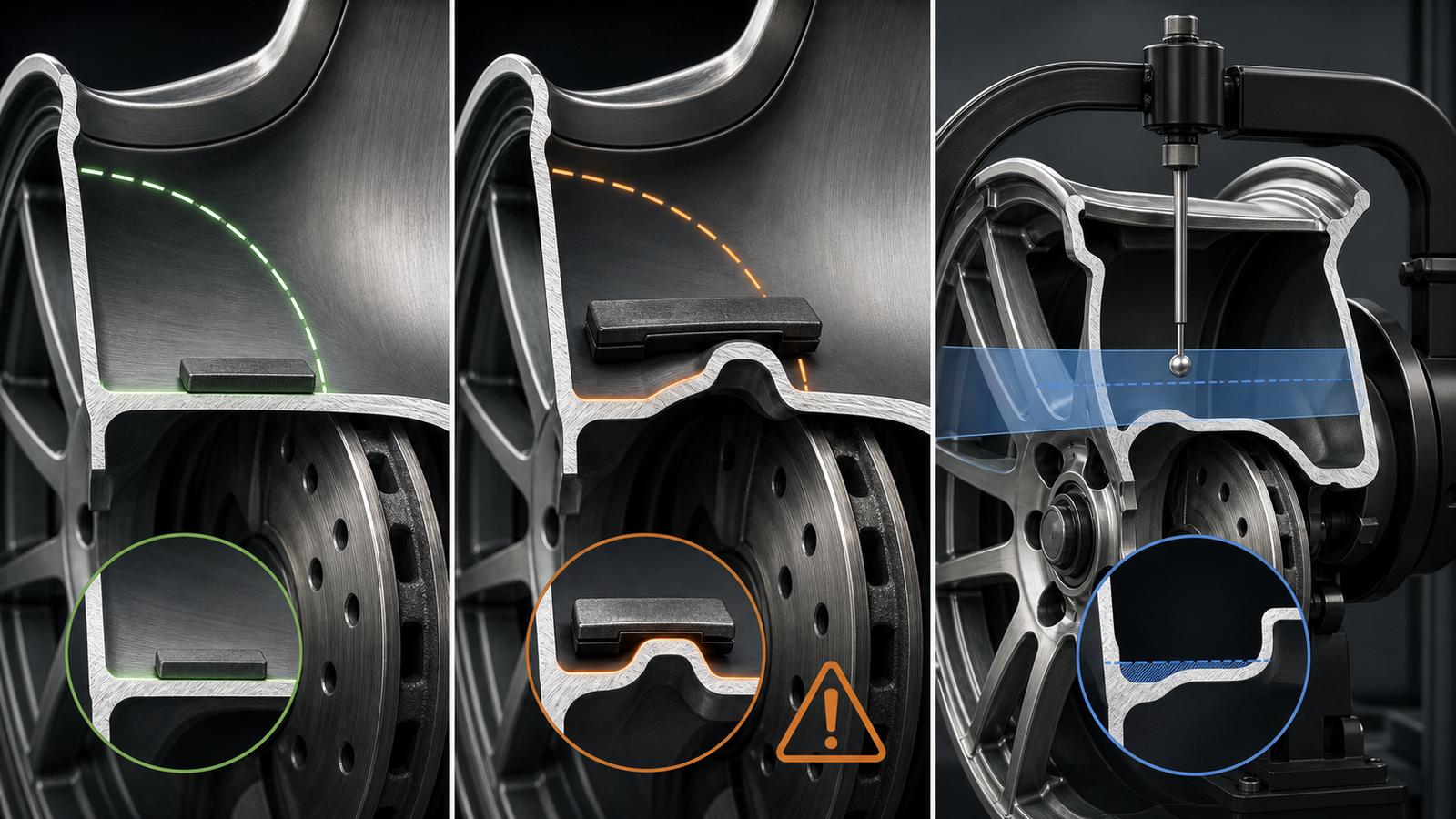
Clearance is not only about thickness. A thin strip installed across a ridge can lift at the edges, while a slightly taller but correctly positioned strip on a continuous surface may be the more reliable choice. Likewise, moving a weight solely to gain clearance can change the correction plane and lead to an inaccurate balance result. Verify the mounting zone, then select a profile that genuinely matches it.
Avoid publishing or using a generic “safe clearance” figure across EV models. Brake calipers, dust shields, suspension components, wheel barrel shapes, and vehicle manufacturer instructions vary. A responsible process checks the installed assembly or the relevant vehicle documentation and records any application-specific restriction.
Why must the balancer program determine the weight location?
The balancer program must determine the weight location because different modes model different correction planes and attachment positions. An adhesive strip can only be a valid correction when it is applied where the selected program expects it, using the wheel dimensions and placement method that program requires.
Alloy-wheel or ALU-style modes commonly accommodate adhesive placements, but their exact names and workflows differ by machine. A Snap-on wheel-balancer manual, for example, distinguishes several ALU patterns, including adhesive locations on rim flanges and hidden locations in the rim disc, with some modes using a gauge arm for precise compensation-plane measurement.3 The important operational point is not to memorize a mode label; it is to select the program that matches the actual wheel and available approved locations.
That is why a former strip’s shadow should not dictate a replacement. Start from a mounted assembly, the correct machine inputs, and the chosen program. The wheel-and-tire balancing workflow explains why a correction weight is the result of a measurement rather than a permanent coordinate on a rim.
If a preferred hidden location is unavailable because of the wheel shape or clearance check, do not improvise a nearby position. Reassess the program, the documented wheel procedure, and the compatible weight format. A technician may need a different approved mode or location rather than a different adhesive alone.
What clearance and installation checks protect the final result?
The final result is protected when the technician checks both the physical fit and the adhesive installation process before the wheel returns to service. A low-profile strip cannot compensate for a contaminated rim, a bridged landing surface, a bad balancing mode, or unverified vehicle-side clearance.
Use this practical sequence:
- Confirm the tire-and-wheel assembly is mounted correctly and select the proper balancer program for the wheel and intended attachment locations.
- Identify the machine-indicated correction plane, then inspect the corresponding rim surface for a continuous, usable landing area.
- Check that the selected strip can lie flush without crossing ridges, casting steps, spoke transitions, or sharp changes in radius.
- Prepare the exact area so it is clean and dry; follow the tape supplier’s instructions for handling, temperature, liner removal, and application pressure.
- Verify clearance on the actual assembly or through the vehicle maker’s approved method. Do not infer it from wheel diameter, vehicle type, or an image.
- Apply the weight as specified, run the final balance check, and investigate any unexpected correction request before releasing the wheel.
Surface preparation matters even where clearance is the original concern. A strip that does not sit fully on the barrel can become a durability issue as well as a packaging issue. The 3M wheel-weight application guidance calls for a clean surface and cautions against bridging wheel features, both of which support full contact for tape-attached weights.1
What should buyers validate before ordering EV wheel weights?
Buyers should validate EV wheel weights on representative rims, with the balancing equipment and service conditions that will actually be used. A flat sample panel can show that a tape sticks; it cannot prove that a particular low-profile strip fits every barrel contour, avoids every vehicle-side conflict, or works with the intended balancer program.
Request low-profile adhesive weight samples that cover the candidate profiles, segment patterns, coating or finish, and tape system. Build the trial set around the wheel designs that are most demanding: deep barrels, large diameters, tight curves, high-visibility finishes, and models with limited approved mounting zones.
For new wheel finishes or low-profile strips, an adhesion test plan for representative EV-wheel samples helps buyers verify clearance and retention under the actual installation conditions.
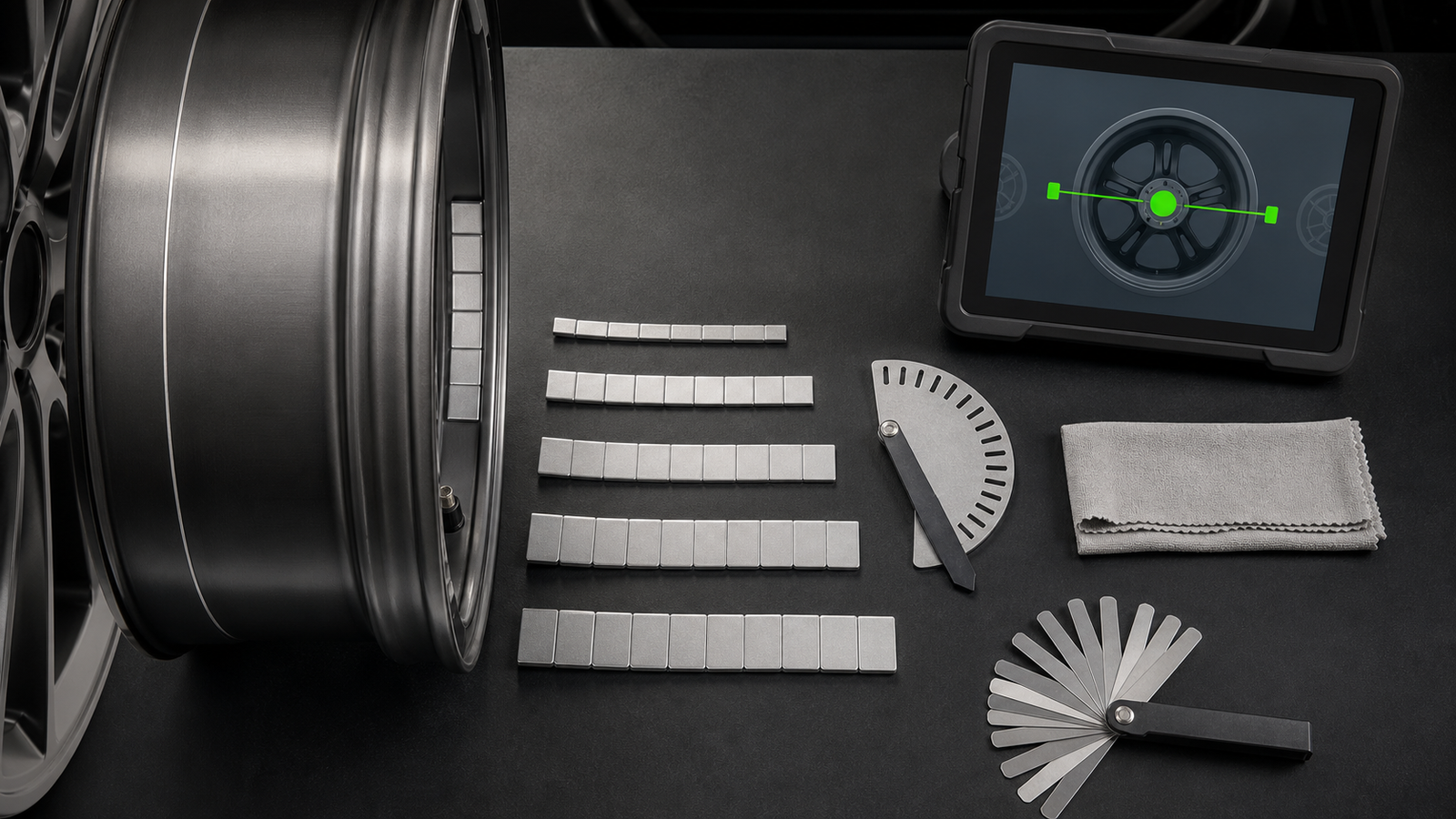
Document the test, rather than treating a successful first application as a final specification. Record the wheel identifier, rim finish, intended weight location, selected balancer mode, strip profile, cleaning process, approximate working conditions, fit observation, clearance confirmation method, and final balance result. This creates a usable basis for repeat orders and technical follow-up.
Ask suppliers focused questions:
- What are the profile dimensions, segment layout, material, and tape construction of each candidate strip?
- Which rim surfaces and application conditions does the supplier recommend?
- Can the supplier provide samples in the expected weight increments or roll format?
- What handling, storage, and surface-preparation guidance accompanies the tape system?
- How will the production lot and packaging identify the approved profile?
When an EV program includes several wheel styles, a small, documented sample comparison is more valuable than a universal claim. Buyers can compare machine-led weight placement on an EV rim and request low-profile samples for the actual clearance checks their technicians must complete.
Conclusion: Choose the profile only after validating the wheel
Wheel weights for EV wheels should be selected around the actual alloy rim, the available balancing planes, a clean adhesive landing surface, and verified installed-assembly clearance. Low-profile adhesive strips can be useful where a slim, discreet, conformable correction is appropriate, but their dimensions are only one part of the decision.
Do not use the vehicle category, an old weight location, or a generic clearance number as a substitute for validation. Confirm the balancer program, evaluate the real rim geometry, prepare the surface, check the relevant clearance, and recheck the balance. For a new EV wheel program, request low-profile adhesive samples and document the results on representative wheels before setting the service assortment.
Frequently Asked Questions
Do EV wheels require special wheel weights?
Not universally. The right format depends on the specific wheel design, permitted balancing locations, clearance, finish, and the service procedure. Many EV alloy wheels may suit adhesive formats, but the actual assembly must be checked.
Are low-profile adhesive wheel weights always better for EVs?
No. A low profile can help where the intended correction plane has limited room, but the strip still needs a clean, continuous surface and a balancer-approved location. A poor geometric fit can fail regardless of the strip’s nominal thickness.
Can I move an adhesive weight to gain brake-caliper clearance?
Do not move a correction weight by visual judgment alone. Changing its position may change the balancing plane. Reassess the balancer program, wheel geometry, and approved service procedure before choosing another location.
Do adhesive weights affect EV wheel appearance?
They can help preserve the visible outer rim because they are typically installed inside the barrel. Appearance depends on the wheel design, selected placement, and whether the strip is properly fitted and hidden from normal view.
What should a buyer send for an EV wheel-weight sample check?
Provide representative rim details or samples, the desired wheel styles and finishes, likely service temperatures, proposed balancing equipment or program, and any vehicle-specific clearance information available through approved documentation.
References
[1] Wheel Weights for the Service Market. 3M, n.d. Accessed July 24, 2026.
[2] 3M Wheel Weight PN55409 (TN4020P). 3M, n.d. Accessed July 24, 2026.
[3] EEWB331A Motorized Wheel Balancer Operator's Manual. Snap-on Equipment, n.d. Accessed July 24, 2026.