



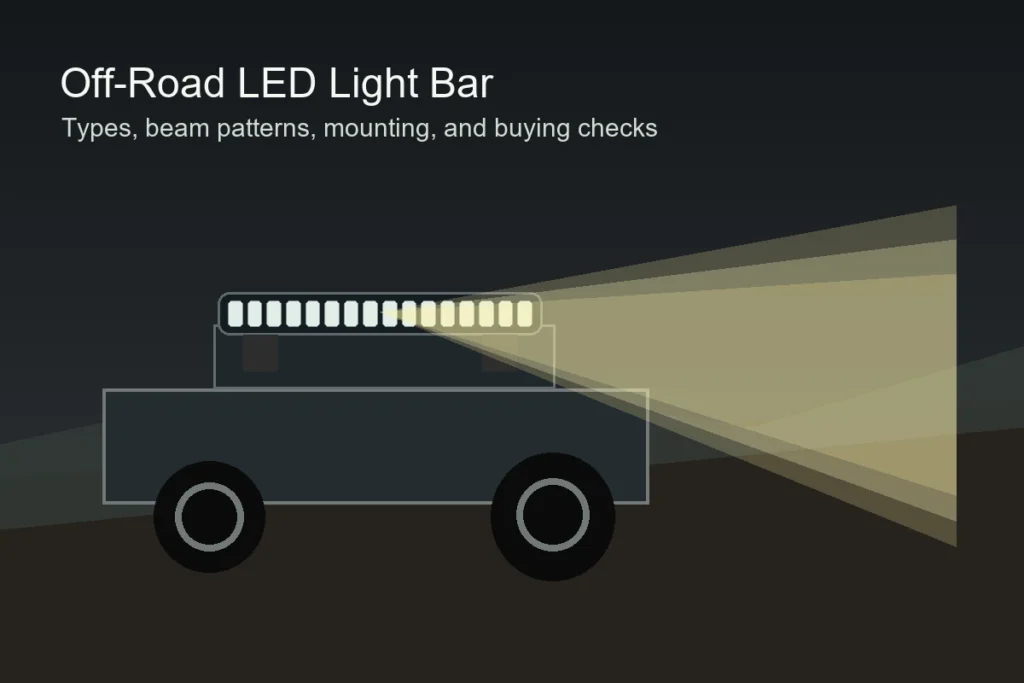
An off-road LED light bar is an auxiliary lamp with LEDs and optics arranged in an elongated housing. Choose it for the required beam coverage, mounting space, electrical supply, and exposure. Its length, row count, or lumen claim alone does not establish useful range, safe aiming, or permission for public-road use.
For a closer look at output claims, see how to read LED lumen ratings and how lumens, candela, and lux help compare an off-road beam.
That matters because light bars are often sold by size or wattage first, while the buyer's real problem is simpler: how far should the light reach, how wide should it spread, where can it mount, and will it survive vibration, water, dust, and heat?
Specify the task before comparing products: forward reach, trail-side coverage, close work, or rear loading. Then compare beam data and the complete mounting and wiring kit under the same conditions.
Table of Contents
- What is an off-road LED light bar?
- What types of off-road LED light bars are available?
- What beam pattern should an off-road LED light bar have?
- Where should you mount an off-road LED light bar?
- How do size, wattage, and lumens affect real performance?
- Is an off-road LED light bar legal on public roads?
- What should buyers check before choosing a light bar?
- Conclusion: Choose the beam pattern before the biggest size
- Frequently Asked Questions
- References
What is an off-road LED light bar?
An off-road LED light bar is a row-style auxiliary lamp designed to add stronger forward or area lighting beyond factory headlights. It is commonly mounted on a bumper, grille, roof, bull bar, roll bar, or rear rack, depending on whether the driver needs long-distance visibility, trail spread, work lighting, or reverse lighting.
The basic design is simple: LEDs sit behind reflectors or lenses inside an aluminum housing, usually with a polycarbonate lens, end caps, mounting brackets, and a wiring harness. The housing helps protect the electronics and move heat away from the LEDs. The optics shape the beam into a spot, flood, combo, driving, or scene pattern.
Housing length, row count and curve affect packaging and mounting. Delivered output and coverage depend on the actual LEDs, drive conditions and optics, so compare the named configuration rather than treating a double row or curved housing as an automatic performance upgrade.
For readers comparing product options, an off-road LED light bar category is the natural place to look at the hardware side after the basics are clear. From Yirox Team sample checks, the useful comparison is not "which bar is brightest" but which bar fits the vehicle, beam need, wiring plan, packaging promise, and sales market.
What types of off-road LED light bars are available?
Off-road LED light bars are usually grouped by shape, row count, length, beam pattern, and mounting style. The right type depends on the vehicle, terrain, driving speed, and whether the light is used for trail driving, work lighting, recovery, camping, or rear visibility.
| Type | What it means | Best fit | Watch out for |
|---|---|---|---|
| Single-row light bar | One horizontal row of LEDs | Slim grille or bumper mounting | Compare measured complete-lamp output |
| Double-row light bar | Two LED rows in one housing | A compact package for two rows; compare actual output | Verify dimensions, heat behavior and operating current |
| Straight light bar | Flat housing across the vehicle | Bumpers, grilles, racks, work setups | Beam spread depends heavily on optics |
| Curved light bar | Housing follows a shallow arc | Roof or wide front mounting | Can create hood glare if mounted poorly |
| Mini light bar or pod bar | Compact bar under 12 inches | ATVs, UTVs, fog-style positions, tight spaces | Range depends on the exact optic and measured beam |
| Rear or scene light bar | Wide-area work lighting | Campsites, recovery, loading, reverse lighting | Not designed for forward high-speed driving |
Compare single- and double-row designs by available mounting depth, aiming adjustment, measured output and actual operating load. Row count does not establish which complete lamp produces more useful light.
A curved housing changes the package and may change the direction of individual optics. The curved light bar fitment guide shows why nominal length, housing depth and mounting span need separate checks. Inspect the exact beam map and driver-visible reflections before accepting the installation.
Mini bars and pods serve a different purpose. They can fill dark shoulders, light a campsite, support slow trail driving, or help a work vehicle see around equipment. When the Yirox Team helps customers think through a lineup, the most helpful range is usually not one oversized hero SKU; it is a mix of bars, pods, harnesses, brackets, and switch options for different work problems.
What beam pattern should an off-road LED light bar have?
The beam pattern should match the driving problem: spot for distance, flood for width, combo for mixed trail use, and scene lighting for slow work around the vehicle. Beam pattern is usually more important than raw lumen numbers because uncontrolled brightness can create glare instead of usable vision.
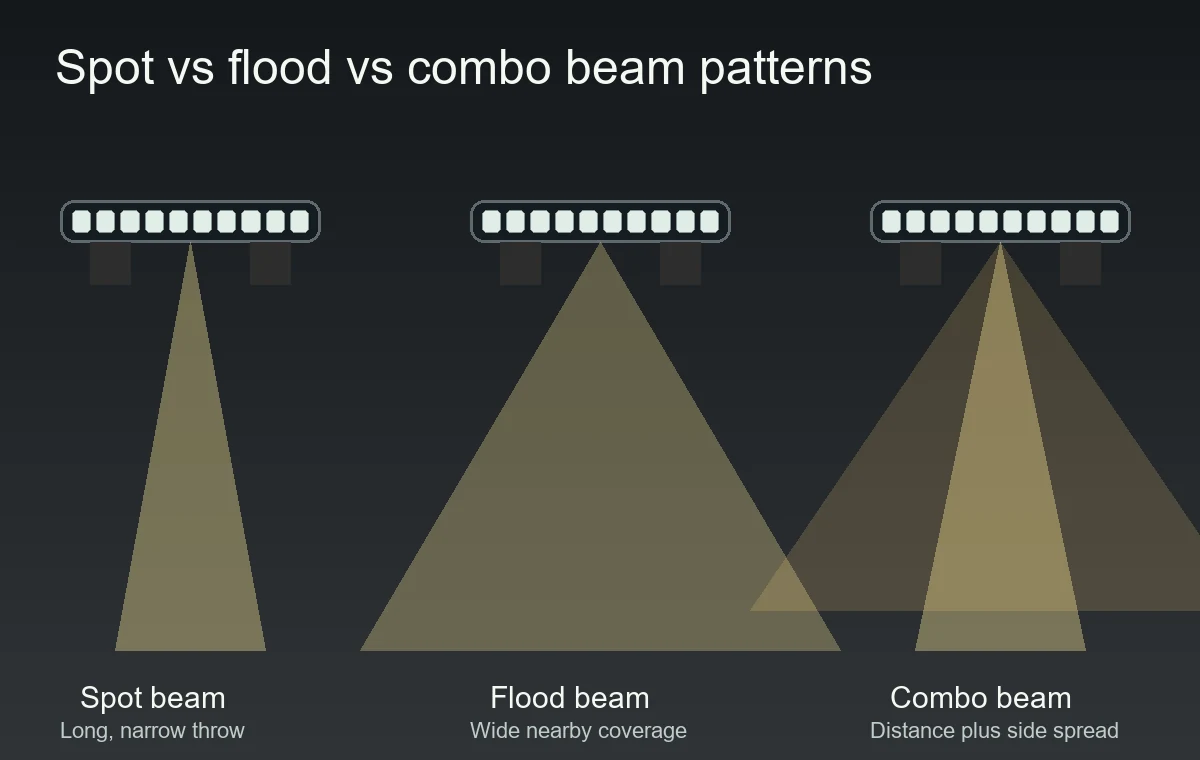
A spot beam is narrow and long. It helps drivers see farther down a trail, across open terrain, or along rural tracks where speed is higher. The trade-off is that it does not light the shoulders as well.
A flood beam spreads light wide and short. It is helpful for slow trails, work areas, recovery, loading, and campsites. The trade-off is shorter distance and more reflected glare if aimed poorly.
A combo beam mixes spot optics in the center with flood optics on the sides. This is often the most practical choice for a general off-road light bar because it gives forward reach and side fill in one unit.
Driving, fog, and scene labels refer to different intended functions; they are not interchangeable just because the housing is a bar. For markets using UN approvals, road-illumination and light-signalling functions are covered by different requirements. Verify the applicable function and regulation series on the actual documentation.34
The buyer's question should be: where does the light go, and does that make driving easier? A bar that throws a bright blob into the foreground can look dramatic in a product photo, but too much foreground light can shrink the driver's night vision downrange. In sample reviews, this is easy to miss when buyers only check lumens.
When separate mounting points or individual aiming suit the job better, the LED pod comparison helps distinguish compact driving, flood and scene applications. Compare the actual beam and coverage rather than assuming a pod or bar shape decides the result.
Where should you mount an off-road LED light bar?
Choose the mount from clearance, aiming, a secure bracket, unobstructed output and the driver’s view. Roof height does not by itself establish more range or coverage; compare the actual lamp and check hood reflection, wind noise and applicable installation rules.
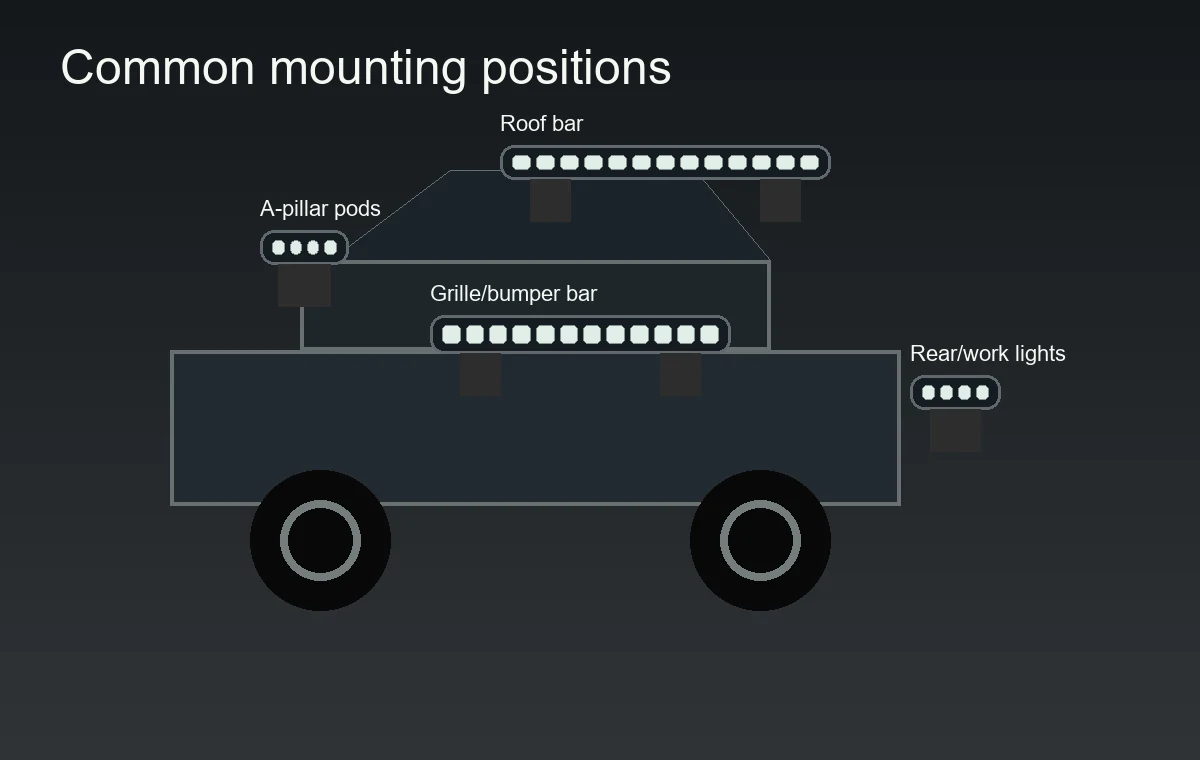
A bumper-mounted light bar is common because it sits low, keeps wiring relatively short, and avoids much of the hood reflection that happens with roof lights. It is useful for trail driving, general off-road use, and trucks with aftermarket bumpers or bull bars.
A grille-mounted light bar gives a cleaner appearance and is often protected inside the front structure. The limitation is airflow, space, and bracket design. Buyers should check whether the bar blocks cooling airflow or interferes with sensors.
A roof mount changes the source position and the potential for reflection, obstruction, wind noise, and restricted road use. It does not by itself establish a longer beam range. Check the same lamp from the proposed driver viewpoint for hood reflection and glare before approving that position.
A rear-mounted work light serves reversing, loading, or another defined work area. Keep its operation separate from forward-driving illumination and assess glare toward people behind the vehicle.
Good mounting is not only about location. The bracket must resist vibration, the wiring must avoid hot or moving parts, the switch should be easy to identify, and the beam should be aimed after installation. The Yirox Team treats the bracket and harness as part of the product because a strong lamp body still frustrates customers if the mount shakes, the wire is too short, or the switch label is unclear. A powerful light bar aimed too high can blind other drivers and reduce the user's own visibility in dust or fog.
How do size, wattage, and lumens affect real performance?
Size, wattage, and lumens matter, but they do not tell the whole story. Real performance depends on optical design, beam control, LED efficiency, heat management, electrical stability, and how honest the product rating is.
A longer light bar can hold more LEDs and spread light across a wider area. That does not automatically mean it is the best choice. A 50-inch roof bar may look impressive, but a smaller bumper bar with better optics may give more usable trail light and less glare.
Wattage tells you how much electrical power the light can draw, not exactly how useful the beam will be. High wattage can mean more light, but it also means more heat and more demand on the wiring harness, relay, fuse, switch, and vehicle electrical system.
Lumens are easy to market and easy to misunderstand. Some listings show theoretical LED lumens, while others show measured output. Theoretical lumens can be much higher than real output after optical losses and heat. A helpful supplier explains whether the number is raw, effective, or tested, protecting buyers from overpromising.
Color temperature also affects visibility. Very cool light can look bright, but it may create harsh reflections in dust, rain, fog, or snow. Many practical off-road users prefer a controlled white output rather than chasing the bluest possible beam. Amber covers or amber bars may help in dust or poor weather, though they are not a cure for bad aiming.
Which output data can you actually compare?
Compare the same optic, operating mode, and test conditions. A published product table can separate measured lumens, raw LED lumens, peak candela, and lux at a stated distance; these answer different questions.5
| Claim or record | What to request |
|---|---|
| Lumens | Measured complete-lamp output or raw LED total; identify the method and mode |
| Distance or spot performance | Beam intensity and illuminance at a stated distance, with aiming and threshold explained |
| Coverage | A beam map or comparable photographs showing the useful width and foreground |
| Electrical load | Supply voltage and steady operating current for the named mode |
| Warm operation | Measurement timing and whether output changes as the lamp heats |
| Installation result | The intended height, driver viewpoint, bracket adjustment, and reflections |
Do not rank two lamps from photographs with different camera exposure, or compare one lamp’s raw output with another’s measured output. Record the product code, optic, mode, and conditions with any acceptance decision.
Is an off-road LED light bar legal on public roads?
An off-road LED light bar is often not legal to use on public roads unless it meets the relevant lamp function, mounting, aiming, and local vehicle rules. Buyers should treat many light bars as off-road or auxiliary equipment, not as a legal substitute for headlights, fog lamps, or approved driving lamps.
In the United States, NHTSA’s supplemental-lighting interpretation discusses whether additional equipment impairs required lighting. Commercial-vehicle requirements in 49 CFR 393.24 have a specific scope; they are not a universal rule for every passenger-car installation.12 Confirm the applicable vehicle and local installation rules before making a road-use claim.
For practical product wording, this means sellers should be careful with claims such as "street legal" or "DOT approved." A light bar may be excellent for off-road use but still not approved for use as an on-road headlamp. If a product is intended for on-road auxiliary use, the supplier should provide the relevant standard, marking, beam function, and market documentation.
The safe everyday rule is simple: use off-road light bars only where they are allowed, dim or switch them off around other road users, and cover them if local law requires it. Public road compliance should be checked in the target market before packaging, catalog text, or advertising claims are finalized.
What should buyers check before choosing a light bar?
Buyers should check beam pattern, size, housing quality, IP rating, heat control, wiring harness, brackets, voltage range, certifications, packaging, and batch consistency. A good off-road LED light bar is an electrical and optical product, not just a bright aluminum tube.
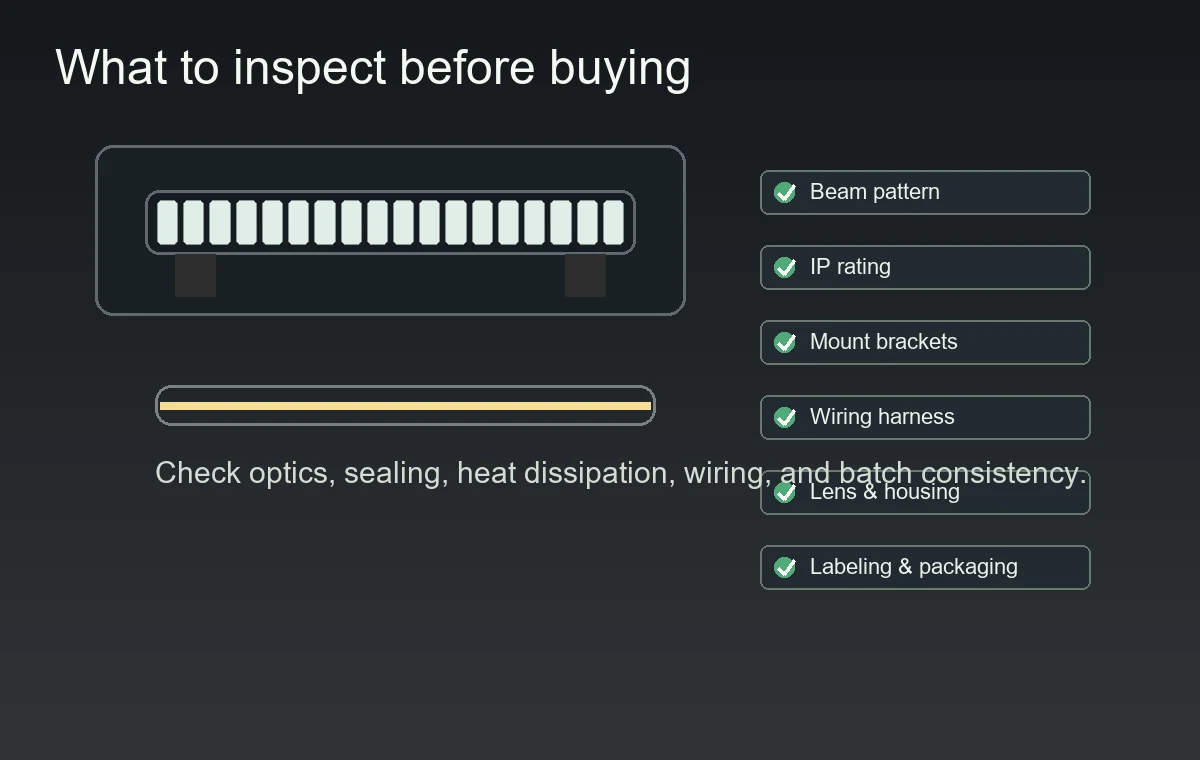
Start with the beam. Ask whether the bar is spot, flood, combo, driving, fog-style, or scene lighting. Then ask where the beam is useful: distance, shoulder fill, close work, rear visibility, or broad campsite lighting.
Next, check the build. Aluminum housings, polycarbonate lenses, stainless or coated brackets, sealed connectors, and clean cable routing all matter because off-road lights face vibration, water, mud, pressure washing, heat, and impacts from debris. The related guide to IP rating for automotive LED lights explains why IP67, IP68, or IP69K should be matched to the actual exposure instead of treated as a simple good-better-best scale.
The wiring harness deserves close attention. A proper harness should match the current draw and include suitable wire gauge, relay, fuse, switch, connectors, and instructions. Poor wiring can make a good light unreliable and can create real safety risks.
For product buyers and brand programs, the checklist should protect the end user first. In Yirox Team sample checks, the common risk is a group of small mismatches: unclear beam wording, weak brackets, short wiring, inconsistent LED color, or packaging that promises more than the product can safely deliver.
Check:
- Beam documentation: beam pattern names, diagrams, and realistic use photos.
- Electrical rating: voltage range, wattage, current draw, fuse recommendation, and harness specification.
- Housing and lens: aluminum body, lens clarity, sealing method, and corrosion resistance.
- Thermal design: heat sink shape, stable output, and realistic operating temperature.
- Mounting kit: bracket strength, hardware finish, adjustment range, and vibration resistance.
- Market documentation: labeling, manual language, warning text, compliance claims, and packaging accuracy.
- Batch consistency: repeatable LED color, optics, waterproofing, cable length, and accessory pack contents.
Conclusion: Choose the beam pattern before the biggest size
An off-road LED light bar adds auxiliary visibility for trails, worksites, recovery, camping, and utility vehicles, but the best choice is not always the largest or highest-lumen option. A more helpful way to choose is to start with the driver's real problem: seeing farther, seeing wider, working around the vehicle, or reducing complaints in a product range.
Choose the required distance and coverage, then verify the actual optic and mounting result. A spot, flood or combo label is a starting point for comparison, while measured beam data and the driver viewpoint establish suitability. Check roof or bumper positions for reflections and clearance rather than assuming one height provides greater range.
Before choosing a product range, buyers should define the target vehicle, use case, beam pattern, size, wiring harness, bracket set, packaging, and compliance wording. The Yirox Team's practical advice is to choose the product that will still make sense after installation, after the first rainy trail ride, and after customers read the label. If the next step is comparing models for a retail or branded lineup, Yirox's LED light bar category is the most relevant place to continue.
Frequently Asked Questions
What is the best beam pattern for an off-road LED light bar?
A combo beam is usually the best all-around choice because it gives center distance and side spread. A spot beam is better for long open trails, while a flood beam is better for slow trails, work areas, and close-range visibility.
Is a curved LED light bar better than a straight light bar?
Not automatically. The housing curve does not establish the delivered beam pattern or range. Compare the exact optics, measured beam data, aiming clearance, and reflection from the proposed mounting position. A straight or curved bar can suit the job when that complete configuration meets the intended coverage.
Can I use an off-road LED light bar on the highway?
Many off-road LED light bars are not legal for highway use unless they meet the relevant lamp rules in that market. In many places, they should be switched off or covered on public roads, especially around other traffic.
Where is the best place to mount a light bar on a truck?
Choose a position with adequate space, aiming adjustment, secure mounting, and a clear beam without obstructing sensors or cooling. Bumper or grille positions can reduce some hood reflection, while a roof position can introduce it. Mounting height alone does not guarantee greater reach, so inspect the actual driver view before deciding.
Are lumens or watts more important for a light bar?
Neither number is enough by itself. Lumens describe light output and watts describe power draw, but beam control, optics, heat management, and honest testing determine how much useful light reaches the trail.
What size off-road LED light bar should I choose?
Choose size after deciding the mounting location and beam goal. A 20-inch bumper bar may be better for many trucks than a large roof bar if it gives the right beam without glare or complicated installation.
Do off-road LED light bars need a relay?
Many higher-power light bars should be wired with a relay, fuse, and proper harness sized for the current draw. Always follow the product instructions and avoid connecting a high-current light directly through an undersized switch or wire.
What should distributors check before ordering light bars in bulk?
Distributors should check beam consistency, housing quality, waterproofing, brackets, wiring harness contents, labels, manuals, packaging, compliance claims, and sample-to-batch consistency. The product should be tested as a complete kit, not only as a lamp body.
References
[1] NHTSA. “FMVSS No. 108 interpretation: supplemental lighting and impairment.”
[2] eCFR. “49 CFR 393.24: commercial-vehicle headlamps and auxiliary lamps.”
[3] UNECE / EUR-Lex. “UN Regulation No. 149: road illumination devices.”
[4] UNECE / EUR-Lex. “UN Regulation No. 148: light-signalling devices.”
[5] Diode Dynamics. “SS3 Yellow Max LED Pod: optic-specific photometric data.”