



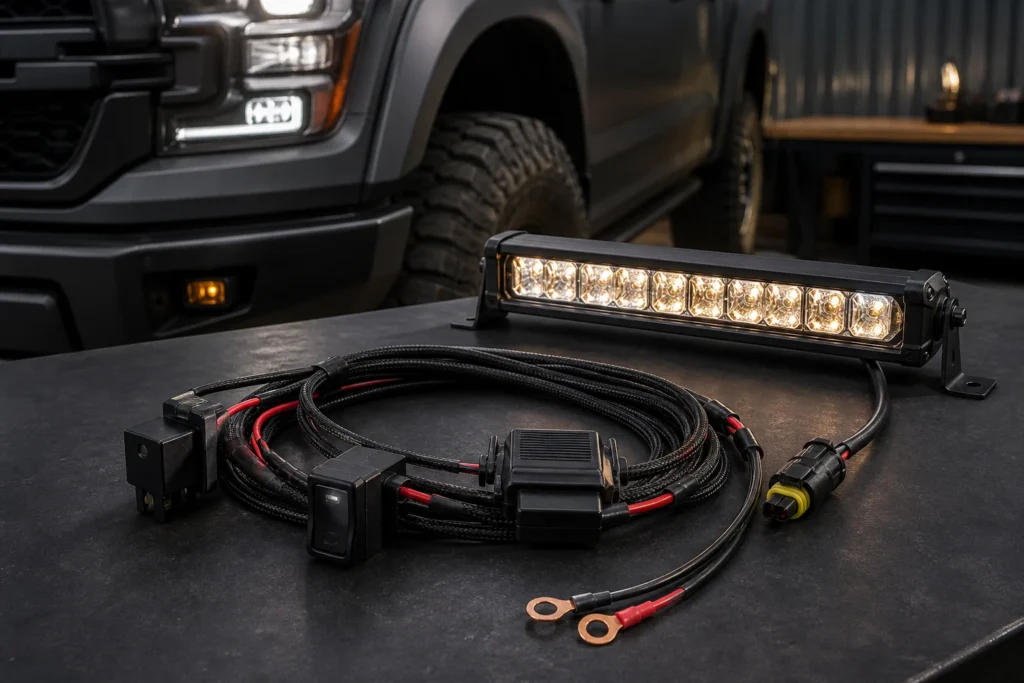
A light bar wiring harness is a dedicated low-voltage circuit that connects the vehicle battery, fuse, relay, switch or trigger, ground, and LED light bar. Its job is to keep the high-current lamp path protected and separated from the small dashboard switch circuit; it does not make an incorrectly sized wire, fuse, connector, or mounting route safe by itself.
The practical buying question is not simply whether a kit includes a relay. Check the light bar's measured current, system voltage, total round-trip cable length, fuse-holder rating, relay contact rating, connector sealing, crimp quality, and trigger method as one system. The related guide to off-road LED light bars helps with the lamp and mounting choice; this guide focuses on the electrical path that makes the lamp usable.
Table of Contents
- What is a light bar wiring harness?
- What parts are included in a light bar wiring harness?
- How does a relay wiring harness work?
- What do relay terminals 30, 85, 86, 87, and 87a mean?
- Which light bar wiring harness type should you choose?
- How do you choose the right wire gauge, fuse, and relay?
- How do you install a light bar wiring harness safely?
- How do you troubleshoot a light bar wiring harness?
- What should buyers check before sourcing light bar harness kits?
- Conclusion: Treat the harness as part of the lighting system
- Frequently Asked Questions
- References
What is a light bar wiring harness?
A light bar wiring harness is the pre-arranged path that powers and controls an auxiliary LED light bar. Heavier battery-side conductors carry the lamp load; lighter control wiring operates the relay or approved vehicle trigger.
Match it to the lamp's current, voltage, connector, and route—not the wire count or relay-box appearance. A 3-in-1 LED light bar may add main-beam, amber or marker, and DRL or warning inputs, each with its own current, polarity, and trigger requirement.
What parts are included in a light bar wiring harness?
A harness normally has seven functional parts. Wire colors vary; use the supplied diagram and a continuity check.
| Part | What it does | What to verify |
|---|---|---|
| Battery positive lead | Carries power from the source to the protected circuit | Conductor size, insulation, terminal crimp, and length |
| Inline fuse holder | Interrupts the circuit during an overcurrent event | Fuse type, holder rating, sealing, and placement close to the source |
| Relay and socket | Lets a low-current trigger control the lamp load | Contact rating, coil voltage, socket fit, heat and moisture protection |
| Switch or trigger lead | Activates the relay coil or a separate lamp function | Polarity, trigger current, OEM compatibility, and legal use |
| Ground lead | Completes the circuit and limits ground-side voltage drop | Clean attachment point, fastener security, corrosion protection |
| Lamp-side connector | Joins the harness to the light bar | Mating key, terminal retention, current rating, and sealed state |
| Loom, grommets, and strain relief | Protects the wires from abrasion, heat, water, and movement | Material, temperature location, bend radius, and cable-entry support |
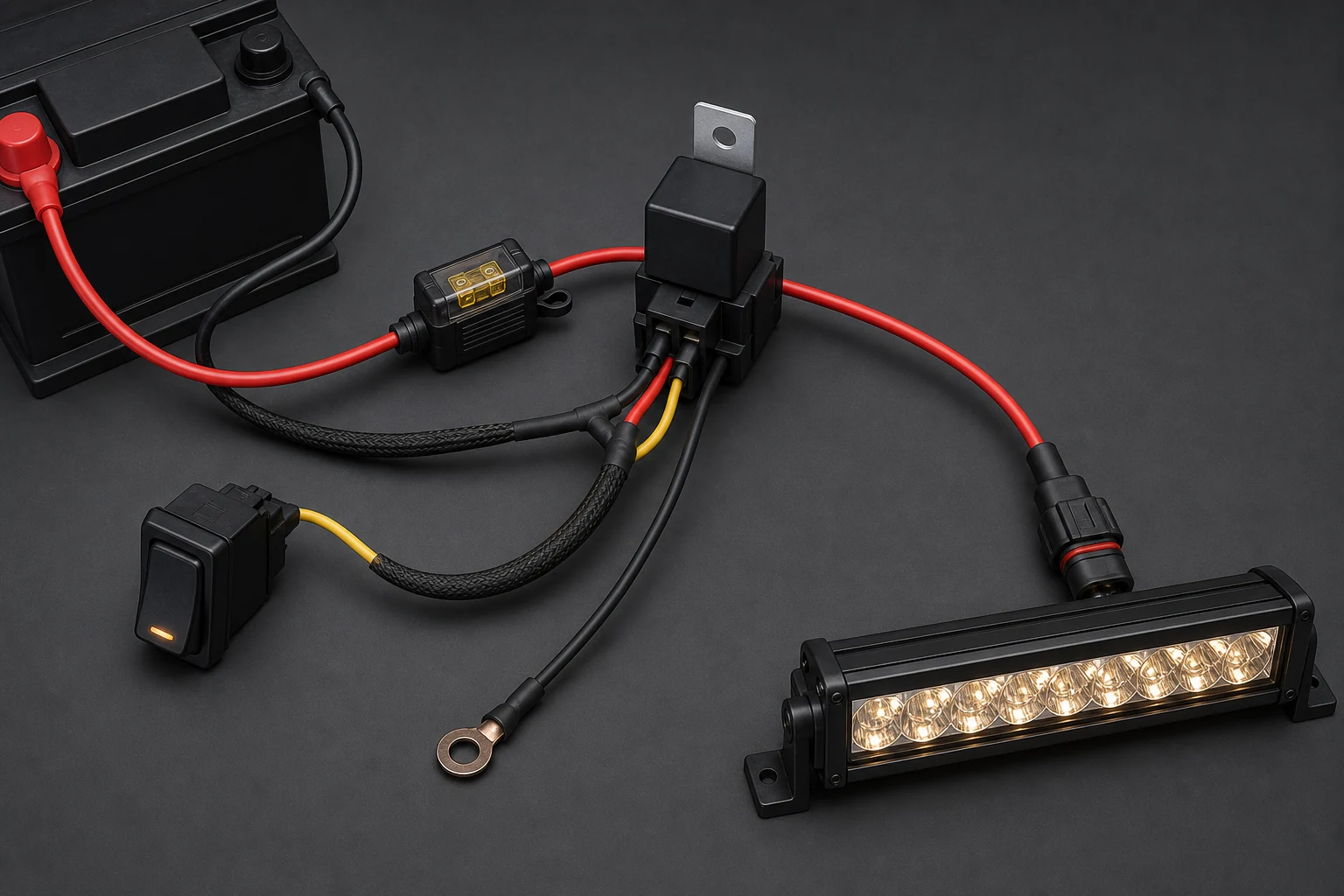
The fuse protects the conductor from a short; it cannot fix an overloaded lamp or loose terminal. Littelfuse identifies automotive fuses as overcurrent devices and warns that shorts can exceed wire and connector capability 3. Coordinate the fuse, wire, relay, and connector.
Sealed connectors are useful in engine bays, but the IP claim belongs to the exact connector, seals, cable entry, and mated condition. TE Connectivity's DEUTSCH DT information shows why contact, wire size, and sealing details must match 5. A sealed housing cannot compensate for a poor crimp.
How does a relay wiring harness work?
A relay harness uses a small control circuit to switch a separate high-current circuit. The switch energizes the relay coil; the contacts then connect fused battery power to the light bar.
The key distinction is control current versus load current. The switch and trigger carry coil current, while the battery lead, fuse, relay contacts, ground, and lamp connector carry the main load. Negative-side triggers, diode-protected relays, five-pin relays, and controllers require the supplied diagram. Never infer polarity or terminal function from wire color alone.
What do relay terminals 30, 85, 86, 87, and 87a mean?
For a common four-pin automotive relay, terminal 30 is the fused supply, terminal 87 is the normally open output to the light bar, and terminals 85 and 86 are the coil connections. A five-pin relay may add 87a as a normally closed contact; it should not be used as the lamp output unless the circuit is intentionally designed for that behavior.
| Terminal | Common function | Check before connecting |
|---|---|---|
| 30 | Battery-side contact input, normally after the fuse | Confirm the fuse is upstream and the terminal is rated for the load |
| 87 | Normally open contact output to the lamp | Confirm it becomes live only when the relay is energized |
| 85 | Relay coil return | Check whether the relay has a suppression diode or resistor |
| 86 | Relay coil trigger | Confirm the switch or vehicle trigger supplies the required polarity |
| 87a | Normally closed contact on some five-pin relays | Leave unused unless the circuit specifically requires a changeover path |
If the relay has an internal diode, reversing 85 and 86 can prevent it from operating or damage the control circuit. The relay body, supplier diagram, or test fixture should identify that detail. A good harness kit includes a diagram that matches the actual relay and socket supplied, not a generic pinout copied from another model.
Which light bar wiring harness type should you choose?
Choose the harness by current, voltage, outputs, connector family, trigger method, cable length, and environment. A small 12V pod, long roof bar, dual-lamp setup, and 24V work vehicle need different checks.
Beam selection also affects the lamp load and mounting plan; compare spot, flood, and combo LED light bar beam patterns before finalizing the harness.
| Harness type | Best fit | Main advantage | Main risk |
|---|---|---|---|
| Single-output harness | One light bar or one paired load | Simple circuit and easy diagnosis | Must match the complete lamp current |
| Dual-output harness | Two pods or two small bars | One organized installation | Shared fuse and relay may be undersized |
| High-current harness | Large bar or multiple lamps | Heavier conductors and stronger protection | More heat, larger connectors, and greater routing demands |
| Switch-panel harness | Several separately controlled accessories | Clearer expansion path | More trigger wires and labeling discipline required |
| Vehicle-specific harness | OEM-style switch or model-specific routing | Cleaner fit and fewer loose wires | Less flexible across vehicle platforms |
For a DRL, amber, or position-light input, use a documented branch rather than assuming the main relay output feeds every function. The guide to light bar DRL mode wiring covers this lower-current accent circuit.
Connector choice depends on the environment. A "waterproof" claim may require the correct terminals, rear seals, wedge lock, and mating half. The guide to IP ratings for LED lights and connectors explains why an enclosure rating is not a complete harness rating.
How do you choose the right wire gauge, fuse, and relay?
Start with measured or specified current, then check ampacity, round-trip cable length, voltage drop, temperature, connector rating, and fuse coordination. Measured current and the datasheet should beat a marketplace wattage claim.
The table is an illustrative planning example, not a universal prescription. It assumes 13.8V, copper conductors, a 3% voltage-drop target, and the stated round-trip length. Heat, SAE versus AWG construction, insulation, terminals, and local rules may require a larger conductor.
| Light-bar load | Approx. current at 13.8V | Example round-trip length | Starting conductor check | Fuse checkpoint | Relay checkpoint |
|---|---|---|---|---|---|
| 60W | 4.3A | 15 ft / 4.6m | About AWG 14 or larger after voltage-drop and ampacity checks | Often 7.5-10A, only if the wire and lamp data support it | 15-20A contact rating or higher |
| 120W | 8.7A | 15 ft / 4.6m | About AWG 10-12 depending on construction and derating | Often 10-15A, matched to the wire and lamp | 20-30A contact rating or higher |
| 240W | 17.4A | 20 ft / 6.1m | About AWG 6-8 after the calculation | Often 20-25A, never above the protected conductor limit | 30-40A contact rating or higher |
| 480W | 34.8A | 20 ft / 6.1m | About AWG 4-6 after the calculation | Often 40-50A only if the whole circuit supports it | 50-60A contact rating or a purpose-built high-current design |
Use load current and round-trip length in Blue Sea Systems Circuit Wizard, then check conductor ampacity and engine-bay conditions 4. The wire must satisfy both current capacity and voltage drop.
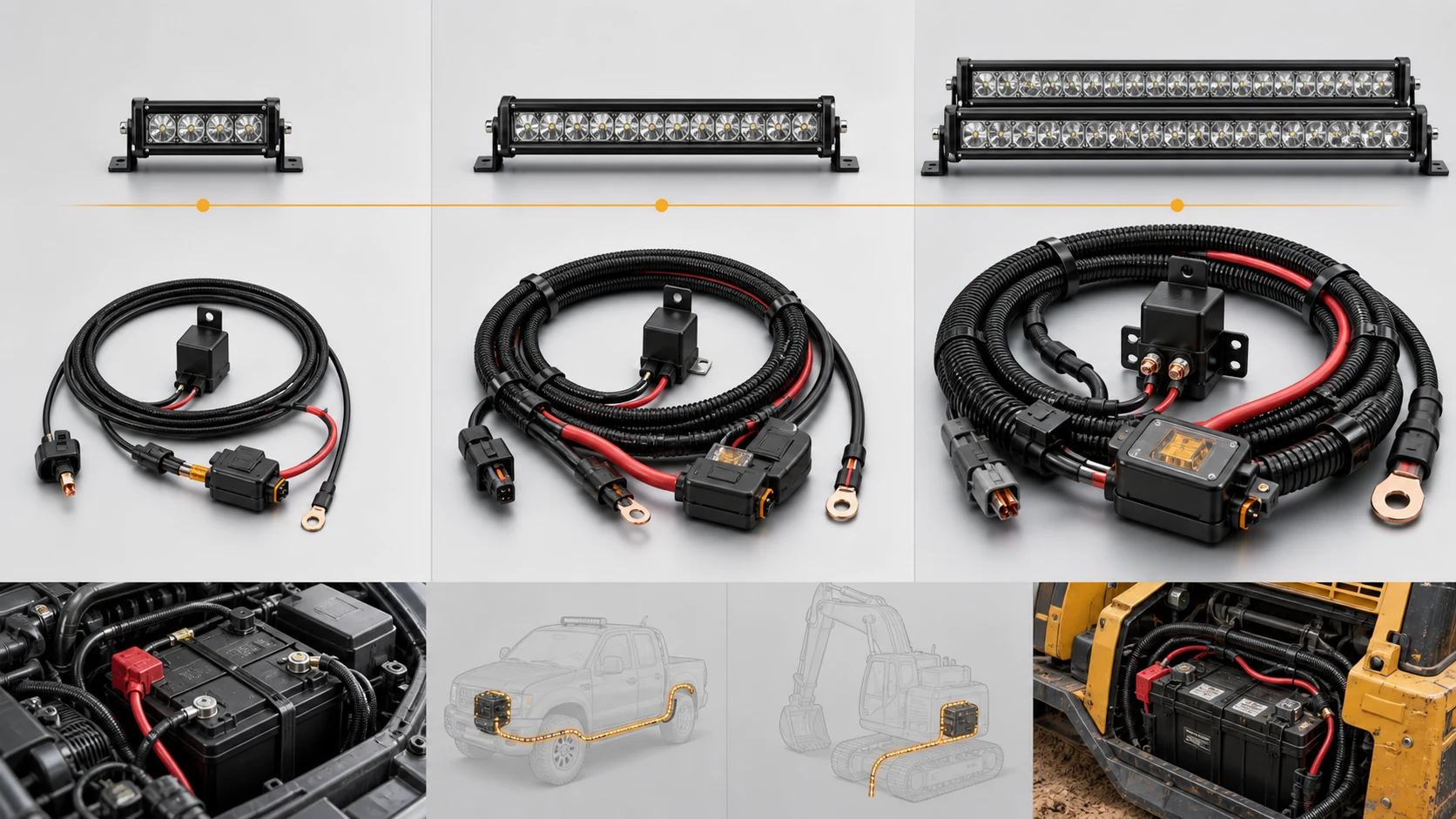
Place the fuse close to the positive source. It must protect the smallest conductor and stay within the ratings of the holder, terminals, relay, and lamp. Repeated fuse opening is a diagnostic signal, not a reason to fit a larger fuse.
How do you install a light bar wiring harness safely?
Install with the battery disconnected, the route planned, the fuse close to the source, and every cable protected from heat, abrasion, water, and movement. Test the finished circuit under load before refitting trim.
- Confirm the specification. Record voltage, current, connector, trigger inputs, and whether the vehicle is 12V or 24V.
- Plan the route. Avoid exhausts, belts, fans, steering parts, hinges, sharp brackets, and pinch points. Use a grommet at every pass-through.
- Install protection. Put the fuse near the positive source and mount the relay away from uncontrolled heat and water.
- Make the ground reliable. Use a clean, secure return path and protect the finished connection from corrosion.
- Secure the cable. Add loom, clips, strain relief, and service slack. Do not let the connector carry cable tension.
- Check the trigger. High-beam, ignition, reverse, or factory-lighting inputs may have legal or body-control limits. Use the specified interface when needed.
- Test under load. Check lamp voltage, current, temperatures, ground drop, and flicker after the system reaches normal temperature.
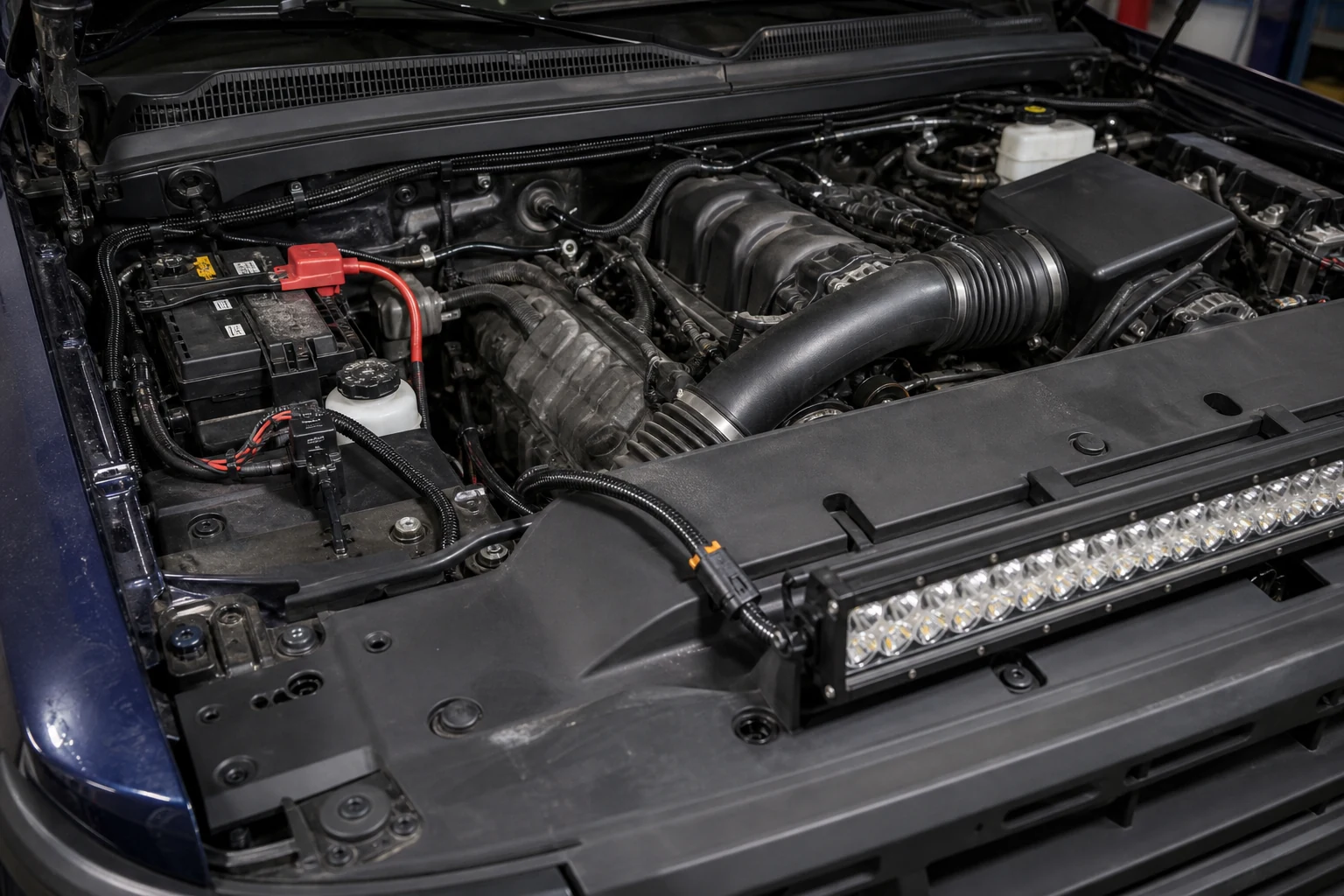
For public-road use, an auxiliary light bar does not replace required headlamps. U.S. commercial-vehicle rules address auxiliary lamps, mounting, and aiming 2; local rules vary.
How do you troubleshoot a light bar wiring harness?
Troubleshoot from source to load: battery, fuse, relay trigger, relay output, ground, connector, then lamp. This is faster than replacing parts at random.
| Symptom | First checks | Likely cause or next action |
|---|---|---|
| No light and no relay click | Battery voltage, fuse continuity, trigger voltage, coil ground | Open fuse, missing trigger, wrong coil polarity, or poor ground |
| Relay clicks but lamp stays off | Voltage at terminal 87, lamp ground, connector pin fit | Open contact, loose crimp, reversed pin, or lamp-side ground fault |
| Fuse opens immediately | Disconnect lamp, inspect positive cable and connector | Short to ground, crushed cable, water bridge, or wrong fuse size |
| Light flickers or dims on a long run | Measure voltage at battery and lamp while operating | Undersized conductor, loose ground, high contact resistance, or low battery voltage |
| Connector or fuse holder gets hot | Check current, terminal tension, crimp and contact surfaces | Overload, undersized connector, poor crimp, or oxidized contact |
| Works dry but fails after rain or washing | Inspect rear seal, mating lock, cable entry, and corrosion | Connector is not sealed in its installed condition or water is entering the loom |
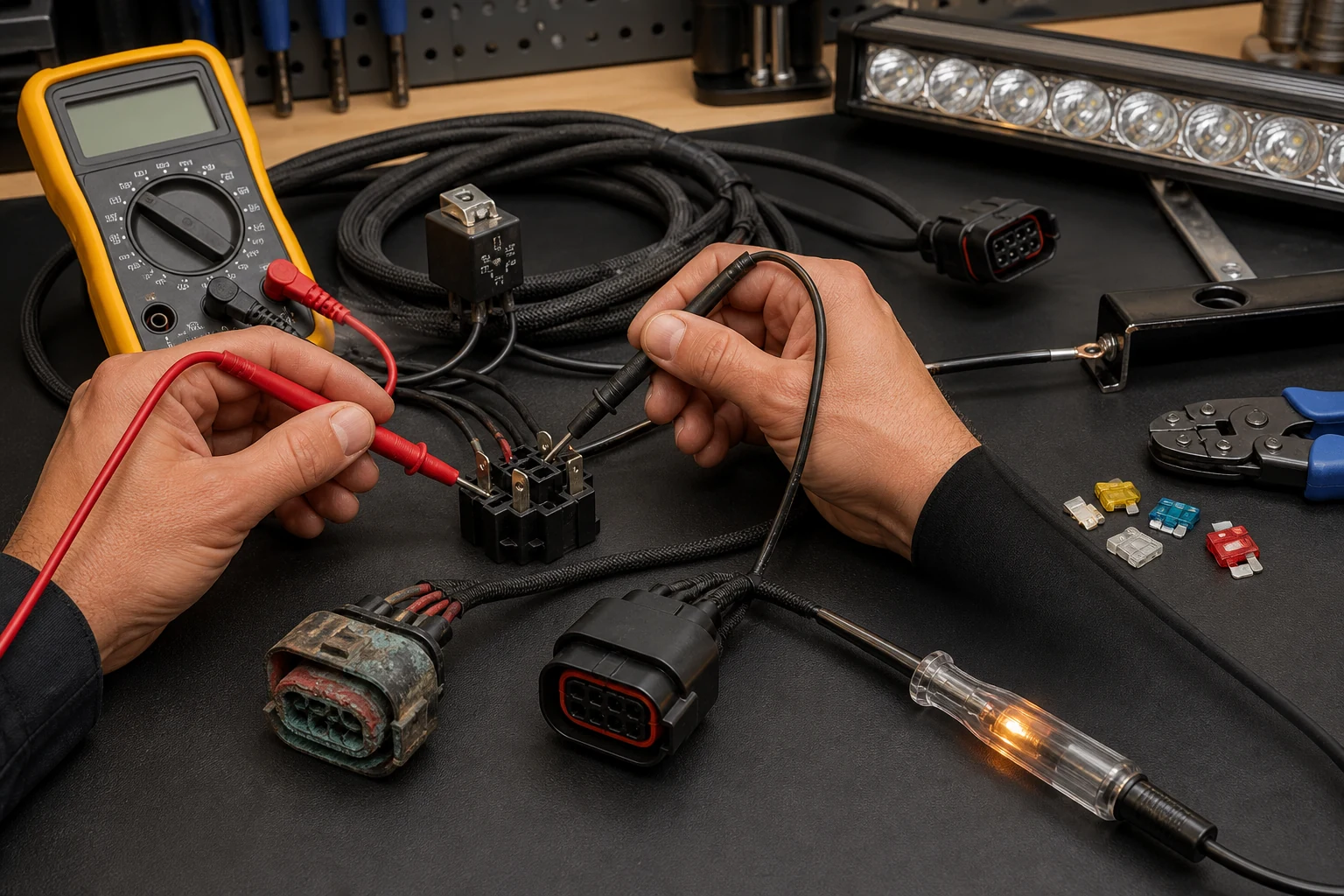
Continuity alone does not prove a high-current connection is healthy. A weak crimp can pass a no-load test but create voltage drop or heat under load, so measure voltage while operating and inspect the terminal mechanically.
What should buyers check before sourcing light bar harness kits?
Before approving a harness kit, request a model-specific bill of materials and sample test record linking the lamp rating to the exact wire, fuse holder, relay, connector, switch, length, and vehicle voltage.
- Electrical scope: rated voltage, measured current, continuous current, outputs, and triggers.
- Protection: fuse type and location, holder rating, relay part number, contact rating, coil suppression, and short-circuit test.
- Conductors: wire construction, AWG or mm2 size, insulation temperature, total length, and loaded voltage drop.
- Connectors: mating part number, terminal size, seal, crimp tooling, retention test, and mated-state IP boundary.
- Installation: grommets, loom, clips, strain relief, bend radius, heat clearance, labeling, and matching diagram.
- Quality: pull-test records, terminal inspection, load and thermal tests, packaging, batch traceability, and revision control.
Align the harness with the automotive LED light bar product range instead of one generic kit for every bar. Compare the delivered bundle, label, connector, length, and test evidence—not just the quotation artwork.
Conclusion: Treat the harness as part of the lighting system
Treat the harness as a protected low-voltage system: verify the load, calculate round-trip cable needs, protect the smallest conductor, confirm relay and connector ratings, route away from heat and abrasion, then test under load.
Frequently Asked Questions
Do you need a relay for an LED light bar?
Most medium and large LED light bars should use a fused relay harness so the switch carries control current. Small lamps may differ; follow the manual and measured load.
What fuse size does a 120W light bar need?
At 13.8V, 120W is about 8.7A before losses. A 10-15A fuse is only a starting checkpoint; it must protect the conductor and match every component rating.
Can a 12V light bar wiring harness be used on a 24V vehicle?
Only when the light bar, relay coil, switch, fuse holder, connector, and other components are 24V-rated. A 12V relay can fail even with heavy cable.
What do terminals 30 and 87 do on a relay?
On a common relay, 30 is the fused input and 87 the normally open output. Verify the diagram because five-pin and diode-protected relays differ.
Why does my light bar fuse keep blowing?
Check for a shorted lead, crushed loom, water, damaged lamp, undersized holder, or excessive load. Do not fit a larger fuse first.
Are DT connectors waterproof for light bar wiring?
Some DEUTSCH DT families are environmentally sealed, but the rating depends on the part, terminals, seals, cable size, and mated condition. The name alone does not prove the whole harness is waterproof.
References
[1] National Highway Traffic Safety Administration. (2019). FMVSS No. 108 interpretation on supplemental lighting.
[2] Electronic Code of Federal Regulations. (2026). 49 CFR 393.24, Requirements for head lamps, auxiliary driving lamps and front fog lamps.
[3] Littelfuse. (2020). Automotive Electronics Applications Guide.
[4] Blue Sea Systems. Circuit Wizard for DC wire size and circuit protection planning.
[5] TE Connectivity. DEUTSCH DT sealed automotive connectors.