



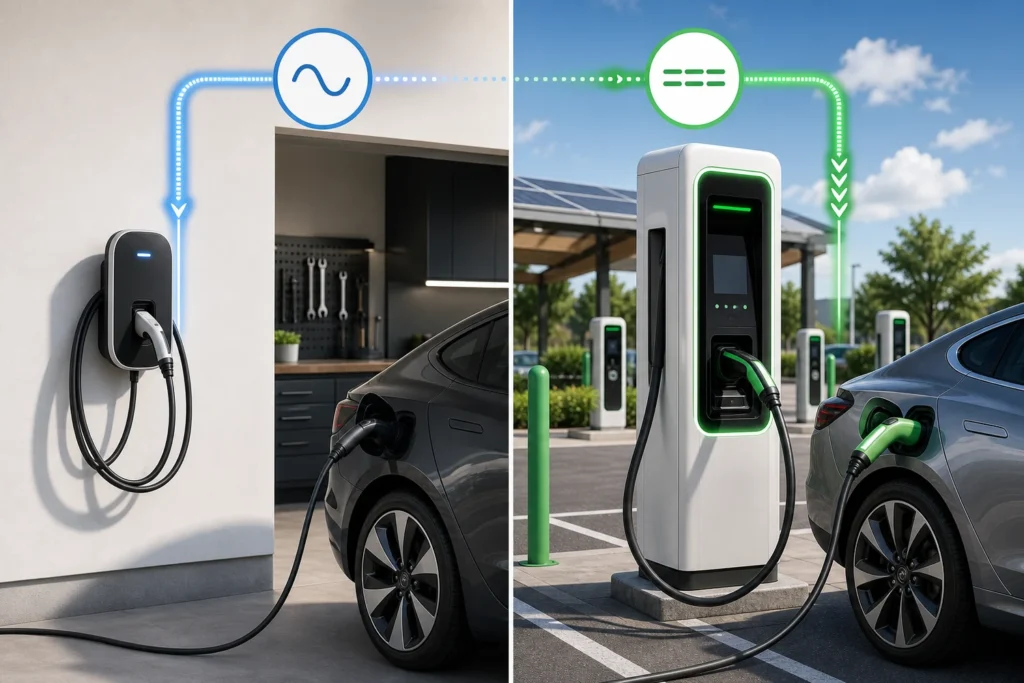
AC EV charging sends alternating current to the vehicle, and the vehicle's onboard charger converts it into direct current for the battery. DC EV charging does that conversion inside the charging station, then sends direct current to the battery, which is why DC charging is usually much faster.
The difference matters because electric vehicle batteries store DC power, while the power supplied by most homes and buildings is AC. AC charging is usually the practical choice for daily home, workplace, apartment, and overnight charging. DC charging is the faster option for highway stops, commercial charging sites, fleet depots, and other places where vehicles need a lot of energy in less time.
Speed is not the only difference. AC and DC chargers use different hardware, installation costs, cables, connectors, power levels, thermal requirements, and business models. A home wallbox and a public DC fast charger may both charge an EV, but they solve very different problems.
This guide explains how AC and DC charging work, which one is faster, when each type makes sense, and what buyers should check before choosing charging products, cables, connectors, or accessories.
Table of Contents
- What is the basic difference between AC and DC EV charging?
- Which is faster, AC charging or DC charging?
- When should you use AC charging?
- When should you use DC fast charging?
- How do AC and DC charging compare side by side?
- What should buyers check before choosing AC or DC charging products?
- Conclusion: AC and DC charging solve different problems
- Frequently Asked Questions
- References
What is the basic difference between AC and DC EV charging?
The basic difference is where the AC-to-DC conversion happens. In AC charging, the vehicle converts power through its onboard charger; in DC charging, the charging station converts power before it reaches the vehicle battery.
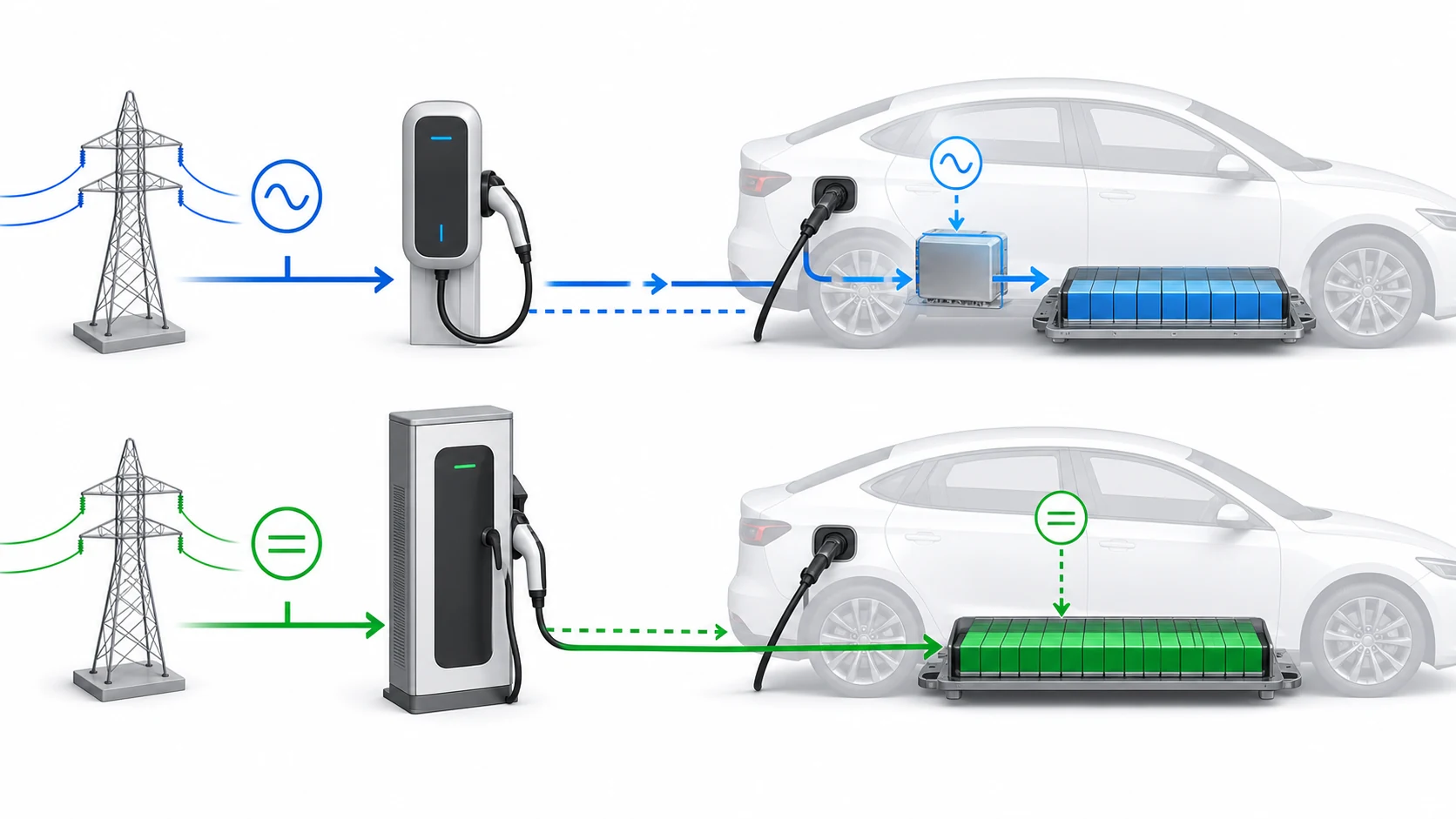
Every EV battery stores energy as DC. When a driver plugs into an AC charger, the charger supplies controlled AC power, but the vehicle's onboard charger is responsible for converting that power into DC. That onboard charger has a maximum rating, so even if the AC wall charger can supply more power, the vehicle may only accept what its onboard charger allows.
DC charging works differently. A DC fast charger contains the power conversion hardware inside the charging station. It delivers DC power directly to the battery system through high-power charging electronics and vehicle communication. This is why DC chargers are larger, more expensive, and more complex than typical AC wall chargers.
For readers still sorting out the bigger charging family, Yirox's guide to EV charging station types is useful background. AC and DC charging are not just two plug shapes; they represent different charging architectures.
Which is faster, AC charging or DC charging?
DC charging is faster in most real-world situations because it bypasses the vehicle's onboard AC charger and delivers higher-power DC directly to the battery. AC charging is slower, but it is usually more practical for long parking periods.
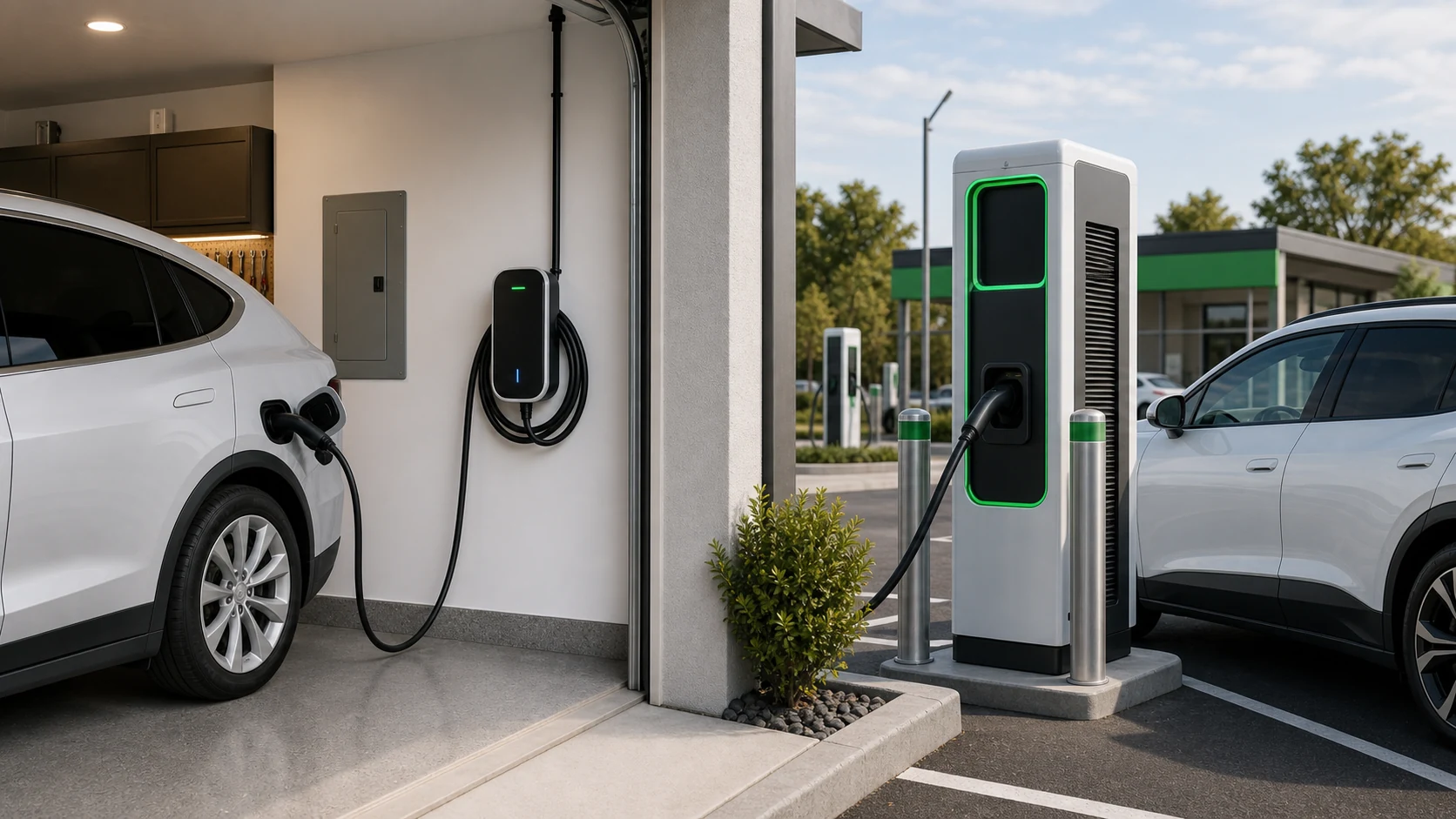
AC charging speed depends on the circuit, charger rating, cable, connector, and vehicle onboard charger. A Level 1 AC outlet may add range slowly, while Level 2 AC charging can be much more useful for daily charging. The U.S. Department of Energy notes that Level 2 charging is commonly used at homes and workplaces and generally provides faster charging than Level 1 1.
DC fast charging can deliver much higher power, but the actual speed still depends on the vehicle, battery state of charge, battery temperature, charger power, connector standard, and charging curve. Many vehicles charge fastest when the battery is low to mid range, then slow down as the battery approaches a higher state of charge.
That is why "which is faster" has two answers. DC is faster for adding a lot of energy quickly. AC is often fast enough when the car is parked overnight, during a workday, or for several hours at a destination.
When should you use AC charging?
AC charging is best when the vehicle will be parked long enough that charging speed does not need to be extreme. It is the normal choice for homes, apartments, workplaces, hotels, service centers, and many destination charging sites.
At home, AC charging fits the way many drivers already use their vehicles. The car parks for several hours, the charger supplies steady power, and the vehicle is ready later without a special trip to a charging station. EPA guidance explains that home charging is a major part of EV ownership for drivers who can access it 3.
AC charging equipment is also smaller and usually less expensive than DC fast charging infrastructure. A wall-mounted EV charger can be installed near a parking space with a dedicated circuit, cable holder, and connector dock. For flexible or backup charging, a portable EV charger may be a better fit.
AC charging is also easier to scale in many private or semi-private locations. A workplace or apartment site can install multiple AC chargers and manage them over time. The charging session may take longer, but the vehicle is usually parked long enough for that to be acceptable.
When should you use DC fast charging?
DC fast charging is best when charging time matters more than equipment cost or installation simplicity. It is designed for public charging corridors, commercial stations, fleet operations, highway stops, and high-turnover sites.
The U.S. Department of Energy's charging station location guidance distinguishes charging by power level and shows that DC fast charging is generally used where drivers need faster charging away from home 2. These sites require stronger electrical infrastructure, more space, higher installation planning, and more robust thermal and cable management.
DC charging is also useful for commercial fleets when vehicles must return to service quickly. Delivery vehicles, ride-hailing vehicles, taxis, buses, and service fleets may not have enough downtime for slower AC charging in every use case. However, high-power charging needs careful planning because it can create major peak demand on the site.
For public operators, DC charging is not only a hardware choice. It involves grid capacity, payment systems, uptime monitoring, cable wear, cooling, parking layout, service access, and user safety. The charger may be faster, but the business and maintenance requirements are also heavier.
How do AC and DC charging compare side by side?
AC charging is usually simpler, cheaper, and better for long parking sessions, while DC charging is faster, more expensive, and better for short stops or high-utilization vehicles. The right choice depends on parking time, power availability, cost, and user expectations.
| Feature | AC EV Charging | DC EV Charging |
|---|---|---|
| Power conversion | Inside the vehicle onboard charger | Inside the charging station |
| Typical use | Home, workplace, apartment, hotel, destination charging | Highway stops, public fast charging, commercial fleets |
| Speed | Slower but practical for long parking | Faster for short charging stops |
| Equipment size | Smaller wallbox or portable EVSE | Larger charging cabinet or dispenser |
| Installation cost | Usually lower | Usually higher |
| Electrical demand | Easier to manage in many buildings | Higher site power and grid planning needs |
| Cable handling | Lighter cable in many AC use cases | Thicker, heavier cable for high-power charging |
| Best buyer question | "Where will the vehicle park for hours?" | "How quickly must the vehicle return to use?" |
This comparison also explains why AC and DC charging often coexist. A driver may use AC charging at home most nights and DC fast charging during long trips. A fleet may use AC charging overnight for many vehicles and DC charging for top-ups or urgent routes.
The practical answer is rarely "choose only one forever." It is usually "match the charger to the dwell time." Long dwell time favors AC. Short dwell time favors DC.
What should buyers check before choosing AC or DC charging products?
Power level is also a site-capacity decision. The EV charging load management guide includes a fill-in sizing worksheet and examples for checking the charging pool, simultaneous sessions, per-phase limits, and required energy before departure.
Buyers should check vehicle compatibility, connector type, cable rating, charging power, installation environment, safety standards, and energy management needs before choosing AC or DC charging products. The charging method must match the real vehicle and site.
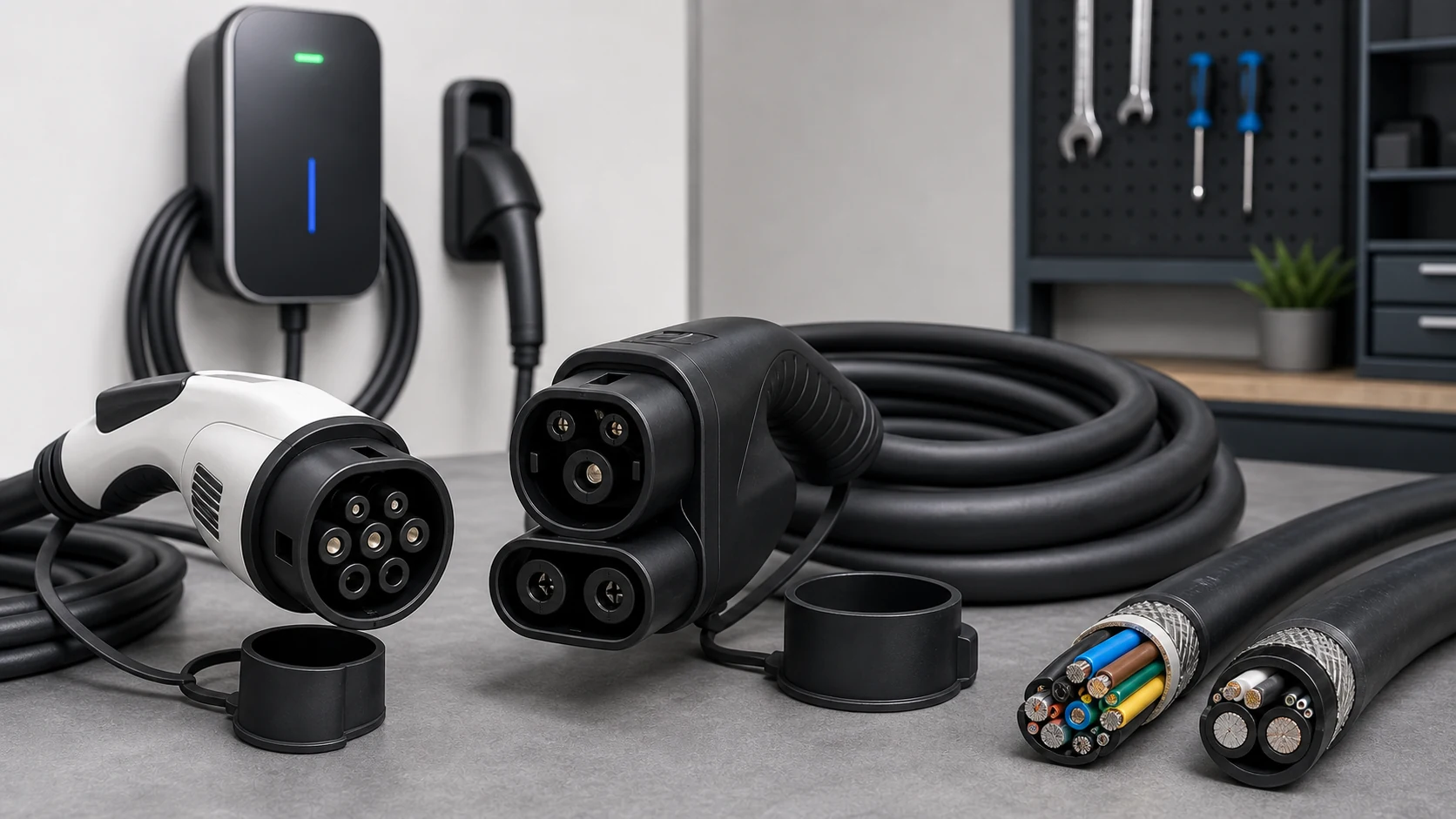
Connector compatibility comes first. AC and DC charging may use different connectors or combined connector systems depending on the region and vehicle standard. Yirox's guide to EV charging cable connector types explains why the plug shape, pin layout, cable rating, and regional standard all matter. For AC market comparison, the Type 1 vs Type 2 EV charger comparison is also a useful next step.
Cable design matters more as power rises. DC fast charging cables are often thicker and may need advanced thermal management at higher power levels. AC cables may be easier to handle, but cable material, length, flexibility, connector durability, and strain relief still affect daily use.
Installation planning is also different. AC chargers can often fit into homes or buildings with dedicated circuits and appropriate load planning. DC fast chargers may require utility coordination, transformer capacity, switchgear, civil work, ventilation, and more complex service planning. For multi-charger AC sites, dynamic load balancing in EV charging can help avoid overloading the building supply.
A buyer's checklist should include:
- Charging use case: overnight, workplace, destination, public fast charging, or fleet turnaround.
- Vehicle compatibility: onboard charger rating for AC, DC fast charging capability, and connector standard.
- Power availability: panel capacity, utility supply, transformer limits, and peak demand concerns.
- Cable and connector design: cable length, current rating, material, cooling needs, and connector protection.
- Safety and compliance: local electrical rules, certification expectations, grounding, fault protection, and temperature monitoring.
- Operation model: private use, shared access, commercial payment, fleet scheduling, or network management.
- Supplier support: OEM/ODM options, documentation, packaging, inspection, batch consistency, and market-specific configuration.
For product programs, the AC/DC decision should be made before packaging, catalog claims, manuals, cable sourcing, and certification planning. It affects the whole product architecture.
If you are selecting EV charging equipment for a home, site, fleet, or resale program, tell us the vehicle mix, power requirements, connector standard, installation conditions, and compliance market you need to serve. We can help you narrow the charging configuration and sample requirements.
Conclusion: AC and DC charging solve different problems
AC and DC EV charging are not competitors in a simple race. DC charging is faster when the driver needs to add energy quickly, but AC charging is often the better everyday tool because vehicles spend many hours parked at homes, workplaces, and destinations.
AC charging is smaller, more affordable, and easier to install in many buildings. DC charging is faster, larger, and better suited to commercial stations, highway corridors, and fleets that need fast turnaround. The right answer depends on parking time, available power, vehicle compatibility, and the user's real charging behavior.
For buyers, the safest approach is to match the charger to the site instead of chasing the highest power number. Check the connector, cable, current rating, installation requirements, smart controls, and documentation before choosing. If the next step is building an EV charging product range, Yirox's EV charging accessories range is a practical place to compare related cables, chargers, connectors, and accessory options.
Frequently Asked Questions
Is DC charging always faster than AC charging?
DC charging is usually faster because it delivers high-power DC directly to the battery, but actual speed depends on the vehicle, charger rating, battery temperature, and state of charge. Some vehicles cannot accept the full power of a high-output DC fast charger.
Is AC charging better for daily charging?
AC charging is often better for daily charging because it is practical, lower cost, and well suited to long parking periods. For many drivers, overnight AC charging provides enough range for normal use.
Does every EV support DC fast charging?
No. Most modern EVs support some form of DC fast charging, but capability varies by vehicle, connector standard, market, and battery system. Buyers should check the vehicle manual and connector compatibility.
Why do EV batteries need DC power?
EV batteries store energy as direct current. AC power from the grid must be converted to DC either by the vehicle's onboard charger during AC charging or by the external fast charger during DC charging.
Can AC chargers be smart chargers?
Yes. Many AC chargers support app control, scheduling, metering, OCPP, access control, and load management. Smart features are especially useful in shared parking, workplaces, and fleet sites.
Is DC fast charging bad for the battery?
DC fast charging is designed for EV batteries, but frequent high-power charging can create more heat and stress than slower AC charging. Vehicle battery management systems control charging speed to protect the battery, especially at high state of charge or extreme temperatures.
Which is better for businesses, AC or DC charging?
It depends on how long vehicles stay parked. Workplaces, hotels, apartments, and destinations often use AC charging, while highway stations, retail fast-charge sites, and high-turnover fleets may need DC charging.
References
[1] U.S. Department of Energy Alternative Fuels Data Center. (2025). *[Charging Electric Vehicles at Home](https://afdc.energy.gov/fuels/electricity_charging_home.html)*.
[2] U.S. Department of Energy Alternative Fuels Data Center. (2025). *[Electric Vehicle Charging Station Locations](https://afdc.energy.gov/fuels/electricity_locations.html)*.
[3] U.S. Environmental Protection Agency. (2025). *[Charging Electric Vehicles at Home](https://www.epa.gov/greenvehicles/charging-electric-vehicles-home)*.
[4] Joint Office of Energy and Transportation. (2025). *[Charger Types and Speeds](https://driveelectric.gov/charger-types)*.
[5] U.S. Department of Energy Federal Energy Management Program. (2025). *[Managed EV Charging for Federal Fleets](https://www.energy.gov/femp/managed-electric-vehicle-charging)*.