
When purchasing a portable EV charger, the most critical question buyers ask is: “Is this charger truly safe to use at home and outdoors?” The short answer is yes—but only if it complies with internationally recognized safety standards including CE marking, TÜV certification, and a verifiable IP67 waterproof rating. This guide breaks down exactly what these certifications mean, how testing is conducted, and how to select a reliable portable EV charger safety solution that protects your vehicle, your home, and your family.
The global EV charging accessories market was valued at USD 3.4 billion in 2024 and is projected to reach USD 12.5 billion by 2033, growing at a CAGR of approximately 15.6% [1]. This explosive growth has unfortunately also flooded the market with unverified, low-quality products that pose significant fire and electrical hazards. According to the U.S. Fire Administration (USFA), improper EV charging equipment is a documented contributing factor in residential electrical fires. Understanding safety standards is no longer optional—it is essential knowledge for any EV owner, fleet manager, or B2B distributor.
This guide covers the core certifications, decodes the IP rating system, explains what happens during TÜV testing, and provides actionable steps to verify whether a charger’s certification is genuine. If you are also evaluating suppliers, our parent guide on OEM EV Charging Accessories covers the full landscape of what to look for in a compliant manufacturing partner.
What Does CE and TÜV Mean on a Portable EV Charger?
For anyone buying or distributing EV charging accessories in Europe, the letters CE and TÜV are the two most important symbols you will encounter. However, they represent fundamentally different levels of safety assurance, and confusing them can be a costly mistake.
CE Marking: The Mandatory Legal Baseline
CE (Conformité Européenne) is a mandatory certification mark required for products sold within the European Economic Area (EEA). It signals that the product complies with the applicable EU health, safety, and environmental protection directives [2].
For a portable EV charger (also known as a Mode 2 EVSE or ICCB—In-Cable Control Box), CE certification typically requires compliance with several key directives:
- Low Voltage Directive (LVD) 2014/35/EU: Governs the electrical safety of the device, tested against standards like EN 61851-1 (General requirements for EV conductive charging systems) and EN 60335-1 (Safety of household electrical appliances).
- Electromagnetic Compatibility (EMC) Directive 2014/30/EU: Ensures the charger does not emit electromagnetic interference that could disrupt other electronic devices, tested under EN 55022 (radiated interference) and EN 61000-3-2 (harmonic current emissions).
- RoHS Directive 2011/65/EU: Restricts the use of hazardous substances like lead and mercury in electrical equipment.
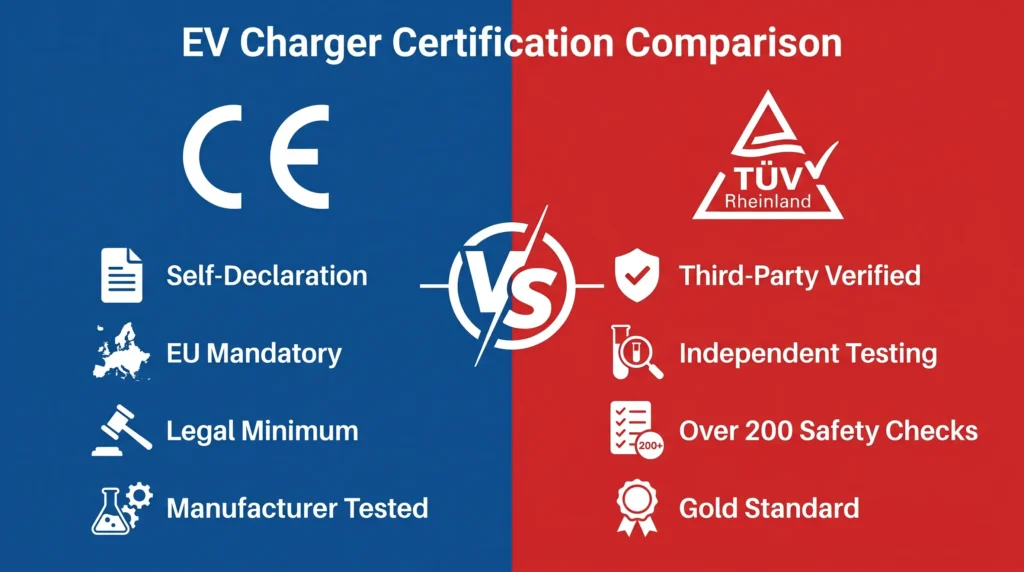
The Critical Limitation of CE: The CE marking system allows for manufacturer self-declaration. This means a manufacturer can conduct their own internal tests, sign a Declaration of Conformity (DoC), and legally affix the CE mark—all without any independent third-party verification [3]. While reputable manufacturers like Yirox Auto Parts conduct rigorous internal testing and maintain full documentation, the self-declaration model creates an opening for less scrupulous producers to apply the mark without genuine compliance. This is precisely why CE should be viewed as the legal minimum, not the safety ceiling.
TÜV Certification: Third-Party Verified Safety
TÜV (Technischer Überwachungsverein), which translates to Technical Inspection Association, is Germany’s premier independent technical safety authority with over 150 years of engineering heritage [3]. Unlike CE, TÜV is not a regulatory standard itself—it is a rigorous, voluntary third-party testing and certification process conducted by accredited, neutral experts.
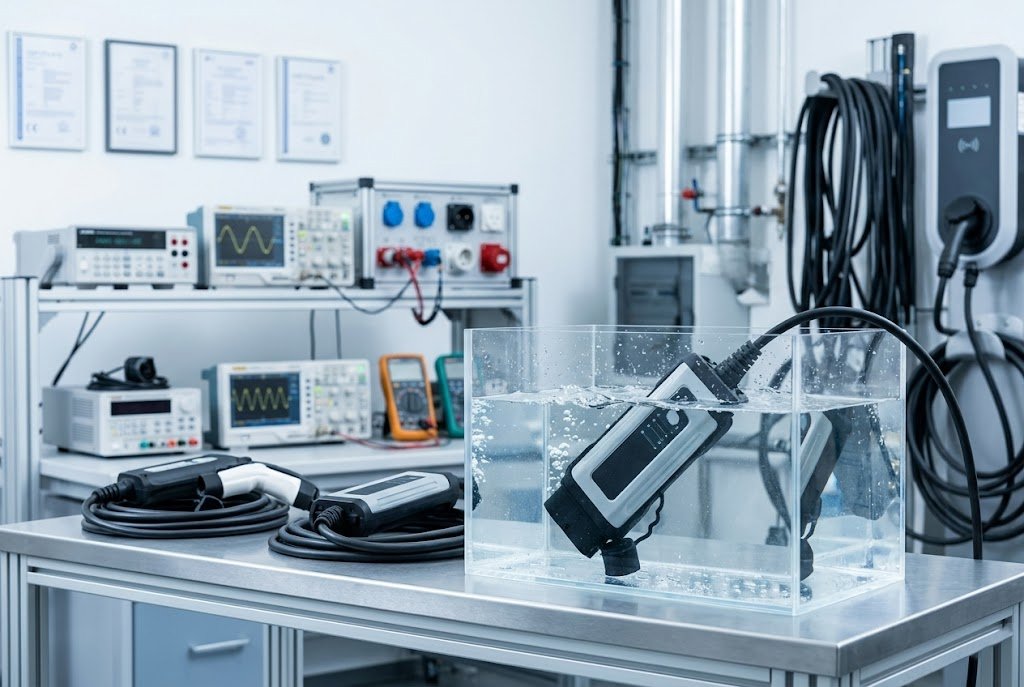
The two most recognized bodies are TÜV Rheinland and TÜV SÜD, both of which operate globally accredited testing laboratories. When a portable EV charger bears either mark, it means the product has passed a comprehensive battery of over 200 independent safety and performance checks, including:
- Thermal Stress Testing: Simulating extreme operating temperatures to verify that the control box, cable, and connectors do not overheat under continuous high-current loads.
- Electrical Fault Scenarios: Testing the charger’s response to short circuits, overvoltage surges, and ground faults to ensure automatic protective shutdown.
- Mechanical Durability: Connector plug/unplug cycle testing (typically 10,000+ cycles), cable flex and bend resistance, and impact drop tests.
- Leakage Current Measurement: Verifying that the Residual Current Device (RCD) correctly detects and interrupts dangerous leakage currents.
- Dielectric Strength: High-voltage insulation testing to confirm that the electrical insulation will not break down under fault conditions.
“CE defines the rules. TÜV makes sure you actually follow them. That’s why TÜV means trust—especially when charging safety is on the line.” — Rheidon Tech Industry Insights [3]
Unlike CE self-declarations, TÜV certification also typically involves periodic factory audits, ensuring that the production quality of ongoing manufacturing batches matches the certified prototype. This makes TÜV the gold standard for EV charging safety in Europe and increasingly, a benchmark demanded by discerning buyers worldwide.
IP67 Rating: What Does It Mean for Portable EV Charger Outdoor Safety?
EV chargers are routinely used outdoors—in driveways, parking lots, and on the road. This exposes them to rain, snow, dust, and mud. This is where the Ingress Protection (IP) rating becomes a decisive safety factor. Defined under the international standard IEC 60529, the IP rating system classifies the degree of protection provided by an electrical enclosure against the intrusion of solid particles and liquids [4].
The IP code consists of two digits, each representing a distinct level of protection:
- First Digit — Solid Particle Protection (0–6): A rating of “6” indicates the enclosure is completely dust-tight, with no ingress of dust whatsoever under vacuum test conditions.
- Second Digit — Liquid Ingress Protection (0–9): A rating of “7” indicates the device can withstand temporary immersion in water up to 1 meter deep for a minimum of 30 minutes without harmful water ingress.
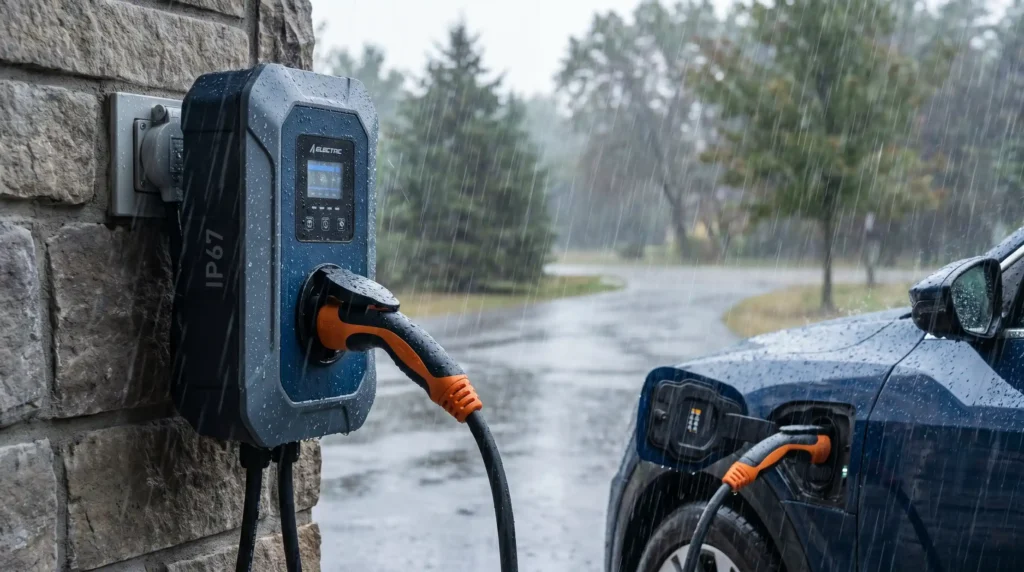
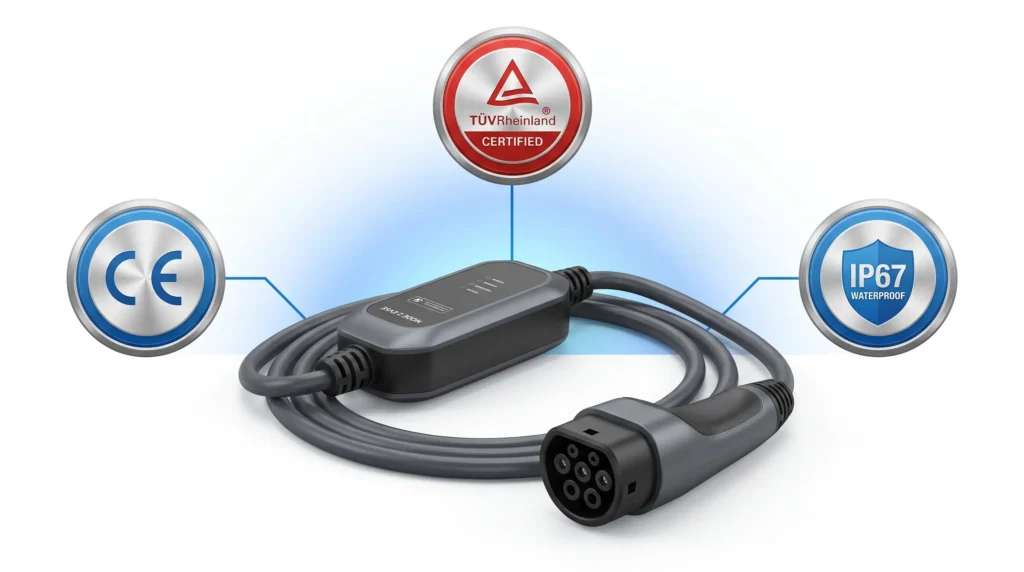
Therefore, an IP67-rated portable EV charger is simultaneously dust-tight and capable of surviving temporary submersion—a combination that provides robust protection for virtually any real-world outdoor charging scenario.
IP54 vs. IP65 vs. IP67: Choosing the Right Protection Level
Not all outdoor environments are equal, and the right IP rating depends on your specific use case. Here is a practical comparison:
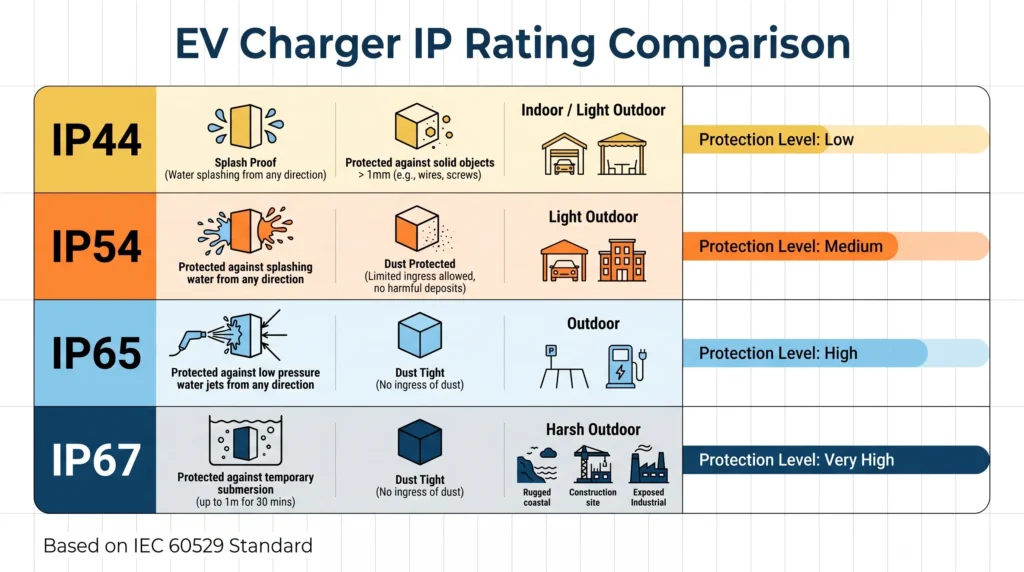
| IP Rating | Solid Particle Protection | Liquid Ingress Protection | Recommended Use Case |
|---|---|---|---|
| IP44 | Objects > 1mm (wires, screws) | Water splashes from any direction | Covered indoor garages only |
| IP54 | Dust Protected (limited ingress) | Water splashes from any direction | Sheltered carports or light outdoor use |
| IP65 | Dust Tight (zero ingress) | Low-pressure water jets from any direction | Standard outdoor use; handles normal rain well |
| IP67 | Dust Tight (zero ingress) | Temporary submersion up to 1m for 30 min | Harsh outdoor environments, heavy storms, flood-prone areas |
From a practical standpoint, IP65 is the minimum acceptable standard for any portable EV charger intended for regular outdoor use. However, for drivers in regions with heavy rainfall, coastal environments, or those who frequently charge in unprotected outdoor spaces, IP67 provides a meaningful additional safety margin. The difference between IP65 and IP67 is not just about surviving a puddle; it is about the long-term integrity of the internal electronics when exposed to repeated moisture stress over years of use.
An IP67-rated charger’s control box can be accidentally dropped into a deep puddle during a heavy downpour, and the internal circuitry will remain completely dry and functional [5]. This is a scenario that is far more common than most people realize, particularly when charging in the dark or in wet conditions.
What Are the Real Fire Risks of Uncertified Portable EV Chargers?
This is a question I get asked often, and the honest answer is: the risks are significant and well-documented. A portable EV charger draws a continuous high current—typically 8A to 32A—for hours at a time. This is fundamentally different from charging a smartphone. The thermal and electrical stresses involved are substantial, and without proper engineering and testing, the consequences can be severe.
The Most Common Hazards
1. Overheating from Undersized or Degraded Sockets
A certified charger cannot compensate for a poorly wired or degraded wall socket. If the socket’s contact resistance is high due to corrosion or loose wiring, the heat generated at the connection point can ignite surrounding materials. Always ensure your outlet is rated for the charger’s maximum current draw and has been recently inspected by a qualified electrician.
2. Extension Cord Misuse
This is perhaps the single most common cause of EV charging-related fires. Standard household extension cords are typically rated for 10A or 13A of intermittent use. A portable EV charger drawing 16A or 32A continuously for 6–10 hours will cause the extension cord to overheat rapidly, potentially melting the insulation and igniting a fire [6]. Never use an extension cord with a portable EV charger unless it is a purpose-built, heavy-duty EV extension cable rated for the specific current and duration.
3. Counterfeit Certification Marks
The market is saturated with chargers bearing fake CE or TÜV marks. These products often lack fundamental safety features such as a Residual Current Device (RCD), thermal fuses, or proper over-voltage protection. They may pass visual inspection but fail catastrophically under real-world operating conditions.
Essential Built-In Safety Features to Demand
When evaluating any portable EV charger, whether for personal use or as a B2B distributor, insist on the following built-in protections. Our guide on adjustable current portable EV chargers goes into detail on how these features are implemented across different current settings (8A–32A):
- Type B RCD (or Type A + DC 6mA Sensor): The most critical safety feature. A Type B RCD detects both AC and DC leakage currents, protecting against the specific type of DC fault current that EV onboard chargers can produce. This is a mandatory requirement under IEC 61851-1 for Mode 2 chargers.
- Over-Temperature Protection: Thermal sensors in the plug head and control box that automatically reduce current or shut down the session if temperatures exceed safe thresholds.
- Over/Under Voltage Protection: Monitors grid voltage and disconnects if it falls outside the safe operating range (typically ±10% of nominal voltage).
- Pilot Signal Monitoring: Continuously verifies the communication signal between the charger and the vehicle’s onboard charging system (EVSE pilot signal per IEC 61851-1).
How to Verify if an EV Charger’s Certification Is Authentic
With the proliferation of white-label products and sophisticated counterfeit markings, verifying a manufacturer’s certification claims is a critical skill for both individual buyers and B2B procurement teams. Here is a structured verification process I recommend to anyone sourcing EV charging equipment.
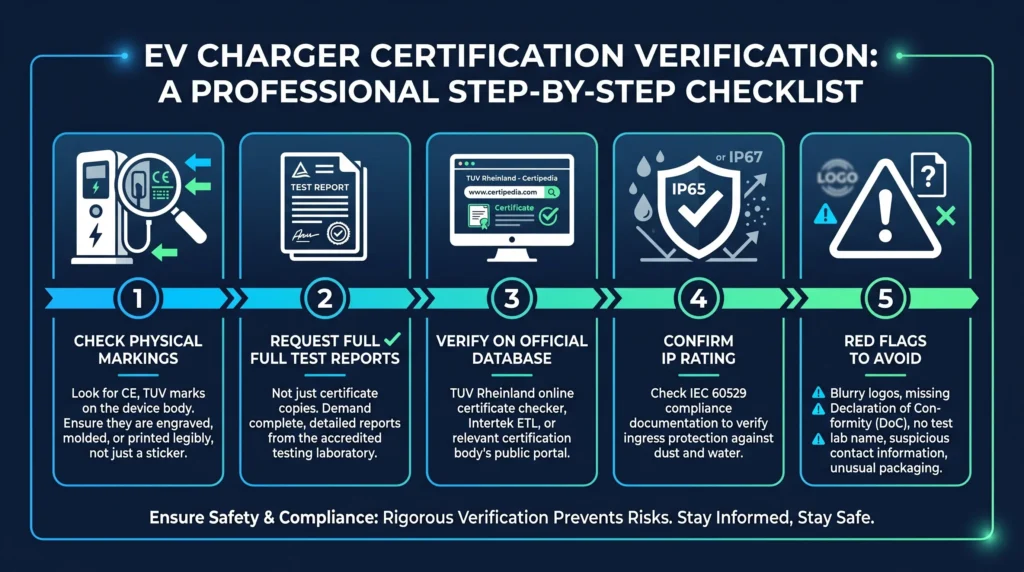
Step 1: Inspect the Physical Markings
Genuine certification marks must be permanently affixed to the product—molded into the housing, laser-engraved, or printed with indelible ink. A CE mark that is merely a paper sticker or appears blurry and disproportionate is a major red flag. The CE mark has a specific, legally defined proportional format; the two letters must be of equal height, and the “E” must be positioned correctly relative to the “C.”
Step 2: Request the Full Test Report, Not Just the Certificate
A one-page certificate is easy to fabricate. A genuine TÜV or accredited laboratory test report is a multi-page technical document listing every test performed, the specific equipment used, the measured values, and the pass/fail result for each parameter. Any reputable supplier should be able to provide this upon request. If they cannot or will not, treat it as a disqualifying factor.
Step 3: Verify on Official Databases
TÜV Rheinland maintains a publicly accessible online database called Certipedia (certipedia.com), where you can search for any certificate by its unique certificate number. Similarly, TÜV SÜD operates a certificate verification portal. If the certificate number on the product does not appear in the official database, the certification is fraudulent.
Step 4: Examine the Declaration of Conformity (DoC)
For CE marking, EU law requires the manufacturer to maintain and provide a Declaration of Conformity (DoC) upon request. This document must specify: the manufacturer’s name and address, the product model number, the specific EU directives the product complies with, the specific EN standards used as the basis for compliance, and the name and signature of the authorized representative. A missing or incomplete DoC is a serious compliance red flag.
Step 5: Check the IP Rating Documentation
IP ratings are not self-declared in the same way as CE. A legitimate IP67 rating must be backed by a test report from an accredited laboratory confirming that the specific product model passed the IEC 60529 dust and water immersion tests. Ask for the IP test report specifically, not just a general product specification sheet.
For distributors and brand owners building a certified product line, transparency in the supply chain is paramount. At Yirox Auto Parts, we provide complete certification documentation—including full TÜV test reports, CE Declarations of Conformity, and IP rating test reports—for all our smart portable EV chargers. This level of documentation is the foundation of a trustworthy B2B relationship.
Global Certification Landscape: What Certifications Does Your Market Require?
If you are a distributor or brand owner selling portable EV chargers across multiple regions, understanding the regional certification requirements is essential. CE and TÜV cover the European market, but different geographies have their own mandatory and recommended standards.
| Target Market | Mandatory Certification | Recommended / Additional | Key Standard |
|---|---|---|---|
| European Union | CE Marking | TÜV Rheinland / TÜV SÜD | EN 61851-1, LVD, EMC |
| United Kingdom | UKCA | (Post-Brexit CE equivalent) | Same as EU |
| United States | UL 2594 (via NRTL) | ETL (Intertek) | SAE J1772, NEC Article 625 |
| Australia / NZ | RCM (SAA) | — | AS/NZS 3820 |
| China | CCC (mandatory from 2025) | — | GB/T 20234 |
| Global Operations | ISO 9001 | ISO 14001 | Quality & Environmental Mgmt |
This table makes clear that a single CE mark is not sufficient for a globally distributed product. A manufacturer claiming “global certification” based solely on CE marking is either misinformed or misleading. A credible OEM partner should be able to demonstrate compliance with the specific standards required for each of your target markets.
Conclusion
Choosing a portable EV charger with genuine, verifiable safety certifications is not about being overly cautious—it is about making an informed decision that protects your vehicle, your home, and your personal safety. The CE mark establishes the legal minimum for the European market, but it is TÜV certification that provides the independent, third-party verified assurance that the charger has been rigorously stress-tested under real-world conditions. The IP67 rating, backed by IEC 60529 testing, ensures that your charger can withstand the harshest outdoor environments without compromising its electrical integrity.
By understanding these standards, demanding authentic documentation, avoiding common charging hazards like extension cord misuse, and partnering with transparent, certified manufacturers, you can confidently build a charging setup—or a product line—that delivers both performance and genuine safety.
FAQ
What is the difference between CE and TÜV on an EV charger?
CE is a mandatory European marking that allows for manufacturer self-declaration of compliance with minimum legal standards. TÜV is a voluntary, independent third-party certification that involves rigorous testing by neutral experts, representing a significantly higher standard of verified safety and quality.
Is an IP65 EV charger safe for outdoor use?
Yes. An IP65-rated EV charger is completely dust-tight and protected against low-pressure water jets from any direction. It is perfectly adequate for standard outdoor use, including exposure to normal rain and snow. For harsher environments, IP67 provides additional protection against temporary submersion.
Do I really need an IP67 portable EV charger?
If you frequently charge outdoors in areas prone to heavy storms, coastal spray, flooding, or deep puddles, an IP67 rating is strongly recommended. It ensures the charger can survive temporary submersion in up to 1 meter of water for 30 minutes without damage to the internal electronics.
Can a portable EV charger cause a fire?
Yes, if it is a low-quality, uncertified unit lacking thermal protection, or if it is used improperly—particularly by plugging it into a standard household extension cord or a degraded wall socket. Always use certified chargers plugged directly into dedicated, professionally inspected circuits rated for the charger’s maximum current draw.
How can I check if my EV charger’s TÜV certificate is real?
Locate the unique certificate number printed on the product label or in the documentation. Then search for it on the official TÜV Rheinland Certipedia database (certipedia.com) or the TÜV SÜD certificate verification portal. If the number does not appear, the certification is not genuine.
What is a Declaration of Conformity (DoC) and why does it matter?
A Declaration of Conformity is a legal document that EU manufacturers must provide for CE-marked products. It lists the specific EU directives and EN standards the product complies with, along with the manufacturer’s details and authorized signature. Requesting a DoC is one of the most effective ways to verify the legitimacy of a CE claim.
References
[1] Yirox Auto Parts. (2026). OEM EV Charging Accessories Manufacturer: Full-Range B2B Solutions.
[2] Zeconex. (2025). International Certification and Standards for EV Chargers: Guide for Wholesalers.
[3] Rheidon Tech. (2025). Understanding TÜV Certification for EV Chargers.
[4] Injet New Energy. (2026). Guide for EV Charger IP (Ingress Protection) Rating.
[5] Feyree. (2025). Battery and EV Charger IP Rating Guide.
[6] Lectron EV. (2026). EV Charging Safety – What You Need to Know.
[7] U.S. Fire Administration (USFA). Electric Vehicle Safety Handout.
[8] IEC. IEC 60529: Degrees of Protection Provided by Enclosures (IP Code).