



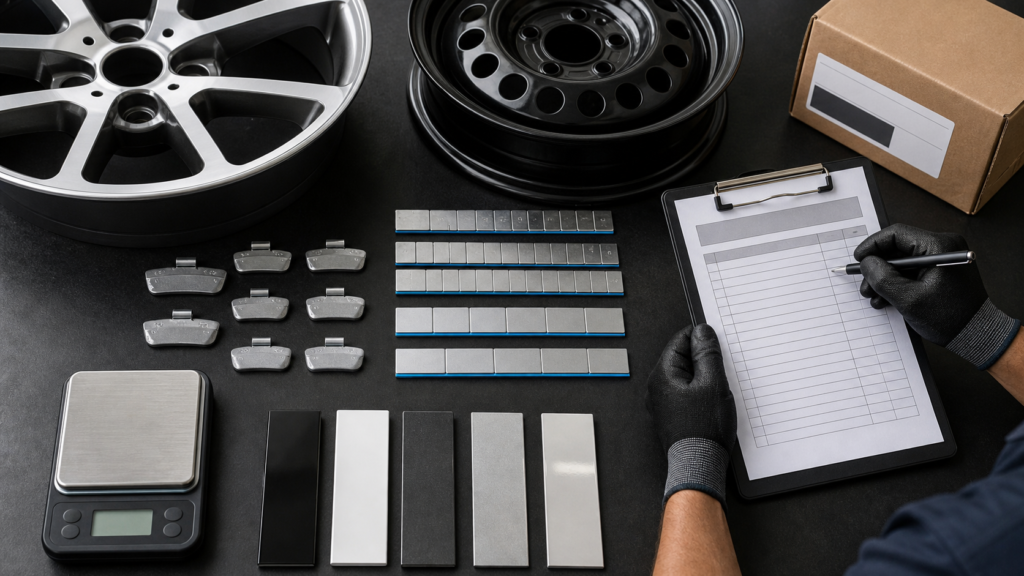
Wheel weight sample approval should test the representative products a buyer will actually order: clip fit or adhesive performance, marked weight, finish, packaging, labels, and batch identification. A documented checklist connects the approved sample to production requirements, so a successful trial is not disconnected from the cartons delivered later.
An attractive sample alone is not an approval decision. A distributor or service program needs evidence that the weight matches the intended rim, works with the chosen balancing process, arrives protected and identifiable, and can be recognized again on repeat orders. The practical outcome is a clear master-sample record rather than a verbal “looks good.”
Table of Contents
- What makes a wheel weight sample representative?
- How should fitment and attachment be checked?
- What should the approval checklist cover?
- How should buyers inspect finish, markings, and weight?
- Why are packaging and labels part of product approval?
- Which approval risks need separate sample checks?
- How should buyers control changes from sample to production?
- How should the approved sample control repeat orders?
- Conclusion: Approve the complete supplied system
- Frequently Asked Questions
- References
What makes a wheel weight sample representative?
A representative sample has the same attachment format, material, profile, marking, finish, tape or clip construction, and packaging form expected in the purchase order. It must be more than a convenient loose piece; it should let the buyer see the product and handling conditions that production will repeat.
Define the intended SKU range before requesting samples. Include the gram or ounce system, clip family or adhesive segment layout, relevant finish, carton configuration, and destination-market labeling needs. The assortment choices before approval help a buyer confirm which formats belong in the validation set before a sample is judged.
The same approved record should define the production QC checks for tolerance, retention, finish, labels, and batch evidence. Before the order leaves the factory, buyers can then verify that the loaded goods still match the approved sample and specification rather than treating approval as a one-time event.
Ask the supplier to identify the sample clearly by product code and lot or sample reference. Retain one unopened package and one approved part as references. If the order will include several profiles or materials, approve each meaningful variation rather than assuming one strip or clip proves the entire range.
How should fitment and attachment be checked?
Fitment should be checked on representative rims using the attachment method the service team will actually use. A clip-on weight must fit the intended flange without damaging the finish or sitting loose; an adhesive weight must sit flush on a clean, continuous barrel surface without bridging a ridge or transition.
For clip weights, inspect the profile, flange contact, retention feel, clearance, and coating condition after trial fit. Do not select a clip by label alone. The clip-on or adhesive format decision is useful here because rim geometry—not a familiar code—determines whether a format is appropriate.
For adhesive samples, follow the proposed preparation and application instructions. 3M’s wheel-weight guidance calls for a clean, dry surface, avoiding contamination of exposed tape, and avoiding bridged placement over wheel features.1 Record the wheel finish, location, cleaner, temperature conditions, pressure method, and observation result. A detailed adhesion comparison can be handled in a separate test plan; approval should at least confirm that the production sample can be applied correctly to the intended rim.
What should the approval checklist cover?
The approval checklist should cover the part, its fit, its appearance, and the way it will arrive and be identified. Keeping these checks together prevents a product from passing a rim trial while its carton label, liner, or supplied profile differs from what was actually tested.
| Area | Check before approval | Evidence to retain |
|---|---|---|
| Fitment | Correct clip/flange match or flush adhesive placement | Rim ID, photos, fit observation |
| Attachment | Clip retention or tape contact on prepared surface | Application method and condition notes |
| Weight and markings | Correct unit, clear marking, sensible segment layout | Sample measurement and close photos |
| Finish | Consistent coating, plating, or surface appearance | Visual standard and defect notes |
| Packaging | Protected product, clear SKU and quantity identification | Inner pack and carton photos |
| Traceability | Link sample to the intended order | Product code, lot, approval date, approver |
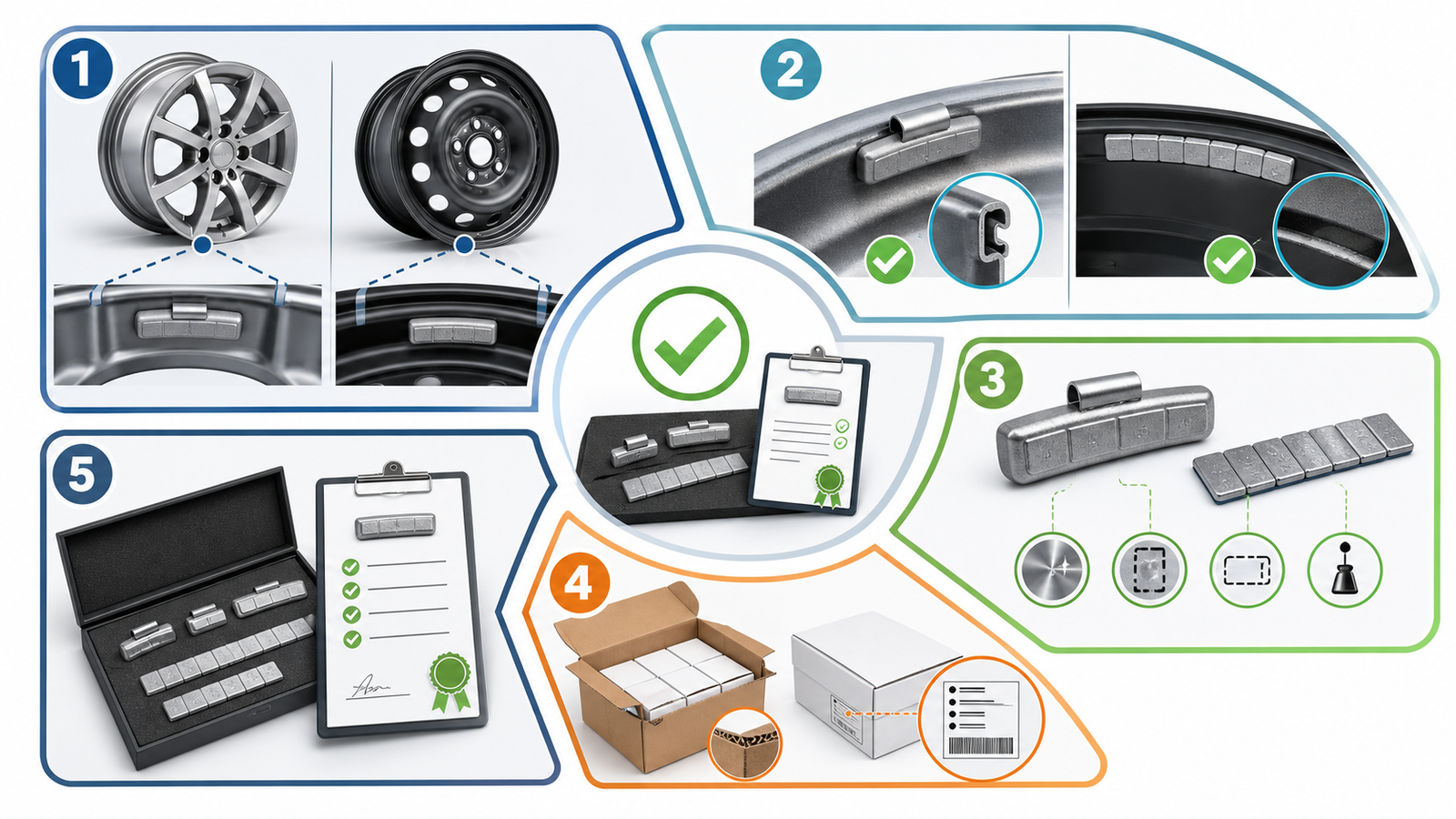
Use the checklist as a shared record, not a supplier-only form. Buyers should write down which details are critical and which are cosmetic preferences. That distinction helps resolve a deviation later without turning every minor visual variation into an undefined rejection.
Set the sample quantity around the risk of the order. A simple replenishment of an already proven SKU may need a smaller confirmation set, while a new alloy-wheel program, a mixed clip assortment, or a private-label launch should include more representative pieces and packaging examples. Where more than one person will install or inspect the product, let the approval record describe the observation in concrete terms that another reviewer can repeat.
How should buyers inspect finish, markings, and weight?
Buyers should inspect finish, markings, and weight against the agreed sample and purchase specification. The key is consistency: a part can look acceptable individually yet still create service, inventory, or customer issues if its coating, unit marking, or segment layout changes from the approved version.
Check for incomplete coating, rust, plating discoloration, sharp edges, distorted clips, poor separation between adhesive segments, damaged liner, or unreadable marks. Compare several pieces from the same sample pack, not just the best one. For marked weight, use a suitable scale and document the method; do not claim a tolerance unless it is agreed in the specification.
Match the inspection to the product’s use. A highly visible alloy-wheel program may set tighter appearance expectations. A steel-wheel service assortment may prioritize flange fit, retention, coating coverage, and reliable carton identification. In both cases, photographs of the accepted condition are often more useful than vague wording such as “good finish.”
Review the relationship between the marking and service workflow as well. A technician must be able to distinguish the attachment type, unit system, and relevant size or segment information at the point of use. If a carton contains a mix of products, confirm that the inner pack or divider prevents an apparently correct master label from hiding a wrong or mixed component inside.
Why are packaging and labels part of product approval?
Packaging and labels are part of approval because they protect the product and tell warehouse and service staff what they received. A correctly made wheel weight can still cause errors if adhesive strips are crushed, clips are mixed, units are unclear, or cartons cannot be connected to the approved SKU.
Inspect the inner pack and master carton as they will be supplied. For adhesive strips, check that the liner and strips are protected from crushing, contamination, and unwanted exposure. For clip-on assortments, check that profiles are separated and identified well enough to prevent a service technician from selecting the wrong type.
Confirm that the label can identify the material, attachment type, unit system, quantity, product code, and any required batch or lot reference. If the buyer needs private labels or market-specific information, approve the artwork and placement with the sample packaging—not after production begins. The sample set should make it easy to confirm that representative wheel weight samples and the delivered SKU are genuinely the same system.
Which approval risks need separate sample checks?
Separate sample checks are needed whenever a variation can change fit, installation behavior, appearance, identification, or the condition in which the product reaches the workshop. A general approval cannot safely cover a different clip profile, tape construction, wheel application, or carton arrangement simply because the product family shares a name.
Start with the risks that can create a field complaint. Clip-on weights deserve a new fit check when the rim flange family, clip geometry, material thickness, or coating changes. Adhesive strips deserve a new review when tape, liner, strip height, segment arrangement, or the intended wheel surface changes. A finish sample needs renewed inspection if the coating process, color, plating, or corrosion-protection approach changes. These are functional differences, not merely catalog differences.
Packaging changes should be judged by their real effect. Moving from a rigid inner box to a loose bag, changing a divider, revising a dispenser, or switching carton label layouts may change product protection and warehouse accuracy. Ask whether a normal receiving team can identify the SKU, material, unit system, and quantity without opening multiple packs or relying on a memory of the previous order.
Use a risk-based approval table when the range is large. High-risk items need a physical sample, representative-rim fitment, and retained packaging. Medium-risk items may need a side-by-side comparison against the master sample. Low-risk artwork or wording changes can be approved from a controlled proof, provided they do not remove required product or batch identification. This keeps approval resources focused without leaving important substitutions undocumented.
How should buyers control changes from sample to production?
Buyers should require written change control so the approved sample remains the product reference, not a one-time illustration. The purchase specification should state that material, attachment construction, tape or liner, profile, coating, markings, packaging, and label fields may not change without review and approval.
Create a simple change-request process. The supplier identifies the current approved configuration, describes the proposed change and reason, sends a comparison sample or artwork where needed, and waits for the buyer’s documented disposition before shipment. The buyer then decides whether the change requires only a record update, a desk review, a new sample check, or a full reapproval on representative rims.
This discipline is especially valuable when several people handle sourcing, receiving, and technical complaints. A clear record lets a warehouse team quarantine an unexpected carton and lets a service manager compare a returned part with the last approved version. It also prevents an urgent replacement shipment from becoming an untested permanent change.
For important orders, add a receiving check that compares a small number of parts and one carton against the master-sample record before the inventory is released. That does not replace a full pre-shipment inspection, but it quickly detects a wrong unit system, profile mix, coating, tape construction, or label before the goods move into normal distribution.
How should the approved sample control repeat orders?
An approved sample should control repeat orders through a dated record that ties photos, product code, packaging, and acceptance notes to the purchase specification. It is a baseline for incoming inspection, production comparison, complaint handling, and changes that need buyer approval.
Retain the master sample in a protected location, or retain sufficient photographic and measurement evidence where physical retention is not practical. Record the supplier, product identity, order reference, rim used for fitment, applicable packaging, and the named approver. Note any approved exceptions explicitly, such as a cosmetic variation that does not affect performance.
On repeat orders, compare the received product and carton against the record before distribution. If a supplier proposes a change to clip profile, tape, material, coating, segment layout, liner, packaging, or label, require review before treating it as an equivalent replacement. This protects the original approval decision from being quietly diluted by an uncontrolled substitution.
The record also shortens complaint investigation. When a shop reports a loose clip, a damaged finish, a tape issue, or an unclear carton, the buyer can compare the returned material with the approved sample, photographs, fitment notes, and lot identification. That is more useful than trying to reconstruct the original decision from a generic product name months later.
Conclusion: Approve the complete supplied system
Wheel weight sample approval works when it connects fitment, attachment, weight, finish, packaging, and traceability in one documented decision. The sample should represent the products that will actually ship, and the record should state what was checked, on which rims, under which conditions, and what must remain unchanged.
Before placing volume orders, request a representative sample set and approval checklist. Compare the clips or adhesive strips on the wheels you serve, verify markings and finish, inspect cartons and labels, and retain a master-sample record for repeat production.
Frequently Asked Questions
Does one approved wheel weight sample cover every SKU?
Usually not. Approve each meaningful variation in attachment profile, material, unit system, finish, tape, segment layout, or packaging that will affect fit, handling, or identification.
What should a buyer photograph during sample approval?
Photograph the part, its fit on the representative rim, the adhesive placement or clip contact, markings, finish, inner packaging, carton label, and the final approved set. Use consistent views where possible.
Should adhesive tape be tested during sample approval?
Yes, at least confirm that it can be applied correctly on the intended prepared rim. Where tape reliability is a major purchase risk, run a separate documented adhesion comparison under representative conditions.
What if the production carton differs from the approved sample carton?
Treat it as a change requiring review. Packaging can affect protection, warehouse identification, and traceability even if the loose product appears unchanged.
References
[1] 3M Wheel Weight System Application Guide. 3M, n.d. Accessed July 24, 2026.