




A wheel weight catalog helps buyers compare the formats, materials, increments, profiles or strip designs, packaging, and labels that make up a usable product range. Use it to narrow the SKUs that suit your market before requesting samples or a quotation; it does not prove that every listed product fits every wheel.
The catalog is most valuable before an RFQ, when a buyer still has time to remove unsuitable variants and define a clean comparison. A low unit price is hard to evaluate when one supplier quotes a mixed clip-on assortment, another quotes only adhesive strips, and a third leaves carton contents or weight units undefined. The right first question is not, “Which catalog has the most pages?” It is, “Can I turn this catalog into a clear, market-specific SKU request?”
Table of Contents
- What should a wheel weight catalog help a buyer decide?
- Which wheel applications should you map before reading the catalog?
- Which catalog fields determine whether an SKU belongs in the shortlist?
- How should buyers compare packaging and SKU coverage?
- What missing catalog information should stop an RFQ?
- How do you turn a catalog shortlist into a quote-ready RFQ?
- Conclusion: use the catalog to define the quote, not to replace it
- Frequently Asked Questions
- References
What should a wheel weight catalog help a buyer decide?
A catalog should help a buyer decide which product families belong in the first shortlist, which fields must be clarified before sampling, and how the eventual quotations can be compared on the same basis. It is a selection tool, not a fitment certificate, test report, or substitute for an approved part specification.
Begin with the service and distribution problem behind the order. A buyer may need an adhesive program for alloy-wheel channels, clip-on profiles for steel-wheel service, a mixed assortment for distributors, or a focused replenishment range. The planning view of wheel applications, materials, and attachment formats helps turn that market description into a starting range before a catalog's long SKU list makes every option appear equally relevant.
Use this decision table near the beginning of a catalog review. It keeps the team from comparing prices before it has agreed what is being compared.
| Catalog decision | Field to inspect | What the buyer should decide before the quote | Evidence to ask for next |
|---|---|---|---|
| Wheel application | Passenger, light truck, commercial, alloy, or steel-wheel indication | Which vehicles and wheel constructions the range must support | Target market, common rim types, and any fitment samples |
| Attachment family | Clip-on profile or adhesive strip | Whether the channel needs rim-flange retention, tape-backed application, or both | Profile drawing or physical fit sample; tape and liner details |
| Material and finish | Steel, zinc, lead-free option, coating or plating | Which material and corrosion-protection claim is appropriate for the destination and use | Material statement, finish description, and agreed test method where needed |
| Increment system | Gram, ounce, segment pattern, available values | The coverage needed for the balancing equipment and service habits in the market | SKU list showing increments, net weight, and conversion basis |
| Commercial pack | Pieces or strips per inner, carton count, labels, pallet data | The order unit, replenishment unit, and warehouse handling method | Packing list, carton dimensions, gross weight, and label artwork or fields |
The table is deliberately practical: it asks what must be decided, not what sounds impressive in a brochure. ISO 9001 treats control of documented information as part of a quality-management system; for a buyer, the useful application is to make sure a catalog revision, drawing, and approved sample can be tied back to the quoted SKU. A catalog can support that discipline, but it cannot certify quality by itself.1
Which wheel applications should you map before reading the catalog?
Map the wheels and service channels first, because attachment and format only make sense when they are tied to real rim constructions and installation practice. A broad catalog becomes manageable once the buyer knows whether the range is for alloy wheels, steel wheels, commercial wheels, or a mix of those applications.
Start with the buyer's downstream customers. A tire-shop distributor may need fast-moving passenger-car adhesive strips plus a selected set of clip-on profiles. A fleet-maintenance channel can place more weight on commercial wheel application, corrosion exposure, and replenishment consistency. A private-label importer may need the same working range across several countries, but should still avoid assuming that one flange profile or material preference serves every local wheel population.
The catalogue page should show enough information to tell these routes apart. For clip-on variants, look for the intended rim type, clip shape, profile family, material, finish, and available weight values. For adhesive variants, look for strip height or thickness, segment design, material, coating, tape system, liner, and the format in which technicians receive the strips. Product photos help recognition, but they are not enough to establish compatibility.
Attachment is often the first decision that removes irrelevant lines. Buyers deciding what their market actually needs can use attachment choice for the wheels a market actually services to separate the wheel-surface and rim-flange questions before asking a supplier for price. That step makes the catalog shortlist more truthful than a generic request for “all wheel weights.”
Create a small application map before marking any catalog pages:
- List the vehicle classes and wheel constructions that create most of the expected demand.
- Note whether technicians work mainly with visible alloy wheels, painted steel wheels, commercial rims, or mixed service work.
- Record any customer preference for grams or ounces and the balancing equipment commonly used.
- Separate a launch assortment from low-frequency or special-fitment lines that can be quoted later.
- Identify the applications where a physical fit test is essential rather than relying on an image or a stated profile name.
This map also prevents a common RFQ mistake: asking every supplier to quote every format, then finding that no quote uses the same material, increment spread, or pack unit. A smaller, stated application scope produces a more useful first comparison.
Which catalog fields determine whether an SKU belongs in the shortlist?
The deciding fields are attachment, material, increment coverage, profile or strip geometry, and pack definition. A SKU belongs in the shortlist only when those fields support the intended application and can be stated consistently in the RFQ.
Attachment and geometry
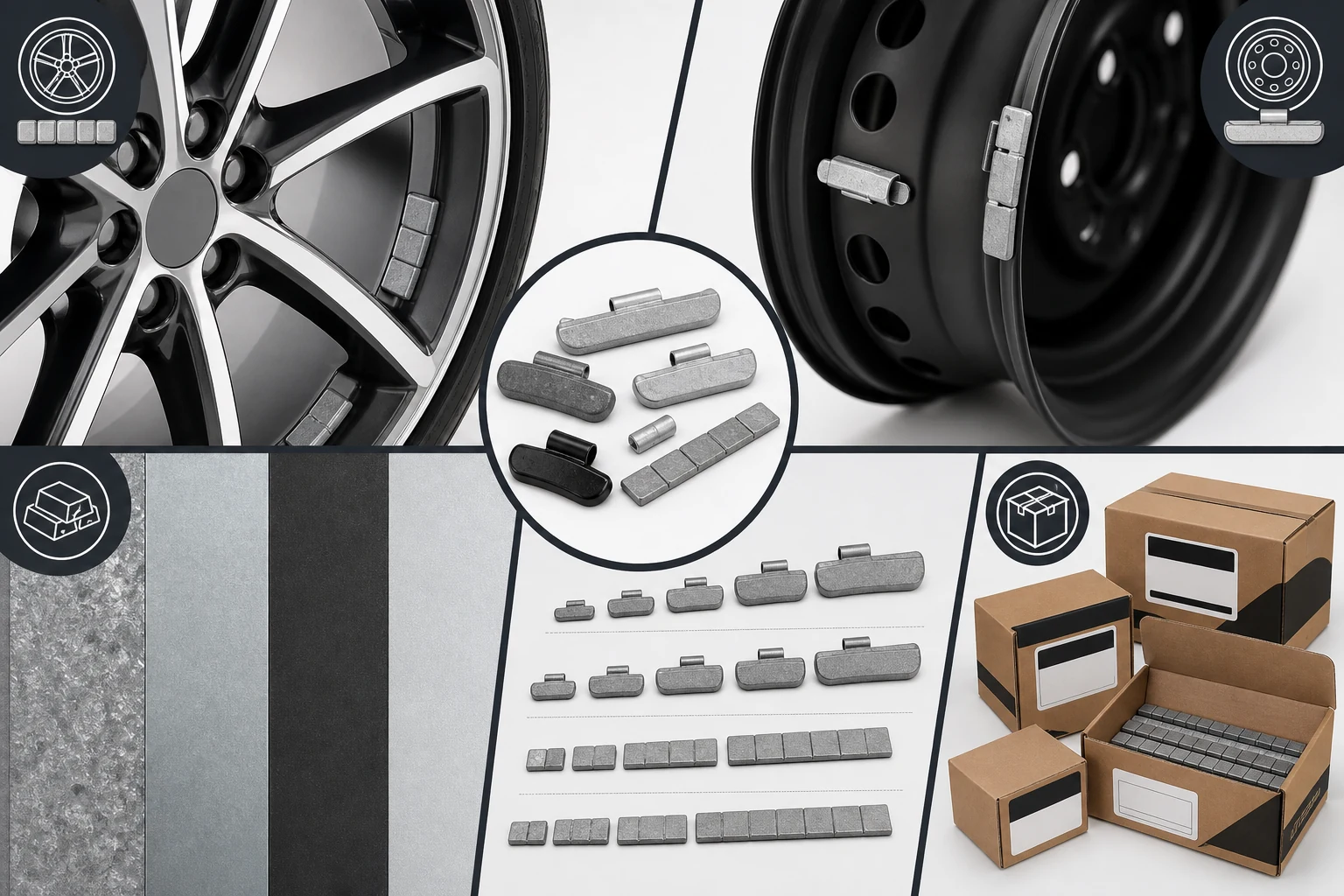
For clip-on weights, a catalog should distinguish the clip profile or wheel fitment family rather than presenting every curved weight as interchangeable. Ask whether the listed shape refers to the weight body, the clip, or an intended rim family. Where the channel depends on a particular profile, request a physical sample and test it on representative rims before approving a larger order.
For adhesive weights, compare strip depth, height, thickness, segment break pattern, exposed edge, tape, and liner. Thin formats may fit behind tight spokes better, while a different strip construction may be easier for technicians to separate or position. None of these characteristics can be reduced to “adhesive versus clip-on.”
Material, coating, and stated performance
The catalog should name the material precisely enough for the buyer to request the right option: for example, steel or zinc rather than an ambiguous “eco” label. It should also say whether a finish is paint, powder coating, plating, or another stated treatment. If corrosion resistance is part of the requirement, ask for the actual test method, exposure duration, pass/fail criteria, and the product version tested. ASTM B117 describes the operation of salt-spray apparatus; it is not a universal prediction of field life, so a catalog claim should lead to a defined, comparable test request rather than a broad durability promise.2
Increment and unit coverage
An increment field tells a buyer how closely the range can support routine balancing work, but the useful question is coverage, not merely the smallest listed value. Check whether the line is sold in grams, ounces, or both; whether values are individual pieces, breakable segments, or a mixed box; and whether the range skips values your service channel expects.
Buyers who need to compare the listed weights against workshop practice can use the gram and ounce increment reference for a service assortment to keep conversion and available-value coverage visible while they narrow the catalog. This avoids a quote that appears complete only because its unit system or segment count was never made explicit.
Tape and strip disclosures
For adhesive products, tape should be a named part of the SKU rather than an afterthought. The supplier should disclose the tape type or agreed performance description, liner, application temperature guidance where available, storage conditions, and the surface-preparation expectations that matter in real installation. Adhesive performance depends on the wheel surface and application conditions as well as the tape; 3M's technical guidance likewise emphasizes surface preparation before bonding.3
That is why tape and strip details that an adhesive listing should disclose are useful before a buyer treats two visually similar strips as equivalent. The destination helps the buyer frame tape, cleanliness, liner, and installation questions that a one-page catalog image often leaves unanswered.
How should buyers compare packaging and SKU coverage?
Buyers should compare packaging as part of the product definition, because pack units affect quotation totals, warehouse handling, technician convenience, and replenishment accuracy. SKU coverage should be judged against the expected service mix, not by the highest number of lines in a supplier's catalog.
Two catalogs can show the same nominal product family but produce very different commercial results. One might sell a strip in short workshop packs with clear labels; another might quote an industrial carton with a different number of segments per strip, a different net weight, or no defined inner pack. For clip-on weights, a mixed assortment can be convenient for a launch, but a repeat buyer may prefer individual SKU cartons so replenishment follows actual demand.
Compare these packaging fields line by line:
| Packaging field | Why it changes the buying decision | Question for the supplier |
|---|---|---|
| Selling unit | A piece, strip, roll, tray, mixed box, or carton changes how price and consumption are interpreted | What exactly is the quoted unit and its net weight? |
| Inner pack | Determines technician access, retail readiness, and stock counting | How many pieces, strips, or rolls are in each inner pack? |
| Outer carton | Affects freight, warehouse slotting, and distributor break-bulk work | What are the carton count, dimensions, gross weight, and strength? |
| Label fields | Controls receiving accuracy and traceability | Does each inner and carton show SKU, material, increment, lot, and quantity? |
| Assortment logic | Determines whether a mixed set matches demand or just looks comprehensive | Which increments and profiles are included, and in what ratio? |
| Pallet plan | Affects export handling and full-order cost | How many cartons per pallet and what protection is used? |
For a shop-oriented assortment, the right measure is how often a technician can complete normal balancing work without opening a second pack or running out of a common value. Buyers building that kind of service range can use the stock-range logic for a shop serving repeat balancing work to distinguish useful fast-moving coverage from a catalog that simply lists many low-turning variants.
Also ask whether the supplier can keep the same pack configuration when the order grows. A launch carton can be suitable for samples or trial sales, while a repeat program may need a specific inner-pack count, blank or private-label carton, barcode field, pallet pattern, and batch label. Those are legitimate quotation variables, not late-stage artwork details.
What missing catalog information should stop an RFQ?
Missing information should pause the RFQ when it prevents the buyer from identifying the product or comparing quotes fairly. Do not wait for every laboratory report before making contact, but do not send a price request that leaves the supplier free to choose the material, attachment version, pack unit, or range coverage without telling you.
The most important missing details are usually practical rather than dramatic:
- No identified wheel application or clip-profile family for a clip-on SKU.
- No stated material, finish, or lead-free material option where the market requires it.
- No clear increment list, unit system, or number of breakable segments in a strip.
- No tape description, liner detail, or storage/application information for adhesive products.
- No net content per selling unit, inner pack, or carton.
- No way to distinguish a sample version from the production SKU being quoted.
- No product revision, lot field, or written method for communicating a material, tape, coating, or packaging change.
Treat omissions proportionately. A distributor evaluating a broad range may first request a clarified SKU sheet. A buyer preparing a private-label order should go further and ask for drawings, sample identification, packaging artwork fields, and a written confirmation of the approved configuration. The International Automotive Task Force's sub-tier requirements are a useful reminder that buyer requirements, change control, and traceability need to be communicated through the supply chain; they cannot be recovered from an undated image after a shipment has left.4
Be especially cautious with catalog shorthand. Terms such as “universal,” “premium tape,” “corrosion resistant,” or “standard packing” may describe a marketing position but do not define an orderable part. Ask the supplier to translate the label into a material, geometry, pack quantity, test basis, or controlled specification.
How do you turn a catalog shortlist into a quote-ready RFQ?
Turn the shortlist into an RFQ by naming the selected SKU families, their required attributes, the quantities and pack units to be quoted, and the evidence needed before approval. The purpose is to let qualified suppliers price the same requirement while preserving room to state a clear exception or alternative.

A concise RFQ can use this sequence:
- Describe the market and application. State the target country or channel, wheel types, and whether the request is for alloy-wheel adhesive products, steel-wheel clip-on products, commercial vehicles, or a defined mix.
- List the requested SKU families. For each line, name attachment type, profile or strip construction, material, finish, and increment or segment format. Attach a catalog page, photo, drawing, or sample code only as an identifier, not as the whole specification.
- Define the commercial unit. Specify whether pricing is required per piece, strip, roll, inner pack, carton, or kilogram; state the quantity for each line and whether an assortment ratio is acceptable.
- Specify packaging and label needs. Include inner and outer counts, cartons per pallet if relevant, private-label fields, barcode expectations, and any language or country-of-origin requirements.
- Request samples and approval evidence. Ask which samples represent the quoted production configuration, how they are labeled, and what test or inspection information can be supplied for the material, finish, tape, or dimensions.
- Ask suppliers to flag exceptions. A supplier may offer a workable alternative increment, tape, or carton. Ask it to be listed separately so it cannot be mistaken for the requested SKU.
After the application, material, increment, and packaging requirements are fixed, use carton and MOQ planning once the SKU list is fixed to check whether the shortlist can be ordered and replenished sensibly. The buyer will be able to compare minimums, freight weight, carton logic, and SKU mix without reopening the product-definition decision.
The next useful action is to request sample families that match the selected attachment and pack format. Send the short RFQ with the selection table instead of asking for a generic price list. This gives the supplier enough context to identify realistic samples and makes later quotation differences visible.
If you are turning a wheel-weight catalogue into a real SKU plan, share your vehicle mix, attachment formats, size increments, labels, and packaging targets. We can help you identify the range that should go into a focused sample and quotation request.
Conclusion: use the catalog to define the quote, not to replace it
A wheel weight catalog is valuable when it helps a buyer identify a workable product range: the wheel applications to serve, attachment format, material and finish, increments, strip or profile geometry, and pack units. It becomes risky when a polished page is treated as proof of fitment, tape performance, corrosion resistance, or repeat production.
Before requesting price, turn the marked catalog pages into a short SKU brief. State what must remain fixed, ask suppliers to identify alternatives separately, and request samples that are traceable to the quoted configuration. That approach makes a market-specific wheel weight catalog and SKU list a useful beginning to an RFQ, rather than an attractive but ambiguous attachment.
Frequently Asked Questions
What should be included in a wheel weight catalog?
A useful wheel weight catalog identifies attachment type, wheel application or profile family, material, finish, available increments, dimensions or strip construction, selling unit, and packaging. It should also give the buyer a way to request samples and clarify what version of the SKU is being quoted.
Is a wheel weight catalog enough to choose the right clip-on profile?
No. A catalog can narrow the profile family, but clip-on fitment should be confirmed against representative rims or an agreed drawing and sample. A photograph or a general term such as “universal” does not prove that the clip will fit every steel wheel.
How should buyers compare adhesive wheel weight strips in a catalog?
Compare the material, finish, strip dimensions, segment pattern, increment coverage, tape and liner information, unit count, and carton configuration. Then request samples using the same stated configuration, because visual similarity alone does not establish equivalent tape or application behavior.
Should price be compared by piece, strip, or carton?
Compare prices on the unit that matches the use and stock decision, then calculate a common view using net weight and stated pack content. A lower carton price may conceal fewer pieces, a different segment count, or a different material and pack format.
What should I send with a wheel weight catalog RFQ?
Send the selected SKU pages or codes, target wheel applications, required material and attachment type, increments, package counts, quantities, label needs, destination market, sample requirement, and a request that all alternatives are clearly identified. This lets suppliers quote a comparable requirement rather than filling gaps with assumptions.
References
[1] International Organization for Standardization. “ISO 9001:2015 – Quality management systems – Requirements.” 2015.
[2] ASTM International. “ASTM B117 Standard Practice for Operating Salt Spray (Fog) Apparatus.” 2026.
[3] 3M. “VHB Tape Surface Preparation Technical Bulletin.” 2014.
[4] International Automotive Task Force. “Minimum Automotive Quality Management System Requirements for Sub-Tier Suppliers.” 2017.