



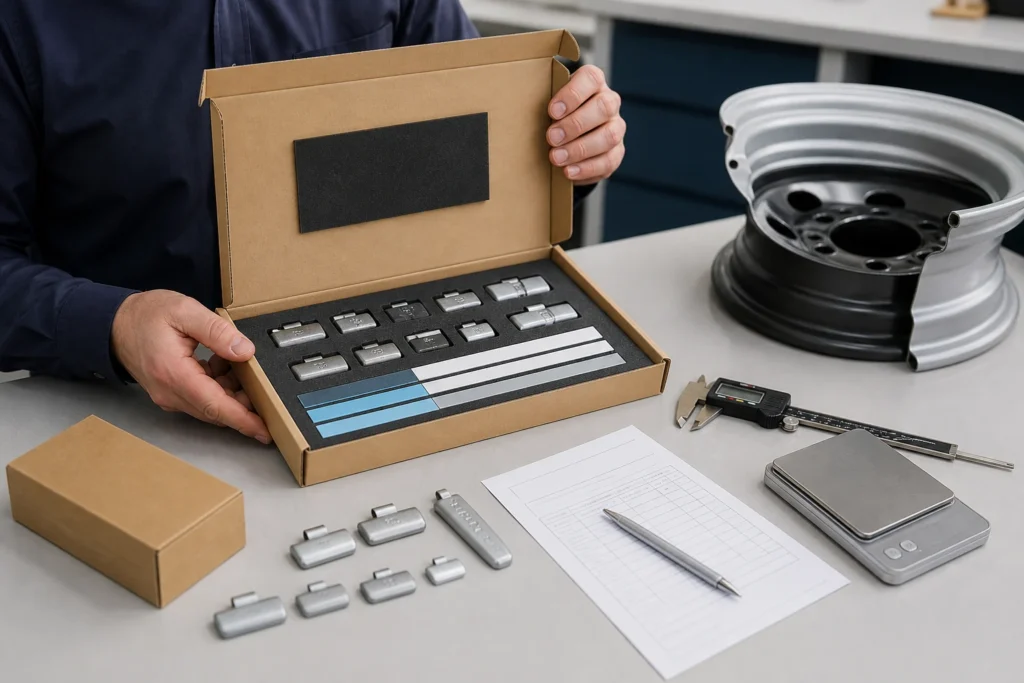
A wheel weight sample request should identify the representative SKU, intended wheel application, material, unit system, clip profile or strip format, finish, packaging, and documents needed for testing. A focused sample request gives buyers evidence they can use in approval instead of a box of parts with no clear connection to the planned order.
The point of a sample is not to collect the widest possible assortment. It is to test the few products that most clearly represent the range the buyer may actually purchase. When a sample has no identified configuration, no target wheel, and no matching pack information, even a successful test can be difficult to use in a quotation or repeat order.
Table of Contents
- What is a useful wheel weight sample request?
- How should buyers choose representative SKUs?
- How should buyers define the test wheel and use case?
- What documents and data should accompany samples?
- How should sample packaging be checked?
- What should happen after samples arrive?
- What should buyers send in the sample request?
- Conclusion: request evidence, not an anonymous assortment
- Frequently Asked Questions
- References
What is a useful wheel weight sample request?
A useful request names the expected application and the exact sample family needed to represent it. It asks the supplier to identify each product rather than sending a generic box that cannot be linked to a later SKU, carton, or quotation.
Begin with the product and application choices. The product and application choices that should guide the sample request help a buyer define the wheel types, attachment formats, materials, increments, and channel needs before it decides what belongs in the sample set.
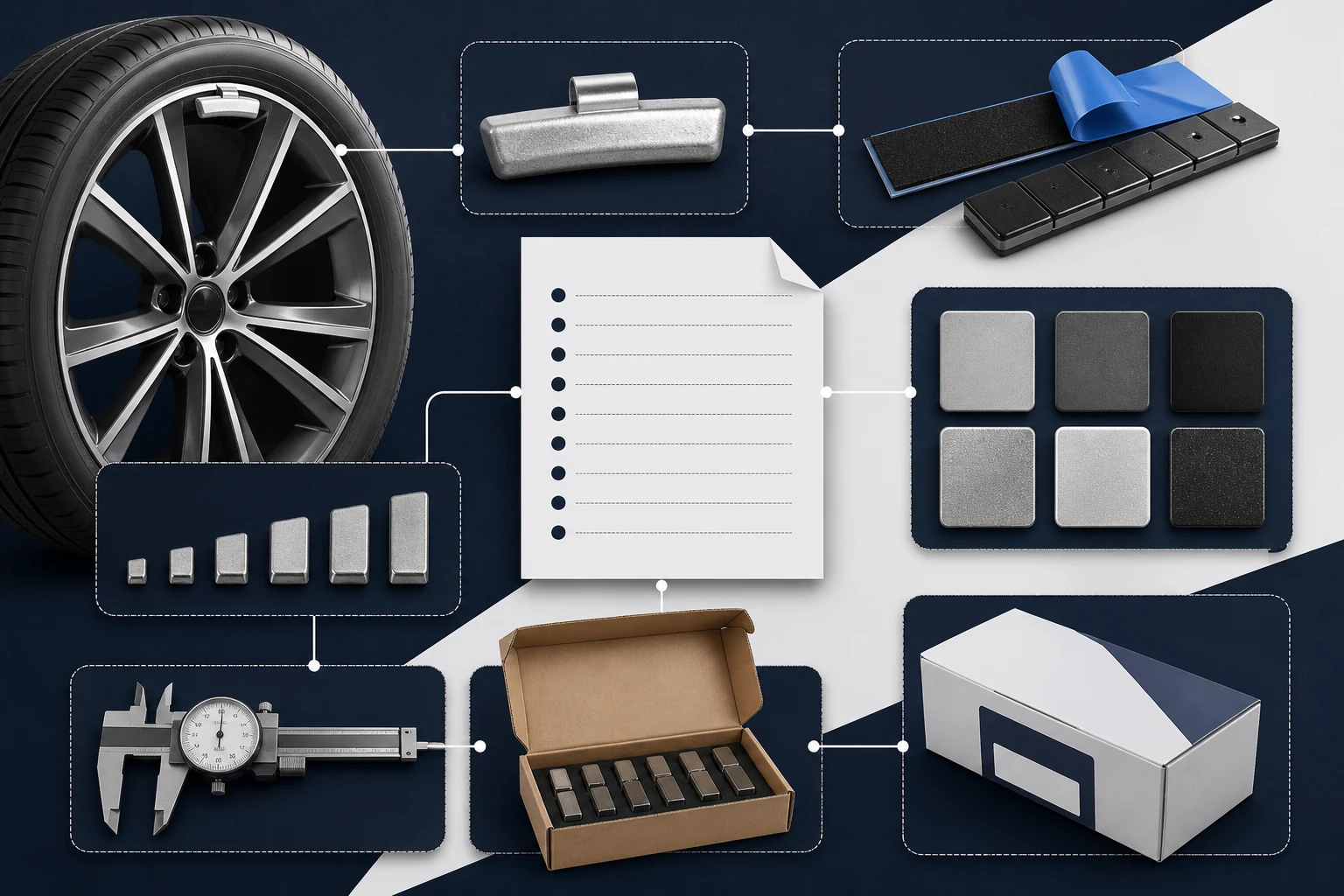
| Request field | What to state | Why it matters |
|---|---|---|
| Sample purpose | Fitment check, adhesive evaluation, range review, packing review, or pre-production approval | Stops a concept sample from being mistaken for a production sample |
| Target application | Alloy, steel, passenger, commercial, or named wheel/rim samples | Lets the supplier select a representative attachment and geometry |
| Product identity | Clip or strip family, material, finish, increments, tape/liner where relevant | Links each sample to an intended orderable configuration |
| Quantity | Enough pieces or strips for the agreed checks and repeat measurements | Avoids an attractive but untestable sample quantity |
| Data | Configuration sheet, material/finish statement, packing data, and any requested evidence | Makes the result traceable to the supplied item |
| Packaging | Inner pack, carton, label, or a stated “loose evaluation sample” status | Shows whether the sample also represents the receiving format |
How should buyers choose representative SKUs?
Choose representative SKUs by covering the applications and formats that drive the planned range, not by taking one of every visible catalog line. A small, identified set is better than a large mixed box when each item has a reason to be tested.
If the market needs both attachment families, first decide how they will be used. The attachment choice before the buyer asks for clip-on and adhesive samples helps separate rim-flange fitment from wheel-surface application before a buyer requests products that cannot fairly be compared.
For each family, select the likely fast-moving profiles or strips, the material and finish needed for the destination, and the increments that will be sold or used. The unit and increment coverage to include in the sample shortlist helps prevent a sample kit from overlooking the gram, ounce, or segment pattern that makes a range workable in the target channel.
Ask the supplier whether each requested part is a standard production SKU, a sample-only configuration, or a proposed alternative. This distinction is commercially important: a satisfactory standard SKU may lower development risk, while a custom configuration needs a separate drawing, sample path, and MOQ discussion.
How should buyers define the test wheel and use case?
Define the test wheel and use case with the same realism expected from the planned order. A sample cannot prove fitment on a wheel it was never tested against, and an adhesive strip cannot prove its intended performance on an unspecified surface.
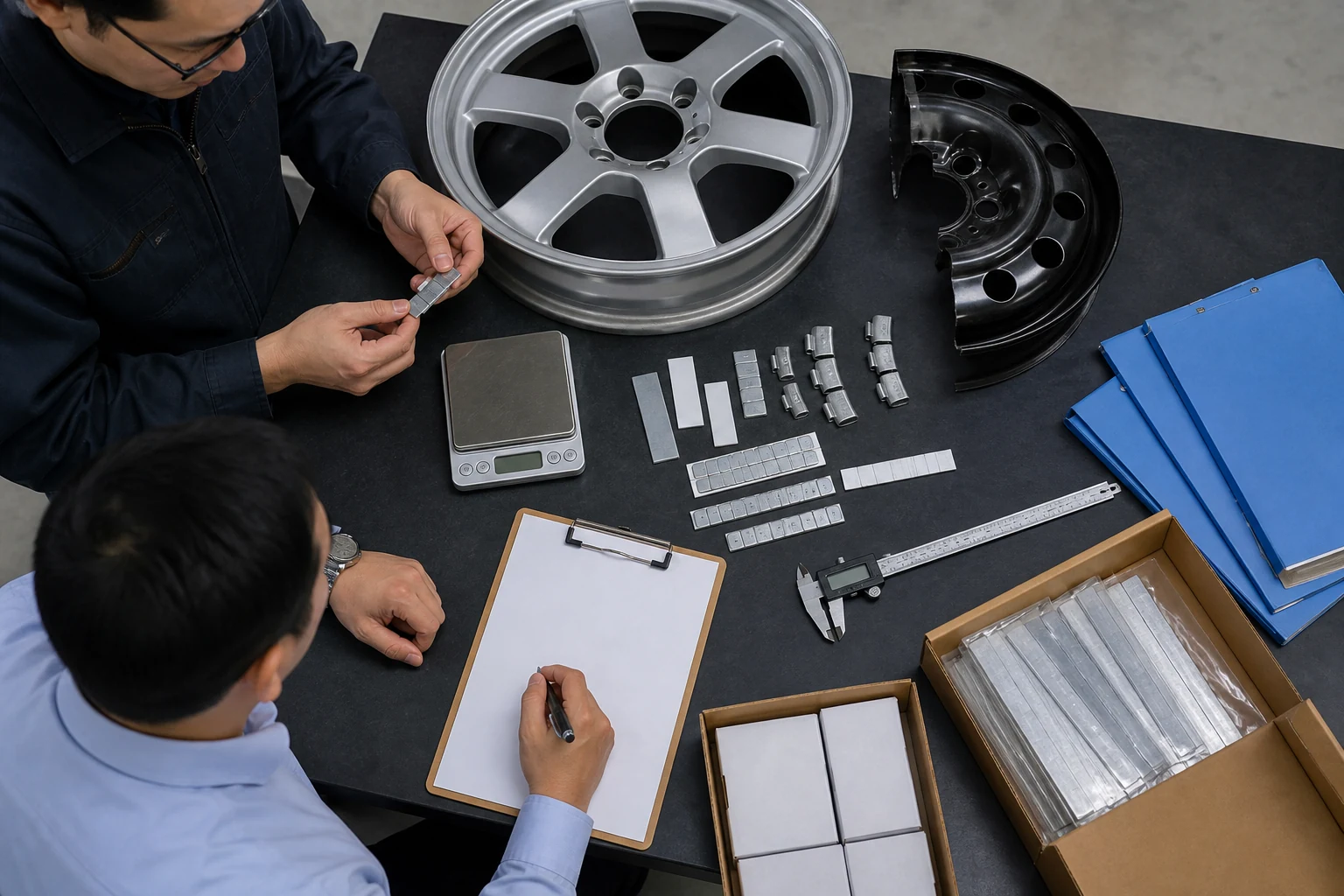
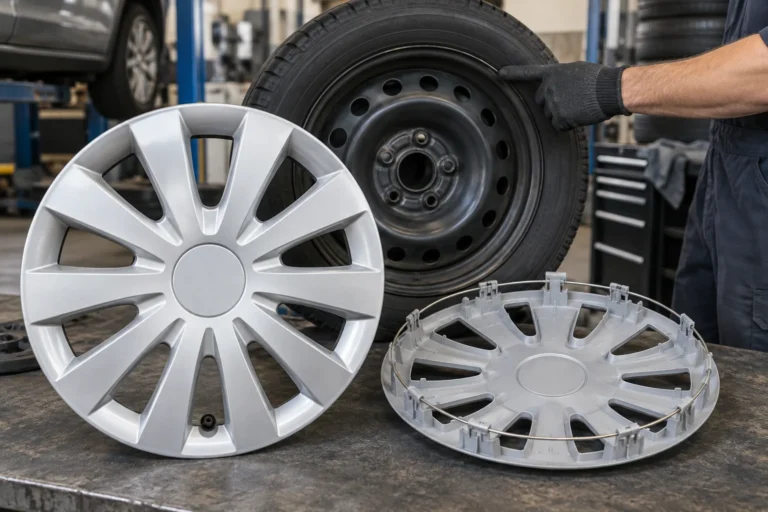
For clip-on weights, provide or describe representative steel rims, flange shape, paint condition, and placement practice. The clip-on wheel fitment points for steel-wheel sample checks help buyers identify why a similar-looking profile is not enough evidence of fit.
For adhesive weights, state the wheel surface, placement area, cleaning approach, expected temperature and handling conditions, and the checks to be made. Adhesive performance depends on surface preparation as well as the tape itself; 3M's technical bulletin likewise emphasizes preparing the bonding surface.1 A useful request therefore asks the supplier to identify tape and liner details and point the buyer to any relevant storage or application guidance.
What documents and data should accompany samples?
Samples should be accompanied by enough information to identify the product and interpret the test result. The buyer does not need every internal factory document, but it should not be forced to guess whether the tested sample uses the material, tape, finish, or pack proposed for the order.
For adhesive samples, request adhesive tape and liner details that should travel with a strip sample, along with the strip configuration and intended application. For clip-on samples, ask for the profile or application identity, material and finish, and the increments included.
Useful accompanying data includes:
- Sample code, revision or date, and the supplier's contact for technical clarification.
- Material, finish, attachment, increment, and profile or strip description.
- Intended wheel application and any stated limit.
- Sample status: concept, standard SKU, production-intent sample, or packing proof.
- Requested measurement, test, or inspection information.
- Pack quantity, carton information, and labels when they are part of the planned program.
ISO 9001's documented-information principle supports a practical buyer rule: keep the request, received-sample record, observations, and supplier response connected to one identified configuration.2
How should sample packaging be checked?
Check sample packaging when it represents the planned receiving and selling format; otherwise, record that the sample is loose evaluation material. Packaging is part of the orderable SKU when it determines count accuracy, protection, labels, warehouse handling, or the buyer's branded presentation.
Confirm inner and outer counts, gross and net weight where relevant, carton strength, label fields, barcode needs, and pallet assumptions for larger orders. Buyers planning scale-up can use packaging details to confirm before a sample becomes a bulk order to move from a small evaluation kit to a practical carton and pallet discussion.
GS1's logistic-label guidance illustrates why handling-unit identity matters. When cartons or pallets are part of the program, clear SKU, quantity, and relevant lot information help the buyer receive and investigate goods correctly.3
What should happen after samples arrive?
After samples arrive, log them, confirm they match the request, run only the defined checks, and record the result against the identified SKU. Do not allow one positive fit check to become blanket approval for different material, tape, coating, profile, or pack versions.
Record the sample code, photos where useful, test wheel or surface, measurements, observations, packing condition, and decision: accepted for the next approval stage, needs clarification, rejected, or acceptable only as a stated alternative. Then request representative clip-on and adhesive sample families for the requested SKU list if a gap remains between the received samples and the planned assortment.
Before any purchase order, ask the supplier to confirm that the quoted SKU and packaging reflect the sample that was accepted, or to identify every difference separately. That one confirmation makes the sample result far more useful for the order that follows.
What should buyers send in the sample request?
Buyers should send one concise brief that combines the product request, intended test, destination, and practical response deadline. A supplier can then identify standard items, flag alternatives, and state what it cannot represent with the requested sample instead of filling gaps with guesses.
Include the target market and customer channel; the wheel or rim applications; clip-on, adhesive, or mixed attachment need; requested material, finish, profile or strip family, increments, and pack format; the quantity required for each check; and the destination for the sample shipment. State whether you are requesting a standard SKU, a proposed alternative, a development sample, or a sample pack that must match final labels and cartons.
Ask the supplier to return a matching data sheet for every sample code and to list any difference between the sample and its normal production configuration. Add the intended checks: rim fit, segment or mass check, surface or tape review, appearance, packaging count, and document review. This turns the request into a small evidence plan rather than a request for promotional samples.
If the supplier cannot provide a requested SKU, invite it to propose the closest standard alternative in a separate line. That keeps an alternative useful without allowing it to be confused with the part the buyer originally needed. After the sample result is recorded, the next commercial discussion can name exactly what is approved, what needs development, and what remains to be verified.
When the sample request covers several clip-on profiles, use a clip-on wholesale assortment built around validated rim profiles to decide which profiles belong in the initial range and which should remain conditional until fitment evidence is complete.
If you are requesting wheel-weight samples, send us the wheel applications, attachment formats, size range, coating, tape, labels, packaging, and tests you need to review. We can help you prepare a sample brief that produces evidence you can actually compare.
Conclusion: request evidence, not an anonymous assortment
A wheel weight sample request should connect representative SKUs to the intended wheels, attachment method, material, units, finish, packaging, and documents. That gives the buyer a credible basis for fit, application, packaging, and supplier discussions before it commits to a larger order.
Request a representative sample set with the matching data sheet, identify the test conditions in advance, and record the result against the supplied configuration. The resulting evidence can then move cleanly into a formal approval and quotation decision.
Frequently Asked Questions
How many wheel weight samples should I request?
Request enough identified pieces or strips to run the agreed fitment, measurement, application, and packaging checks, including repeats where needed. The right quantity depends on the test purpose; a few loose parts are not enough for a representative packing or range decision.
Should wheel weight samples match the final packaging?
They should when packaging, labels, carton counts, or presentation are part of the decision. If the supplier sends loose evaluation samples, record that the final pack still needs separate approval.
What should I ask for with adhesive wheel weight samples?
Ask for the strip configuration, material and finish, tape and liner details, segment pattern, intended application, storage/application guidance, data sheet, and enough pieces or strips to test on representative prepared wheel surfaces.
Can a standard wheel weight sample support a custom order?
Yes, when it establishes an existing configuration that may meet the need or identifies the precise feature that needs modification. It should not be treated as approval for a custom product unless the sample record states which custom details it represents.
References
[1] 3M. “VHB Tape Surface Preparation Technical Bulletin.” 2014.
[2] International Organization for Standardization. “ISO 9001:2015 – Quality management systems – Requirements.” 2015.
[3] GS1. “GS1 Logistic Label Guideline.” n.d.