


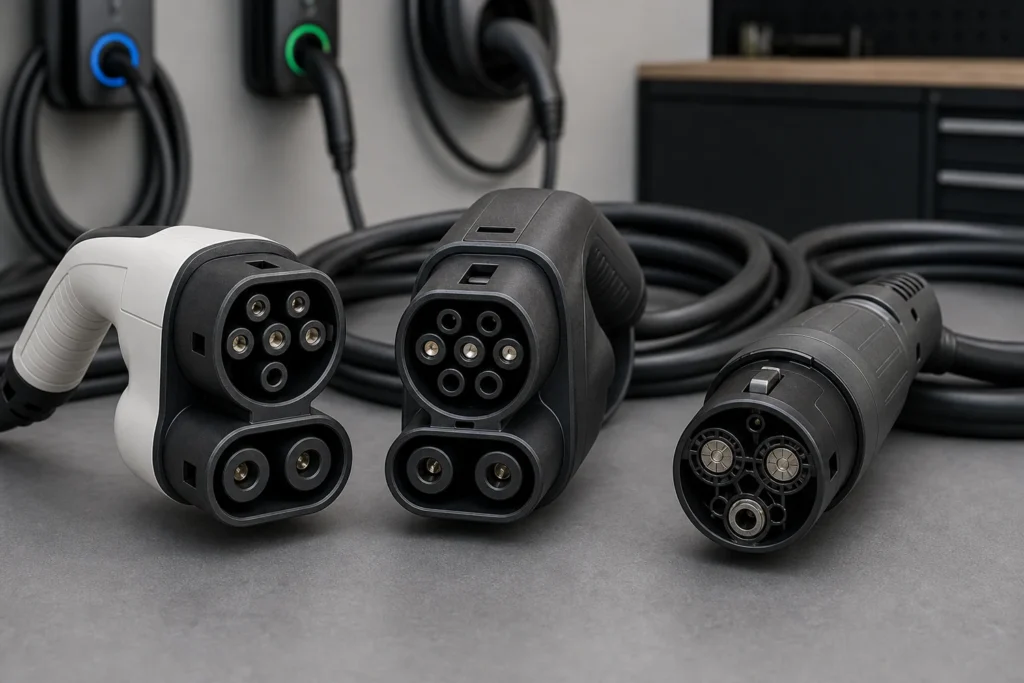
A CCS connector is a combined EV inlet and charging interface that supports AC charging through its upper connector section and DC fast charging through two additional lower power contacts. CCS is not one universal plug: CCS Type 1 and CCS Type 2 fit different regional and vehicle platforms, so compatibility must be checked across the vehicle inlet, charger, cable rating, and charging protocol.
For an EV owner, the useful question is whether a particular car can connect safely to a particular station. For an installer, fleet operator, distributor, or private-label buyer, the question is broader: which CCS version, current range, cable assembly, locking arrangement, and evidence package can be approved for the intended market?
Table of Contents
- What Is a CCS Connector, and What Does “Combined” Mean?
- How Does CCS Deliver AC and DC Charging?
- What Is the Difference Between CCS Type 1 and CCS Type 2?
- Which Vehicles and Charging Stations Use CCS?
- Is a CCS Connector the Same as Type 2 or J1772?
- How Does CCS Compare With CHAdeMO and NACS?
- What Should You Check Before Buying a CCS Cable or Connector?
- How Can Buyers Approve a CCS Configuration?
- What Mistakes Cause CCS Compatibility Problems?
- Conclusion: Treat CCS as a Complete System
- Frequently Asked Questions
- References
What Is a CCS Connector, and What Does “Combined” Mean?
CCS means Combined Charging System. “Combined” refers to the way the inlet combines an AC charging interface with two larger DC contacts in one vehicle-side opening. A vehicle can therefore use the same inlet for slower AC charging and, when the vehicle and station support it, higher-power DC charging. The U.S. Alternative Fuels Data Center describes the CCS arrangement as an SAE J1772 or Type 2 AC section with two additional lower pins for DC fast charging. 1
That distinction matters when a product listing says “CCS cable” without stating whether it is a CCS1 or CCS2 vehicle connector, an inlet, a charging gun, a vehicle-to-charger cable, or an adapter. Those parts may look related but are not interchangeable. Identify the side of the connection and the intended charging direction before evaluating a quotation.
How Does CCS Deliver AC and DC Charging?
In AC charging, the external station supplies alternating current and the vehicle’s onboard charger converts it to DC for the battery. The connector still matters for physical fit, proximity and pilot signaling, temperature sensing, locking, and safe current negotiation, but the power-conversion stage is inside the vehicle. For a deeper explanation of the power path, see the difference between AC versus DC EV charging.
In DC fast charging, the station performs the main AC-to-DC conversion and sends controlled DC power through the two lower contacts. The vehicle and station communicate before and during the session, so charging time depends on the battery, vehicle limits, station output, temperature, and state of charge—not on the connector name alone. 1
Mechanical engagement can still be correct while a session fails because of unsupported communication, a control-pilot fault, software restrictions, or an adapter that does not carry the required signaling. A connector sample intended for resale or repeated deployment should therefore be tested with a representative vehicle and charger.
What Is the Difference Between CCS Type 1 and CCS Type 2?
CCS Type 1, also called Combo 1 or CCS1, is built around the SAE J1772-style AC connector. CCS Type 2, also called Combo 2 or CCS2, is built around the Type 2 AC connector. Both add two lower DC contacts, but their upper AC geometry, signaling arrangement, regional use, and physical mating requirements differ. CharIN’s CCS Basic implementation material identifies Combo 1 with North American applications and Combo 2 with European applications, while noting that market and vehicle evidence still needs to be checked for a specific product. 2
| Item | CCS Type 1 / Combo 1 | CCS Type 2 / Combo 2 |
|---|---|---|
| Upper AC interface | J1772-style Type 1 | Type 2-style interface |
| Lower DC interface | Two large DC contacts | Two large DC contacts |
| Common market association | North America and some related vehicle platforms | Europe and many markets using Type 2 AC infrastructure |
| Main selection risk | Assuming a J1772-shaped part supports every CCS1 function | Assuming a Type 2 AC cable is automatically a CCS2 DC cable |
| Evidence to request | Vehicle fitment, station support, pinout, current rating, test record | Vehicle fitment, station support, pinout, current rating, test record |
The regional association is a starting point, not a substitute for a fitment check. Imported vehicles, grey-market models, older model years, and vehicles built for a different charging network can break a simple “country equals plug” assumption. If a buyer is sourcing for multiple markets, maintain separate CCS1 and CCS2 SKUs and show the vehicle-side and charger-side connector in each product drawing.
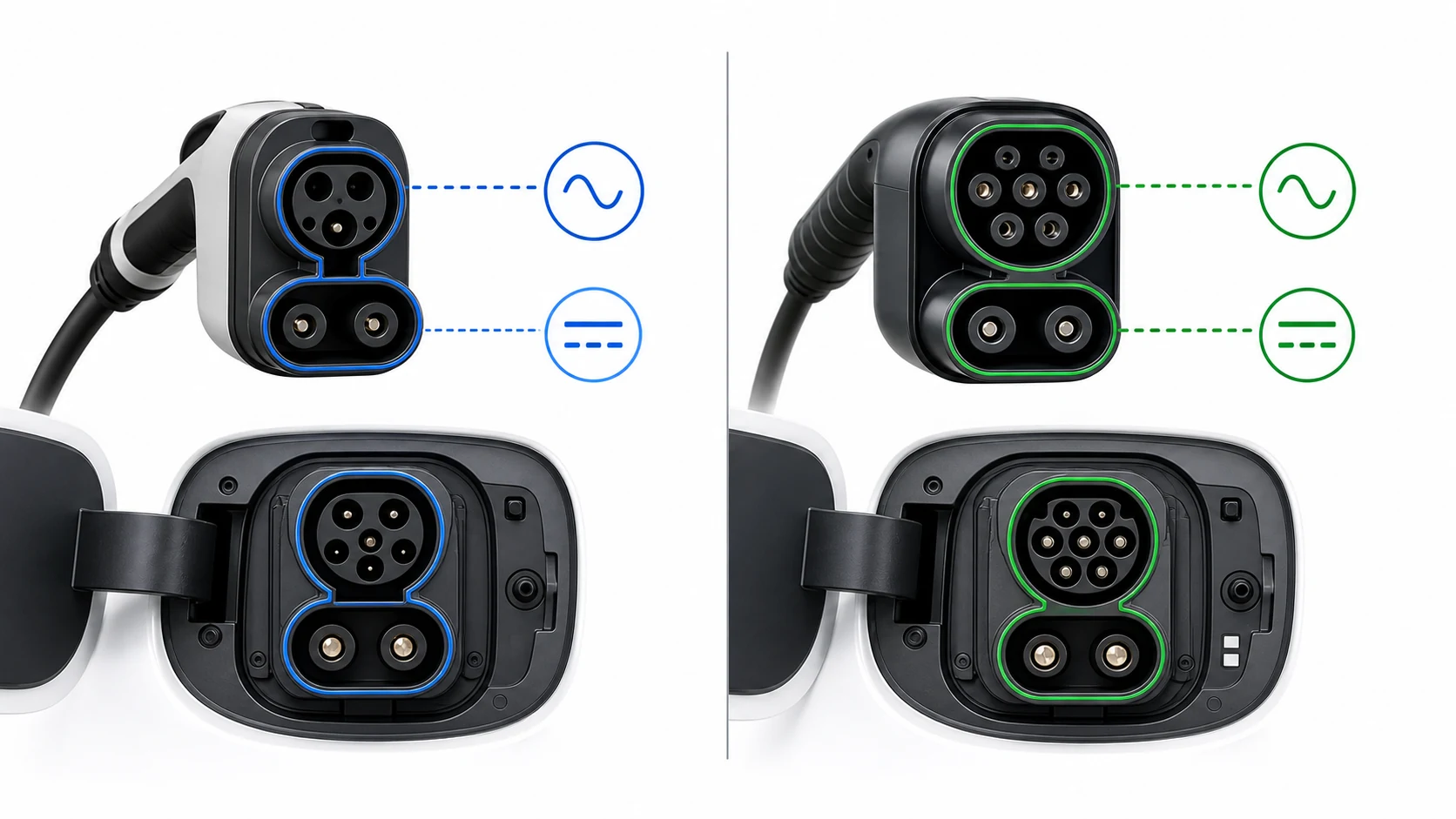
IEC 62196-1 provides a useful reference for plugs, socket-outlets, vehicle connectors, and vehicle inlets, but a standard citation is not automatic approval for a particular cable assembly. Confirm the exact part, regional requirements, and complete-assembly test evidence. 3
Which Vehicles and Charging Stations Use CCS?
CCS compatibility exists when the vehicle inlet, charging equipment, cable or connector assembly, communication method, and regional installation requirements agree. A CCS1 vehicle normally needs a CCS1-compatible DC station connection, while a CCS2 vehicle normally needs CCS2-compatible equipment. The vehicle’s charge port label, owner’s manual, station specification, and product drawing should tell the same story.
Use this sequence when checking an individual vehicle:
- Record the exact make, model, model year, market, and vehicle inlet photo or part number.
- Identify whether the inlet is CCS1, CCS2, another interface, or an inlet that accepts an approved adapter.
- Separate the AC requirement from the DC requirement. A vehicle can accept one type of AC connection but use a different DC fast-charging path.
- Check the station’s connector type, output range, communication support, and cable reach.
- Confirm that any adapter is approved for the stated direction and charging mode.
- Test a representative vehicle and station before ordering a production quantity.
Public stations may display several connector options, but a CCS plug does not mean every vehicle can use it. Software, authorization, temperature protection, and power sharing can also affect a session, so installation decisions should start with the actual EV charging station configuration. For fleets, record the real vehicles rather than only the country; separate connector kits when vehicles have different inlets or charging limits.
Is a CCS Connector the Same as Type 2 or J1772?
No. Type 2 and J1772 generally describe the upper AC connector families used as the basis for CCS2 and CCS1. A CCS connector includes the additional lower DC contacts and the related combined-inlet geometry. A Type 2 AC cable is therefore not automatically a CCS2 DC cable, and a J1772 connector is not automatically a CCS1 fast-charging connector.
The naming problem usually appears in catalogs. “Type 2 cable,” “CCS2 plug,” and “CCS2 DC charging cable” can describe different products with different power paths. A buyer should ask whether the part is intended for AC only, DC fast charging, a vehicle inlet, a station outlet, or an adapter. The broader EV charging cable and connector types article can help separate those product categories.
| Product wording | What it may describe | What must be confirmed |
|---|---|---|
| Type 1 or J1772 connector | AC vehicle-side interface | AC current, signaling, latch, inlet fitment, and regional approval |
| Type 2 connector | AC vehicle-side or station-side interface | AC-only use versus CCS2 combination use, pinout, and intended side |
| CCS1 or CCS2 connector | Combined AC/DC interface | Exact vehicle-side or station-side part, DC rating, communication, and cable assembly |
| CCS adapter | Interface conversion product | Direction, charging mode, protocol, thermal limits, locking, and vehicle approval |
List the connector family, connector side, charging mode, rating, cable length, and intended vehicle or station family in the first specification block. This prevents an AC-only Type 2 item from being selected for a DC application.
How Does CCS Compare With CHAdeMO and NACS?
CCS, CHAdeMO, and NACS are different charging interfaces and ecosystems. The vehicle inlet and station connector must be compatible, and an adapter can only bridge a defined set of electrical, mechanical, communication, and safety requirements. A similar-looking DC fast-charging plug is not sufficient evidence that a vehicle can use a station.
| System | Interface characteristic | Practical buyer question |
|---|---|---|
| CCS1 | Combined J1772-style AC section plus two DC contacts | Is the vehicle and station built for the same North American CCS configuration? |
| CCS2 | Combined Type 2-style AC section plus two DC contacts | Is the Type 2 upper section and DC assembly correct for the target vehicle and market? |
| CHAdeMO | Separate DC fast-charging interface and communication ecosystem | Is the vehicle inlet CHAdeMO, and does the station support that protocol? |
| NACS | Separate North American charging interface standardized through SAE J3400-related requirements | Is the product an approved NACS part or a qualified adapter with the required safety evidence? |
CHAdeMO is not a CCS variant. A CHAdeMO vehicle generally cannot connect to a CCS station with a passive shape-changing plug. An active adapter, if available for the exact vehicle and station combination, must handle communication and safety controls; its approval and operating limits are part of the product specification.
NACS should also be treated as a separate interface rather than as a synonym for CCS. When an adapter or transition product is involved, the buyer should document the source inlet, destination outlet, charging direction, maximum voltage and current, temperature sensing, interlock behavior, and approved vehicle list. SAE’s adapter safety designation is a useful reference point for evaluating the safety scope of an adapter product. 4
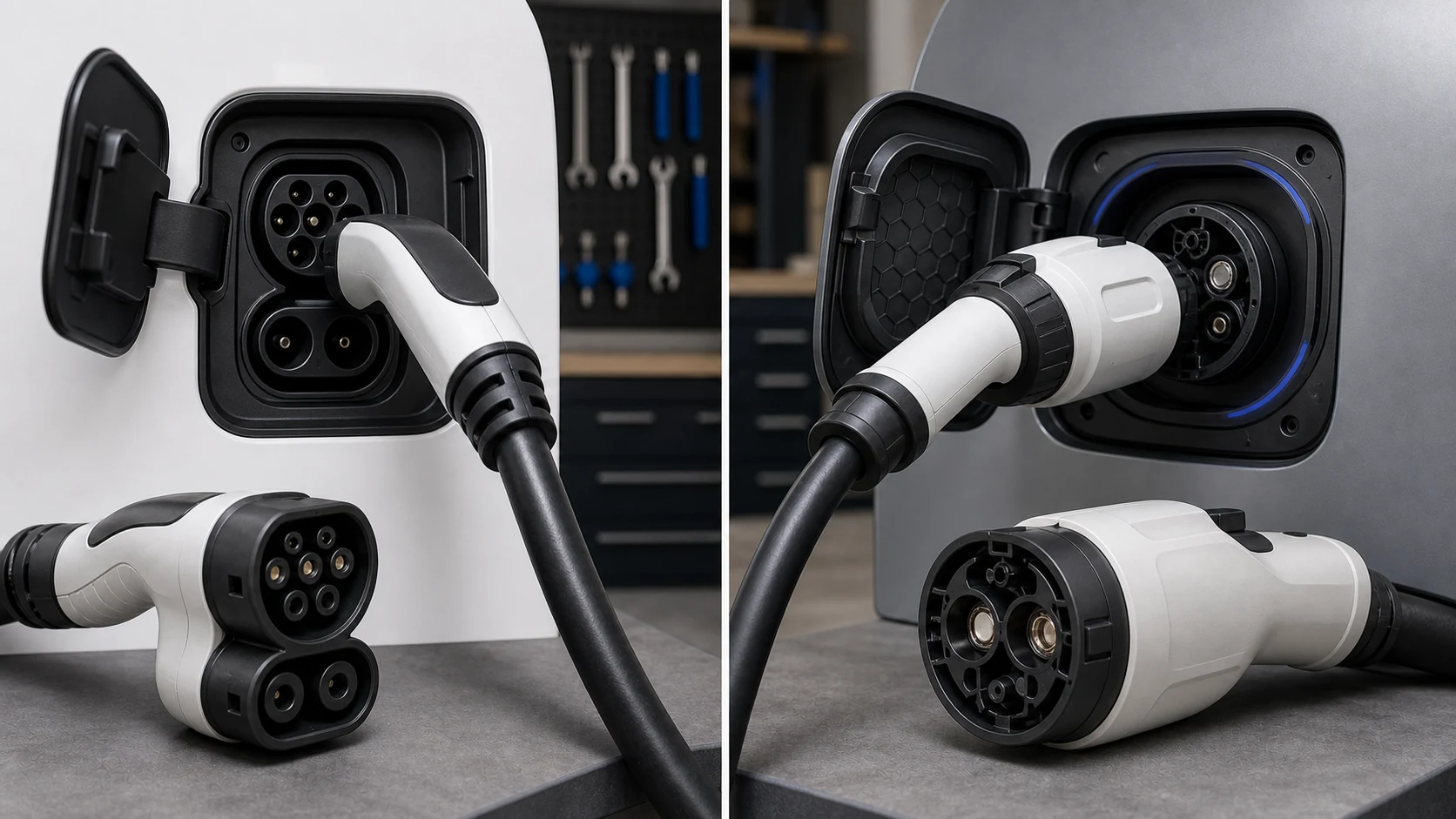
The right choice depends on the vehicle population, station network, country requirements, replacement availability, and future vehicles. A multi-market distributor may need separate CCS1, CCS2, CHAdeMO, and NACS families instead of one unclear “universal” SKU.
What Should You Check Before Buying a CCS Cable or Connector?
For a personal purchase, start with vehicle fitment and the charger’s connector label. For a distributor, fleet, installer, or private-label buyer, a complete product brief prevents rework. The EV charging accessories compatibility checklist helps organize evidence across cable, adapter, connector, and station accessories.
Confirm these fields before comparing price:
- Interface and side: CCS1 or CCS2; vehicle connector, vehicle inlet, station connector, or station inlet.
- Charging mode: AC, DC fast charging, or a defined adapter application. Do not combine AC and DC claims in one unlabeled rating.
- Electrical range: rated voltage, continuous current, peak current if applicable, conductor size, insulation, and temperature derating.
- Mechanical fit: keying, latch or lock position, insertion depth, contact arrangement, housing dimensions, strain relief, and cable bend radius.
- Cable behavior: length, flexibility, minimum bend radius, torsion or bend-life target, cold-weather behavior, and storage requirements.
- Thermal and protection features: temperature sensors, contact resistance, sealing, insulation, over-temperature response, and short-circuit or fault protection in the complete system.
- Environment: ingress exposure, dust, water, salt, UV, oil, road debris, operating temperature, and indoor or outdoor installation.
- Evidence package: drawing, pinout, materials, test reports, traceability, batch inspection, labeling, and applicable declarations.
Ask for the connector drawing before asking for a final quote. It should show the interface side, key dimensions, pin naming, cable exit, latch or lock, and reference orientation. For a cable assembly, request the complete assembly rating; conductor size, crimp quality, contact resistance, cooling, strain relief, and ambient temperature can limit the headline connector rating.
For a replacement connector, compare the mating inlet and existing cable termination. A new housing can fit physically but fail because the terminal family, seal, wire gauge, crimp tooling, or control-pilot circuit is different. The EV charging adapter compatibility guide provides a practical way to record source interface, destination interface, direction, and operating limits.
How Can Buyers Approve a CCS Configuration?
A repeatable approval process turns “it fits” into evidence that can survive a production order. Use one row per vehicle and station combination, and assign a clear status: Pass, Hold, or Clarify. This is particularly important when a supplier offers several cable lengths, overmold versions, current ratings, or regional connector variants under similar names.
| Approval field | Evidence to record | Pass condition |
|---|---|---|
| Vehicle identity | Make, model, year, market, inlet photo or part number | The exact target vehicle is identified, not only the brand |
| Vehicle-side interface | CCS1 or CCS2, inlet drawing, latch position | Connector mates without force or modification |
| Station-side interface | Station model, outlet type, DC or AC mode | Station connector and communication support match |
| Electrical rating | Voltage, continuous current, temperature conditions | Assembly rating meets the vehicle and station limits |
| Communication and control | Protocol, control pilot, proximity, locking, adapter behavior | Charging starts and remains stable through a full session |
| Mechanical and environmental | Dimensions, bend radius, sealing, temperature, UV, salt | Product remains safe in the actual installation environment |
| Quality evidence | Samples, inspection record, test report, lot traceability | Documents match the exact SKU and production revision |
| Commercial continuity | MOQ, lead time, spare parts, revision notice | Replacement supply and change control are acceptable |
The minimum sample test should include visual and dimensional inspection, continuity and insulation checks, mating and unlatching, pilot and proximity behavior, charging start, sustained charging, stop or fault recovery, and temperature observation at the intended current. Test both a normal session and the edge case most likely to occur in the application, such as a warm enclosure, long cable, outdoor moisture, or repeated daily insertion.
Document the SKU, hardware revision, station version where relevant, vehicle identity, current and voltage, ambient conditions, session duration, and fault codes. Keep label photos and connector orientation with the record. If terminal plating, cable construction, housing resin, sensor location, or molding revision changes, reopen approval.
Use a three-way decision rule:
- Pass: fit, charging behavior, rating, documents, and commercial conditions all meet the brief.
- Hold: a safety-critical or compatibility result is missing, contradictory, or outside the requested limit.
- Clarify: the item may work, but the product side, charging mode, rating condition, or target market is not stated precisely enough.
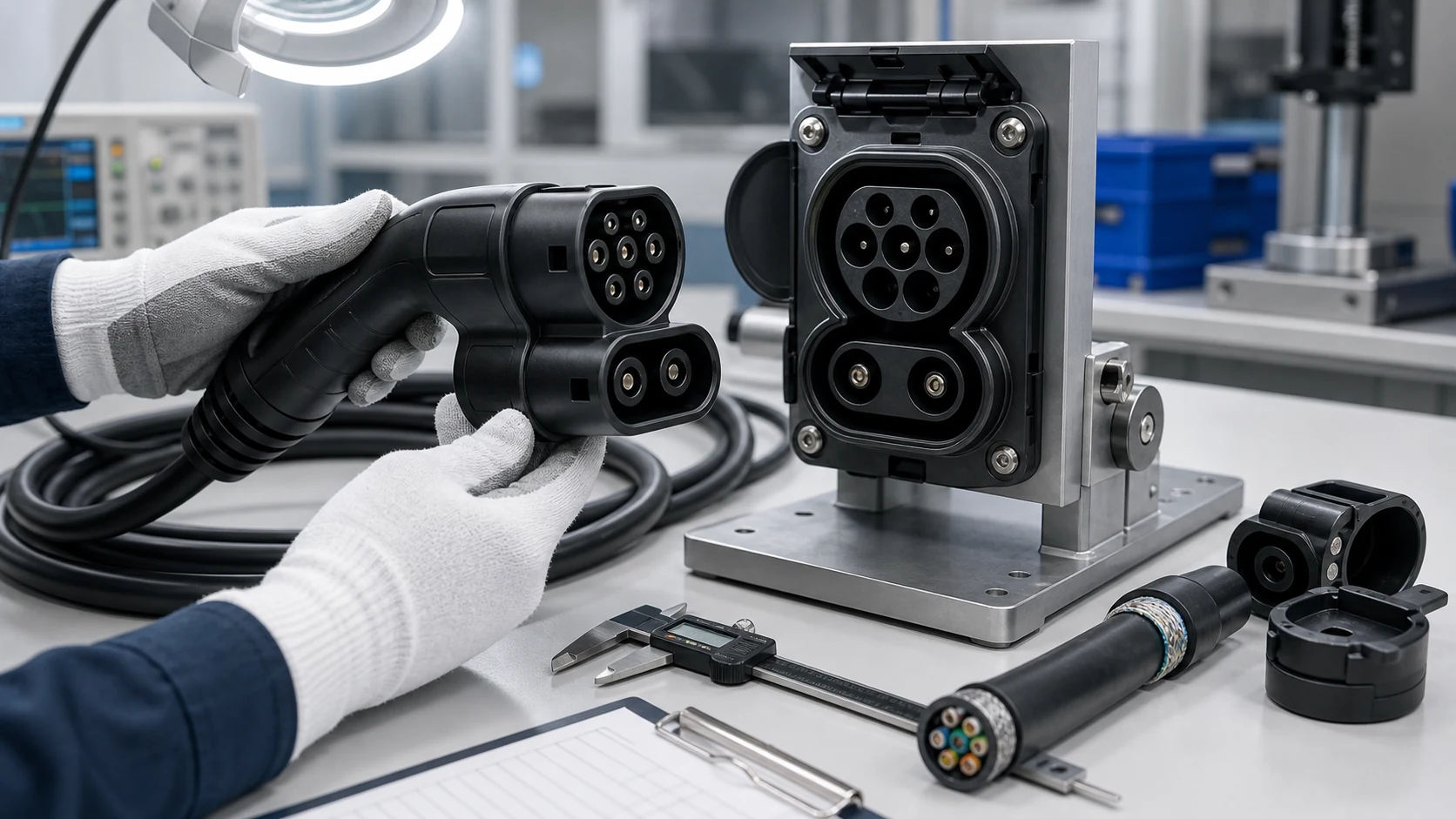
If the intended product is a branded replacement or private-label assembly, include a change-notification requirement in the purchase terms. It should cover connector geometry, contact materials, cable jacket, sensor or control components, molding tools, factory location, and test method. This protects the buyer from a silent substitution that retains the same marketing name but changes the field behavior.
What Mistakes Cause CCS Compatibility Problems?
Common failures come from six shortcuts: describing only “CCS2” without the connector side; treating a latch as proof of a successful charging session; inferring fitment from country; quoting maximum power from the connector alone; hiding adapter direction; and choosing on unit price alone. Use separate mechanical and live-session checks, state the rating conditions, identify source and destination for adapters, and compare approval effort, traceability, replacement supply, and return risk. A structured EV charging accessories category also helps keep connector families separated.
If you are specifying a CCS cable, connector, adapter, or charging-station variant, share the target market, vehicle inlet, AC or DC use, voltage and current range, cable length, connector direction, installation or fleet use, and expected volume. We can help turn those details into a fitment matrix and sample-approval request. You can also request a configuration review with the vehicle and station information available.
Conclusion: Treat CCS as a Complete System
CCS is a combined charging interface that makes AC and DC charging available through related vehicle-inlet geometry, but CCS1 and CCS2 are different regional variants. Type 1, Type 2, CHAdeMO, and NACS should not be treated as interchangeable labels, and an adapter is a controlled product with its own safety and communication boundary.
The most reliable selection method is to identify the exact vehicle and station, separate AC from DC use, confirm the connector side and rating, inspect the drawing and evidence package, and test a representative configuration. For repeat orders, keep the approved SKU, revision, conditions, and change-notification rules together so that a visually similar replacement does not bypass the original compatibility decision.
Frequently Asked Questions
Is CCS the same as Type 2?
No. Type 2 is an AC connector family that forms the upper portion of CCS2. CCS2 adds two lower DC contacts and the combined charging interface. A Type 2 AC cable should not be marketed as a CCS2 DC cable unless the complete product is designed and approved for that use.
What is the difference between CCS Type 1 and CCS Type 2?
CCS Type 1 uses a J1772-style upper AC interface, while CCS Type 2 uses a Type 2-style upper AC interface. Both have two additional lower DC contacts, but their physical geometry, regional associations, and vehicle-platform fitment differ. Check the exact vehicle inlet and station connector before ordering.
Is CCS faster than CHAdeMO?
Neither connector name guarantees a faster session. Charging speed depends on the vehicle, battery, station, cable assembly, temperature, state of charge, and communication limits. Compare the complete vehicle-and-station configuration rather than comparing plug labels alone.
Can a CHAdeMO car use a CCS charger?
Not through a simple passive plug change. A compatible active adapter may exist for a particular vehicle, station, and charging direction, but it must manage the required communication and safety functions. Verify approval and operating limits for the exact combination.
Can a CCS connector be used for AC charging?
The combined vehicle inlet can accept AC through its upper AC section when the vehicle and AC equipment are compatible. A DC-only cable or connector assembly should not be assumed to support AC. Confirm whether the product is AC, DC, or a defined combined application.
Do all EVs have CCS connectors?
No. EVs may use CCS1, CCS2, CHAdeMO, NACS, or other regional interfaces, and some vehicles support approved adapters. The vehicle’s actual inlet and market specification determine which equipment can be used.
What should distributors check before sourcing CCS cables or connectors?
Distributors should record the target vehicles and stations, connector family and side, AC or DC mode, voltage and current conditions, cable construction, environmental requirements, documents, sample-test results, revision control, MOQ, lead time, and replacement plan. A single “CCS compatible” claim is not enough for a multi-market catalog.
References
[1] U.S. Department of Energy. “Alternative Fuels Data Center: Electric Vehicle Charging Stations.” Accessed 2026.
[2] CharIN. “CharIN Implementation Guide: CCS Basic.” Version 1.1.
[3] International Electrotechnical Commission. “IEC 62196-1:2022: Plugs, socket-outlets, vehicle connectors and vehicle inlets.” 2022.
[4] SAE International. “SAE J3400/1: Electric Vehicle Charging Adapter Safety.” 2025.