



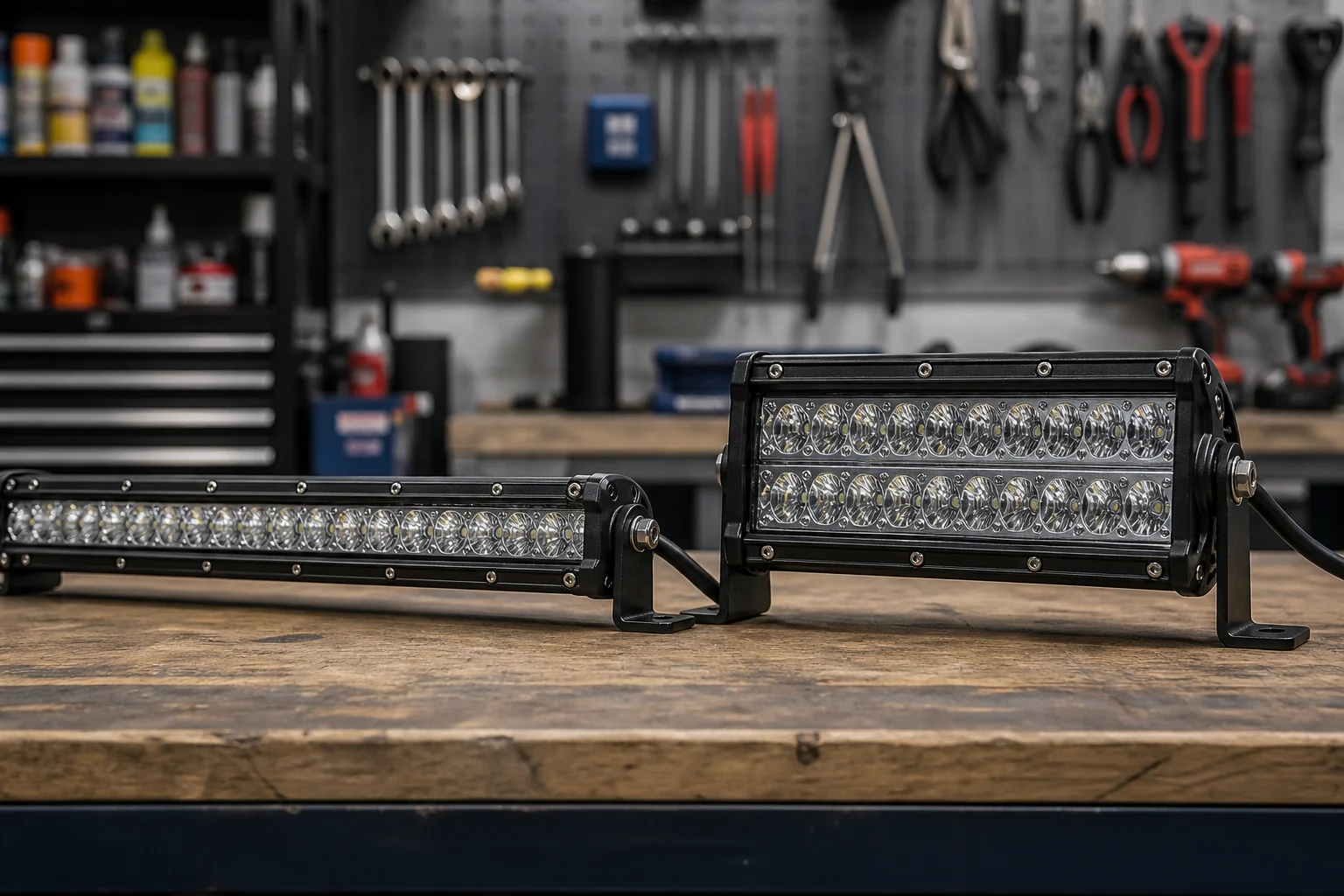
A single row LED light bar uses one horizontal line of LEDs in a slimmer housing, while a dual row LED light bar uses two lines of LEDs in a taller housing for more LED density. Neither is automatically better; the right choice depends on where the bar mounts, how much space the vehicle has, how much output is useful, and whether the driver values a low-profile look or maximum lighting presence.
This question comes up often because row count is easy to see in a product photo. What matters after installation is less obvious: beam pattern, optic quality, cooling, bracket strength, wiring load, hood glare, and whether the light still fits the vehicle cleanly after the bumper, grille, or roof rack is measured.
Table of Contents
- What is the difference between a single row and dual row LED light bar?
- Is a dual row LED light bar always brighter?
- When is a single row LED light bar the better choice?
- When does a dual row LED light bar make more sense?
- Which light bar is better for different mounting positions?
- What should buyers check before choosing single row or dual row?
- Conclusion: Choose the row style after the mounting position
- Frequently Asked Questions
- References
What is the difference between a single row and dual row LED light bar?
The main difference is housing height and LED layout. A single row bar is slimmer and usually easier to hide in tight openings, while a dual row bar is taller and can place more LEDs behind the lens in the same length.
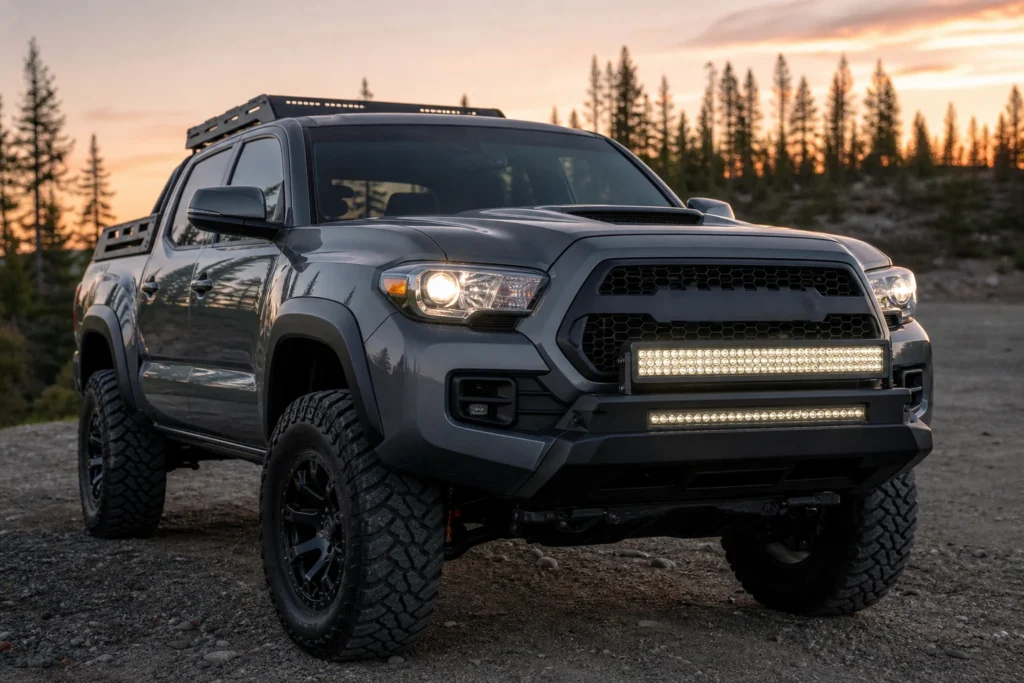
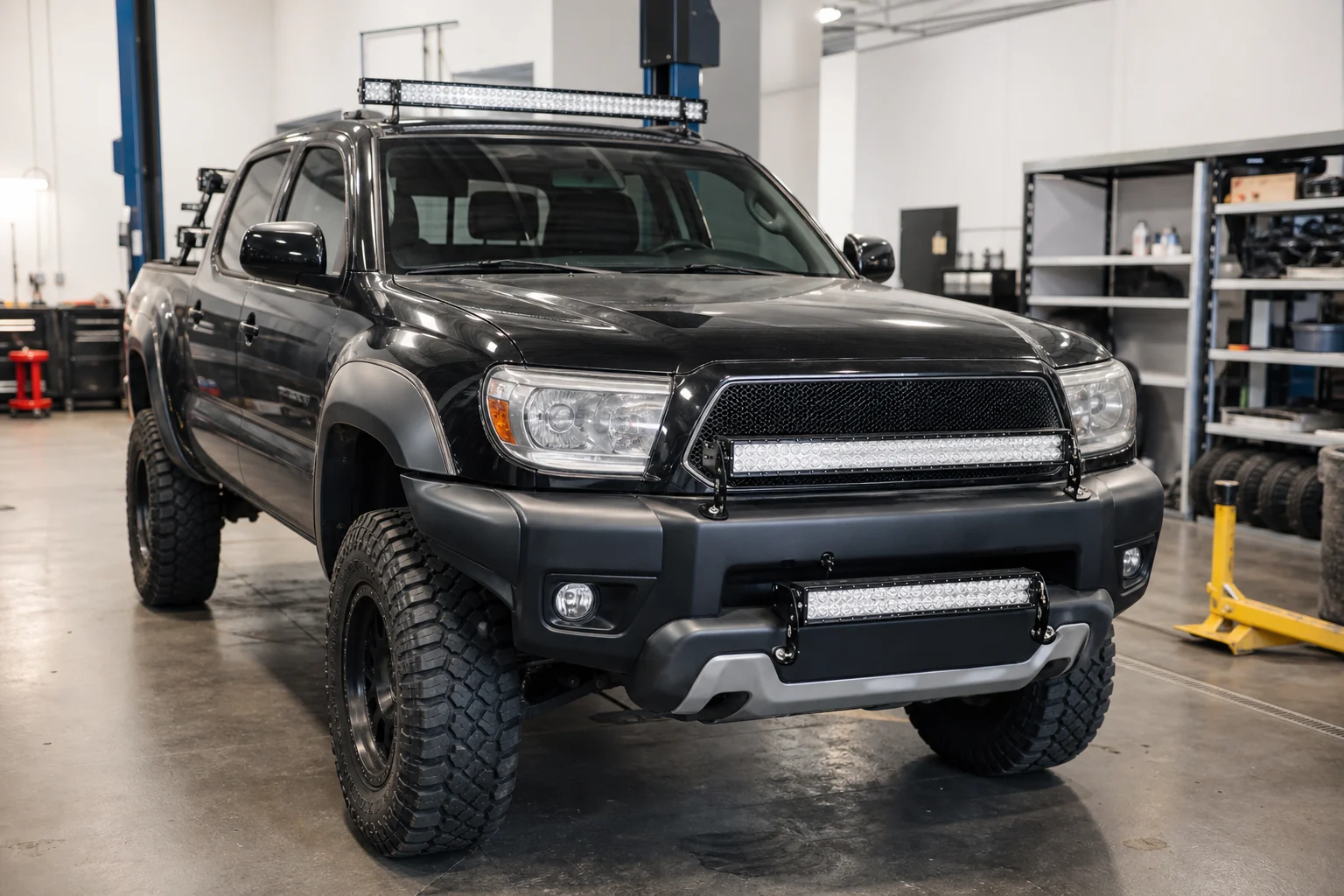
Single row bars often suit grille slots, lower bumper openings, license-plate mounts, slim bull bars, and cleaner builds where the accessory should not dominate the vehicle. Dual row bars often suit roof racks, larger bumpers, work vehicles, farm vehicles, and builds where the owner wants a more obvious off-road lighting look.
This is why the row decision should come after the basic light-bar decision. If the reader is still sorting out housings, mounting, beam patterns, and off-road use cases, the related guide to off-road LED light bars is the useful starting point before narrowing the choice to one row or two.
Is a dual row LED light bar always brighter?
A dual row light bar often has more potential output, but it is not always better in real visibility. Extra LEDs help only when the optics, thermal design, wiring, and beam pattern turn that output into useful light on the trail.
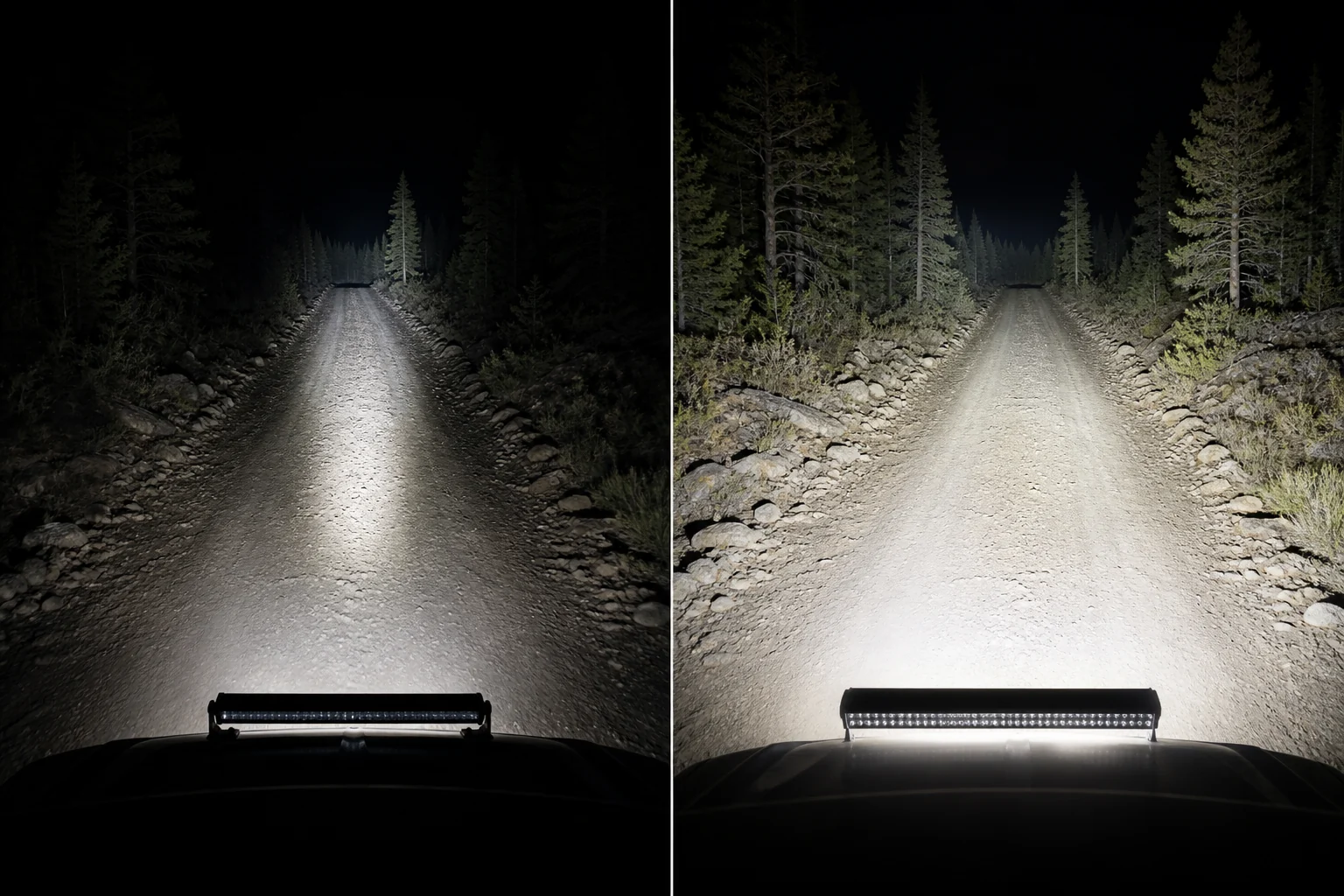
Two bars can have the same length and very different performance. A well-designed single row spot or combo bar may reach farther than a cheap dual row flood-heavy bar. A dual row bar may create more foreground light, which feels bright near the bumper but can make distant hazards harder to read.
Row count also does not explain beam shape. For readers comparing visibility rather than just brightness claims, the related guide to spot, flood, and combo LED light bar beam patterns explains why optics decide where the light goes. The related article on LED lumen output is also useful because lumens alone do not show distance, beam control, or glare.
Road use needs caution. NHTSA treats certain extra forward lighting as supplemental lighting and looks at whether it impairs required lighting equipment 1. Federal commercial motor vehicle rules also describe auxiliary driving and fog lamps as lamps used with required headlamps, not replacements for them 2.
When is a single row LED light bar the better choice?
A single row LED light bar is better when the vehicle has limited space, the owner wants a clean low-profile look, or the light needs to fit inside a grille, bumper slot, or narrow rack opening. It is also a good choice when lower wind noise and less visual bulk matter.
Single row bars tend to be easier to package. Their lower height can reduce hood obstruction, make hidden mounts more realistic, and leave more room around parking sensors, license plates, winches, intercooler airflow, and trim pieces. On modern trucks and SUVs, those practical details often matter more than chasing the largest possible bar.
Single row also works well when the build already uses other lights. A slim bar can handle forward fill while ditch lights, fog lights, pods, or work lights handle other zones. In that setup, the bar does not have to do every lighting job by itself.
The trade-off is simple: in the same length and product family, a single row usually has less LED density than a dual row. Buyers should check actual beam images, current draw, and housing depth rather than assuming slim means weak or expensive means better.
When does a dual row LED light bar make more sense?
A dual row LED light bar makes more sense when the vehicle has enough mounting space and the driver wants stronger output from a shorter bar length. It is common on roof racks, larger bumpers, utility vehicles, agricultural equipment, and builds where lighting is expected to look rugged and visible.
Dual row bars can be useful when a 20-inch or 30-inch opening must produce as much usable light as possible. Because two LED rows fit into a taller housing, the product designer has more room for emitters and optics. LED Equipped notes that dual-row designs typically offer more light output, while single-row designs are slimmer and more discreet 3.
The trade-offs are height, weight, wind exposure, and glare control. A roof-mounted dual row bar can throw a lot of light, but it may also reflect from the hood if aimed badly. A bumper-mounted dual row bar may look strong but block airflow or interfere with sensors if the fit is not checked first.
For retail programs, the Yirox Team usually treats dual row as a product-family decision, not only a brightness decision. Sample checks should include bracket fit, lens seal, cable exit, heat control, packaging protection, and whether the delivered batch matches the approved sample.
Which light bar is better for different mounting positions?
The better row style depends heavily on mounting position. A slim single row bar often fits better in grille and hidden bumper positions, while a dual row bar usually works better where there is open vertical space.
| Mounting position | Better common choice | Why it fits | Main caution |
|---|---|---|---|
| Grille opening | Single row | Slim housing fits tighter spaces | Check airflow and sensors |
| Lower bumper | Single row or compact dual row | Both can work if space allows | Avoid blocking winch access |
| Roof rack | Dual row or long single row | More open mounting room | Watch hood glare and wind noise |
| Bull bar | Dual row | Taller housing usually looks balanced | Confirm bracket strength |
| Rear work light | Single row or pods | Compact light is often enough | Aim for work area, not traffic |
The installer's rule should be: measure first, choose second. A row style that looks good online can become awkward if the brackets push it forward, the harness is too short, or the beam reflects off the hood.
What should buyers check before choosing single row or dual row?
Buyers should check fitment, beam pattern, current draw, wiring harness, IP rating, bracket design, heat control, and batch consistency before choosing row count. The row layout is only one part of the finished product.
A dual row bar may draw more current than a comparable single row bar, so the wiring kit must be matched to the load. If the buyer is planning the electrical side, the related light bar wiring harness guide explains fuses, relays, switches, and wire sizing in plain terms.
Sealing also matters. Many returns do not start with the LED chips; they start with water entry, cable strain, lens gaps, poor bracket coating, or loose hardware. The related guide to IP ratings for LED lights helps buyers understand why IP67, IP68, and IP69K claims should be read alongside real construction details.
For distributors and private-label programs, review the whole kit: light bar, brackets, harness, switch, label, manual, carton, and spare hardware. Aurora Lightings also points out that the choice affects performance, appearance, and mounting fit, not only LED count 4.
Conclusion: Choose the row style after the mounting position
Single row is usually better for clean fitment, tight spaces, lower profile, and more subtle vehicle styling. Dual row is usually better when the buyer wants more LED density, a stronger off-road look, and maximum output from a shorter length.
The better choice is the one that fits the vehicle and puts useful light where the driver needs it. A slim single row bar with good optics can outperform a bulky dual row bar with poor beam control, while a well-built dual row bar can be the right answer for roof, bull bar, or work-vehicle use.
If the next step is comparing real product options, the related off-road LED light bar product range is the natural place to review sizes, housings, beam options, brackets, wiring, and packaging expectations together.
Frequently Asked Questions
Is a dual row LED light bar better than a single row?
A dual row bar is better when the vehicle has space and the driver needs more output from a shorter length. A single row bar is better when fitment, low profile, and clean styling matter more.
Do single row LED light bars last longer?
Not automatically. Lifespan depends on heat control, sealing, LED quality, driver electronics, vibration resistance, and installation, not just row count.
Is a single row light bar bright enough for off-road driving?
Yes, a good single row bar can be bright enough for many off-road builds, especially when paired with the right beam pattern. The key is matching the bar to speed, terrain, and mounting height.
Does a dual row light bar need a stronger wiring harness?
Often yes, because many dual row bars draw more current than similar-length single row bars. Always check the rated current or wattage and match the fuse, relay, wire gauge, and connectors.
Which looks better on a pickup truck?
Single row usually looks cleaner in a grille or bumper opening, while dual row looks more aggressive on a roof rack, bull bar, or larger front bumper. The best look is the one that fits the vehicle without awkward brackets or blocked airflow.
References
[1] NHTSA. (2019). *[FMVSS No. 108 interpretation on supplemental lighting](https://www.nhtsa.gov/interpretations/571108-supplement-beam-boykin-16-0884)*.
[2] Electronic Code of Federal Regulations. (2026). *[49 CFR 393.24 Requirements for head lamps, auxiliary driving lamps and front fog lamps](https://www.ecfr.gov/current/title-49/section-393.24)*.
[3] LED Equipped. (2020). *[Single-Row or Dual-Row LED Light Bar – Which Should You Buy?](https://www.ledequipped.com/blogs/news/single-row-or-dual-row-led-light-bar-which-should-you-buy)*
[4] Aurora Lightings. (2025). *[What Is The Difference Between Single Row And Dual Row Light Bars?](https://auroralightings.com/what-is-the-difference-between-single-row-and-dual-row-light-bars/)*