



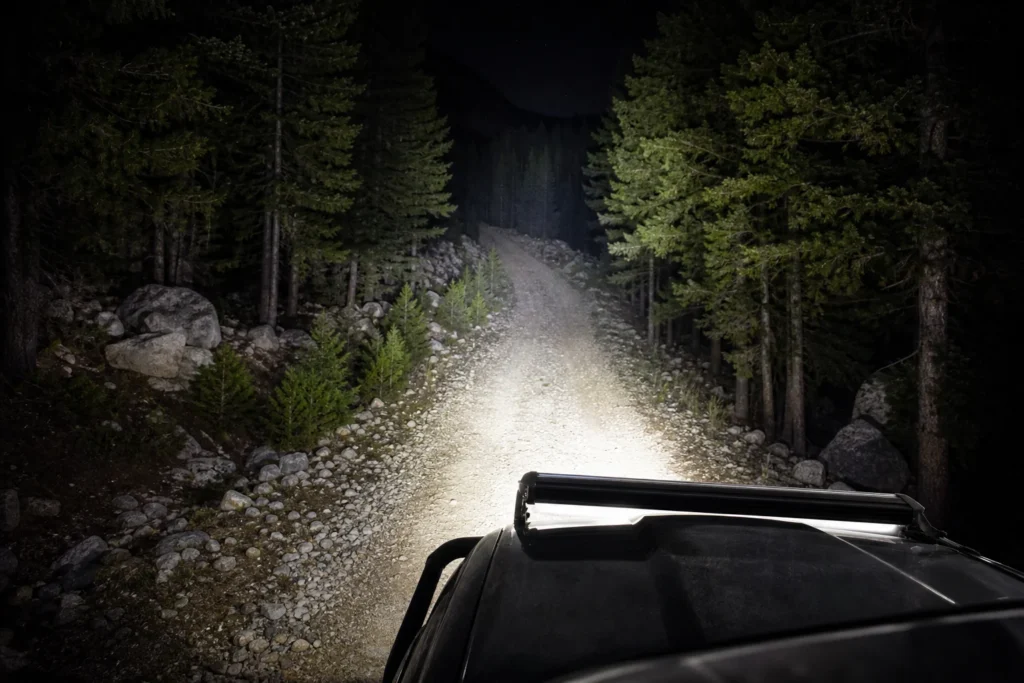
LED lumen output is the amount of visible light an LED lamp produces, but it does not tell the whole story for off-road lights. A higher lumen number can mean more total light, yet real trail visibility also depends on beam pattern, optical control, candela, lux at distance, color temperature, mounting height, and how honestly the product is tested.
This is why off-road buyers should read lumen claims carefully. A 10,000-lumen light bar can look impressive on a listing, but if that light is scattered into the foreground or lost as glare, it may feel worse than a lower-lumen lamp with better optics.
Table of Contents
- What does LED lumen output mean?
- How are lumens different from candela and lux?
- Why can two light bars with the same lumens perform differently?
- Are more LEDs or more rows the same as more usable light?
- How should buyers read an off-road light specification?
- What lumen range is enough for off-road driving?
- Conclusion: Use lumens as one clue, not the whole decision
- Frequently Asked Questions
- References
What does LED lumen output mean?
LED lumen output means the total visible light produced by the lamp or LED system. In simple buying language, lumens describe how much visible light comes out, not where that light goes.
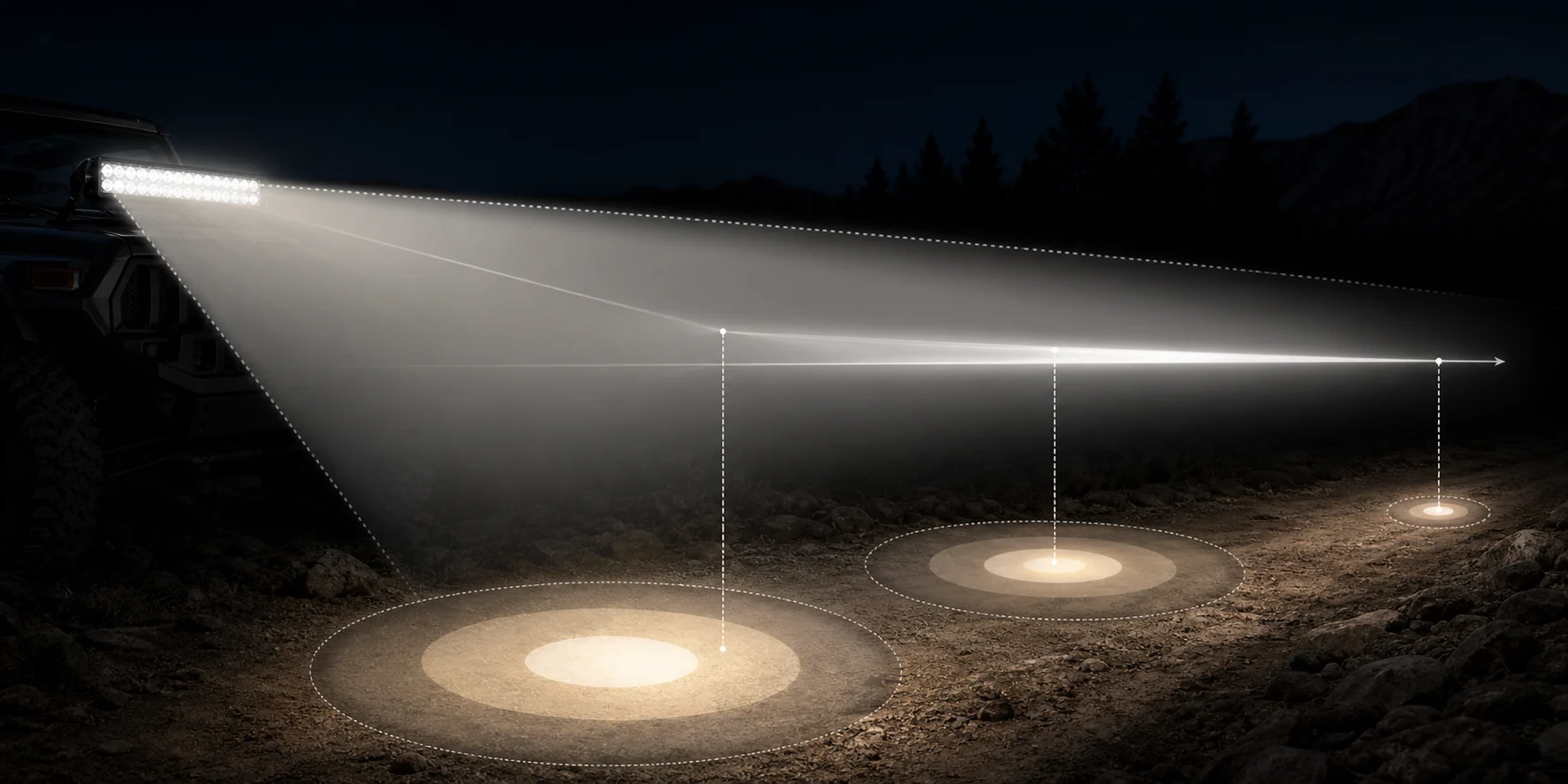
The Illuminating Engineering Society defines lumen as luminous flux emitted within a unit solid angle by a point source with uniform luminous intensity of one candela 2. That technical definition matters because it reminds buyers that lumens are about total visible output, not beam usefulness.
The U.S. Department of Energy explains the same idea for household lighting in plainer terms: lumens are a measure of brightness, and a higher lumen number means a brighter bulb in that context 4. Off-road lighting is trickier because the lamp is not trying to brighten a room evenly. It is trying to put light on a trail, ditch, work area, or distant path.
If the reader is still choosing the basic hardware type, the related guide to off-road LED light bars explains how lumens fit alongside size, mounting position, beam pattern, wiring, and durability.
How are lumens different from candela and lux?
Lumens measure total visible output, candela measures intensity in a specific direction, and lux measures how much light reaches a surface. All three can matter, but they answer different questions.
NIST explains that candela is the SI base unit for photometry and measures luminous intensity in a given direction; it is not the unit for the entire amount of light, which is where lumens come in 1. IES defines lux as one lumen per square meter 3. For off-road buyers, that means lux is closer to the question, "How much light actually lands on the trail?"
Here is the practical version:
| Metric | What it tells you | Why it matters off-road | What it does not tell you |
|---|---|---|---|
| Lumens | Total visible output | Overall light potential | Beam distance or glare |
| Candela | Intensity in one direction | Long-distance throw | Width of useful coverage |
| Lux | Light on a surface | Real illumination at a distance | Total lamp output |
| Beam angle | Spread of the beam | Width vs distance balance | Product durability |
This is why a strong light-bar listing should show more than one number. Lumens without beam pattern can mislead. Candela without context can feel too technical. Lux is useful when measured at a known distance, but not every seller publishes it.
Why can two light bars with the same lumens perform differently?
Two light bars with the same lumen claim can perform differently because optics, reflectors, lenses, heat control, LED binning, current regulation, and beam pattern decide how much of that output becomes usable light. The lumen number is only the starting point.
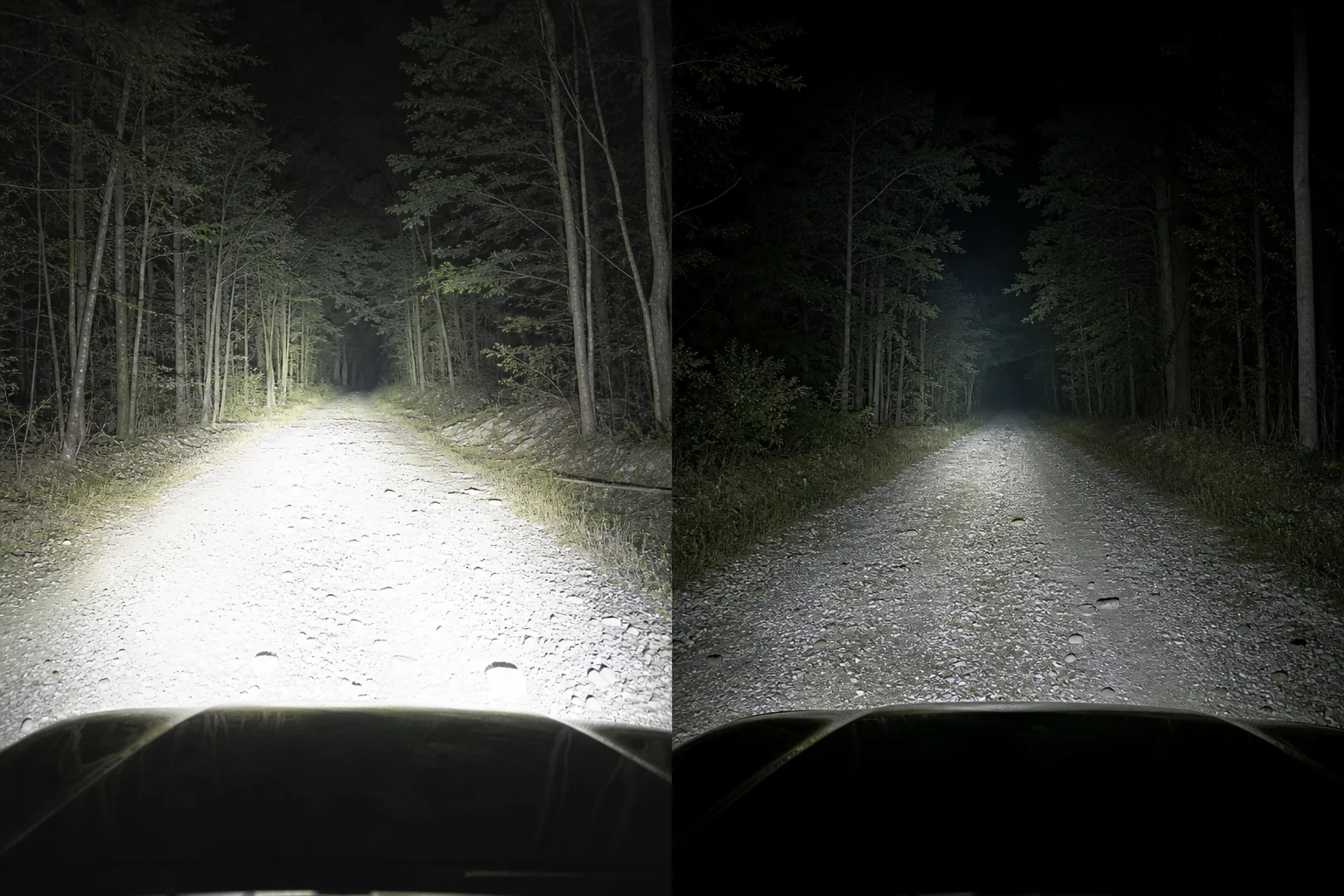
A flood-heavy light may spread light wide across the foreground. That can help during slow recovery work, loading, camping, or farm use, but it may not reach far enough for faster trail driving. A spot-heavy light may throw farther down a track but leave the shoulders darker.
For readers comparing real visibility, the related guide to spot, flood, and combo beam patterns is the natural next step. Beam pattern decides whether lumen output becomes distance, width, or a balanced mix.
Heat also changes performance. LEDs may be efficient, but they still need thermal control. A light bar with poor heat sinking can start bright and then drop output as temperature rises. That is one reason sample testing should include a warm-running check, not only a quick switch-on photo.
The lens can change the result too. A clear lens, diffused lens, reflector cup, projector-style optic, or mixed optic layout can turn similar LED output into very different trail behavior. Buyers should be careful with product photos that show only the lamp face but not a real beam shot against distance markers, trees, walls, or a road surface.
Are more LEDs or more rows the same as more usable light?
More LEDs or more rows can increase potential output, but they do not guarantee more usable light. A dual row bar may produce more total output than a single row bar, yet the final result still depends on optics, aiming, current draw, and installation.
This is especially important when comparing single row, dual row, and multi-row products. More emitters can create more heat, more current demand, and a taller housing. If those details are not controlled, the buyer may get a bright-looking product that is harder to mount and less pleasant to use.
The related single row vs dual row LED light bar comparison helps connect lumen output with housing shape and fitment. In the Yirox Team's sample checks, the question is not only "How many LEDs are inside?" but also "Where does the light go after the lens and reflector do their work?"
How should buyers read an off-road light specification?
Buyers should read lumens together with wattage, current draw, beam pattern, color temperature, voltage range, IP rating, housing material, bracket design, connector type, and warranty language. A complete specification reduces wrong purchases and makes sourcing more predictable.
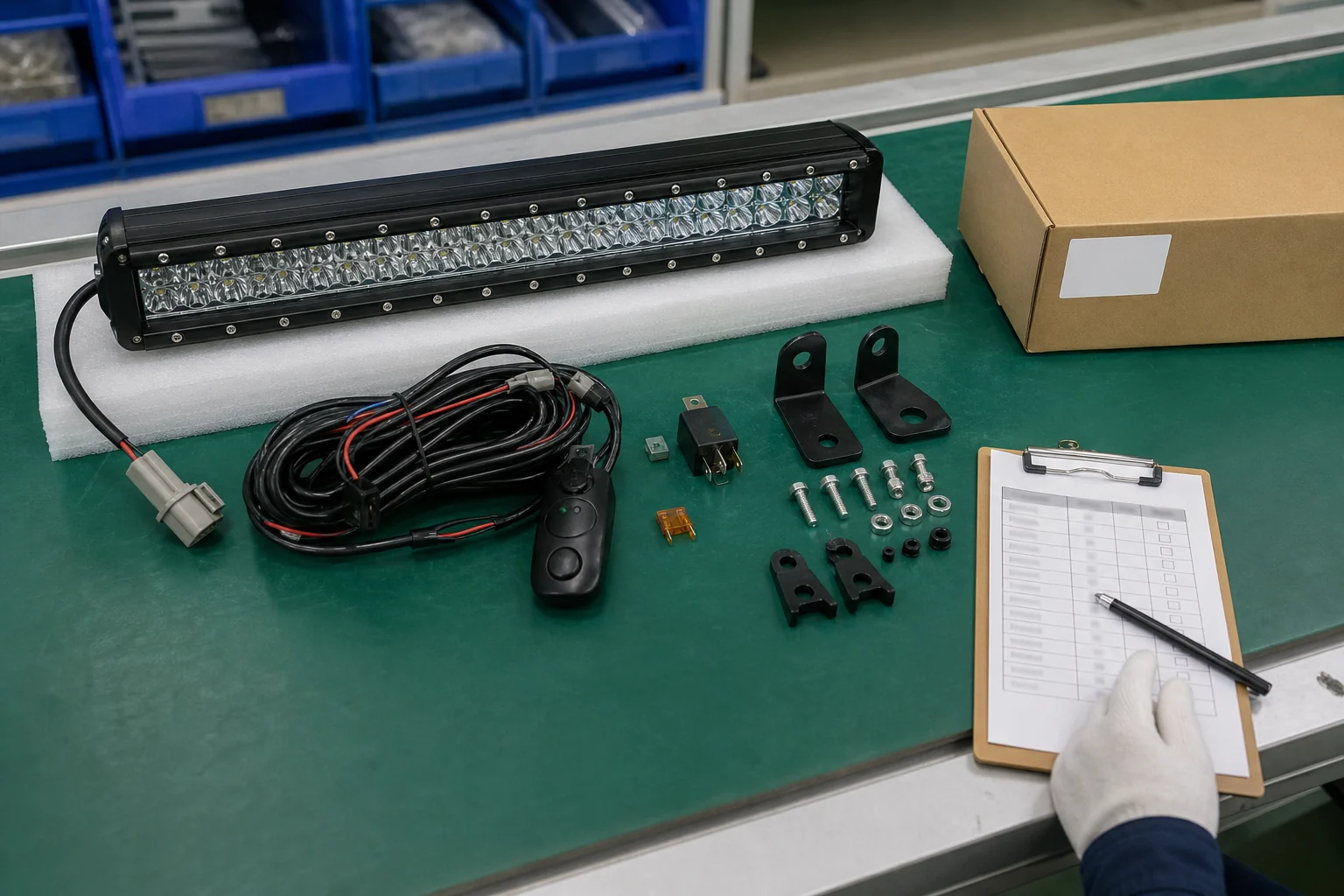
Start by separating theoretical lumens from measured or effective lumens. Some listings estimate output by multiplying LED-chip ratings under ideal conditions. Better specifications make it clearer whether the number reflects the complete lamp after optics, lens, driver electronics, and heat.
Then check sealing and wiring. A bright product can still fail if water enters the housing or the harness is undersized. The related guide to IP ratings for LED lights helps explain sealing claims, while the related light bar wiring harness guide explains fuses, relays, current draw, and connector matching.
Finally, consider legal and road-use language. NHTSA has discussed supplemental lighting under FMVSS No. 108 in terms of whether the extra lighting impairs required lighting equipment 5. For everyday vehicles, product claims should be careful about public-road use, beam aim, color, and local rules.
What lumen range is enough for off-road driving?
There is no universal lumen number that is enough for every off-road vehicle. Slow technical trails, rural work, high-speed desert driving, snow, rain, and campsite lighting all need different beam shapes and mounting choices.
For compact grille or bumper bars, a moderate lumen output with a controlled combo beam may be more useful than a huge claim with scattered light. For roof bars or open terrain, higher output can help, but only if the beam is aimed properly and hood glare is managed.
Buyers should treat lumen range as a filter, not a final answer:
- Define the task: trail distance, side spread, reverse work, recovery, or general accessory package.
- Choose the beam: spot for distance, flood for width, combo for mixed use.
- Match the housing: single row, dual row, curved, straight, pod, or work light.
- Check the kit: bracket, harness, switch, relay, fuse, IP rating, and packaging.
- Verify samples: compare beam photos, warm operation, connector quality, and batch consistency.
This approach helps buyers avoid paying for a lumen number that looks impressive but does not solve the driver's actual visibility problem.
For Yirox Team product reviews, the most useful comparison is usually side-by-side: same voltage, same warm-up time, same camera exposure, same mounting height, and the same distance markers. That kind of check quickly shows whether a lumen claim is supported by a clean beam or only by a bright foreground splash.
Conclusion: Use lumens as one clue, not the whole decision
LED lumen output is useful, but it should not be treated as the only measure of an off-road light. Lumens tell you total visible output; they do not tell you whether the beam reaches far enough, spreads wide enough, avoids glare, survives weather, or fits the vehicle cleanly.
The best off-road lighting decisions combine lumens with beam pattern, candela or lux information when available, mounting position, wiring load, IP rating, and real sample checks. For distributors and private-label buyers, that means comparing the whole product package, not just the biggest number in the listing.
If the next step is comparing actual hardware, the related off-road LED light bar product range is the right place to review sizes, beam options, housings, brackets, and accessory kits together.
Frequently Asked Questions
Are more lumens always better for off-road lights?
No. More lumens can help, but only when the optics and beam pattern put the light where the driver needs it. Poorly controlled high output can create glare and wasted foreground brightness.
What is the difference between lumens and lux?
Lumens describe total visible light output. Lux describes how much of that light reaches a surface area, so it is closer to real illumination at a specific distance.
Why do some lower-lumen lights reach farther?
Lower-lumen lights can reach farther when they have higher candela and tighter optics. They may concentrate less total light into a stronger distance beam.
Should I compare off-road lights by watts or lumens?
Use both, but do not stop there. Watts show power use, lumens show total output, and beam pattern shows whether that output becomes useful visibility.
Do LED lumens drop as the light gets hot?
They can. LED output and driver behavior can change with heat, which is why housing design, heat sinking, and warm-running sample checks matter.
References
[1] NIST. (2018). *[Candela](https://www.nist.gov/si-redefinition/candela)*.
[2] Illuminating Engineering Society. *[lumen](https://ies.org/definitions/lumen/)*.
[3] Illuminating Engineering Society. *[lux](https://www.ies.org/definitions/lux/)*.
[4] U.S. Department of Energy. *[Lumens and the Lighting Facts Label](https://www.energy.gov/energysaver/lumens-and-lighting-facts-label)*.
[5] NHTSA. (2019). *[FMVSS No. 108 interpretation on supplemental lighting](https://www.nhtsa.gov/interpretations/571108-supplement-beam-boykin-16-0884)*.