



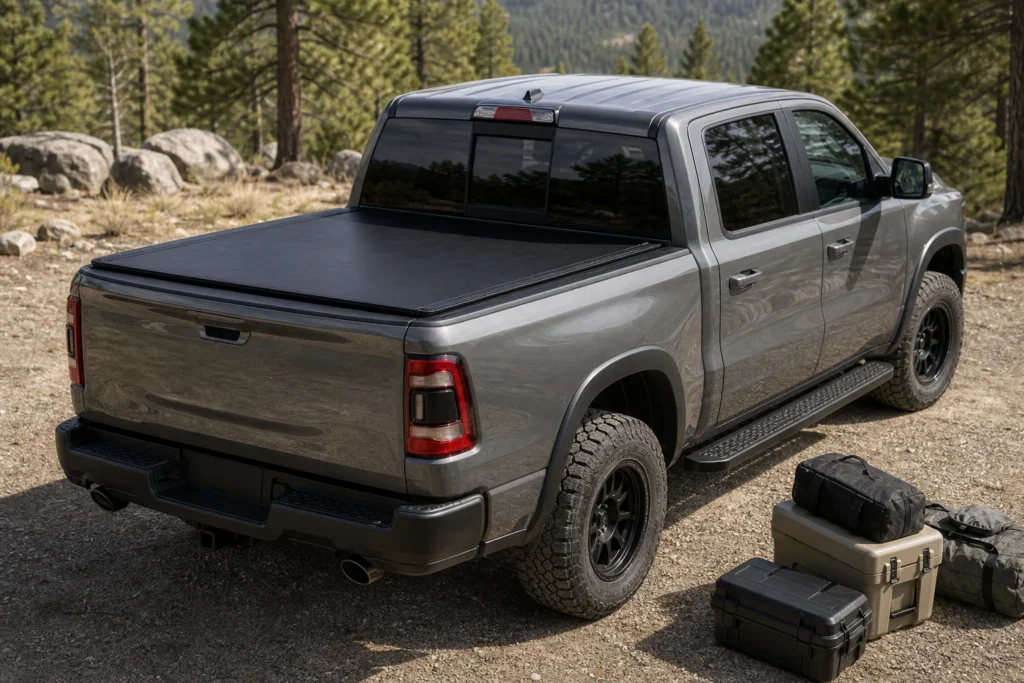
A tonneau cover is a pickup bed cover that sits over the cargo box to protect items, improve privacy, and give the truck a cleaner finished look. It can be soft or hard, folding or rolling, retractable or hinged, and the best choice depends on how the truck is used.
Many buyers start with one simple question: "Which cover is best?" The more useful question is: "What do I need the cover to do most of the time?" A contractor, family road-trip driver, overland customer, fleet buyer, and weekend DIY owner may all choose different covers for good reasons.
Table of Contents
- What is a tonneau cover?
- What are the main types of tonneau covers?
- Tonneau cover decision matrix
- What are the benefits of a tonneau cover?
- Are tonneau covers waterproof?
- How do you choose the right tonneau cover?
- What should buyers check before ordering tonneau covers?
- Tonneau Cover Fitment & Sample Inspection Sheet
- Conclusion: Choose the cover around the way the truck is used
- Frequently Asked Questions
- References
What is a tonneau cover?
A tonneau cover is an accessory that covers the open pickup bed. It can be made from vinyl, aluminum, fiberglass, composite panels, fabric over a frame, or interlocking slats depending on the cover style.
The cover usually mounts to the bed rails with clamps, rails, seals, hinges, latches, or a canister system. Some covers sit on top of the bed rails. Others install with a lower-profile flush fit. Most are designed to be opened when the driver needs cargo access and closed when the bed should be protected.
The name can sound technical, but the purpose is practical. A tonneau cover helps hide cargo from view, reduce direct exposure to sun and rain, keep light cargo from blowing around, and make the truck look more complete.
What are the main types of tonneau covers?
Tonneau covers are easiest to understand through two dimensions: construction and opening mechanism. Construction describes whether the cover is soft or hard. Opening mechanism describes whether it rolls, folds, retracts into a canister, or lifts as one hinged panel. The two dimensions combine, so a cover can be soft and roll-up, hard and roll-up, soft and folding, or hard and folding.
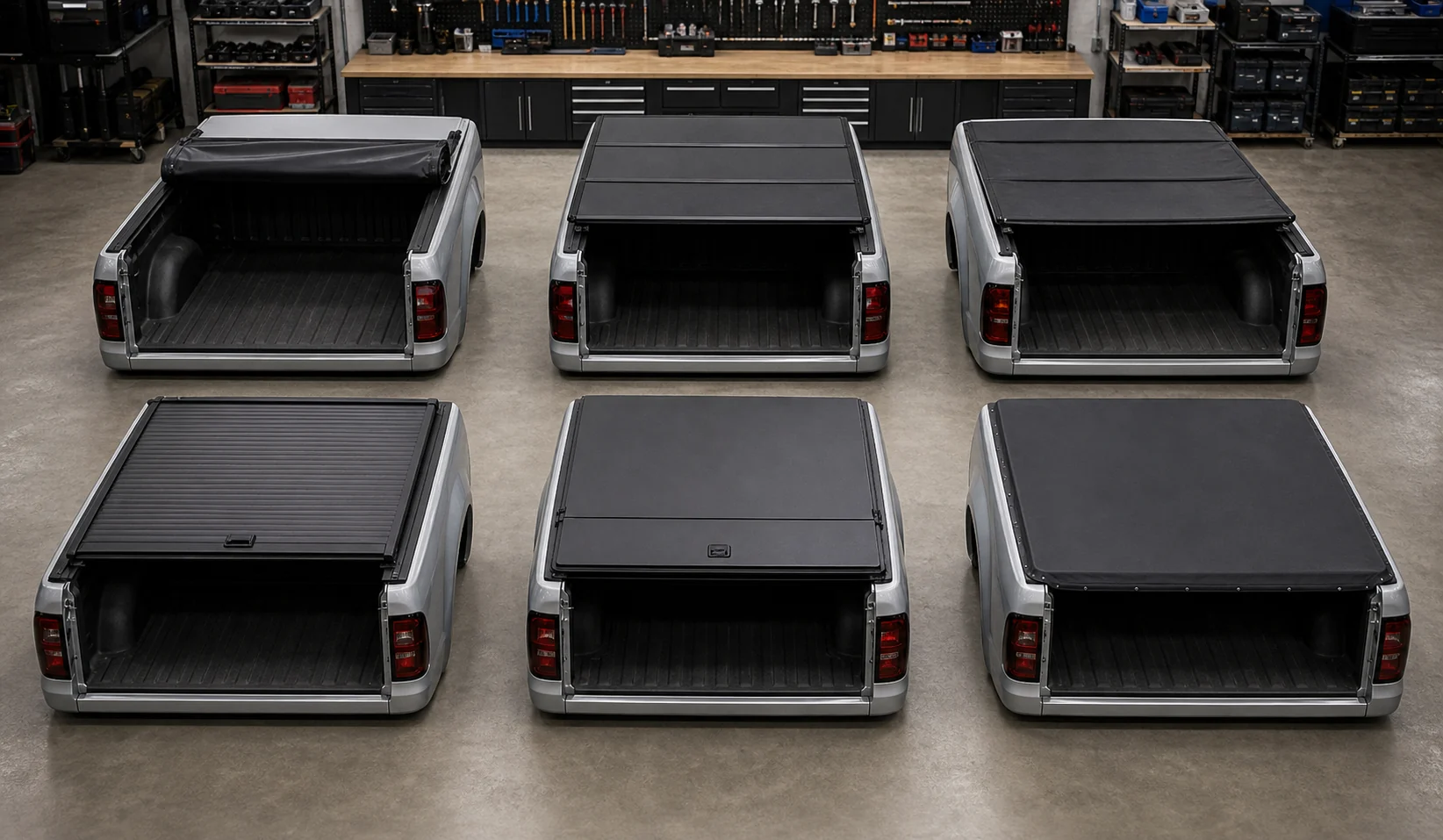
Dimension 1: is the tonneau cover soft or hard?
| Construction | Typical materials | What it changes | Main trade-off |
|---|---|---|---|
| Soft | Vinyl or coated fabric over bows or a frame | Lower weight, easier removal, lower relative price | The surface can be cut and usually offers less theft deterrence |
| Hard | Aluminum, composite, ABS, fiberglass, or rigid slats/panels | Better resistance to cutting and a more rigid surface | Higher weight and relative price |
Hard and soft are not opening styles. A folding cover can be hard or soft; a roll-up cover can also be hard or soft. The related hard vs soft tonneau cover comparison covers that construction decision in more detail, while the tonneau cover material comparison explains how vinyl, aluminum, composite, and fiberglass affect the finished product.
Dimension 2: how does the tonneau cover open?
| Opening mechanism | How it opens | Bed-space effect | Common construction |
|---|---|---|---|
| Roll-up | Rolls toward the cab | Usually preserves most bed length when open | Soft fabric or linked hard slats |
| Folding/tri-fold | Two or more panels fold toward the cab | The folded stack may cover part of the bed or rear window | Soft framed panels or hard panels |
| Retractable | Slides along rails into a front canister | The canister occupies space near the cab | Aluminum or composite slats |
| Hinged one-piece | Lifts as one lid using hinges and struts | Clear space below the raised lid, but limited tall-cargo flexibility | Fiberglass, ABS, composite, or aluminum |
Snap-style covers are normally a soft-cover attachment variation, not a separate opening-mechanism family. Toolbox-compatible and rack-compatible describe fitment, not the way the cover opens.
For deeper operating details, use the related guides to roll-up tonneau covers, tri-fold tonneau covers, retractable tonneau covers, and hinged tonneau covers.
Tonneau cover decision matrix
Use this matrix to narrow the shortlist before checking vehicle-specific fitment. Ratings are relative category guidance, not universal product test results: actual performance depends on material, seals, rail design, installation, tailgate condition, and the specific truck.
| Cover type | Bed access | Security | Water resistance | Installation | Weight | Rack compatibility | Relative price |
|---|---|---|---|---|---|---|---|
| Soft roll-up | Excellent; typically exposes nearly the full bed | Low | Moderate when tension and seals are correct | Usually simple clamp-on | Light | Moderate when it mounts inside the rails | $ |
| Hard roll-up | Excellent; rolls toward the cab without a large canister | High | Moderate to good | Moderate; rail alignment matters | Medium to heavy | Moderate; best with compatible inside-rail or T-slot systems | $$$ |
| Soft folding/tri-fold | Moderate; a folded section usually remains near the cab | Low to moderate | Moderate | Usually simple clamp-on | Light to medium | Low to moderate, depending on rail clearance | $–$$ |
| Hard folding/tri-fold | Good; some designs fold upright for fuller access | High | Good when hinges, caps, and tailgate seals align | Moderate; panel and rail alignment matter | Medium to heavy | Moderate; higher with compatible T-slot rails | $$–$$$ |
| Manual retractable | Good; stops at several positions, but the canister uses bed space | High | Good with correctly routed drains | More involved; rails and canister must be square | Heavy | Good when designed with T-slot rails | $$$–$$$$ |
| Powered retractable | Good and convenient; canister still uses bed space | High | Good with correctly routed drains | Complex; adds wiring and controls | Heavy | Good only with a declared compatible rail system | $$$$ |
| Hinged one-piece | Limited for tall cargo unless the lid is removed | High | Good to very good with an even perimeter seal | Moderate; alignment and strut mounting matter | Heavy | Low unless the lid has a purpose-built rack system | $$$–$$$$ |
Read the matrix by priority, not by total score. A soft roll-up cover can be the right answer when full bed access, light weight, and price matter most. A hard folding or retractable cover is stronger when the buyer carries tools and prioritizes theft deterrence. A rack-compatible system requires confirmation of rail geometry; the word "compatible" should never be assumed from the cover type alone.
What are the benefits of a tonneau cover?
A tonneau cover can improve cargo privacy, weather protection, truck appearance, cargo organization, and day-to-day bed usability. It does not turn the pickup bed into a sealed trunk, but it can make the bed much more useful.
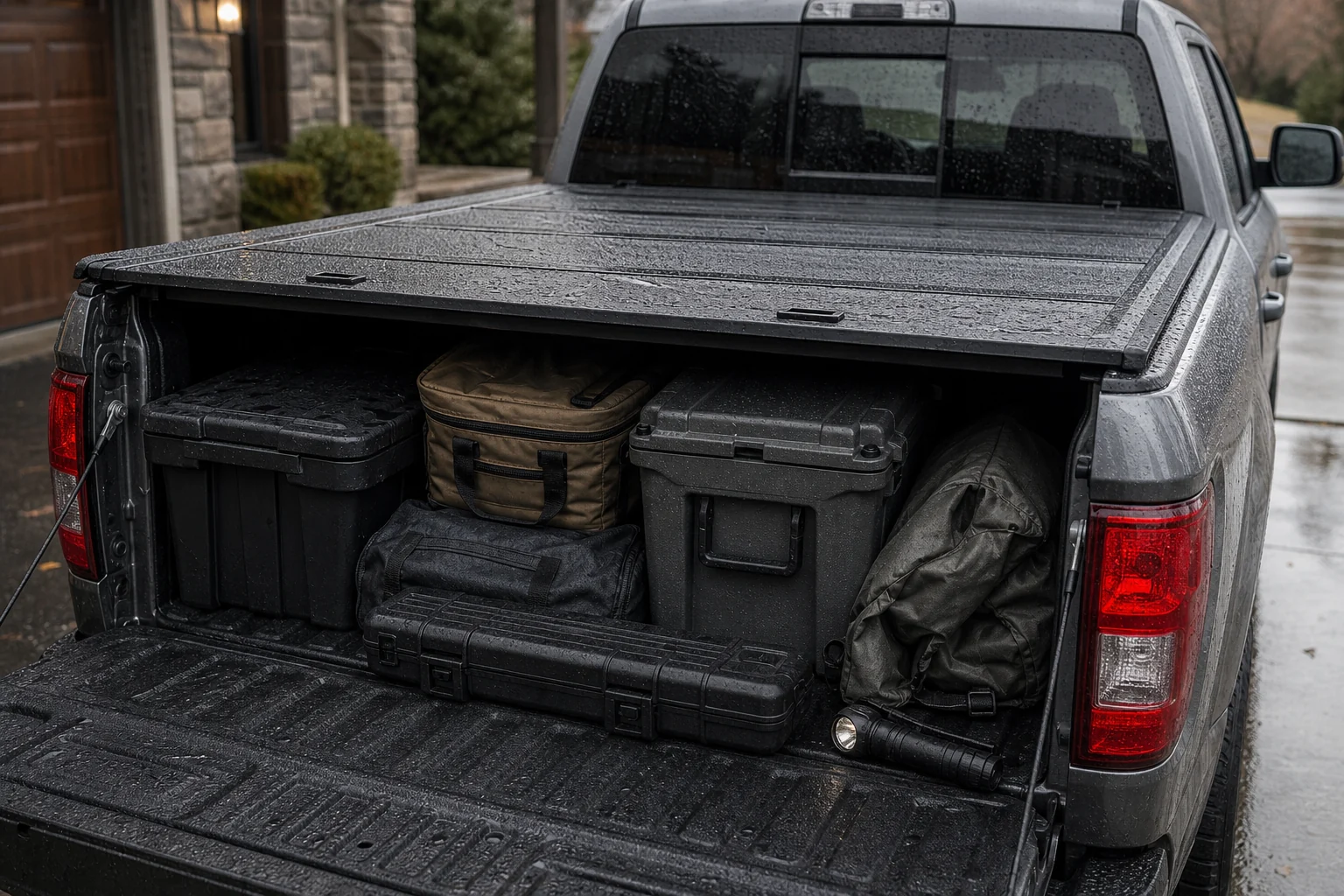
The privacy benefit is immediate. Tools, luggage, recovery gear, sports equipment, and groceries are less visible when the cover is closed. A hard cover paired with a locking tailgate adds a stronger theft-deterrent layer than a soft vinyl cover, though no tonneau cover should be described as theft-proof.
Weather protection is another major reason buyers choose a cover. A good cover helps reduce exposure to rain, snow, dust, leaves, and sun. It also helps keep cargo from bouncing or blowing around in the open bed. NHTSA's load-securing advice is a useful reminder that cargo still needs to be secured properly; a cover should not be treated as the only restraint for loose items 1.
Appearance matters too. Many truck owners like the clean horizontal line a cover gives the bed. For retail programs, that visual difference is often what makes a customer stop and compare options.
Fuel economy should be treated as a possible secondary benefit rather than the main purchase promise. Vehicle speed, route, wind, tires, load, and measurement method can easily obscure small changes; the separate review of tonneau cover fuel economy research explains how to evaluate that claim without overpromising.
Are tonneau covers waterproof?
Most tonneau covers are water-resistant, not completely waterproof. They can reduce water entry during normal rain, but water may still enter around tailgates, bed caps, stake pockets, rails, hinges, seals, or drain paths.
This is where product wording matters. "Waterproof" creates expectations that are hard to satisfy on a pickup bed because the truck bed itself has gaps and moving panels. "Weather resistant" or "helps keep cargo protected from rain" is usually more accurate.
Retractable covers often use drains because water can collect near the canister. Folding covers rely on hinge seals and side rail seals. Roll-up covers depend heavily on tension, side seals, and correct installation. Hinged covers may seal well around the perimeter, but access and fitment still matter.
For buyers, the useful check is not only the cover surface. Look at the tailgate seal, rail contact, clamp pressure, drain routing, and whether the bed liner or bed caps affect fit.
Maintenance also affects water resistance. Soft covers need the right tension so water does not pool in the middle. Folding covers need hinge areas kept clean so grit does not damage seals. Retractable covers need rails and drain paths checked because leaves, dust, and ice can slow the mechanism. A cover that performs well when new can start leaking or rubbing if the owner never cleans the contact points.
How do you choose the right tonneau cover?
Choose a tonneau cover by matching the cover type to the truck's normal use: budget, security, weather exposure, bed access, cargo height, appearance, and installation preference.
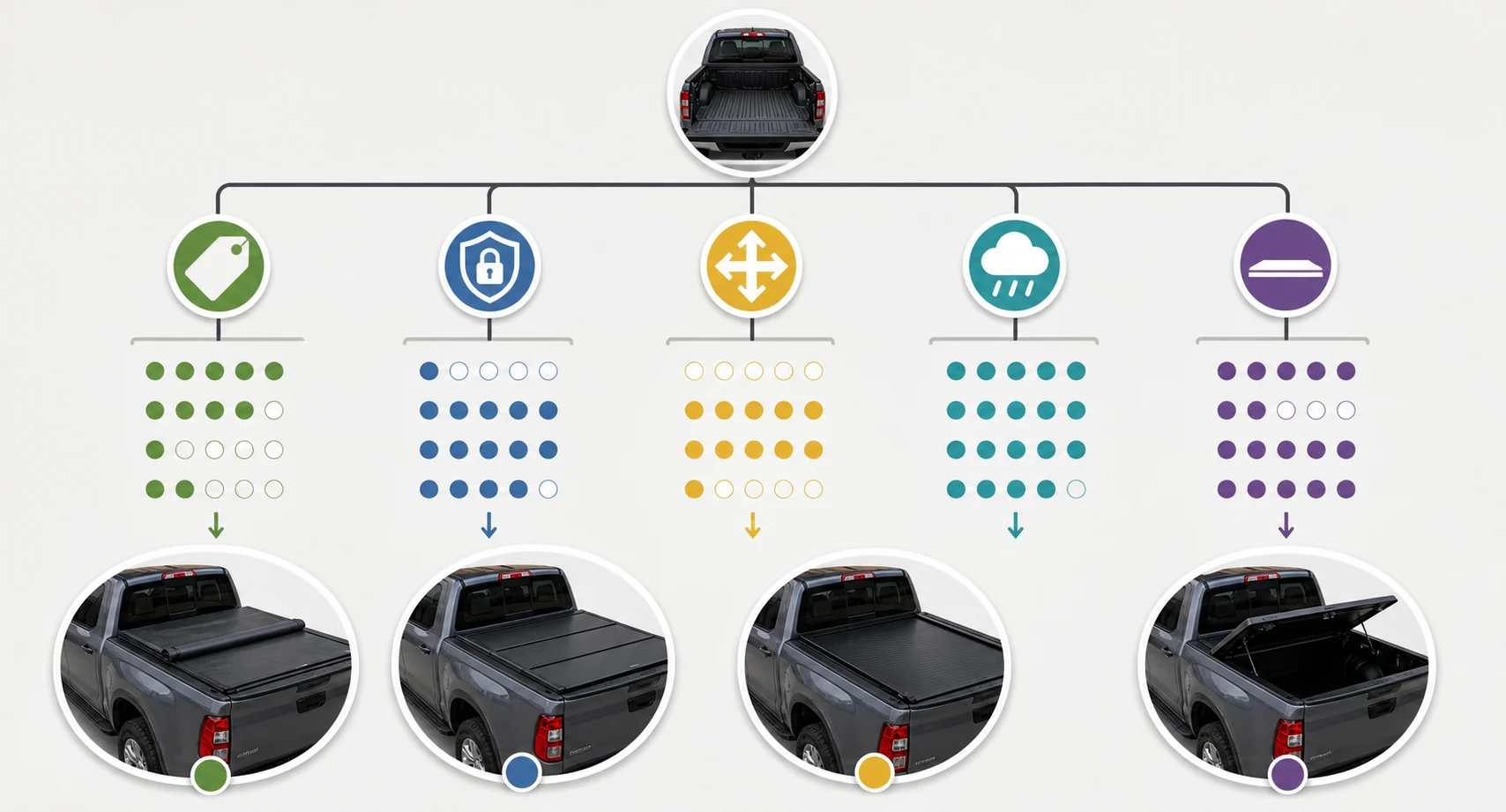
Start with cargo. If the driver often carries tall items, a roll-up or retractable cover may be better than a folding cover that rests near the cab. If the driver carries tools and wants better security, a hard folding or retractable cover may be worth the higher cost.
Then check the truck. Bed length, rail shape, bed liner, utility track, sports bar, toolbox, rack, tailgate shape, and cargo management system can all affect fitment. A cover that works well on one pickup may be awkward on another if the clamp or rail system conflicts with factory accessories.
For premium bed access, the related retractable tonneau cover guide explains the canister, rail, and drain-tube trade-offs.
If the driver regularly carries cargo above the bed rails or wants an enclosed camping space, compare a tonneau cover vs truck cap before choosing a low-profile cover.
Budget should be read together with use frequency. A low-cost soft cover may be perfect for a driver who only needs occasional cargo privacy. A more expensive hard folding or retractable cover may make sense for a truck used every day for tools, outdoor gear, delivery work, or family travel. Paying for strength that the user does not need wastes money, but underbuying can create returns, water complaints, or early replacement.
What should buyers check before ordering tonneau covers?
Buyers should check fitment data, material, frame strength, seals, clamps, latch design, installation instructions, carton protection, and after-sales parts before ordering tonneau covers.
For the Yirox Team, sample review starts with fitment and installation. Do the rails sit straight? Do the clamps hold without damaging the bed? Does the tailgate close cleanly? Does the cover open and close without rubbing? Are the instructions clear enough for a normal installer?
Material consistency also matters. Soft covers should have even stitching, clean tension, UV-resistant surface quality, and stable edges. Hard panels should feel rigid, align evenly, and resist obvious warping. Retractable slats should slide smoothly without binding.
Packaging is easy to overlook. Long rails, panels, and hinges can be damaged in shipping if foam, corner protection, and hardware bags are not designed well. A cover that looks good in a sample room can still create returns if the box allows panels to rub.
For wholesale or private-label programs, consistency is just as important as the first sample. Check whether the production batch uses the same fabric grain, panel thickness, clamp shape, seal profile, label placement, and instruction sheet as the approved sample. Small changes can create fitment problems that only appear after customers install the cover.
After-sales parts should be planned before launch. Common service items include clamps, latches, hinge seals, drain tubes, tension adjusters, rail end caps, and hardware bags. A retailer can often save a customer relationship by sending a small part quickly instead of replacing a whole cover.
Tonneau Cover Fitment & Sample Inspection Sheet
Use one sheet for every truck application and sample revision. Record actual measurements rather than writing only "fits" or "does not fit." The approved sheet should stay with the fitment database, installation photos, supplier drawing, and golden sample.
A. Truck and fitment inputs
| Inspection item | Fill in | How to measure or verify | Pass criteria |
|---|---|---|---|
| Vehicle | Make ___ / Model ___ / Year ___ / Cab ___ | VIN/build configuration or verified vehicle | Exact application recorded |
| Bed length | ___ mm / ___ in | Inside front bulkhead to inside closed tailgate; also record manufacturer nominal size | Measurement matches the intended SKU range |
| Rail width | Front ___ / Middle ___ / Rear ___ | Inside-to-inside and outside-to-outside at three positions | Cover and rail drawing match measured taper |
| Cap profile | Flat / raised / tapered / factory cap / aftermarket cap | Photograph both rails and measure cap height | Seal contacts the intended surface continuously |
| Liner | None / spray-in / under-rail drop-in / over-rail drop-in | Photograph rail and bulkhead interfaces | Liner does not block clamps or create an unsealed step |
| Utility track | None / brand and position ___ | Measure track height and distance from clamp zone | Supplied adapters fit without bending or interference |
| Toolbox | None / type / width / position ___ | Measure toolbox footprint and lid swing | Cover operates without contact; compatible SKU is documented |
| Rack | None / stake-pocket / clamp-on / T-slot / drilling required | Record mounting footprint and rail channel dimensions | Rack feet and cover can operate together with declared clearance |
| Bed accessories | Sports bar / bed extender / tie-downs / lighting / other ___ | Cycle every accessory with the cover | No interference, pinched wires, or blocked release |
B. Installed-sample measurements
| Inspection item | Front | Middle | Rear | Pass/fail rule |
|---|---|---|---|---|
| Rail-to-bed alignment | ___ mm | ___ mm | ___ mm | Rails remain parallel and within the product drawing tolerance |
| Clamp clearance | ___ mm | ___ mm | ___ mm | Clamp fully seats without contacting track, liner, wiring, or moving parts |
| Tailgate gap | Left ___ mm | Center ___ mm | Right ___ mm | Gap is even; tailgate closes without lifting or crushing the cover |
| Seal compression | ___% | ___% | ___% | Continuous contact within the seal supplier/product drawing range; no rolled or torn seal |
| Cover height above rail | ___ mm | ___ mm | ___ mm | Symmetrical profile; no panel twist or rail lift |
| Diagonal/squareness check | Left ___ mm | — | Right ___ mm | Difference remains within the assembly drawing tolerance |
Do not invent a universal clamp-clearance, tailgate-gap, or seal-compression number. The acceptable range must come from the cover design, seal profile, clamp drawing, truck geometry, and approved sample. The point of the sheet is to expose variation before production, not to replace engineering limits with a generic number.
C. Functional sample inspection
| Test | Record | Pass criteria |
|---|---|---|
| Open/close cycles | ___ cycles | No binding, rail movement, torn fabric, loose fastener, or latch misalignment |
| Tailgate operation | ___ cycles closed/open | Tailgate opens and closes without forcing the cover |
| Latch engagement | Left ___ / Right ___ | Each latch fully engages and releases from the intended access point |
| Full-bed access | Usable opening ___ mm / ___% | Matches the product claim; folded or rolled cover is positively secured |
| Water check | Method ___ / Duration ___ / Leak locations ___ | Result is reported by location; no unsupported "waterproof" claim |
| Road/retention check | Method and speed per approved protocol ___ | Cover, straps, buckles, and panels remain secured according to instructions |
| Drain routing | Left ___ / Right ___ | Tubes run downhill without kinks and discharge at approved locations |
| Rack/toolbox interference | Combination tested ___ | Both systems operate through their full intended range |
| Installation time | Technician ___ / Time ___ | Time and required tools match the instruction claim |
| Removal/reinstallation | Time ___ / Result ___ | No stripped fasteners, lost adjustment, or damaged seals |
D. Replacement-parts plan
| Replacement part | Part number | Included with product? | Service stock | Compatibility note |
|---|---|---|---|---|
| Clamps and clamp pads | ___ | Yes / No | ___ sets | Position-specific? ___ |
| Latches and release cable | ___ | Yes / No | ___ sets | Left/right or universal? ___ |
| Hinge and panel seals | ___ | Yes / No | ___ m/sets | Profile and revision ___ |
| Bulkhead/tailgate seal | ___ | Yes / No | ___ m/sets | Adhesive and surface prep ___ |
| Drain tubes and fittings | ___ | Yes / No | ___ sets | Canister/rail version ___ |
| Tension adjusters/bows | ___ | Yes / No | ___ sets | Soft-cover application ___ |
| Rail end caps | ___ | Yes / No | ___ sets | Left/right and color ___ |
| Struts and brackets | ___ | Yes / No | ___ pairs | Force rating/application ___ |
| Hardware bag | ___ | Yes / No | ___ bags | Fastener revision ___ |
| Instructions/labels | ___ | Yes / No | ___ sets | Language and market ___ |
Approve the sample only when the vehicle application, measurements, photos, functional results, replacement parts, packaging revision, and instruction revision all point to the same SKU. A cover that closes once in a sample room is not yet a repeatable fitment program.
Conclusion: Choose the cover around the way the truck is used
A tonneau cover is one of the most practical pickup accessories because it changes how the bed works every day. The best cover is not always the strongest, cheapest, or most expensive one. It is the one that matches the cargo, climate, security need, installation skill, and truck fitment.
Soft roll-up covers are affordable and simple. Hard folding covers are a strong everyday choice. Retractable covers feel premium and clean. Tri-fold covers balance price and function. Hinged covers give a smooth one-piece look. Each style is right for a different buyer.
If the next step is comparing product options, the related pickup tonneau covers category is the practical place to review styles, materials, fitment, packaging, and sourcing expectations together.
Frequently Asked Questions
What is the purpose of a tonneau cover?
A tonneau cover protects the pickup bed, hides cargo from view, improves appearance, and makes the bed more useful in daily driving. It can also reduce casual exposure to rain, dust, sun, and leaves.
Which tonneau cover type is best?
There is no single best type. Soft roll-up covers are budget-friendly, hard folding covers are strong daily choices, retractable covers feel premium, and tri-fold covers are popular because they balance access and simplicity.
Are tonneau covers waterproof?
Most are water-resistant rather than fully waterproof. Good seals and installation reduce water entry, but pickup beds have gaps around the tailgate, rails, and accessories.
Can you drive with a tonneau cover open?
Many covers can be driven open only when they are secured according to the instructions. Loose panels, rolled fabric, or unsecured sections can be damaged or become unsafe.
Do tonneau covers fit all pickup trucks?
No. Fit depends on make, model, year, bed length, rail shape, bed liner, accessories, and cargo management system. Always confirm fitment before ordering.
References
[1] National Highway Traffic Safety Administration. “How to Secure Your Load.” 2026.
[2] RealTruck. “How to Choose a Truck Bed Cover.” 2026.
[3] Access Cover. “Frequently Asked Questions.” 2026.
[4] Consumer Reports. “Pickup Truck Buying Guide.” 2026.