


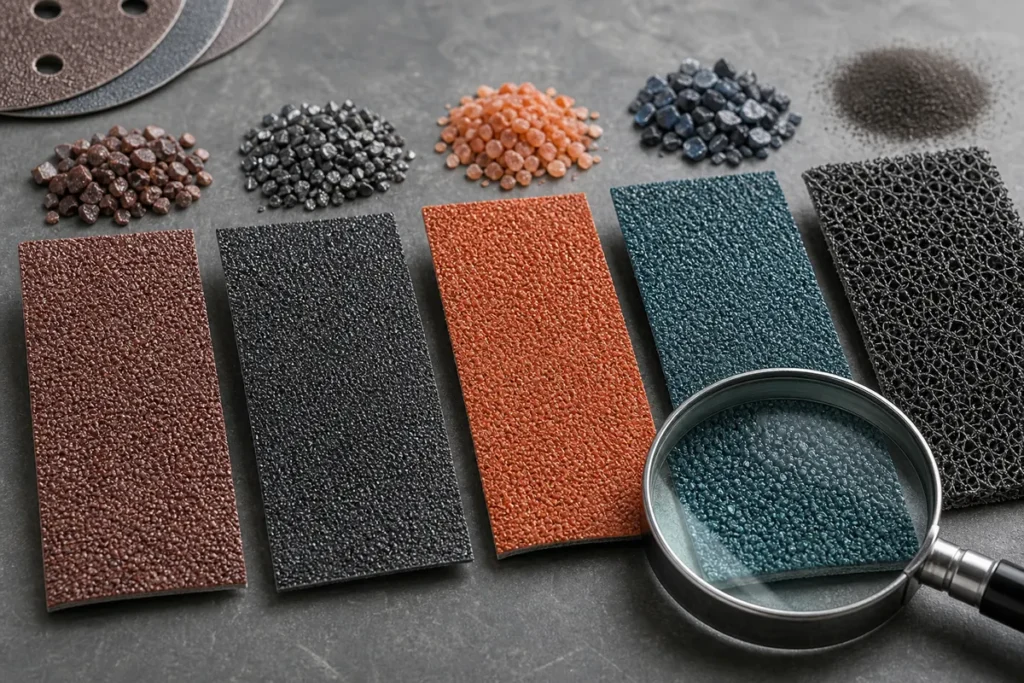
Abrasive grain is the hard cutting mineral bonded to sandpaper, sanding discs, belts, rolls, and other abrasive products. In automotive sandpaper, grain type affects how fast the abrasive cuts, how long it lasts, how it fractures, how much heat it creates, and what kind of scratch pattern it leaves.
Grit number tells you particle size, but abrasive grain tells you cutting behavior. Two P320 discs can feel different if one uses aluminum oxide and another uses ceramic grain or a film-backed precision abrasive. That is why grain choice matters in body filler shaping, primer sanding, paint preparation, and clear coat finishing.
This guide explains common abrasive grain types used in automotive sandpaper, how they differ, and what buyers should check when comparing abrasive products.
Table of Contents
- What does abrasive grain mean in sandpaper?
- What abrasive grain types are used in automotive sandpaper?
- How is abrasive grain different from grit?
- Which abrasive grain is best for body filler, primer, paint, and clear coat?
- How do backing, coating, and dust extraction change grain performance?
- How should buyers evaluate abrasive grain quality?
- What sourcing questions should you ask about abrasive grain?
- Conclusion: Grain choice controls more than roughness
- Frequently Asked Questions
- References
What does abrasive grain mean in sandpaper?
Abrasive grain is the cutting mineral that actually scratches, cuts, or refines the surface. The backing holds it, the bond locks it in place, and the grit size controls particle size, but the grain is the working edge.
Common automotive abrasives may use aluminum oxide, silicon carbide, ceramic alumina, zirconia alumina, or blends. Some premium systems use shaped or precision grain concepts designed to cut consistently and fracture in a controlled way. Major abrasive suppliers describe grain type as a key factor in cut rate, durability, and application fit 1.
The related automotive sandpaper guide gives the broader product context. Grain is one part of the product, but it works together with backing, coating, grit, hole pattern, and sanding method.
What abrasive grain types are used in automotive sandpaper?
The most common abrasive grains in automotive sandpaper are aluminum oxide, silicon carbide, ceramic alumina, and zirconia alumina. Each has a different balance of sharpness, toughness, fracture behavior, heat control, and cost.
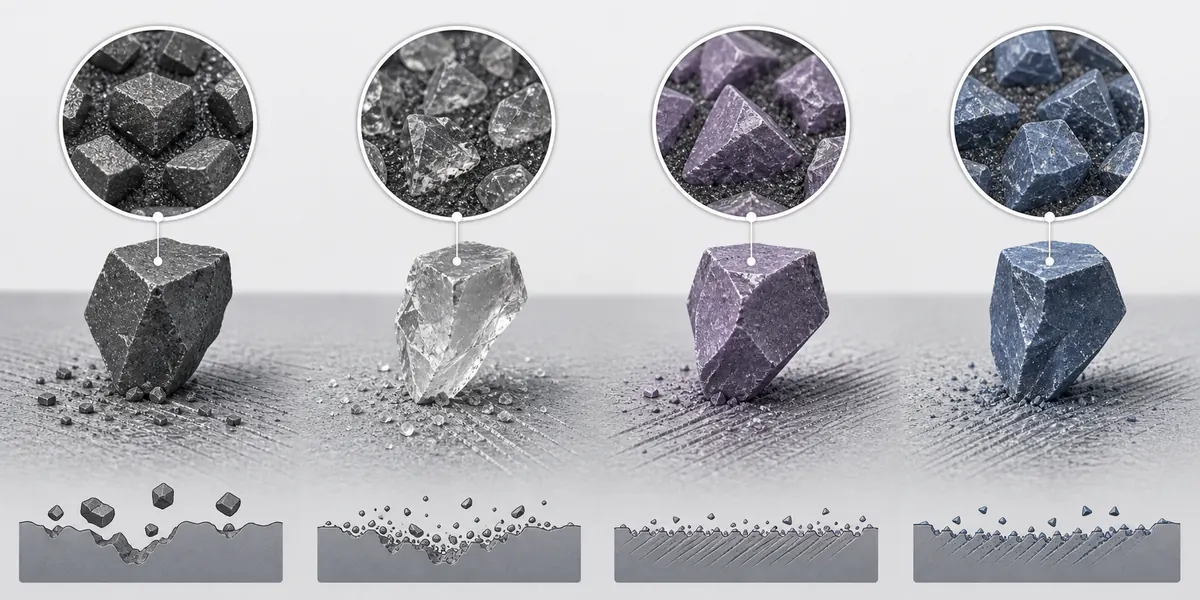
| Grain Type | Typical Feel | Common Automotive Use | Main Trade-Off |
|---|---|---|---|
| Aluminum oxide | Durable, versatile | General sanding, primer, filler, old paint | Not always the fastest cut |
| Silicon carbide | Very sharp, fine cutting | Wet/dry paper, paint and clear coat finishing | Can fracture faster under heavy pressure |
| Ceramic alumina | Fast, self-sharpening | Heavy sanding, production work, premium discs | Higher cost |
| Zirconia alumina | Tough and aggressive | Heavy stock removal, harder materials | May be too aggressive for fine finishing |
| Blended grains | Balanced behavior | Multi-purpose automotive discs | Quality depends on blend and coating |
Aluminum oxide is common because it is versatile and cost-effective. Silicon carbide is sharp and often used in wet/dry finishing papers. Ceramic grain can keep cutting by fracturing into fresh edges, which helps in demanding production sanding. Zirconia is tough and aggressive, but it is not usually the first choice for delicate clear coat finishing.
Many automotive abrasives also use grain blends. A disc may combine a familiar aluminum oxide base with a sharper or tougher mineral to balance cost, cut speed, and finish quality. This is why buyers should avoid judging only from a single grain name. The real question is whether the abrasive produces the right scratch for the next step, keeps cutting long enough, and behaves consistently from batch to batch.
How is abrasive grain different from grit?
Grit is particle size, while abrasive grain is particle material and behavior. A P400 abrasive tells you the approximate size range; the grain type tells you how that particle cuts, dulls, fractures, and handles heat.
This is why the same grit number can produce different shop results. One disc may cut longer and stay cooler. Another may feel sharp at first but clog or dull quickly. Another may leave a more uniform scratch pattern that is easier for primer or paint to cover.
For readers comparing size ranges, the related sandpaper grit chart explains coarse, medium, fine, and ultra-fine grits in automotive use. Grain choice becomes the next layer after grit choice.
FEPA and other standards help define abrasive grain sizing and coated abrasive grading, but they do not make every product perform identically 4. Backing, bond, coating, mineral quality, and manufacturing control still matter.
Which abrasive grain is best for body filler, primer, paint, and clear coat?
There is no single best abrasive grain for every automotive stage. Aluminum oxide is a strong general-purpose choice, silicon carbide is often useful for fine wet/dry finishing, ceramic grain is useful for faster cutting, and zirconia is better for heavier removal than delicate finishing.
For body filler shaping, durability and cut rate matter. Aluminum oxide or ceramic blends can work well depending on the shop’s speed and budget. For primer sanding, consistency and clog control matter more than raw aggression. For paint preparation, the scratch pattern must be controlled enough for the coating system.
For clear coat finishing, sharp fine abrasives and very consistent scratch patterns are critical. Silicon carbide wet/dry papers and fine finishing discs are common because clear coat correction needs controlled removal and easy polishing afterward.
If the abrasive is used as a disc rather than a sheet, the related sanding disc guide explains why hole pattern, backup pad, attachment style, and dust extraction also change the result.
How do backing, coating, and dust extraction change grain performance?
Backing, coating, and dust extraction can make the same grain feel completely different. A strong grain on weak backing may tear. A sharp grain with poor anti-clog coating may load up. A good disc with blocked dust holes may overheat or create pigtails.
Open coat abrasives leave more space between grains to reduce loading. Closed coat abrasives pack more grain onto the surface and can cut more aggressively on some materials. Stearate or anti-clog coatings help when sanding paint, primer, and filler that might load the abrasive.
Dry sanding performance depends heavily on dust extraction. A grain that stays exposed cuts better and creates a cleaner scratch. Wet sanding changes the situation because water carries away residue and cools the surface. The related wet sanding vs dry sanding guide explains how method changes dust, slurry, visibility, and cleanup.
Heat is another reason the full abrasive construction matters. A sharp grain on a stable backing usually cuts with less rubbing, while a dull or loaded abrasive can polish the surface and build heat. Heat can soften coatings, smear filler, load the disc faster, or make clear coat edges easier to damage. For production sanding, dust control and anti-clog treatment are not small extras; they help the grain stay exposed and do its job.
How should buyers evaluate abrasive grain quality?
Buyers should evaluate abrasive grain quality by testing cut rate, scratch consistency, disc life, clog resistance, grain shedding, heat behavior, and batch repeatability. A supplier claim such as “ceramic” or “silicon carbide” is not enough by itself.
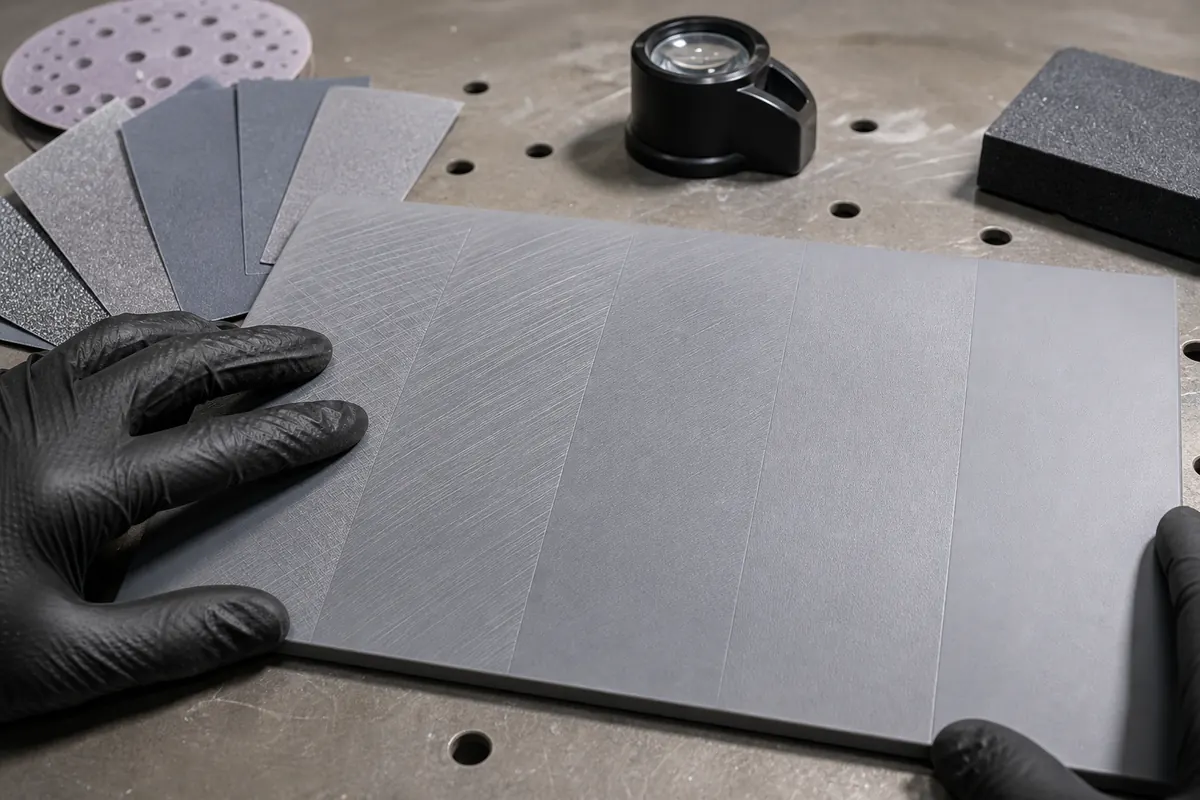
Use the same substrate and same tool when comparing samples. Sand a primer test panel under the same pressure and time. Check whether the abrasive loads up, whether scratches are uniform, and whether the previous grit can be removed by the next step.
Abrasive grain quality also shows up in consistency. If one disc cuts cleanly and the next from the same box feels dull or leaves random deep scratches, the product is risky. For automotive users, that inconsistency can become paint defects and returns.
A practical sample test should include more than first impression. Measure how many passes are needed to level a defined area, inspect the scratch under good light, then follow with the next finer grit to see whether the previous scratches are removed cleanly. Also check whether the abrasive sheds grain, leaves random deep scratches, or changes feel after a short amount of work. These details matter more than a dramatic first cut that cannot be repeated.
What sourcing questions should you ask about abrasive grain?
Ask what grain type is used, whether it is a blend, what backing and coating are paired with it, what grit standard is used, and what applications the abrasive is meant for. Also ask for sample testing across multiple batches, not just one perfect sample.
For product programs, the automotive sandpaper and abrasives category is the right Yirox starting point. Buyers can compare sheets, discs, wet/dry products, and related abrasive formats around real use cases rather than just mineral names.
Yirox Team sample checks usually include grit feel, scratch pattern, backing strength, hole alignment, packaging, and batch consistency. That practical review helps make sure the abrasive grain claim matches what technicians feel on the panel.
Conclusion: Grain choice controls more than roughness
Abrasive grain controls how sandpaper cuts, dulls, fractures, heats, clogs, and leaves scratches. Grit number still matters, but grain type explains why two abrasives with the same grit can perform differently in a body shop.
For automotive use, aluminum oxide is versatile, silicon carbide is sharp and common in wet/dry finishing, ceramic grain is strong for fast cutting, and zirconia is useful for heavier removal. The right answer depends on the surface, repair stage, sanding method, and required finish.
Good abrasive selection starts with the job and ends with verification on a real panel.
Frequently Asked Questions
What abrasive grain is best for automotive sandpaper?
Aluminum oxide is the most versatile general choice, while silicon carbide is common for fine wet/dry finishing and ceramic grain is useful for faster cutting. The best grain depends on the repair stage.
Is silicon carbide better than aluminum oxide?
Silicon carbide is sharper and often useful for fine finishing, but aluminum oxide is tougher and more versatile for general sanding. Neither is better for every job.
What does ceramic abrasive grain do?
Ceramic abrasive grain is designed to fracture and expose fresh cutting edges during use. It can cut faster and last longer in demanding sanding, but it usually costs more.
Does grit matter more than abrasive grain?
Both matter. Grit controls particle size and scratch depth, while grain controls cutting behavior, durability, heat, and consistency.
Can different abrasive grains leave different scratches at the same grit?
Yes. Grain shape, fracture behavior, backing, coating, and dust control can make two abrasives with the same grit leave different scratch patterns.
References
[1] Norton Abrasives. (2026). *Abrasive Grain Types and Applications*.
[2] 3M. (2026). *Automotive Abrasive Mineral and Sanding Resources*.
[3] Mirka. (2026). *Automotive Abrasives and Dust-Free Sanding Systems*.
[4] FEPA. (2026). *Coated Abrasives Standards*.