



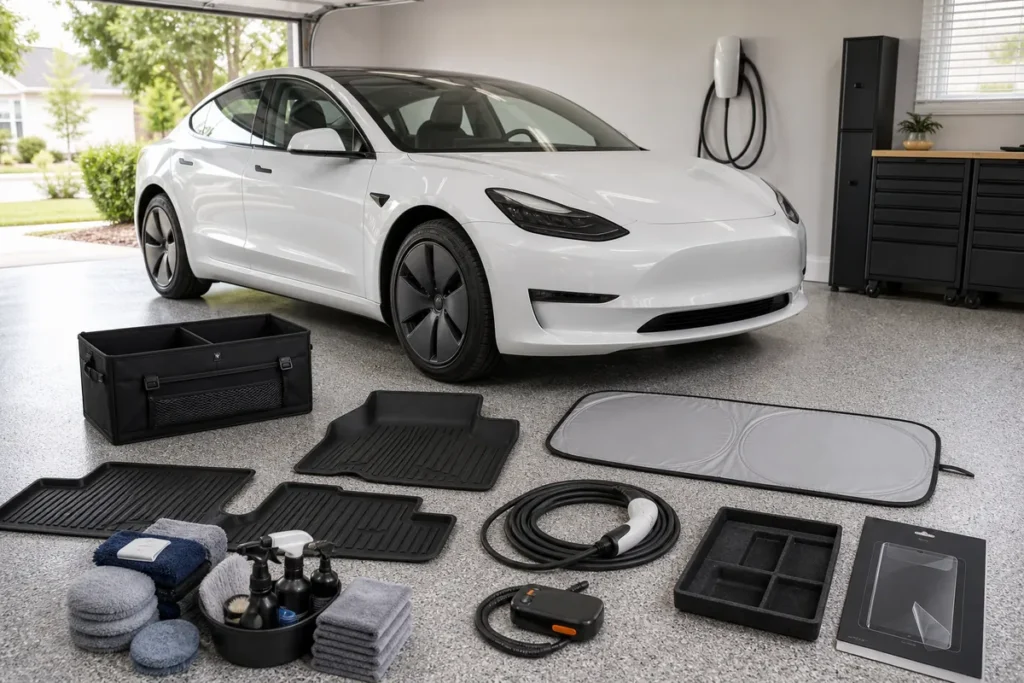
Tesla accessories are add-on products that protect the car, improve charging, organize storage, increase comfort, or make daily ownership easier. The best upgrades are not the flashiest ones; they are the accessories that fit your Tesla model, solve a real problem, and do not interfere with safety, charging, sensors, or warranty-sensitive parts.
Tesla owners tend to buy accessories quickly because the cars are minimalist by design. A clean cabin is great, but it also means owners often want better floor protection, console organization, cargo control, screen protection, charging cable storage, and road-trip tools.
This guide explains what Tesla accessories are, which 15 upgrades are genuinely useful for most owners, and how to choose them without wasting money on poor-fit parts or risky electrical products.
Table of Contents
- What does Tesla accessories mean?
- Which 15 Tesla accessories are actually worth buying?
- What interior Tesla accessories should you buy first?
- What charging accessories do Tesla owners need?
- What cargo and road-trip accessories make Tesla ownership easier?
- How do you choose Tesla accessories for Model 3, Model Y, Model S, Model X, or Cybertruck?
- Which Tesla accessories should you be careful with?
- What should buyers check before sourcing Tesla accessories?
- Conclusion: Choose Tesla accessories by function, fit, and safety
- Frequently Asked Questions
- References
What does Tesla accessories mean?
Tesla accessories are aftermarket or official add-ons made for Tesla vehicles, including cabin protection, charging equipment, storage tools, exterior protection, comfort upgrades, and emergency items. They are different from vehicle modifications because most accessories are removable and do not change the core vehicle system.
Official Tesla accessories are sold through Tesla’s shop and vehicle support ecosystem 1. Aftermarket accessories are sold by many independent brands and factories. Some are excellent; others look similar online but fit poorly, smell bad, interfere with use, or fail after heat and UV exposure.
The practical way to think about Tesla accessories is by purpose:
- Protect: floor mats, cargo liners, mud flaps, seat protectors, screen protectors.
- Charge: wall connectors, adapters, cable holders, portable charger storage, connector covers.
- Organize: console trays, trunk organizers, frunk bags, under-seat storage.
- Comfort: sunshades, pet covers, cup holder inserts, rear seat accessories.
- Emergency: tire inflator, repair kit, first aid kit, roadside tools, warning light.
Tesla accessories should not block airbags, cameras, sensors, vents, seat movement, pedals, charge ports, or drainage paths. A simple product can still cause trouble if it fits badly.
Which 15 Tesla accessories are actually worth buying?
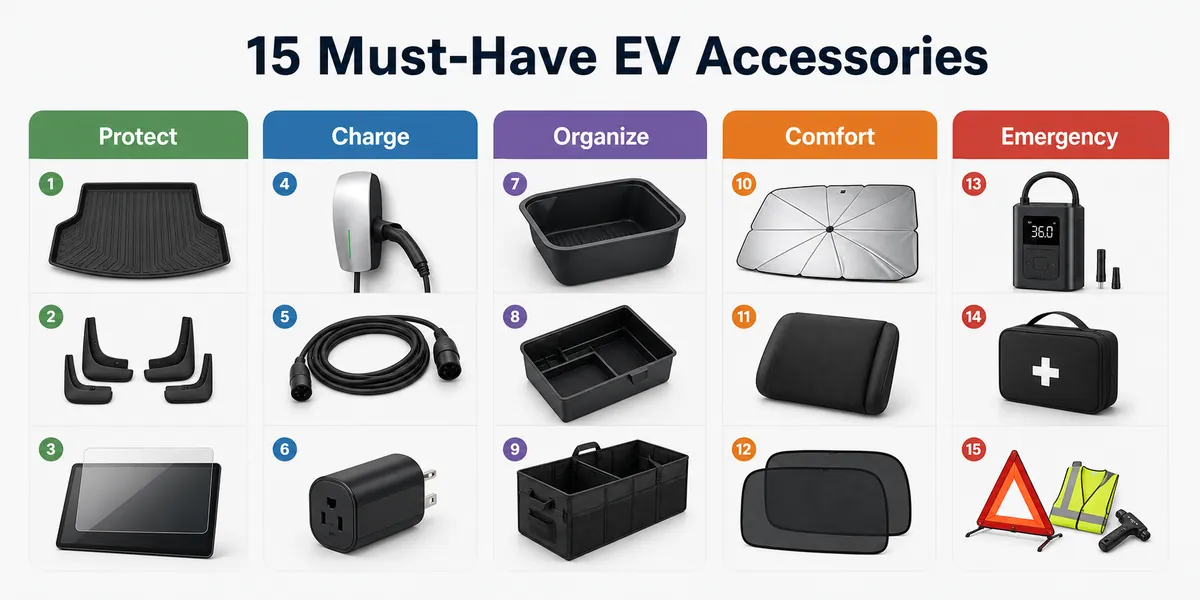
The most useful Tesla accessories are the ones that protect high-wear areas, make charging easier, keep the cabin organized, and prepare the car for unexpected situations. Most owners do not need every accessory at once, but these 15 are the strongest starting list.
| Must-Have Accessory | Why It Helps | Best For |
|---|---|---|
| 1. All-weather floor mats | Protects carpet from mud, rain, salt, and spills | Every owner |
| 2. Cargo liner | Keeps trunk and sub-trunk easier to clean | Families, groceries, pets |
| 3. Frunk liner or bag | Makes front storage more usable | Road trips, daily storage |
| 4. Center console organizer | Adds compartments to a minimalist interior | Daily drivers |
| 5. Screen protector | Helps reduce scratches and fingerprints | High-touch cabin use |
| 6. Sunshade | Reduces heat and glare through large glass areas | Hot climates |
| 7. Mud flaps | Reduces road spray and lower-body debris | Rain, snow, gravel roads |
| 8. Seat back protectors | Protects rear seat area from children or cargo | Families |
| 9. Trunk organizer | Keeps tools, groceries, and cables from sliding | Commuting and travel |
| 10. Charging cable organizer | Keeps cables cleaner and easier to store | Home charging |
| 11. Portable charging kit storage | Keeps adapters and portable EVSE together | Road trips |
| 12. Wall connector cable holder | Prevents cable drag and garage clutter | Home garages |
| 13. Tire inflator | Helps with low-pressure warnings and emergencies | Every owner |
| 14. Jack pads | Helps service shops lift the vehicle correctly | Maintenance |
| 15. First aid and roadside kit | Adds basic emergency readiness | Road trips |
What interior Tesla accessories should you buy first?
The first interior Tesla accessories most owners should consider are all-weather floor mats, a cargo liner, a console organizer, a screen protector, cup holder inserts, seat protectors, and a sunshade. These upgrades protect surfaces that get used every day.
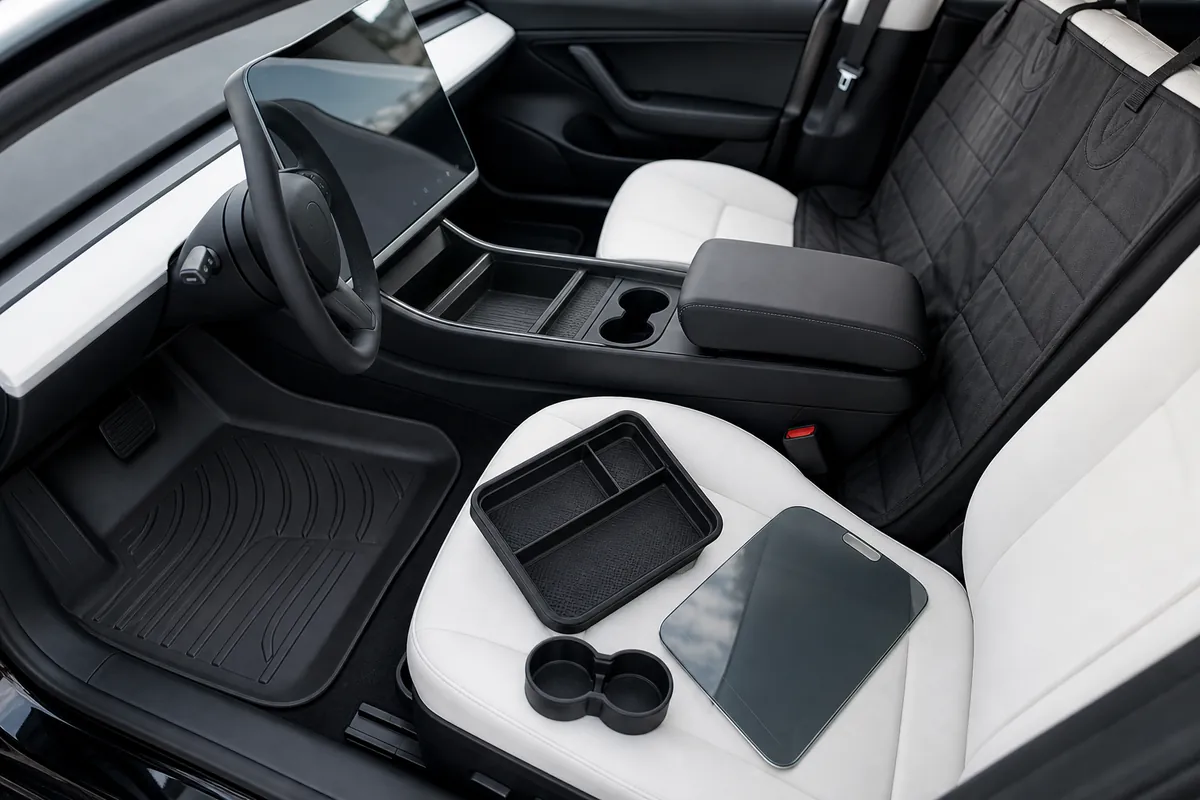
All-weather floor mats are usually the first purchase because carpet is hard to clean once dirt, salt, or spilled drinks settle in. The mat should fit the exact model year and floor shape. It should not slide forward, curl near pedals, or trap water where it can spill into the carpet.
Console organizers are popular because Tesla cabins have large storage spaces with few divisions. A good tray lets owners separate keys, cards, sunglasses, charging cards, wipes, and small tools. Poor organizers can rattle, block the sliding cover, or become difficult to remove.
Screen protectors are simple but useful. The center screen is touched constantly, and a protector can reduce fingerprints and minor scratches. Choose one with clean edges, good touch response, and a finish that does not make glare worse.
What charging accessories do Tesla owners need?
Tesla charging accessories should match the owner’s home setup, travel habits, connector type, and electrical safety requirements. Useful charging upgrades include a wall connector or home charger setup, cable organizer, adapter case, portable charging storage, and connector protection.
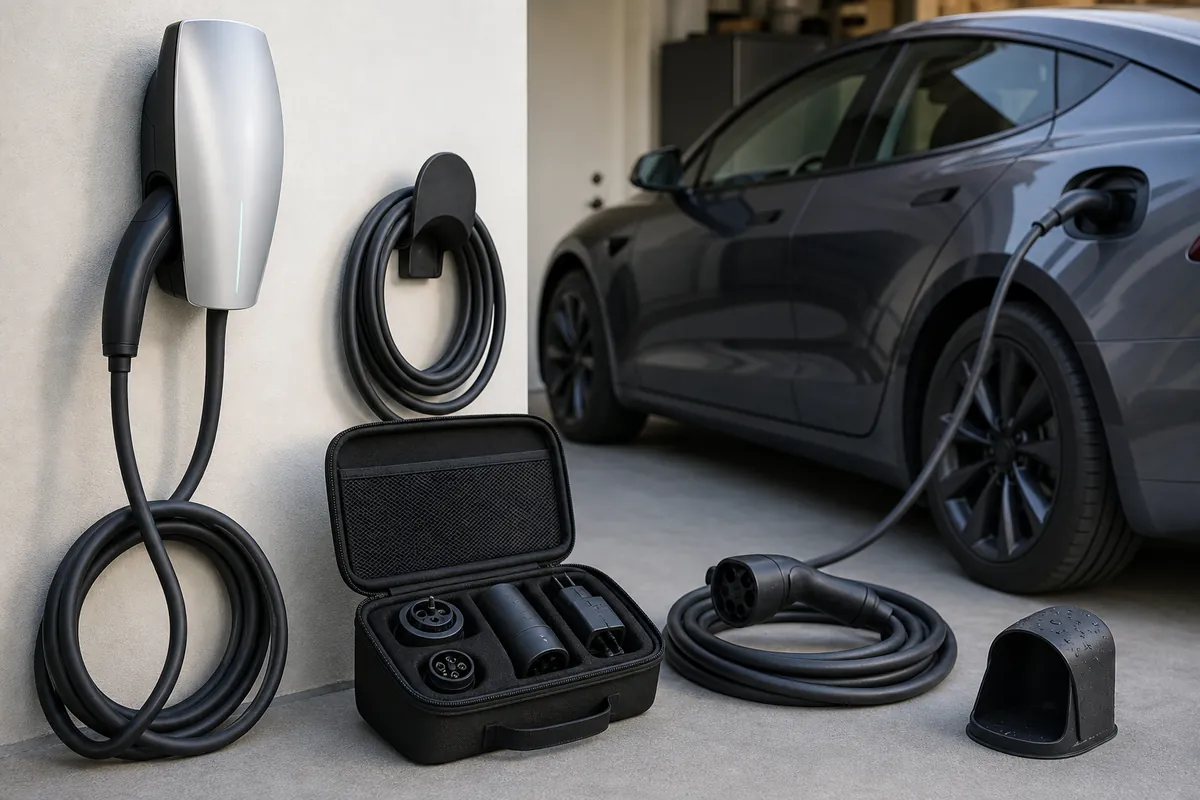
Home charging is the biggest convenience upgrade for many EV owners. Tesla’s own charging support explains Wall Connector and charging options, but the correct installation still depends on local electrical rules and a qualified installer 2. For readers comparing home hardware, the related wall-mounted EV charger guide explains charger types, installation, and key features.
Portable charging accessories are useful for travel, backup charging, and owners who move between locations. A related portable EV charger guide explains types, pros, cons, and best uses. If the next step is building or comparing EV accessory ranges, Yirox’s OEM EV charging accessories page gives a broader view of portable chargers, cables, adapters, and related products.
Connector compatibility also matters. Depending on market, model, and adapter use, owners may encounter Tesla/NACS, CCS, Type 1, Type 2, or regional connector differences. The related EV charging cable connector guide helps explain why connector type, cable rating, and use case need to match.
What cargo and road-trip accessories make Tesla ownership easier?
Cargo and road-trip Tesla accessories make the vehicle easier to live with when carrying groceries, luggage, tools, pets, or emergency items. The most useful upgrades are cargo liners, trunk organizers, frunk bags, charging cable bags, tire inflators, jack pads, and roadside kits.
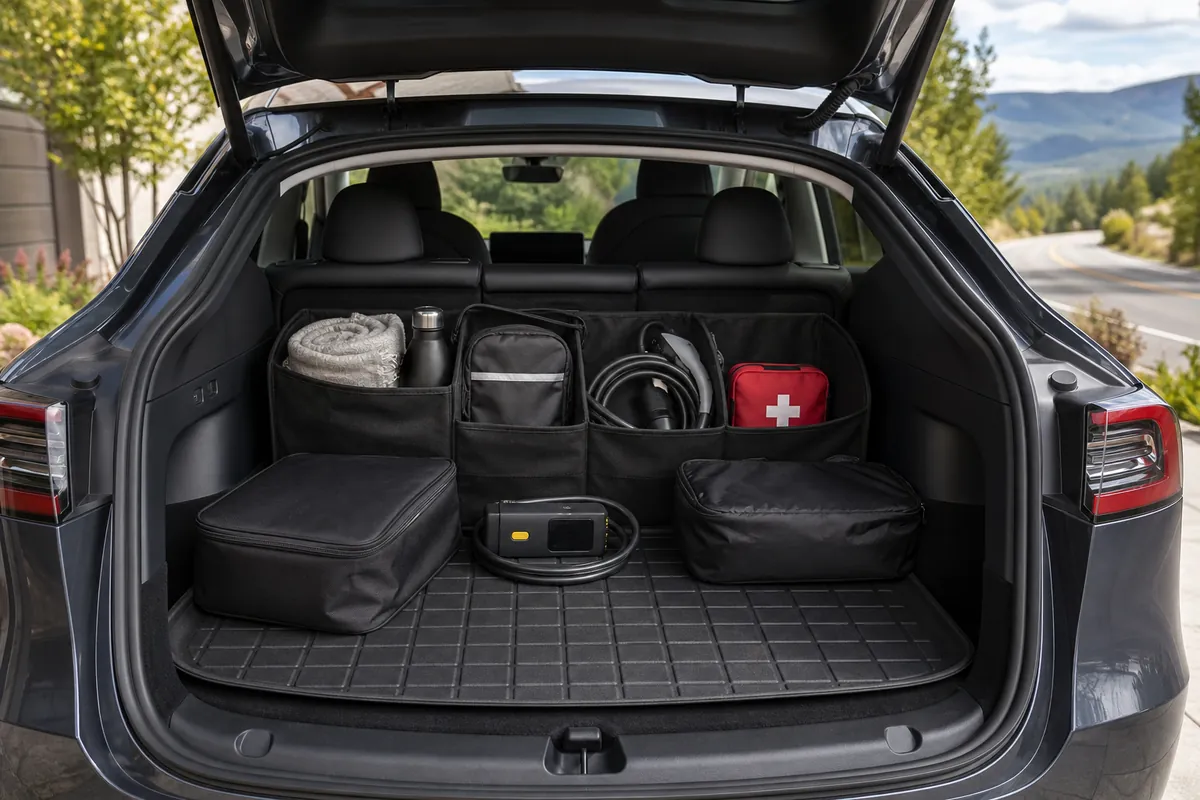
A cargo liner protects the rear trunk from spills, pet hair, sports equipment, and dirty tools. It should fit the floor shape and allow access to underfloor storage. If the liner blocks access to the sub-trunk, owners may stop using one of the most useful storage areas in the vehicle.
Trunk organizers help keep groceries, charging adapters, towels, tools, and cleaning supplies from sliding around. A collapsible organizer is often better than a bulky fixed box because it can be folded away when the full cargo area is needed.
Tire inflators and roadside kits are practical because many EVs do not carry a traditional spare tire. A compact inflator can help with slow leaks or low-pressure warnings, but it is not a replacement for safe tire inspection. Jack pads are also useful because service shops need to lift the vehicle at the correct points.
Charging planning is part of road-trip comfort too. The related AC vs DC EV charging guide explains why home charging, destination charging, and fast charging solve different problems.
How do you choose Tesla accessories for Model 3, Model Y, Model S, Model X, or Cybertruck?
Choose Tesla accessories by exact model, model year, seating layout, cargo shape, trim details, climate, charging connector, and how the owner uses the car. A product that fits one Tesla model may not fit another, even if it looks similar online.
Model 3 and Model Y accessories are often confused because the vehicles share some design language, but cargo areas, seat layouts, mats, liners, and rear storage shapes can differ. Model S and Model X have their own cabin dimensions and trim details. Cybertruck accessories are more truck-oriented and may involve bed storage, all-weather protection, and heavier-duty cargo use.
Fitment should be verified with more than a product title. Check year range, left-hand or right-hand drive, seat configuration, refresh version, and whether the part blocks storage lids, vents, sensors, or seat rails. Tesla owner manuals and vehicle support pages are useful for checking vehicle-specific use and safety details 3.
Which Tesla accessories should you be careful with?
Be careful with electrical accessories, anything near airbags or pedals, lift-related tools, exterior adhesive parts, heavy roof or cargo products, and accessories that interfere with cameras, sensors, or cooling. A cheap accessory can become expensive if it creates a safety or fit problem.
Electrical products deserve the most caution. Charging cables, adapters, portable EVSE units, extension cords, and power-related accessories must match voltage, current, connector type, and safety requirements. U.S. Department of Energy charging guidance explains that EV charging levels and equipment vary by power source and charging speed 5. NHTSA also treats EV high-voltage safety as a serious vehicle-safety topic 4.
Avoid accessories that cover cameras, ultrasonic sensors where fitted, radar areas, airbag zones, seat belt anchors, pedals, or charge-port operation. A floor mat that slides under a pedal is not a harmless fit issue. A camera cover or poorly placed exterior trim can affect driver assistance behavior.
Adhesive exterior parts should use automotive-grade materials and should be tested for heat, UV, rain, and car wash exposure. Poor adhesive can fail, leave residue, or damage paint.
What should buyers check before sourcing Tesla accessories?
Buyers should check exact fitment, material safety, odor, heat resistance, electrical ratings, packaging, label clarity, installation instructions, and batch consistency. Tesla accessories are highly fitment-sensitive, so a few millimeters can decide whether a product feels premium or annoying.
For cabin products, test installation and removal in a real vehicle whenever possible. Check whether mats slide, whether liners block storage, whether trays rattle, and whether sunshades sag. For charging products, verify connector fit, cable flexibility, current rating, temperature behavior, and certification requirements for the target market.
If the next step is product selection, the branded automotive NEV accessories category is a natural Yirox starting point for EV-focused vehicle accessories. For charging-focused products, the related EV charging accessories category helps connect cables, chargers, adapters, and supporting parts.
Yirox Team sample checks usually focus on real-car fitment, material feel, odor after heat exposure, packaging protection, labeling, connector accuracy, and whether repeat batches match the approved sample. That matters because Tesla owners notice small fit issues quickly.
Conclusion: Choose Tesla accessories by function, fit, and safety
Tesla accessories are best understood as practical upgrades for protection, charging, organization, comfort, cargo use, and emergency readiness. The most useful 15 upgrades are not random gadgets; they solve everyday ownership problems.
Start with floor mats, cargo protection, console organization, charging cable storage, sun protection, and basic emergency gear. Add charging accessories only after checking connector type, electrical rating, and installation needs. For any model-specific product, verify exact fitment before buying or sourcing.
Good accessories should make the Tesla easier to own without interfering with the vehicle. That means clean fit, stable materials, safe installation, clear instructions, and batch consistency.
Frequently Asked Questions
What are the most useful Tesla accessories for new owners?
The most useful first accessories are all-weather floor mats, a cargo liner, a screen protector, a center console organizer, a sunshade, a charging cable organizer, and a tire inflator. These solve daily wear, storage, charging, and basic emergency needs.
Are Tesla accessories model-specific?
Many Tesla accessories are model-specific and sometimes year-specific. Mats, liners, trays, sunshades, cargo products, and exterior trim should be checked against the exact model, model year, drive side, and seat layout.
Do Tesla owners need a portable charger?
Some owners benefit from a portable charger for travel, backup charging, or locations without a fixed wall charger. It should match the vehicle connector, power supply, local electrical rules, and safety requirements.
Are aftermarket Tesla accessories safe?
Many aftermarket accessories are safe when they fit correctly and use appropriate materials, but electrical products and parts near airbags, pedals, sensors, or charging equipment need extra caution. Poor fit or weak certification can create real risk.
What Tesla accessories are best for road trips?
Useful road-trip accessories include a cargo organizer, charging cable bag, portable charging kit storage, tire inflator, first aid kit, sunshade, trunk liner, and cleaning supplies. The best mix depends on route, climate, cargo, and charging plan.
References
[1] Tesla. (2026). *Tesla Shop and vehicle accessories*.
[2] Tesla. (2026). *Wall Connector and charging support*.
[3] Tesla. (2026). *Vehicle owner manuals*.
[4] NHTSA. (2026). *Electric vehicle safety information*.
[5] U.S. Department of Energy. (2026). *Electric vehicle charging basics*.