



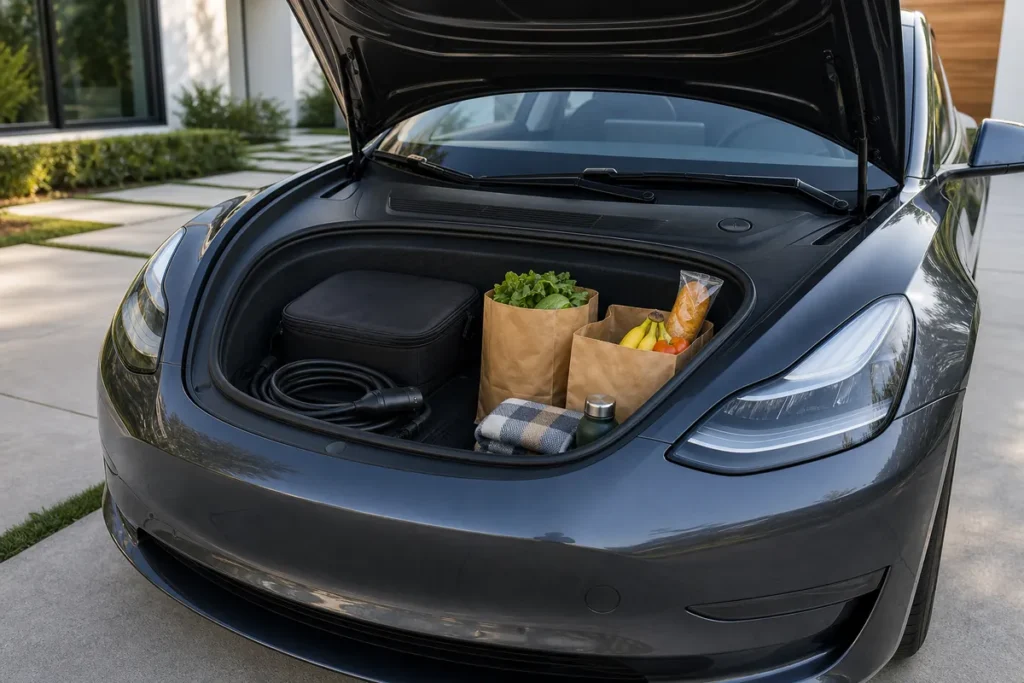
A Tesla frunk is the front trunk under the hood. It gives the car a second cargo area for groceries, charging equipment, emergency supplies, and small bags, but the usable space, water protection, load limit, and opening method depend on the exact Tesla model, model year, market, and configuration.
The useful question is not simply “How big is a Tesla frunk?” It is “What will I carry, how will I protect it, and which liner, bag, or organizer will still fit when the hood closes?” A good answer connects the vehicle manual with real storage habits and model-specific accessory fitment. For a broader starting point, the Tesla accessories guide covers other vehicle-specific upgrade decisions.
Table of Contents
- What does frunk mean on a Tesla?
- How is a Tesla frunk different from the rear trunk?
- How much capacity does a Tesla frunk have?
- Which Tesla models have a frunk?
- How do you open and close a Tesla frunk safely?
- What can you put in a Tesla frunk?
- Is a Tesla frunk waterproof?
- What are the best Tesla frunk accessories?
- How should you choose a Tesla frunk liner or organizer?
- What should distributors check before sourcing Tesla frunk accessories?
- What are common Tesla frunk accessory mistakes?
- How should you organize a Tesla frunk for daily use?
- Conclusion: Make the frunk fit the way you use the car
- Frequently Asked Questions
- References
What does frunk mean on a Tesla?
“Frunk” is a casual combination of front and trunk. On a Tesla, it means the storage compartment beneath the front hood, separate from the rear trunk or liftgate. Tesla owner manuals use the more formal term Front Trunk, while owners and accessory brands commonly use “frunk.”
The space exists because the vehicle’s front packaging is different from a gasoline car’s engine bay. A Tesla can use part of that area for storage, but it is still a vehicle-specific compartment with its own hood structure, latches, drainage design, load guidance, and service boundaries. It is not a spare cabin, a cooler, or a universal waterproof box.
That distinction matters when buying accessories. A liner or organizer must fit the shape of the actual front trunk, not only the outside badge on the hood. A Model 3 product, a Model Y product, and a Model X product should be treated as different fitment programs unless real-vehicle testing proves otherwise.
How is a Tesla frunk different from the rear trunk?
A frunk is a smaller, separated storage zone; the rear trunk is usually the main cargo area for larger or heavier loads. The front compartment is most useful when separation, cleanliness, or quick access matters more than maximum volume.
| Storage area | Best use | Main limitation | Access and accessory concern |
|---|---|---|---|
| Front trunk | Groceries, charging gear, emergency kit, cleaning supplies, small bags | Smaller shape and model-specific load limit | Hood clearance, liner fit, drain or liner design, latch access |
| Rear trunk | Luggage, boxes, strollers, larger equipment | Items can move together and occupy the main cargo area | Floor coverage, cargo tie-downs, rear opening clearance |
| Cabin storage | Phones, documents, small personal items | Reduces passenger space and may become a safety hazard if loose | Noise, visibility, passenger access |
The separation can be valuable on a road trip. A charging cable can stay in a pouch at the front, while clean clothing stays in the rear. Groceries can be isolated from tools. A wet rain jacket can be contained in a washable bag instead of being thrown over luggage.
How much capacity does a Tesla frunk have?
There is no single Tesla frunk capacity that applies to every model and year. Tesla’s official manuals and specifications should be checked for the exact vehicle because body style, production version, seating configuration, market, and front-trunk design can change the usable space and load guidance.
Tesla’s Model X dimensions page lists a 183-liter front trunk in its five-seater cargo-volume table 4. That is a useful example of a model-specific figure, not a safe number to copy into a Model 3, Model Y, Cybertruck, or another configuration.
For everyday use, usable capacity matters more than the published volume. Measure the opening, the narrowest point, the depth below the hood, and the clearance around the latch and emergency-release area. A soft bag may use an irregular corner better than a rigid box. A molded liner may reduce a small amount of raw space while making spills and cleaning much easier.
Use this quick capacity check before ordering an organizer or liner:
- Confirm the vehicle identity: model, model year, market, trim, and production version where relevant.
- Measure the access opening: the item must pass through the opening, not only fit inside the deepest part of the tub.
- Check the hood path: the accessory must not touch the hood, latch, seals, emergency release, or nearby hardware when closed.
- Check the useful footprint: measure the bottom area and corner shape after accounting for a liner or factory insert.
- Check the load boundary: use the owner’s manual and vehicle rating, not a seller’s generic capacity claim.
Which Tesla models have a frunk?
Several Tesla vehicle lines have a front trunk, but the presence of a frunk does not make accessories interchangeable. Treat each model and production version as a separate fitment unless the same liner, organizer, or bag has been tested on both vehicles.
| Tesla vehicle line | What a buyer should verify | Why a shared product claim is risky |
|---|---|---|
| Model 3 | Model year, refresh, market, trim, opening shape, and hood clearance | Sedan packaging can differ from the taller Model Y even when accessories look similar online |
| Model Y | Model year, five- or seven-seat configuration where relevant, liner or drain design, and load guidance | The manual describes different front-trunk constructions and different water and load cautions 1 |
| Model S | Exact model year, front-trunk insert, hood clearance, and interior release area | A long, low front compartment needs a different shape and organizer footprint |
| Model X | Seating configuration, front-trunk geometry, load guidance, and access method | Cargo-volume tables and equipment can differ by configuration 3 |
| Cybertruck or newer configurations | Current regional manual, production version, and real-vehicle sample | New body structures can change the tub, hood, latches, and accessory requirements |
The Model 3 owner manual includes a dedicated Front Trunk section and describes opening it while the vehicle is in Park through the touchscreen, key fob, or mobile app 2. That operating pattern belongs to the documented version, not automatically to every model year or accessory.
How do you open and close a Tesla frunk safely?
The safe process is to place the car in Park, use the vehicle’s approved opening control, keep the hood path clear, and close it using the method in the exact owner’s manual. Tesla documents touchscreen, key-fob, and mobile-app controls for current Model 3 and Model Y versions 1 2; features can vary by model and production version.
Opening checklist
- Put the Tesla in Park.
- Use the front-trunk control on the touchscreen, the mobile app, or the approved key-fob command for that vehicle.
- Stand clear of the hood as it opens and check that bags, cables, or accessories are not caught in the latch area.
- Keep your phone key out of the compartment. Tesla specifically warns against leaving an authenticated smartphone in the front trunk 1.
Closing checklist
- Remove anything that could touch the latch, emergency release, hood structure, or seal.
- Lower the hood until it reaches the latches.
- On models that require hand pressure, press only on the areas shown in the owner’s manual. Current Model 3 and Model Y manuals warn against pressing the front edge or dropping the hood 1 2.
- Do not slam the hood or close it with one concentrated hand position.
- Before driving, carefully check that the hood is fully latched and does not lift at the front edge.
What can you put in a Tesla frunk?
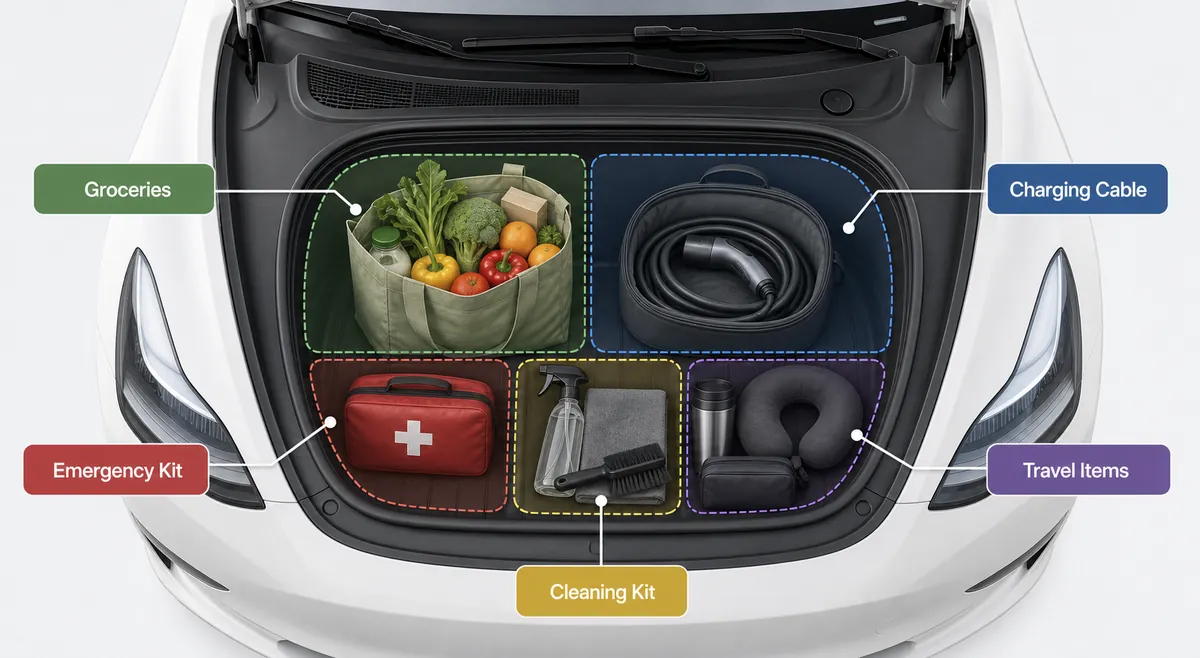
A Tesla frunk works best for clean, compact, moderately light items that benefit from separation from passengers or the rear cargo area. Common examples include groceries, takeout, charging cables, a portable EVSE, cleaning supplies, emergency tools, shoes, small travel bags, and outdoor accessories.
The EV charging cable and connector guide helps identify the connector and cable format before choosing a pouch. If the vehicle carries a backup unit, the portable EV charger guide explains the equipment context; the frunk only provides storage and does not change the charger’s electrical requirements.
Use a simple three-question test for any object:
- Can it move? Loose metal tools, pumps, or connectors can rattle, scuff the tub, or contact a release area.
- Can it leak? Food, cleaning liquid, and wet gear need a contained bag and a liner appropriate for the actual compartment.
- Can heat or cold damage it? The frunk is exposed to vehicle temperature changes. It is not a refrigerator or a climate-controlled storage cabinet.
Avoid treating the frunk as a place for people, sharp unsecured objects, heavy loads beyond the manual’s limit, or items that could activate a release. Tesla’s Model Y manual also warns that water and ice should be contained while driving and that the load limit depends on the front-trunk construction 1.
Is a Tesla frunk waterproof?
Do not assume that every Tesla frunk is waterproof. Water protection depends on the vehicle’s model, production version, liner, drain design, and the condition of its seals. Even when a manual describes a waterproof liner and drain plug, that does not mean exposed electronic components or stored cargo can be treated casually.
The current Model Y manual distinguishes between front-trunk constructions. Some versions have a waterproof liner and drain plug; another described construction is not sealed and should not be used for items that could be damaged by water 1. That is why “waterproof Tesla frunk” is too broad a product claim without a model and configuration.
| Situation | Safer decision |
|---|---|
| Spill-prone groceries | Use a fitted liner or sealed bag, then follow the vehicle’s cleaning guidance |
| Wet cable or rain gear | Contain it in a washable pouch; do not rely on the tub alone |
| Cleaning the tub | Confirm whether the vehicle has a drain and keep liquid away from modules, switches, and exposed cabling |
| Aftermarket liner | Confirm that it preserves the intended drainage path and does not cover a release or latch |
| Unclear vehicle version | Treat the frunk as dry storage until the owner’s manual confirms otherwise |
The accessory should communicate this boundary clearly. “Water-resistant liner” is a product attribute to verify; “the frunk is waterproof” is a vehicle-wide claim that may be false for another version.
What are the best Tesla frunk accessories?
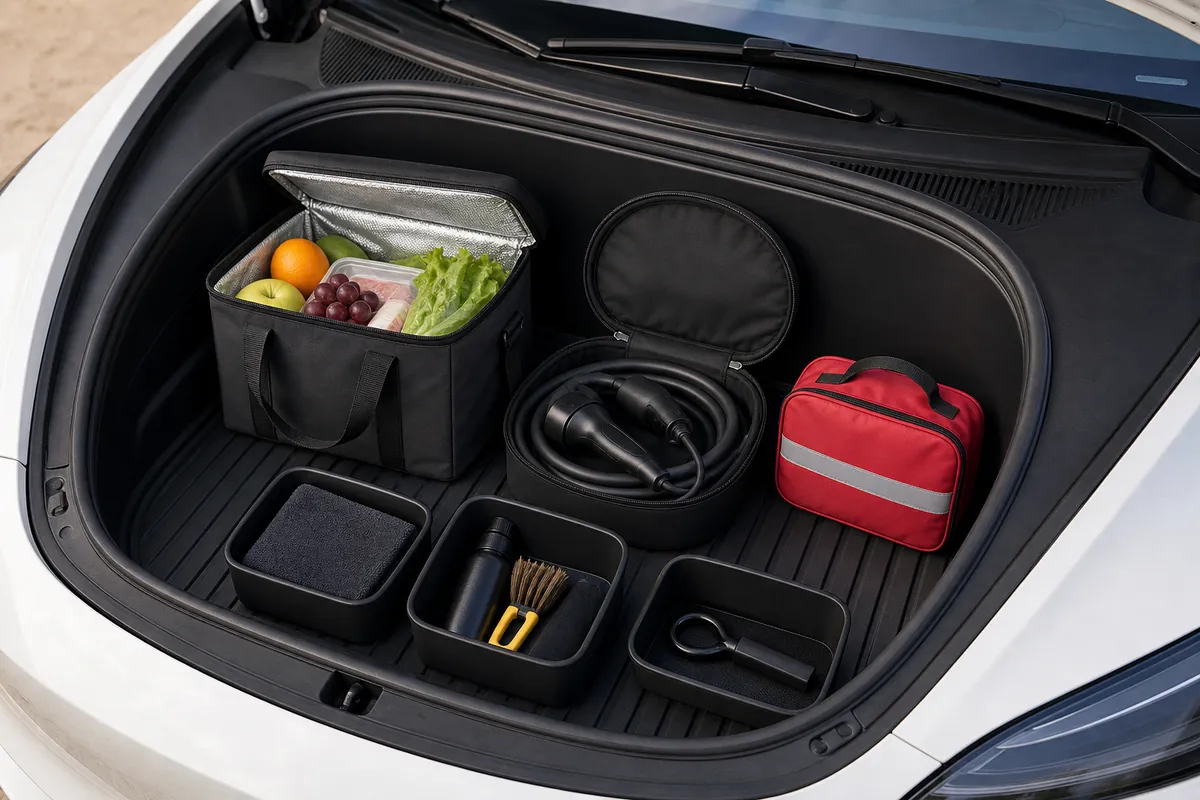
The best Tesla frunk accessory is the one that solves the owner’s actual problem without reducing safe clearance. For most owners, the useful order is a fitted liner first, then an organizer, bag, cable pouch, or divider only when that item has a clear job.
| Accessory | Problem it solves | What to check before buying |
|---|---|---|
| Fitted frunk liner | Dirt, spills, and difficult cleaning | Exact model/year fit, edge height, material odor, grip, removal, and drain clearance |
| Organizer bins | Small items slide into corners | Footprint, lid or handle access, rattling, stacking, and hood clearance |
| Insulated grocery bag | Food and takeout need separation | Size, wipe-clean surface, handles, thermal claims, and stability while driving |
| Charging cable pouch | Cable and connector need containment | Cable length and bulk, connector protection, water residue, zipper, and handle strength |
| Cargo net or divider | Bags move during turns | Attachment points, tension, removal, and whether it contacts the hood or latch |
| Emergency kit bag | Tools need a visible, contained home | Nonconductive organization, secure closure, heat exposure, and no loose metal parts |
| Cleaning kit bag | Towels and chemicals need separation | Leak control, chemical compatibility, wipe-clean fabric, and odor after heat exposure |
How should you choose a Tesla frunk liner or organizer?
Choose a frunk liner or organizer by matching the vehicle first, then checking closure, material, retention, cleaning, and packaging. A product that is 95% the right shape can still lift at a corner, block the latch, reduce hood clearance, or create an annoying rattle.
Use this buyer checklist:
- Fitment identity: Record model, year, refresh, market, trim, and seating configuration where applicable.
- Physical match: Compare the opening, wall angle, corners, raised edges, inserts, and the location of the emergency release or tow eye.
- Closure test: Install the accessory, place representative cargo inside, close the hood, and verify the latch without forcing it.
- Movement test: Drive over a representative road surface or use a controlled movement check to identify rattles, sliding, and edge lift.
- Material test: Check odor after heat exposure, flexibility in cold conditions, surface grip, stain resistance, and cleaning effort.
- Water path: Confirm that the accessory does not cover a drain, pool liquid against a seal, or direct water toward sensitive components.
- Service access: Ensure the product does not hide warnings, release controls, tow-eye access, or areas the owner needs to reach.
- Repeatability: For a branded range, compare more than one sample and record the production version, material, dimensions, and packaging.
The model-specific Tesla accessory fitment example is useful because it treats vehicle year, coverage, edge shape, retention, and cleaning as part of the buying decision. Frunk products need the same discipline even when the item looks simpler.
What should distributors check before sourcing Tesla frunk accessories?
Distributors should approve a complete vehicle-specific configuration, not a generic “Tesla frunk organizer.” The approval sample should include the exact model coverage, material, color, dimensions, packaging, labels, and any accessory insert that will ship to customers.
Ask the supplier to provide:
- A fitment matrix listing model, year, market, trim or configuration, and known exclusions.
- A dimension sheet showing the opening, base footprint, wall height, corner radii, and clearance points.
- Real-vehicle photos of installation, closed-hood clearance, latch area, and drainage or liner interface.
- Material information for odor, flexibility, cleaning, heat exposure, and surface grip.
- A sample test record covering fit, closure, movement, removal, cleaning, and repeat installation.
- Packaging and label controls that prevent Model 3, Model Y, Model S, and Model X stock from being mixed.
- A change-control process for tooling, material, factory, artwork, packaging, or model-year coverage.
Yirox’s EV aftermarket accessories range is a useful related reference when a distributor is building more than one model-specific accessory. If the product range includes charging storage, the EV charging accessories category helps separate cable and charger products from vehicle-storage accessories.
For private-label programs, approve the physical sample before carton artwork and volume production. The OEM/ODM product development process should preserve the approved fitment and material details so a later batch does not quietly become a different product under the same label.
What are common Tesla frunk accessory mistakes?
Most frunk accessory failures come from a small gap between the listing and the physical vehicle. The product is not always defective; the fitment claim, test method, or use instruction may be incomplete.
| Mistake | What happens | Better control |
|---|---|---|
| “Fits all Tesla models” claim | Corners, walls, or hood clearance do not match | Publish model- and year-specific coverage |
| Testing only on a bench | Product looks correct but fails at the latch or hood | Test on the real vehicle with the hood closed |
| Ignoring the drain | Liner traps water or covers the intended path | Map the drain and release areas in the drawing |
| Using rigid bins in a low hood area | Hood contact, marks, or closure resistance | Measure the closed clearance with representative cargo |
| No heat or odor check | Material smells strongly after parking in the sun | Include controlled heat exposure and acceptance criteria |
| Loose cable storage | Connector and cable bounce against the tub | Use a fitted pouch or restraint and check movement |
| Mixed cartons | Customers receive the wrong model version | Use SKU, year, batch, and carton checks at packing |
The fastest way to reduce returns is to photograph the exact fitment points that cause complaints: front corners, hood seam, latch area, drain opening, and the edge near the release. A single attractive top-down product photo does not prove any of those points.
How should you organize a Tesla frunk for daily use?
Organize the frunk around frequency and consequence: frequently used items near the opening, spill-prone items inside a liner or bag, and emergency items secured where they cannot move into the latch area.
For daily driving, a practical arrangement is:
- Keep the charging cable or portable EVSE in a dedicated pouch, with the connector protected and the cable dry enough for storage.
- Put groceries or takeout inside a washable or insulated bag rather than directly on the tub.
- Store cleaning supplies in a separate leak-controlled bag so chemicals do not contact food or fabric luggage.
- Keep the emergency kit visible and restrained, with no loose metal tools near the release or hood structure.
- Leave a clear inspection path around the latch, seal, release, and any drainage point.
For a road trip, do not fill every corner just because space remains. Leave room for the hood to close naturally and keep heavier items low and stable. Recheck the compartment after adding a new organizer: a product that worked empty may create pressure when loaded.
Conclusion: Make the frunk fit the way you use the car
A Tesla frunk is a front storage compartment that can make daily driving cleaner and more organized. Its value comes from separation: groceries away from luggage, charging gear away from clean cargo, and emergency supplies in a dedicated location.
The important limits are model-specific. Confirm the exact vehicle and production version, check the owner’s manual for opening, closing, load, and water guidance, and test any liner or organizer with the hood closed. Choose accessories for a defined problem, not for a generic “fits Tesla” label.
If you are sourcing Tesla frunk liners, organizers, bags, or charging-storage accessories, share the exact model coverage, production years, dimensions, material, packaging, branding, and expected volume. We can help turn those requirements into a focused sample and fitment review through the request a Tesla frunk accessory fitment review form.
Frequently Asked Questions
What is the frunk on a Tesla?
The frunk is the front trunk under the hood. It is a separate storage area that can hold groceries, charging equipment, emergency supplies, and small bags, subject to the vehicle’s model-specific load and water guidance.
How big is a Tesla frunk?
Size varies by model, year, market, seating configuration, and vehicle design. Check the official manual or specifications for the exact vehicle. Published volume is only part of the answer; the opening, corners, hood clearance, and usable footprint determine what will actually fit.
Can you put groceries in a Tesla frunk?
Yes. Groceries and takeout are practical frunk uses because they can stay separate from passengers and rear-cargo luggage. A washable liner or insulated bag helps contain spills, but it does not make every frunk waterproof.
Is a Tesla frunk waterproof?
Not universally. Some vehicle configurations have a waterproof liner and drain, while others are described as unsealed in the owner’s manual. Confirm the exact model and production version before storing items that can be damaged by water.
Can you store a portable EV charger in a Tesla frunk?
You can store a portable charger if it is clean, dry enough for storage, contained so it cannot move, and compatible with the vehicle’s available space. Keep the connector and cable protected, and do not let the equipment interfere with the latch, hood, or release area.
Do Tesla frunk liners fit every Tesla model?
No. Frunk liners are usually model-specific and can also be year- or version-specific. Check the exact fitment, hood clearance, edge coverage, drainage, and closure before buying or approving a product.
What should a distributor request from a Tesla frunk accessory supplier?
Request a model-and-year fitment matrix, dimension sheet, real-vehicle installation photos, material information, closure and movement test results, packaging labels, and a change-control record. For private-label products, approve the physical sample and packaging together.
References
[1] Tesla. “Model Y Owner’s Manual: Front Trunk.” 2026.
[2] Tesla. “Model 3 Owner’s Manual, 2024+ North America Edition.” 2026.
[3] Tesla. “Model X Owner’s Manual, 2021+ North America Edition.” 2026.
[4] Tesla. “Model X Owner’s Manual: Cargo Volume.” 2026.