



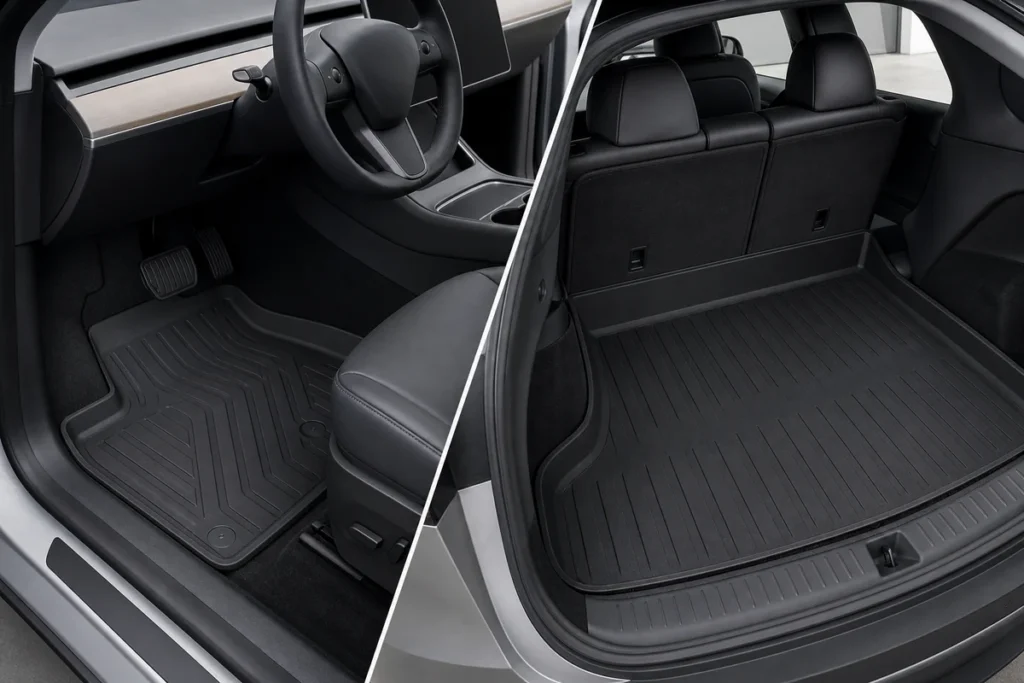
A Tesla Model Y floor mat is a removable carpet mat or molded liner that protects the vehicle's footwells from dirt, water, salt, sand, spills, and heel wear. The correct choice depends first on the exact Model Y version and cabin layout, then on coverage, material, retention, pedal clearance, cleaning, and price. “Model Y” alone is not a complete fitment specification.
The most important distinction is the vehicle version. Tesla lists separate all-weather liner applications for Model Y vehicles produced in 2020–2024 and vehicles produced in 2025+, so a mat that looks close can still be the wrong shape for the floor, seat rails, or retention points. 2 3
For a wider ownership checklist, the related Tesla accessories guide helps place floor mats alongside cargo, charging, storage, and protection products. When choosing a mat, start with the decisions that determine whether it fits, stays secure, cleans well, and is worth buying or stocking.
Table of Contents
- What does a Tesla Model Y floor mat do?
- Do Model Y floor mats fit every year and version?
- What types of Model Y floor mats and liners are available?
- Which material suits your Tesla Model Y use case?
- How much coverage should a Model Y mat set include?
- How do you install a Model Y floor mat safely?
- How should you clean and maintain Model Y mats?
- What should distributors check before sourcing Model Y floor mats?
- What should a Model Y floor-mat RFQ include?
- Conclusion: choose the mat that fits the actual Model Y
- Frequently Asked Questions
- References
What does a Tesla Model Y floor mat do?
A Model Y floor mat has four practical jobs: protect the original carpet, contain dirt and moisture, make cleaning easier, and stay out of the way of vehicle controls. A good-looking mat that slides, curls, traps water under its edge, or reaches the pedals has failed the most important part of the job.
| Job | What the mat needs to do | What the owner should notice |
|---|---|---|
| Carpet protection | Cover the areas that receive shoes, mud, sand, spills, and cargo-related dirt | Less staining and less wear on the original carpet |
| Moisture and debris control | Use a suitable surface, channel, or raised edge for the expected exposure | Water and grit remain easier to remove instead of spreading into seams |
| Stable positioning | Match the footwell shape and use the correct retention or anti-slip system | The mat stays flat during entry, braking, turning, and seat adjustment |
| Easy cleaning | Allow vacuuming, wiping, rinsing, or laundering according to the material | The cleaning method does not damage the backing or leave strong odor |
| Comfortable daily use | Keep edge height, texture, thickness, and heel area practical | Shoes do not catch on the edge and the mat does not feel unstable |
Floor mats protect the interior; they do not repair damaged carpet, improve vehicle range, or replace safe driving habits. They also do not need to be the thickest item in a catalogue. The useful test is whether the mat solves the customer's actual exposure and handling problem without creating a new one near the driver's feet.
Do Model Y floor mats fit every year and version?
No. Model Y floor mats should be bought by the exact vehicle application, not by the words “Tesla Model Y” alone. Tesla's own listings separate 2020–2024 liners from 2025+ liners, which is a clear signal that the vehicle version must be recorded before a purchase or product listing is approved. 2 3
Use four fitment gates
- Vehicle production period: Record the model year or production application shown by the supplier. A listing that says only “Model Y” leaves the highest-risk field open.
- Cabin and seating layout: Confirm whether the set is for the intended row layout and whether cargo pieces are included or sold separately. If a supplier uses separate patterns for seating configurations, keep those SKUs separate.
- Driving side and footwell shape: Check left-hand-drive or right-hand-drive coverage where relevant. The driver's pedal area is not a safe place for a “close enough” universal shape.
- Coverage and retention points: Match front, rear, tunnel, seat-rail, edge, hook-and-loop, cleat, or anti-slip details to the actual vehicle floor.
The fitment gate should end with a clear label such as “Model Y, 2020–2024, five-seat cabin, front and rear rows,” or “Model Y, 2025+, specified cabin application, complete interior set.” The exact wording depends on the product, but the principle does not change: year, version, coverage, and set contents must be visible in the product record and packaging.
Why a near fit is still a failed fit
A small mismatch can leave an exposed carpet strip, push the edge into a seat rail, stop a retention point from engaging, or create a fold near the accelerator. A customer may not notice the problem until rain, snow, cleaning, or repeated entry changes the mat's position. That is why a photo of the mat beside a vehicle is weaker evidence than a retained sample installed in the intended footwell.
What types of Model Y floor mats and liners are available?
The main choices are carpet mats, all-weather liners, rubber mats, layered mats, and cargo or frunk liners. They are not interchangeable products: each makes a different promise about comfort, coverage, cleaning, appearance, and weather exposure.
| Product type | Where it fits best | Main advantages | Main trade-off |
|---|---|---|---|
| Carpet mat | Dry climates, indoor parking, comfort-focused use | Soft feel, quiet contact, factory-style appearance | Holds stains and moisture more readily; needs careful drying |
| Molded all-weather liner | Rain, snow, sand, children, pets, and frequent cleaning | Contoured coverage, raised edges, channels, easy wipe or rinse | Can feel more utilitarian; shape and odor vary by material quality |
| Rubber mat | Heavy-duty or lower-cost programs | Familiar grip and rugged surface | Can be heavier, smell stronger, curl, or feel less precisely molded |
| Layered or carpet-over-liner design | Buyers who want a styled surface plus a protective base | Combines appearance and a protective structure | Separated layers can trap moisture or move if retention is weak |
| Cargo liner | Trunk, rear cargo, or seatback loading | Protects against luggage, tools, groceries, pet hair, and wet items | Does not replace cabin footwell mats; coverage is vehicle-version specific |
| Frunk liner | Front storage use | Creates a wipeable surface for charging gear, small tools, or groceries | Must match the frunk shape and should be treated as a separate fitment SKU |
An all-weather liner is not automatically the best choice for every owner. A driver who wants a soft, quiet surface and rarely carries wet or dirty items may prefer carpet. A family, pet owner, or winter driver may value containment and fast cleaning more than a textile feel. The right answer is the one that fits the use case and stays secure.
Which material suits your Tesla Model Y use case?
TPE is often the most balanced material route for a molded all-weather Model Y liner, but “best material” is not a universal conclusion. The formula, molding quality, edge recovery, texture, odor, backing, and fit can matter more than the material name printed on the listing.
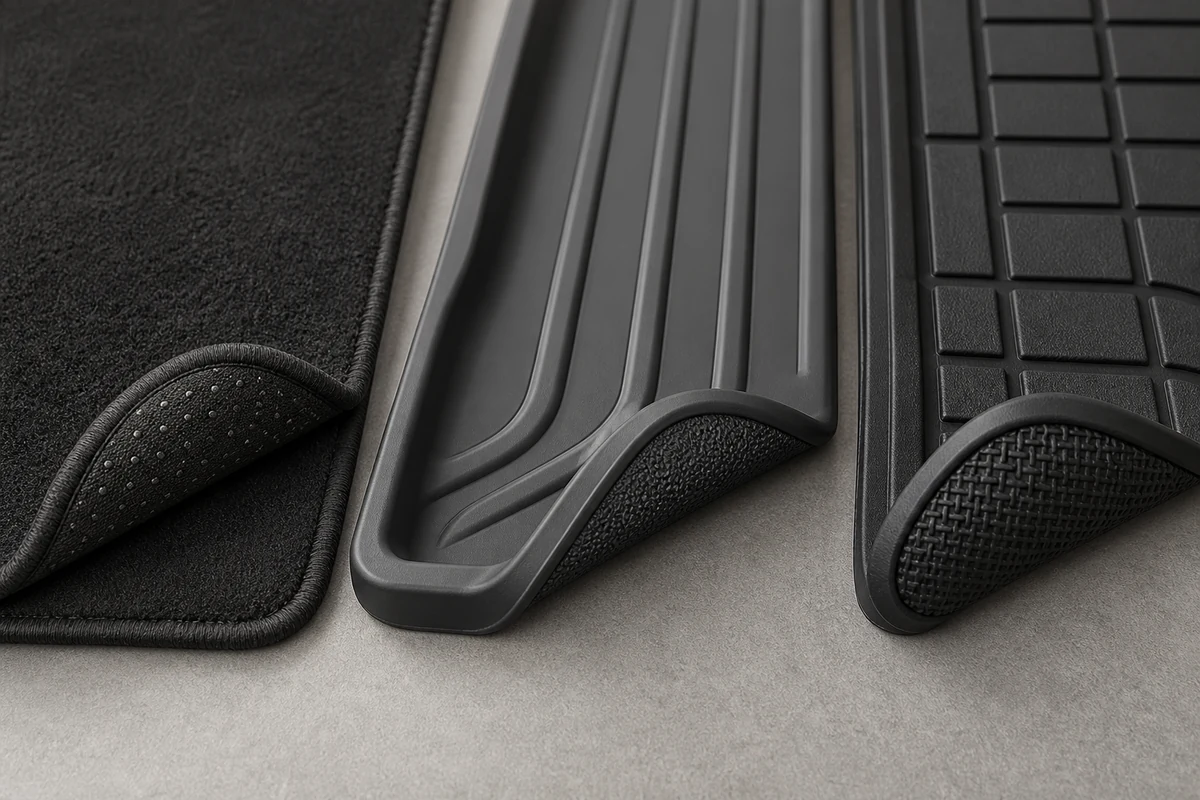
Carpet
Carpet mats work when appearance, softness, and a quieter underfoot feel are priorities. They are easier to coordinate with an original-style interior and can be comfortable for drivers who mostly deal with dry conditions. They need more attention after mud, salt, spilled drinks, or pet accidents because moisture can stay in the fibers and backing.
TPE or other molded thermoplastic materials
Molded thermoplastic liners are valued for their shaped fit, raised edges, channels, and easier cleaning. Tesla describes its Model Y all-weather liners as injection-molded thermoplastic elastomer with vertical walls and integrated retention features. 3 For an aftermarket or private-label product, the word “TPE” still does not prove the same performance. Ask for a sample and inspect flexibility, surface finish, edge recovery after packaging, odor after opening, and how the retention points engage.
Rubber
Rubber can make sense for a rugged, cost-conscious, or workshop-oriented program. It is familiar and can provide a grippy surface, but a rubber mat that is too soft may curl, while one that is too hard may sit poorly on the floor contours. Odor, weight, texture, and shipping deformation should be checked before the material is positioned as a premium option.
What matters more than thickness
Thickness is only one field. Compare the mat's actual coverage, edge height, heel-pad shape, backing, retention, flexibility, temperature behavior, odor, cleaning method, and package recovery. A thinner liner with accurate molding can be safer and more useful than a thicker liner that pushes into a pedal area or does not recover after being folded in a carton.
How much coverage should a Model Y mat set include?
Choose coverage by the way the vehicle is used: front row only, full passenger cabin, cargo area, frunk, seatback, or a coordinated complete set. A “full set” is not a universal term, so the product page and carton should name every included piece.
| Coverage decision | What to confirm before buying | Common mistake |
|---|---|---|
| Front row | Driver and passenger pieces, side orientation, pedal clearance, and retention | Treating a front-only set as complete interior coverage |
| Rear row | One-piece or multi-piece design, center tunnel coverage, seat-rail clearance, and removal path | Assuming every rear layout uses the same shape |
| Complete cabin | Exact piece count, left/right position, edge overlap, and package contents | Mixing a front version from one vehicle period with a rear version from another |
| Trunk or cargo area | Floor position, raised lip, fold or seatback interaction, and load direction | Calling a cargo liner a cabin mat or leaving the rear threshold unprotected |
| Frunk | Actual frunk contour, drainage or cleaning expectations, and lift-out access | Adding a generic tray that blocks access or does not sit flush |
| Seatback or extended cargo | Hinge movement, folding seats, anchor access, and abrasion points | Protecting the floor while leaving the high-contact load surface exposed |
Cargo and frunk products deserve their own fitment record. The related Tesla frunk and storage guide is a useful next step when the buyer is planning a whole-vehicle storage setup rather than only a passenger-floor purchase.
Do not add every piece just to make the set look larger. Extra pieces can create inventory confusion, slow-moving variants, and a package that promises more coverage than the customer actually receives. A smaller, clearly labeled set is easier to sell and easier to replace.
How do you install a Model Y floor mat safely?
Install the mat directly on the vehicle floor, remove any old mat underneath, engage the intended retention system, and check the accelerator and brake through their full movement before driving. Tesla's liner instructions specifically warn against stacking mats, require correct placement and secure retention, and call for reinspection after cleaning, detailing, or service. 1
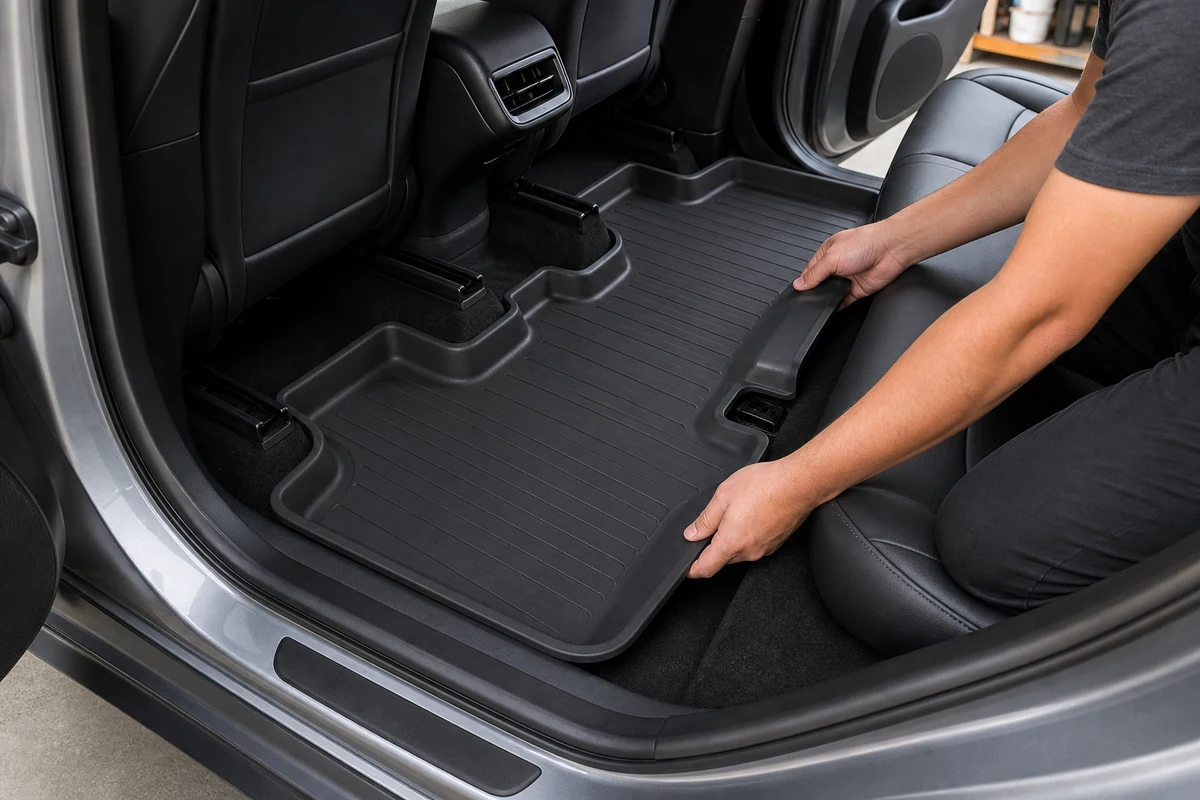
A practical installation sequence
- Remove the original carpet mat or any other loose floor covering from the area.
- Check the mat label and side before placing it. Do not force a driver-side mat into a passenger-side position.
- Set the mat into the footwell and press its retention points into the intended anchors, cleats, discs, or anti-slip interface.
- Run a hand around the edges and under the front lip to confirm that nothing is folded, trapped, or lifted toward the pedals.
- Move the seat through its normal travel and confirm that rails, hinges, vents, and rear foot space remain clear.
- Before starting the vehicle, operate the accelerator and brake through their full range without the mat touching or catching them.
- Recheck after the first drive, after a deep clean, and after any service that requires removing the mat.
If the driver's mat moves forward, curls into the pedal area, or will not engage its retention points, stop using it until the issue is corrected. Do not solve a fitment problem by adding tape, a second loose mat, or a random universal grip layer under the driver-side mat.
How should you clean and maintain Model Y mats?
Clean a Model Y mat according to its material and backing: remove it from the vehicle, remove loose debris, use a compatible cleaner, rinse or wipe as appropriate, dry it fully, and reinstall it with retention and pedal clearance checked again. The cleaning method is part of product selection because a mat that cannot be dried or restored easily creates a recurring odor and fit problem.
| Material or format | Practical cleaning routine | Avoid |
|---|---|---|
| Carpet | Vacuum first; spot-clean with a mild fabric product; dry the backing completely | Saturating the backing or reinstalling while damp |
| TPE or molded thermoplastic | Shake or vacuum grit; rinse or wipe; use mild soap for oily dirt; dry before fitting | Harsh solvents, abrasive brushes, or slippery dressings |
| Rubber | Remove and rinse; brush grooves gently; air-dry out of direct heat | Solvents that change the surface or leave it slick |
| Layered mat | Clean each layer only as its construction allows; check separation and trapped moisture | Assuming the top surface is dry while the lower layer remains wet |
| Cargo or frunk liner | Empty the storage area, clean the liner outside the vehicle, and inspect the edges and fold areas | Leaving grit under the liner where it can abrade the carpet or trim |
During winter, salt residue can collect in channels and along the edge. In pet or family use, hair and sand often gather in corners and under the front seats. A quick inspection after a high-exposure trip is more useful than waiting until the mat is visibly dirty.
Do not use a glossy protectant simply to make a rubber or TPE surface look new. A slippery surface under shoes is a poor trade for visual shine. Follow the product's cleaning instructions and replace a mat when it has lost shape, retention, or safe pedal clearance.
What should distributors check before sourcing Model Y floor mats?
Distributors should approve a Model Y mat as a fitment-controlled product, not as a generic molded accessory. The sample must match the promised vehicle version, material, coverage, retention, packaging, and customer instructions before a larger purchase is released.
The seven-point sample gate
| Gate | What to inspect | Evidence to retain |
|---|---|---|
| Application identity | Model Y production period, cabin layout, driver side, and SKU | Fitment card, label photo, and approved application list |
| Physical fit | Footwell contours, seat rails, edges, tunnel, anchors, and cargo interfaces | Photos in the actual vehicle and measured control points |
| Driver safety | No pedal interference, forward movement, bunching, or loose edge | Signed driver-side clearance check |
| Material and odor | Surface, flexibility, backing, odor after opening, and edge recovery | Material declaration, sample notes, and packaging recovery record |
| Cleaning and wear | Channels, heel area, grip, rinse behavior, and resistance to normal handling | Cleaning trial, wear observations, and acceptance criteria |
| Pack-out | Piece count, left/right labels, version label, barcode, carton, and instructions | Approved artwork and retained package sample |
| Repeatability | Mold revision, critical dimensions, batch identification, and change notification | Golden sample, inspection plan, and production change rule |
The most expensive mistake is approving a sample that fits but cannot be reproduced. Ask the supplier how the mold revision is controlled, which dimensions are inspected, how a changed material is approved, and how the factory prevents 2020–2024 and 2025+ pieces from being mixed in the same carton.
Do not accept “custom fit” as the end of the discussion. Ask what was measured, which vehicle was used, whether the sample was tested after packaging, and which dimensions determine acceptance. This is where Yirox's broader branded automotive NEV accessories range can be evaluated using the same fitment, labeling, sample, and repeat-supply discipline.
What should a Model Y floor-mat RFQ include?
An RFQ should make each supplier quote the same application and package. The minimum brief should identify the vehicle version, exact coverage, material preference, retention method, packaging, target market, sample quantity, and quality evidence.
| RFQ block | Fields to specify |
|---|---|
| Vehicle application | Model Y production period, refreshed or legacy application if relevant, cabin layout, driving side, and vehicle reference |
| Coverage | Front only, full cabin, rear, cargo, frunk, seatback, or complete set; exact piece count |
| Material | Carpet, TPE, rubber, layered construction, color, surface texture, backing, and odor requirement |
| Fit and retention | Molded contours, edge height, anchors, cleats, hook-and-loop or anti-slip design, and pedal-clearance requirement |
| Cleaning and use | Expected climate, mud/snow/sand/pet exposure, cleaning method, and storage conditions |
| Packaging | Logo, label, barcode, language, version warning, bag, carton size, and protection against folding or compression |
| Quality evidence | Sample photos in vehicle, dimensional check, material information, odor review, cleaning trial, and retained golden sample |
| Commercial terms | Sample price, tooling or mold ownership, MOQ, production lead time, reorder terms, warranty, spare pieces, and change notification |
Ask for separate prices for the mat set, cargo or frunk add-ons, packaging, tooling, and any new version-specific mold work. This shows whether a low unit price is hiding a larger tooling or packaging commitment.
For a private-label program, define who owns the artwork, mold, application list, product photos, and revised sample. Also state who is responsible if the product is relabeled for the wrong Model Y period. Clear ownership is not legal decoration; it determines who can correct the listing and the inventory when a customer reports a fitment problem.
Send the vehicle application, desired coverage, material preference, target market, package contents, and sample requirements when you request a Model Y mat sample and fitment review. A focused request produces a comparable quotation and gives the supplier a chance to flag a version conflict before production.
Conclusion: choose the mat that fits the actual Model Y
The right Tesla Model Y floor mat is not simply the thickest, most expensive, or most heavily advertised option. It is the product that matches the vehicle version and cabin layout, covers the areas the customer actually uses, stays secure, cleans without creating odor or slipperiness, and remains clear of the pedals.
For owners, start with the Model Y production period, set contents, material, retention, and driver's-side clearance. For distributors, add a sample gate for fitment, odor, edge recovery, packaging, mold control, version labeling, and repeat supply. Tesla's separate 2020–2024 and 2025+ liner applications make the first decision non-negotiable: record the vehicle version before you compare materials or prices. 2 3
That is the independent value of a useful Model Y mat decision: it tells you what to check before purchase, what to test before installation, and what to put in the supplier's product record before the wrong version becomes inventory.
Frequently Asked Questions
What is the best material for Tesla Model Y floor mats?
For many all-weather users, a well-molded TPE liner offers a balanced combination of shaped fit, raised-edge coverage, cleanability, and daily durability. Carpet can be better for a soft, original-style feel, while rubber can suit heavy-duty or cost-focused use. The formula and fit matter more than the material name alone.
Do 2020–2024 Model Y floor mats fit 2025+ vehicles?
Do not assume they do. Tesla lists separate Model Y all-weather liner applications for vehicles produced in 2020–2024 and 2025+, so the exact vehicle application must be matched before buying. 2 3
Can I put new floor mats over the original Model Y mats?
No. Tesla's all-weather liner instructions say to remove existing carpet mats or other floor mats before installation and not to stack liners. 1 Stacking can raise the surface or allow movement near the pedals.
How do I stop Model Y floor mats from sliding?
Use a mat molded for the exact vehicle application with the intended anchors, cleats, hook-and-loop discs, or anti-slip interface. Install it directly on the floor, press the retention points into place, and check the accelerator and brake through their full travel. If the mat still moves, stop using it on the driver side.
Are cargo and frunk liners included with a Model Y floor-mat set?
Not necessarily. Some sets cover only the front and rear passenger footwells; others add the trunk, frunk, seatbacks, or storage areas. Check the exact piece count and package contents rather than relying on a product photo that shows optional pieces.
What should I check when buying Model Y floor mats in bulk?
Confirm the vehicle version, cabin layout, piece count, material, retention, pedal clearance, odor, edge recovery after packaging, mold revision, labels, barcode, carton, sample approval, and change-control process. A supplier should be able to show how 2020–2024 and 2025+ variants are separated and traced.
How often should Model Y floor mats be cleaned?
Clean them when dirt, salt, moisture, or pet hair begins to collect, with more frequent checks during winter or heavy-use periods. Remove the mat, use a material-appropriate method, dry it fully, and reinstall it with retention and pedal clearance checked again.
References
[1] Tesla. “All-Weather Interior Liner Safety Information.” Accessed September 2026.
[2] Tesla Shop. “2020-2024 Model Y All-Weather Interior Liners.” Accessed September 2026.
[3] Tesla Shop. “Model Y All-Weather Interior Liners for vehicles produced in 2025+.” Accessed September 2026.