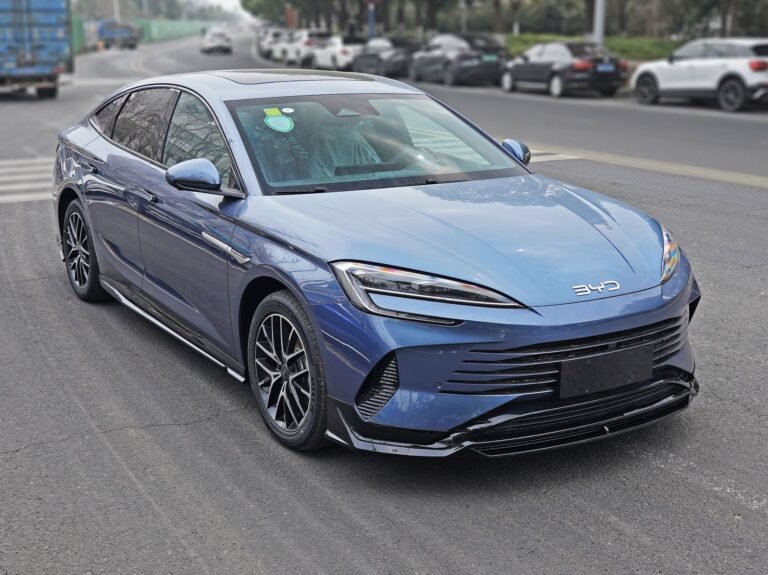





BYD car models include battery-electric vehicles, plug-in hybrid models, hatchbacks, sedans, SUVs, MPVs, and pickup-style vehicles. The exact names and trims depend on the country, model year, and powertrain, so the reliable way to identify a BYD is to confirm the local name, VIN or registration details, body type, drivetrain, and production revision before choosing a vehicle accessory.
The word “BYD” can describe a model sold under the BYD badge or a related group brand. It can also refer to a nameplate that changes between domestic and export markets. That is why a global list of names is only a starting point; the useful answer is a model-identification method that still works when the local dealer list changes.
Table of Contents
- What Are BYD Car Models, and How Is the Lineup Organized?
- Which BYD Models Are Pure Electric and Which Are Plug-In Hybrid?
- Which BYD Models Are Commonly Seen in Export Markets?
- How Are BYD Models Grouped by Body Type?
- Why Do BYD Model Names Change by Market?
- What Is the Difference Between a BYD Model, Trim, and Model Year?
- How Do Battery and Charging Choices Affect a BYD Model?
- How Should You Choose Accessories for a BYD Model?
- What Should Distributors Check Before Adding BYD Accessories?
- What Mistakes Cause BYD Fitment Problems?
- Conclusion: Identify the Local Configuration Before Choosing the Accessory
- Frequently Asked Questions
- References
What Are BYD Car Models, and How Is the Lineup Organized?
BYD models are easier to understand when four layers are kept separate: brand family, nameplate, drivetrain, and local trim. A Dolphin and a Seal are different nameplates; a pure-electric version and a DM-i version use different powertrains; and a local “Comfort,” “Premium,” or similar trim can change equipment without changing the main model name.
BYD’s current European electric-car page is a useful example of why a static global list becomes outdated. It presents models such as DOLPHIN SURF, DOLPHIN, ATTO 2, ATTO 3, SEAL, SEAL U, SEALION 7, TANG, and HAN, while the wider BYD media hub also lists hybrid variants and other model families. These are market-specific examples, not a universal list for every country. 1 2
For a reader comparing cars, start with the use case: city driving, family space, long-distance travel, performance, commercial carrying, or access to charging. For a parts buyer, start with the exact vehicle record instead: market, year, body, drivetrain, inlet or mounting point, and visible part revision. The second approach prevents a popular model name from becoming a misleading fitment shortcut.
Which BYD Models Are Pure Electric and Which Are Plug-In Hybrid?
Pure-electric BYD models run from a traction battery and electric drive system. Plug-in hybrid models, often marked with a DM-i name in BYD’s model materials, combine a rechargeable battery with an internal-combustion powertrain. Both may be sold as “new energy vehicles,” but they do not automatically share charging hardware, underbody parts, storage layouts, or accessory clearances.
| Powertrain group | What the buyer is choosing | What can change for accessories |
|---|---|---|
| Pure electric / BEV | Battery-only propulsion and the local AC or DC charging configuration | Charge-port position, cable needs, underbody protection, floor shape, and battery-related clearance |
| Plug-in hybrid / DM-i | A rechargeable battery plus an engine and hybrid control system | Fuel-system space, exhaust or underbody layout, charge-port details, and trim-specific mounting points |
| Same nameplate, different drivetrain | A model family that looks similar but has different equipment underneath | A mat, tray, splash guard, cable, or mounting kit may require a separate SKU |
The drivetrain label should therefore appear in a product-fitment record. “BYD Seal accessories” is not precise enough if the catalog serves both electric and hybrid variants, or if a nameplate is used differently across markets. Add the local model code and production period before treating two vehicles as one application.
Charging is another boundary. An electric model may need a home charging cable or a public DC connector, while a plug-in hybrid may have a different AC charging requirement and no equivalent DC fast-charging use. Readers who are still separating the hardware should review EV charging cable and connector types before selecting a cable or adapter.
Which BYD Models Are Commonly Seen in Export Markets?
Export-market examples usually fall into recognizable nameplate groups, but availability, spelling, trim names, and specifications must be checked locally. The following map is intended to explain the role of a nameplate, not to imply that every model is sold in every country.
| Representative nameplate | Common role in a lineup | Practical question before purchase |
|---|---|---|
| DOLPHIN SURF and DOLPHIN | Small or compact hatchback-oriented electric models | Is the local car the same wheelbase, door layout, battery version, and interior revision? |
| ATTO 2 and ATTO 3 | Compact crossover or SUV-oriented models | Does the accessory match the local body, console, cargo floor, and model year? |
| SEAL and HAN | Electric sedan nameplates with different size and positioning | Are the item dimensions tied to the exact sedan rather than a generic BYD sedan label? |
| SEAL U, SEALION 7, and TANG | SUV-oriented models serving different size, performance, or seating needs | Is the product for the correct seating layout, cargo configuration, and charging version? |
| SHARK and DM-i nameplates | Hybrid or utility-oriented applications in selected markets | Is the vehicle hybrid, pickup-style, or another local variant with a different installation boundary? |
BYD’s Europe pages identify model roles such as the DOLPHIN as a hatchback, ATTO 3 as a compact crossover SUV, SEAL as a sedan, SEAL U as a family SUV, SEALION 7 as an electric performance SUV, and TANG as a seven-seat electric SUV. Those descriptions help with orientation, but they do not replace the local brochure or vehicle record for an order. 1 4
How Are BYD Models Grouped by Body Type?
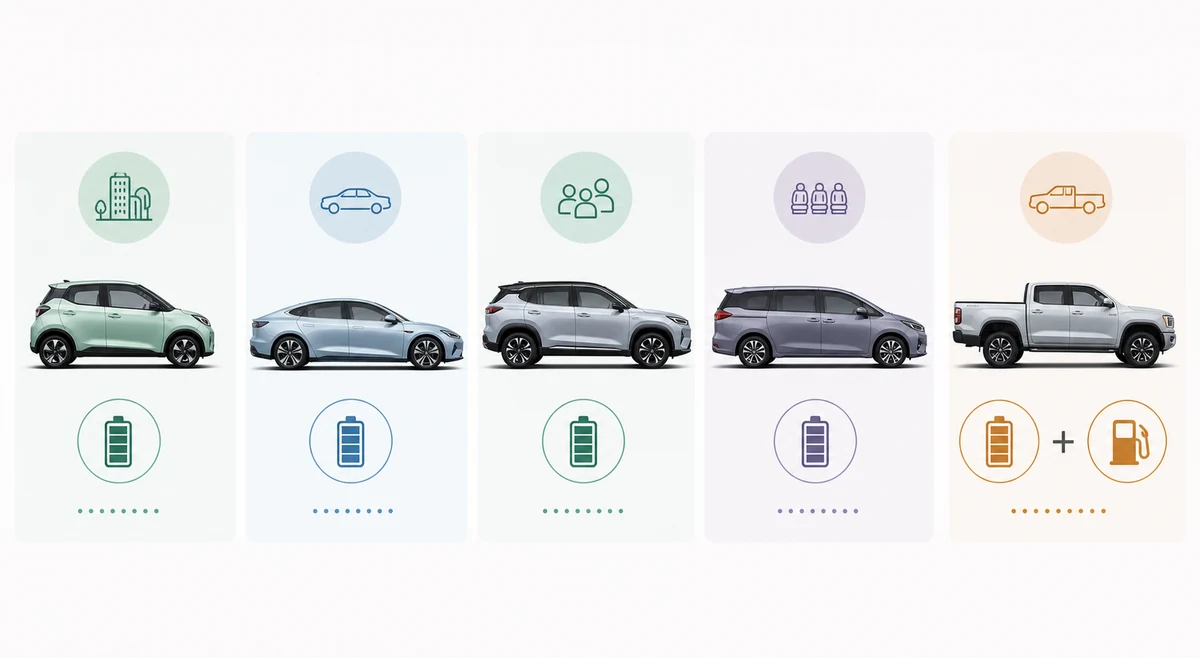
Body type is a useful first filter because it affects cabin space, cargo layout, roofline, and mounting locations. It is not a complete fitment key: two SUVs can have different floor contours, seat rails, cargo floors, or exterior attachment points.
For personal use, a hatchback usually points to compact city driving, a sedan to a separate trunk, an SUV to flexible cargo space, and an MPV or seven-seat vehicle to passenger capacity. For accessories, translate that label into measurable interfaces such as floor sections, cargo dimensions, seat rows, wheel size, sensor locations, and charging-port access.
| Body type | What it helps you decide | What it does not prove |
|---|---|---|
| Hatchback | Front and rear floor coverage, cargo opening, urban-use accessory priorities | That two compact hatchbacks share mats, trays, or rear cargo dimensions |
| Sedan | Trunk layout, lower roofline, passenger-cabin coverage, wheel and aero considerations | That sedan accessories fit across different nameplates or generations |
| Crossover / SUV | Higher body, cargo flexibility, roof or exterior accessory needs | That all BYD SUVs share roof rails, sill shapes, floor clips, or cargo panels |
| MPV / seven-seat vehicle | Number of seating rows, sliding-seat movement, and cargo conversion | That a five-seat and seven-seat version use the same floor or storage kit |
| Pickup or utility vehicle | Bed, cab, load protection, and work-use accessory requirements | That a platform-level part matches every cab, market, or hybrid version |
For the car buyer, combine body type with parking space, passenger count, cargo frequency, charging access, and local service. For distributors, add return data to see where a shared SKU is failing.
Why Do BYD Model Names Change by Market?
BYD names can change because a vehicle is launched under a different local naming system, positioned for a different market segment, or sold with a different drivetrain and equipment package. Translations, model-year updates, and local homologation can also affect the name used by dealers and parts catalogs.
Treat the name as a search key, not final proof. Confirm the VIN or registration detail, local brochure, production date, vehicle dimensions, drivetrain, and the component that the accessory must mate with. An imported vehicle may carry a familiar name while using a different steering side, lighting arrangement, charging inlet, harness, sensor layout, or cargo floor.
Keep the following fields in a model cross-reference:
- Local sales name, country or region, model year, and facelift or generation marker.
- Drivetrain, body, seat count, steering side, and relevant wheel or cargo configuration.
- VIN, OEM part number, or a clear photo of the mating area when available.
- Accessory SKU, drawing revision, sample result, and packaging label.
That cross-reference is more durable than a page that lists names without their decision boundaries. It also gives customer service a specific path when a buyer asks whether an item fits “a BYD SUV.”
What Is the Difference Between a BYD Model, Trim, and Model Year?
A model is the main vehicle name, a trim is an equipment level within that model, and a model year or revision identifies when and how the vehicle was produced. These layers can change a part’s fitment even when the exterior looks almost identical.
Trim can affect seat material, screen size, speaker locations, powered tailgate hardware, roof equipment, wheel diameter, camera modules, charging equipment, and interior storage. A model-year update can alter the center console, dashboard, floor fasteners, bumper sensors, lighting, or wiring. Not every difference requires a new accessory, but none should be assumed away.
Use a fitment confidence label when the evidence is incomplete:
| Status | Meaning | Next action |
|---|---|---|
| Confirmed | Exact model, year, market, version, and interface match the sample or drawing | Approve the SKU for the documented application |
| Probable | Nameplate and body appear to match, but one critical field is missing | Request the VIN, dimensions, photo, or local brochure |
| Unconfirmed | Only a broad brand or model-family name is known | Do not promise fitment or place a bulk order |
| Not compatible | Vehicle, interface, or mounting boundary is different | Offer the correct variant or close the inquiry |
This structure is also useful for online product pages. Put the confirmed application in the first specification block, then list exclusions. “Fits BYD vehicles” creates more uncertainty than “fits BYD ATTO 3, EU-market pure-electric version, specified model years, with the listed center-console revision.”
How Do Battery and Charging Choices Affect a BYD Model?
Battery branding helps explain BYD technology, but it is not a complete vehicle specification. BYD presents the Blade Battery as a battery technology used in its electric-vehicle story, while the pack size, chemistry details, thermal system, charging limits, and vehicle integration still vary by model and market. 3
For a vehicle buyer, check the local battery capacity, AC input, DC input if available, charging-port location, charging curve information, warranty terms, and compatible public equipment. A battery name alone cannot tell you which cable length, connector, adapter, wall-box setting, or storage accessory is correct.
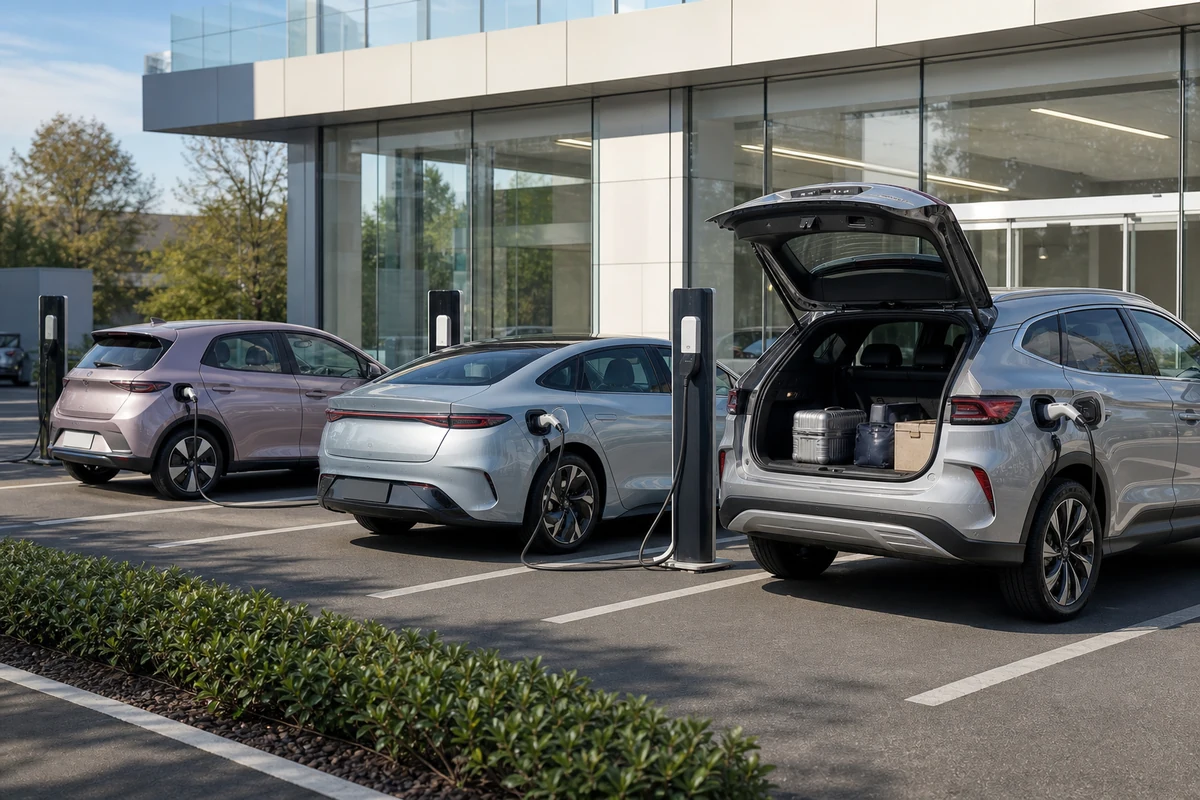
For an accessory buyer, battery and charging information affects clearance and use rather than just range. A cable holder must carry the actual cable and connector; a portable charger bag needs the correct cable bulk; a charge-port cover must match the inlet and weather exposure; and an adapter must be approved for its specific source and destination interfaces.
The BYD Blade Battery explanation is the natural next step for readers who want the technology background. The model page should then return to the local vehicle specification before a product is selected.
How Should You Choose Accessories for a BYD Model?
Choose the accessory by the interface it must cover, attach to, carry, or communicate with. The process is more reliable when the model question is translated into a short fitment brief before a product is compared.
- Identify the vehicle: record the full local name, model year, market, drivetrain, body, seat count, steering side, and VIN or registration details.
- Define the use: decide whether the item is for daily ownership, dealership delivery, fleet replacement, workshop installation, resale, or private label.
- Locate the interface: identify the floor clips, charging inlet, cable connector, bumper sensor, roof mounting point, wheel, screen harness, or other mating boundary.
- State the operating conditions: include indoor or outdoor use, water and dust exposure, temperature, UV, salt, cable weight, repeated handling, and storage.
- Match the evidence: compare the drawing, dimensions, material, mounting method, packaging label, test sample, and product revision with the vehicle record.
- Approve before scaling: test a representative vehicle, record the result, and separate confirmed applications from probable or unconfirmed ones.
For floor mats, cargo trays, organizers, and interior parts, compare floor contour, seat rails, retaining clips, console shape, rear-seat configuration, and cargo-floor position. For exterior parts, compare body panels, sensor cutouts, camera views, fasteners, paint or finish, and local road or weather conditions. The EV exterior accessories category is a useful next step when the request concerns body-mounted products rather than charging hardware.
For charging products, separate AC from DC, vehicle-side from station-side, and cable from adapter. The EV charging accessories compatibility checklist provides a useful structure for recording vehicle inlet, charger connection, current, voltage, communication, locking, market, and product revision.
What Should Distributors Check Before Adding BYD Accessories?
Distributors should build the range around documented applications, not a long list of BYD names. The question is whether the application can be described accurately, replenished consistently, and supported when a buyer has a different local revision.
| Distributor checkpoint | Evidence to keep | Why it protects the range |
|---|---|---|
| Application identity | Market, model, year, drivetrain, body, VIN or OEM reference | Prevents one broad name from covering incompatible vehicles |
| Physical interface | Drawing, dimensions, mating photos, fasteners, clearance | Shows what the part actually fits |
| Material and environment | Material, temperature, UV, water, salt, abrasion, load | Connects a product claim to the customer’s operating conditions |
| Installation | Instructions, tools, clip count, cable routing, labor time | Reduces returns caused by hidden installation steps |
| Sample evidence | Fit photos, test record, revision, vehicle identity | Makes a pass/fail decision repeatable |
| Catalog language | Positive fitment, exclusions, model-year notes | Keeps the customer promise narrower than the evidence, not broader |
| Supply continuity | MOQ, lead time, packaging, labels, spare parts, revision notice | Allows a confirmed SKU to remain supportable after reorder |
When a range covers fleets, ask for the actual vehicle population instead of only the company’s preferred model list. The EV charging accessories for fleets resource is useful when replacement stock and mixed configurations matter.
For a private-label range, approve the product name, model application, label, packaging, and sample together. If the factory changes a mold, clip, cable jacket, sensor position, terminal, or material, require a revision notice and decide whether the application needs a new test. The EV charging accessories supplier checklist can be used for the supplier-side evidence review.
BYD’s official media material also separates BYD-badged models from other group-brand content. Keep those boundaries visible: a related brand may share technology without sharing a dashboard, floor, bumper, charging inlet, or replacement part. 2
What Mistakes Cause BYD Fitment Problems?
The first mistake is treating a model family as one fixed object. A name can cover several years, trims, powertrains, or markets, so add the production window and drivetrain whenever the item touches the vehicle physically or electrically.
The second mistake is copying a domestic name into an export listing. Confirm a VIN, local brochure, registration detail, or interface photo before promising fitment. Shared battery technology also does not prove shared accessories; pack integration, charging equipment, body structure, and cabin dimensions can differ.
The third mistake is mixing BEV and plug-in hybrid applications. Similar styling does not prove the same floor, underbody, charge port, cooling path, or cargo configuration. Create separate fitment rows when the evidence is not identical.
The fourth mistake is using a product photo or long model list as proof. Photos can hide clips, sensor openings, cable direction, connector side, or revisions. Use a drawing, representative sample, and compact Confirmed, Probable, Unconfirmed, or Not compatible matrix instead.
The same principle applies to BYD interior and exterior accessories: sell the documented application, not the largest possible claim.
If you are selecting a BYD accessory, connector, charging cable, trim part, or private-label application, share the market, model name, model year, drivetrain, VIN or vehicle photo, target component, installation conditions, and expected quantity. We can help turn those details into a fitment matrix, sample request, and clearer product specification. You can also request a BYD fitment review with the available vehicle information.
Conclusion: Identify the Local Configuration Before Choosing the Accessory
BYD car models cover multiple powertrains, body types, nameplate families, and market-specific versions. The official lineup is useful for orientation, but a reliable purchase or accessory decision requires more: local name, model year, drivetrain, body and seat configuration, VIN or part reference, and the exact interface the product must fit.
The practical workflow is to classify the vehicle, confirm the local configuration, separate model from trim and year, match the accessory drawing and sample, and record the result as Confirmed, Probable, Unconfirmed, or Not compatible. That process gives owners clearer choices and gives distributors a range they can replenish without turning every model-name variation into a return.
Frequently Asked Questions
What are the main BYD car models?
Common export-market examples include DOLPHIN SURF, DOLPHIN, ATTO 2, ATTO 3, SEAL, SEAL U, SEALION 7, TANG, and HAN, with additional hybrid and market-specific nameplates. Availability changes by country, so use the local BYD model list and vehicle documents rather than treating this set as a global lineup.
Are all BYD cars fully electric?
No. BYD sells pure-electric models and plug-in hybrid models, including nameplates or variants marked with DM-i in selected markets. Confirm the drivetrain because similar-looking vehicles can have different charging, underbody, cargo, and accessory requirements.
Is a BYD model name enough to choose an accessory?
No. Add the country, model year, drivetrain, trim or revision, steering side when relevant, and the exact mounting or charging interface. A VIN, OEM part number, drawing, or clear vehicle photo is stronger evidence than a broad model name.
Do BYD models use the Blade Battery?
The Blade Battery is a major part of BYD’s electric-vehicle technology story, but battery pack details and vehicle integration vary by model and market. Battery branding does not prove that two BYD vehicles share the same accessory or charging specification.
Can the same accessory fit different BYD models?
Sometimes, but it must be demonstrated. Accessories may share a connector, clip, material, or platform concept while differing in dimensions, mounting points, clearance, or local revision. Approve the exact vehicle and product combination before listing it as multi-model compatible.
What should a BYD accessory distributor record?
Record the market, local name, model year, drivetrain, body and seat layout, VIN or OEM reference, interface dimensions, material and environment, installation method, sample result, product revision, packaging label, MOQ, lead time, and change-notification requirements. This turns a model list into a supportable catalog.
References
[1] BYD Europe. “Electric Cars.” 2026.
[2] BYD. “BYD Europe Media Hub.” 2026.
[3] BYD. “Blade Battery.” 2026.
[4] BYD Europe. “BYD ATTO 3: Expressive and dynamic C-SUV.” 2026.