



Wheel balance weights are made by converting material into precisely sized clip-on or adhesive parts, then controlling forming, finish, attachment, mass, and packaging. For steel products, stamping and coating are critical; for adhesive strips, tape and liner performance matter just as much. Reliable quality depends on documented checks throughout production, not final visual inspection alone.
To an installer, a wheel weight may look like a small, simple part. To a distributor or importer, it is a compact assembly that must balance accurately, fit a rim, resist ordinary service exposure, stay attached, and arrive in a usable condition. That is why a meaningful RFQ asks about the process behind the part as well as the material name on the carton.
Table of Contents
- Why does manufacturing detail matter for wheel weights?
- What materials and components go into a wheel weight?
- How are steel wheel weights stamped and formed?
- Why are coating and corrosion control important?
- How are adhesive wheel weights assembled?
- Which quality checks matter during production?
- What should buyers ask a supplier to prove?
- How do packaging and traceability protect order consistency?
- Conclusion: Buy a controlled process, not only a material
- Frequently Asked Questions
- References
Why does manufacturing detail matter for wheel weights?
Manufacturing detail matters because a wheel weight must deliver a specified mass and remain correctly attached after installation. A part can have the right nominal material but still create complaints if its clip profile, coating, tape, segment dimensions, or packaging control is inconsistent.
Wheel balancing works by adding a calculated correction mass at a defined position. That makes mass accuracy fundamental, but it is not the whole product. A clip-on weight needs a formed clip that suits the target rim flange. An adhesive weight needs a tape system that can bond to a prepared wheel surface and a liner that installers can remove cleanly. Both need dimensions that repeat from one order to the next.
The consequences of poor process control show up far from the factory. A rough edge may slow installation or scratch a rim. An undersized clip may loosen. A coating that cracks during forming can expose the underlying steel. A weak or poorly protected adhesive strip can lift after installation. Incorrect carton counts or mixed unit markings can turn a good physical part into a warehouse problem.
For buyers building a service assortment, the wheel-weight range and fitment decisions should come before a detailed manufacturing specification. The range decision identifies which wheel types and attachment formats must be served; the process specification then states what consistent production looks like for those parts.
What materials and components go into a wheel weight?
Wheel weights are assemblies of a balancing mass and, depending on the format, a clip or an adhesive system. Steel, zinc, and other materials can be used for the mass, but the supporting components determine whether that mass can be installed and retained on the intended wheel.
For a steel clip-on weight, the body and retention feature may be formed from steel components designed around a particular rim profile. The finished part may receive a protective coating, and its mass may be created by its geometry, material thickness, or a defined formed design. The exact construction varies by product family; buyers should avoid assuming that every clip-on weight uses the same clip material or profile merely because the weight body is steel.
For an adhesive strip, the weight segments are attached to a pressure-sensitive adhesive tape and protected by a release liner. The strip may be supplied in regular segments, different increment patterns, or a continuous layout intended to be cut or separated during installation. Here, tape type, backing stability, liner removal force, segment spacing, and the cleanliness of the metal surface all affect how the installer experiences the product.
| Component | Clip-on wheel weight | Adhesive wheel weight | What the buyer should define |
|---|---|---|---|
| Balancing mass | Formed or shaped weight body. | Segmented metal pieces or strip units. | Material, nominal mass, increment system, tolerance. |
| Retention method | Rim-engaging clip or formed feature. | Pressure-sensitive tape on a prepared mounting surface. | Rim fitment or tape requirement and expected service conditions. |
| Protective finish | Coating or plating on exposed metal parts. | Finish on the segments plus tape and liner protection. | Finish appearance, handling expectations, and corrosion criteria where relevant. |
| Installation interface | Clip shape and contact area. | Segment spacing, liner, and adhesive face. | Intended wheel type, installation method, and sample-test conditions. |
| Packout | Tray, box, or compartmented assortment. | Strips, cartons, inner packs, or dispenser format. | Count, units, label format, and storage protection. |
The material decision is therefore not separate from the product decision. A lower-density material can require a different geometry for the same correction mass. A coating may influence how a formed part looks after clipping. A tape system may need a different strip architecture. Good suppliers can explain these relationships in product-specific terms rather than offering only a generic statement that the weights are "steel" or "lead-free."
Process controls start with the material route. The material choices that influence forming and finish help buyers understand why steel, zinc, and lead alternatives cannot share one generic specification.
How are steel wheel weights stamped and formed?
Steel wheel weights are commonly made by cutting and shaping steel stock through controlled stamping or press-forming operations. The exact tooling and sequence depend on the weight style, but consistent geometry begins with controlled material thickness, die condition, and dimensional checks.
The process often starts with incoming steel strip, coil, or prepared blanks. Before the first production run, a factory should confirm that the incoming material matches the intended grade, thickness, surface condition, and lot identity. Those basic controls help prevent a finished part from drifting in mass or fit simply because the starting stock changed.
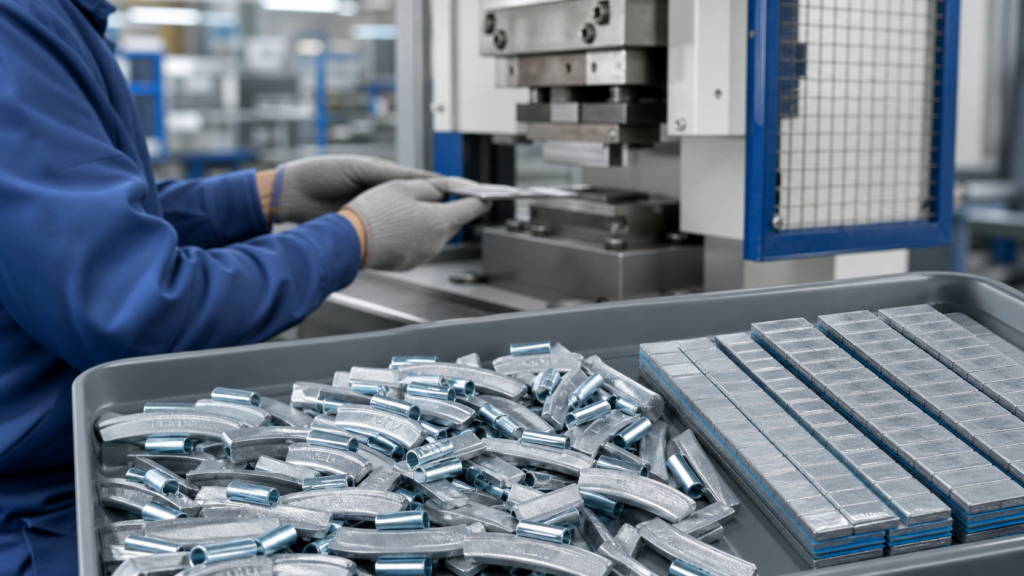
In the press stage, tooling can blank the outline, form a clip feature, create bends, or shape the body. The tooling must hold the part consistently without leaving sharp burrs, distorted edges, or a profile that varies across the run. Stamping is fast, but speed is not the quality measure. Die wear, press setup, lubrication approach, and handling between operations all affect repeatability.
For clip-on products, a useful inspection looks beyond overall length and width. It checks the opening, spring behavior where applicable, contact shape, and the way a sample sits on a representative rim flange. A caliper can confirm a dimension, but only a fit test can show whether the assembled part grips the intended application without rocking or sitting in the wrong location.
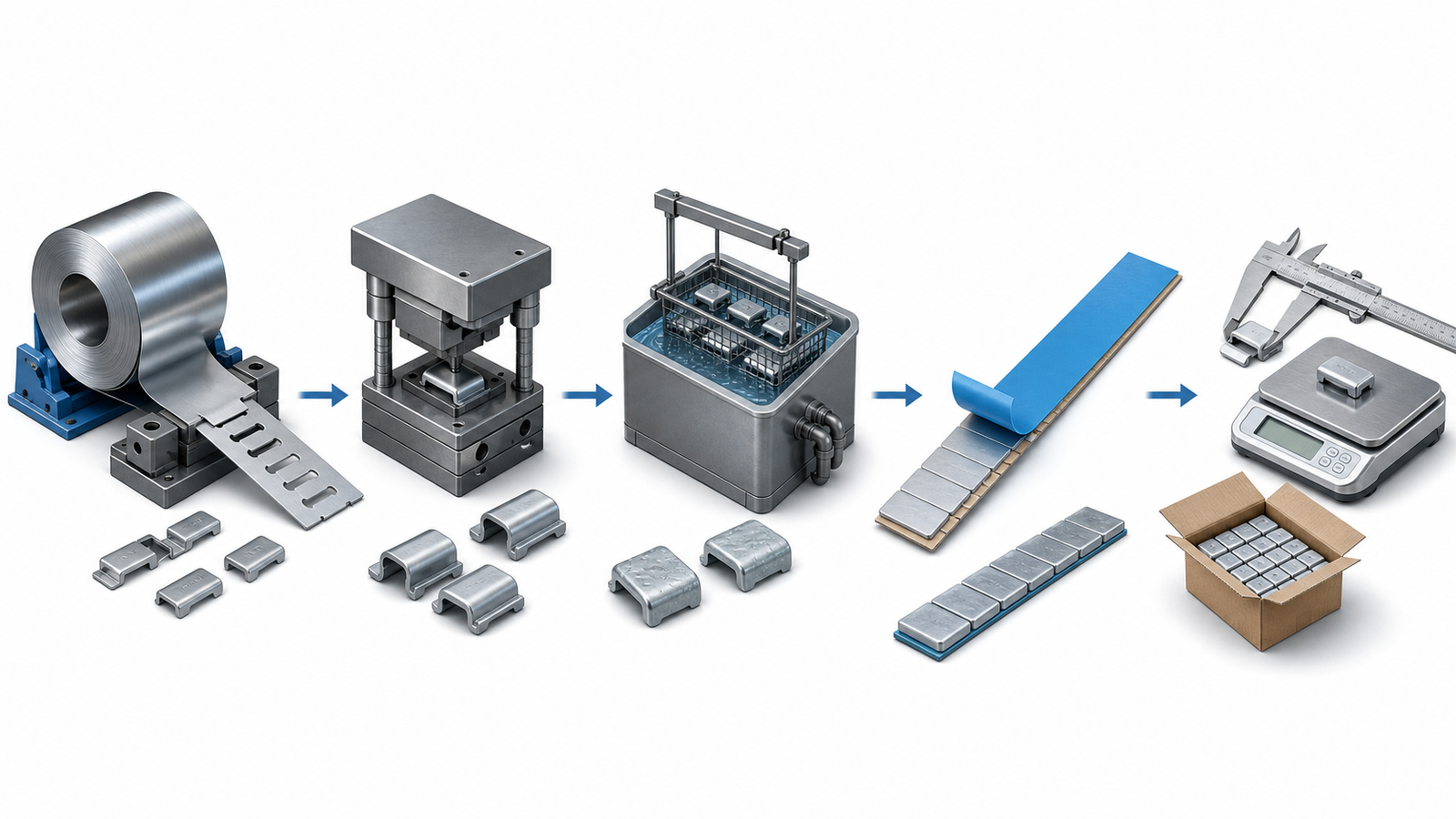
Mass control should be built into the route rather than left entirely to the final line. Forming dimensions, stock thickness, and the chosen material all contribute to the finished mass. A final scale check is essential, but process sampling helps find the source of a trend before a large quantity of off-target parts is packed.
Why are coating and corrosion control important?
Coating and corrosion control are important because steel components can be exposed to moisture, road contamination, storage conditions, and handling damage. The best finish for a product depends on the component, the manufacturing route, and the service environment, so buyers should specify a performance expectation instead of demanding a color alone.
A protective finish may be applied after forming, or a coated material may be processed through a route designed to preserve the finish. The production sequence matters. If a coated part is bent or clipped after finishing, the operation can mark or crack the surface unless the design and process account for it. If coating follows forming, cleaning and surface preparation become central to adhesion and coverage.
Visual appearance is one check, not the full requirement. A uniform finish can still be thin in hard-to-reach areas or poor at an edge. Useful controls may include part cleaning, bath or powder-process parameters, cure conditions where applicable, coverage review, handling protection, and defined acceptance samples. The buyer does not need to prescribe a factory's equipment; the buyer does need to state what the part must withstand and what evidence is expected.
Salt-spray testing is often discussed when corrosion resistance is a concern, but it should be specified carefully. ASTM B117 describes how to operate a salt-spray apparatus; it is a test method, not a universal pass/fail promise for every product or coating.[1] If a customer needs a particular duration, rating method, or post-test appearance requirement, put that condition in the written specification and confirm that the sample and production part are being evaluated on the same basis.
For adhesive strips, corrosion control also connects to the tape. A clean, stable backing and protected adhesive face help prevent storage damage before installation. It is not useful for a metal segment to have a good finish if the tape becomes contaminated, the liner releases prematurely, or the strips are crushed in transit.
How are adhesive wheel weights assembled?
Adhesive wheel weights are assembled by arranging metal segments in a controlled pattern and bonding them to a tape system protected by a release liner. Their quality depends on both the metal segment and the adhesive construction, which is why a strip should be evaluated as an installed product rather than as loose weights alone.
The metal segments must have consistent mass and spacing so that an installer can remove or cut the required increment predictably. Sharp edges, poor segment separation, or uneven underside surfaces can interfere with tape contact and handling. The tape is then applied under controlled alignment and pressure so the adhesive face is continuous, the liner is properly placed, and the strip remains straight enough for dispensing and application.
Tape selection should match the real application. A clean, dry wheel surface, appropriate installation temperature, adequate pressure, and a suitable mounting area all affect adhesion in the field. The tape's own construction affects initial tack, long-term hold, and liner behavior. A factory cannot guarantee adhesion on an unknown contaminated wheel surface, but it can supply a defined tape system and help a buyer run a sample test under stated conditions.
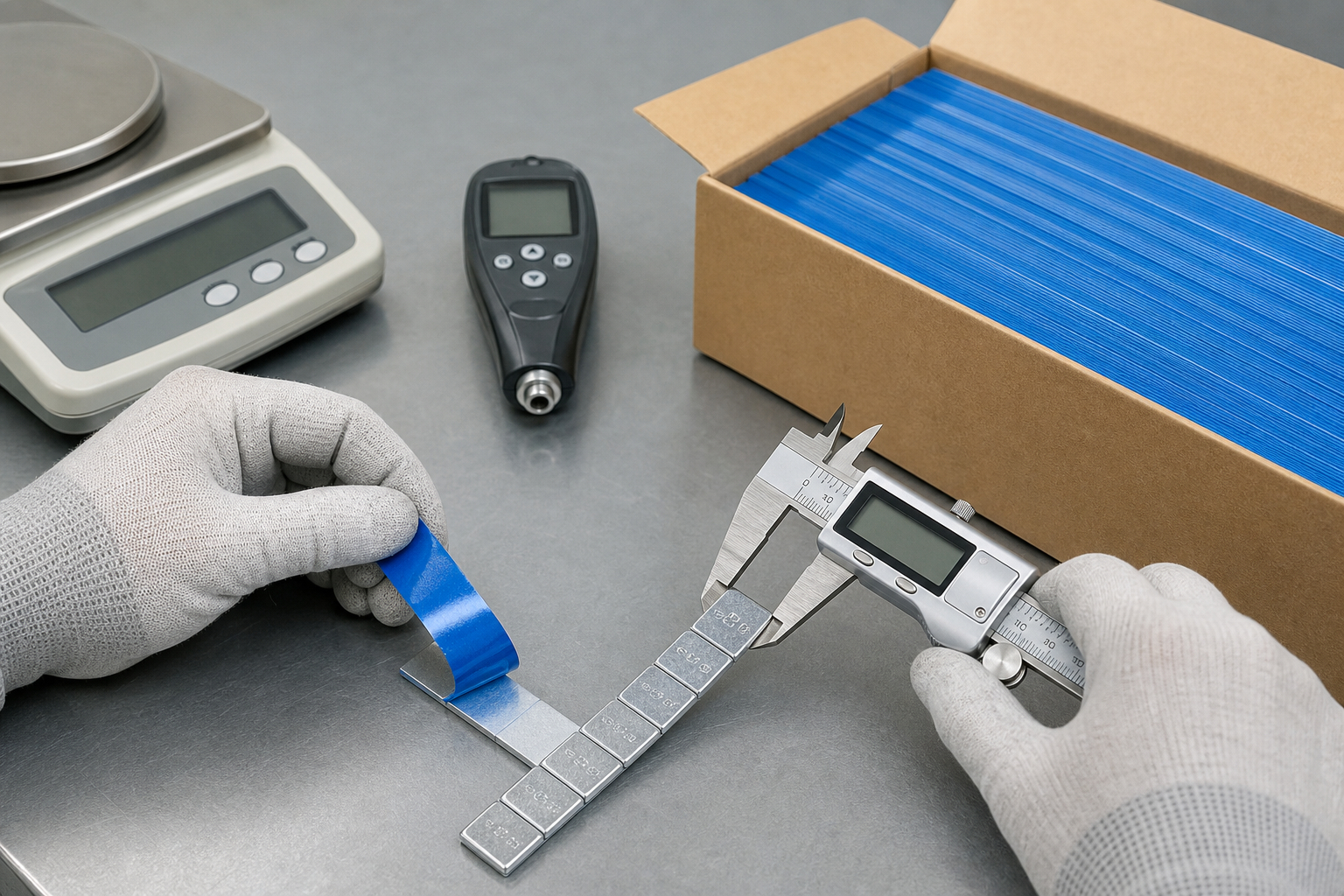
The release liner is easy to overlook until it fails. Installers need it to peel without tearing, leaving residue, or lifting the adhesive from the segment. Warehouse conditions also matter: hot storage, compression, dust, and damaged cartons can affect strips before they ever reach a wheel. For that reason, a packaging test should include opening an actual inner pack, removing a strip, peeling the liner, and applying the sample to the specified test surface.
For adhesive products intended for alloy wheels, tape and segment requirements for alloy-wheel adhesive programs connect the manufacturing discussion to real installation conditions.
Which quality checks matter during production?
The most useful quality checks are those that detect the failures customers can actually experience: wrong mass, poor fit, damaged finish, unreliable tape, incorrect pack quantity, or mixed product identity. A production plan should connect each check to a known risk and record it by lot or order.
Incoming checks can cover material identification, thickness, surface condition, tape lot, liner condition, and packaging components. In-process checks can cover stamped dimensions, burrs, forming consistency, coating appearance, tape alignment, segment spacing, and net mass. Final checks can verify the approved sample, carton configuration, labels, counts, and order-specific documentation.
Those checkpoints become a repeatable production QC checklist for wheel weight tolerance, retention, finish, and batch records when the buyer adds the SKU, sample plan, acceptance rule, evidence, and disposition for the exact product being ordered. The checklist turns process knowledge into a release decision without replacing the deeper manufacturing review on this page.
| Check | What it protects | Practical evidence |
|---|---|---|
| Nominal mass and tolerance | Balancing accuracy and range consistency. | Recorded scale samples by lot or production interval. |
| Clip profile or rim fit | Retention and correct mounting location. | Dimensional record plus fit sample on the agreed rim profile. |
| Edge and finish inspection | Installation safety, appearance, and corrosion exposure. | Approved visual standard and documented inspection results. |
| Coating evaluation | Resistance to expected handling and service conditions. | Stated process, sample result, and agreed test method where required. |
| Tape and liner check | Application reliability and installer usability. | Strip application sample, liner-peel review, and tape-lot record. |
| Packaging audit | Correct SKU, quantity, units, and traceability. | Approved packout sample, carton count, and lot or date code. |
Quality management systems such as ISO 9001 focus on controlled processes, documented information, and corrective action rather than a single inspection ritual.[2] For a wheel-weight buyer, the useful question is concrete: can the supplier show how an issue would be traced from the carton back to the material, process, and inspection records? A brief but clear answer is more valuable than a long generic quality presentation.
First-article inspection is particularly useful when tooling, material, coating, tape, or packaging changes. It gives the buyer and supplier a jointly approved reference before volume production. Repeat-order checks can then focus on the variables most likely to drift instead of recreating the entire approval process every time.
What should buyers ask a supplier to prove?
Buyers should ask for evidence that matches their intended wheel application and commercial risk, not a one-size-fits-all document pack. A well-defined sample, inspection plan, and packout approval usually reveal more about repeatability than a broad claim of "high quality."
Start by naming the format and use case: clip-on weight for a stated flange family, or adhesive strip for a stated wheel surface and installation environment. Then request the nominal mass system, permissible tolerance, dimensions that affect fit or segment layout, and the relevant material or coating description. If the product will be sold across several markets, specify the required carton language, unit system, and any material declaration early enough to be included in the quote.
Once those details are defined, buyers can request application-matched wheel-weight samples instead of relying on a mixed sample box. The sample should include the proposed clip or strip format, finish, tape, and packaging style, so installation and warehouse teams can approve the same construction that will be ordered.
Use this short pre-production checklist:
- Approved product drawing or clear sample reference for weight, clip, or segment geometry.
- Nominal mass, increment system, and permissible tolerance.
- Intended rim flange, wheel surface, or installation conditions.
- Coating or finish description and any agreed corrosion evaluation.
- Adhesive-tape and liner description for stick-on products.
- Inspection points, sampling frequency where agreed, and acceptance criteria.
- Inner-pack and carton quantity, label wording, units, and lot traceability.
- Retained approved sample for repeat-order comparison.
This is not about forcing every order into an expensive audit. It lets a buyer decide which checks are proportionate to the application. A small test order may need a robust installation sample and carton confirmation; a private-label program may also need artwork approval, lot records, and a formal pre-shipment inspection.
Where the order includes clip-on products, clip-fit evidence for steel-wheel applications explains why a dimensional record should be paired with a real rim-flange sample test.
How do packaging and traceability protect order consistency?
Packaging and traceability protect order consistency by keeping the approved product identifiable from production through warehousing and installation. They matter especially for wheel weights because similar-looking materials, increments, clips, and strips can be easy to mix when cartons are not controlled.
For adhesive strips, the pack must protect the liner and tape face from crushing, dust, excessive heat, and uncontrolled compression. For clip-on weights, it should prevent excessive rubbing, coating damage, and mixed-size handling. Inner-pack quantity should suit the customer's service pattern; a dispenser-friendly strip pack has different needs from a bulk carton for a distribution warehouse.
Labeling should make the product understandable without opening the carton. At minimum, the agreed product code, format, material description where appropriate, unit system, quantity, and lot or date convention should be controlled. When an issue arises, lot traceability helps the supplier identify which material, tape, coating batch, machine setup, or packout run needs review.
Before approving repeat production, compare the new carton against the retained reference: product identity, count, unit marking, strip or weight appearance, liner condition, and protective packing. This modest check can catch the frustrating errors that occur after a technically correct part has already left the production line.
For private-label or repeat-order programs, OEM packaging and traceability requirements for repeat programs give buyers a relevant next step after carton and lot conventions are defined.
Conclusion: Buy a controlled process, not only a material
Wheel balance weights are made through a series of linked controls: material preparation, forming, protective finish, adhesive assembly where used, inspection, and packout. The best product is not defined by a material word alone. It is the part whose mass, fit, finish, tape, and carton details consistently match the wheel applications the buyer intends to serve.
For a new program or a change in material, tape, coating, or packaging, ask for application-matched samples and a concise process summary covering the relevant inspection points. Approving that reference before production gives both sides a workable basis for repeat orders, corrective action, and fewer installation surprises.
Frequently Asked Questions
Manufacturing quality for wheel weights is best assessed through application-specific mass, fit, attachment, finish, and packout checks rather than a single generic certificate.
Are wheel balance weights cast or stamped?
They can be made through different routes depending on material and product design. Steel clip-on and adhesive-weight components are often produced through blanking, stamping, forming, or other controlled metalworking steps, while other materials and designs can use different forming methods. Ask the supplier about the route for the exact product you plan to buy.
Why do wheel weights need a coating?
Steel components can be exposed to moisture and road contaminants, so a suitable finish helps manage corrosion and appearance. The relevant question is not simply whether a coating exists, but whether it stays intact through forming, installation, storage, and the expected service environment.
What should be tested on adhesive wheel-weight tape?
Test a production-representative strip on a properly prepared wheel surface under the temperatures and handling conditions that matter to the application. Check segment alignment, liner removal, initial placement, and retention after the agreed dwell or exposure condition. Document the surface preparation and test setup so results are comparable.
How can a buyer check clip-on wheel-weight fitment?
Use the proposed weight on representative rim flanges, not only a dimensional drawing. Check that the clip engages securely, the weight sits at the intended location, the rim is not damaged during normal installation, and the part does not interfere with nearby wheel features.
Is a final inspection enough to control wheel-weight quality?
No. Final inspection can catch visible and packaging issues, but it cannot reliably repair a process that has already drifted. Incoming material checks, in-process dimensional and mass checks, and approved reference samples make it easier to detect problems before a full order is completed.
References
[1] ASTM International. “B117 Standard Practice for Operating Salt Spray (Fog) Apparatus.” 2019.
[2] International Organization for Standardization. “ISO 9001:2015 Quality management systems – Requirements.” 2015.