




Wheel weights wholesale suppliers should be compared by product range, material options, size coverage, quality control, packaging, documentation, sample consistency, and reorder stability. A distributor should not choose by unit price alone, because weak fitment coverage, poor cartons, unclear material claims, or unstable replenishment can create higher downstream costs.
For distributors, the real question is not "Who sells wheel weights cheaply?" It is "Which supplier can help me keep tire shops, repair chains, and wholesale customers supplied with the right products in a repeatable way?" A supplier may quote a low price but still create problems if the range is narrow, cartons fail, adhesive tape is inconsistent, labels are unclear, or documents are missing. Buyers who are still shaping the whole product family can use the wheel-weight range planning framework to connect type, material, size, fitment, compliance, and sourcing needs before comparing suppliers.
Table of Contents
- How should distributors compare wheel weight suppliers?
- Which supplier comparison factors matter first?
- What should distributors compare besides unit price?
- How should distributors evaluate quality control?
- What documents should wholesale buyers request?
- What should a distributor include in a wholesale RFQ?
- How should samples be checked before choosing a supplier?
- Conclusion: compare the supplier, not only the quote
- Frequently Asked Questions
- References
How should distributors compare wheel weight suppliers?
Distributors should compare wheel weight suppliers through a structured matrix: range coverage, material options, quality control, packaging, documents, lead time, reorder stability, and sample-to-bulk consistency. This makes supplier selection less emotional and reduces the risk of choosing a low quote that cannot support repeat sales.
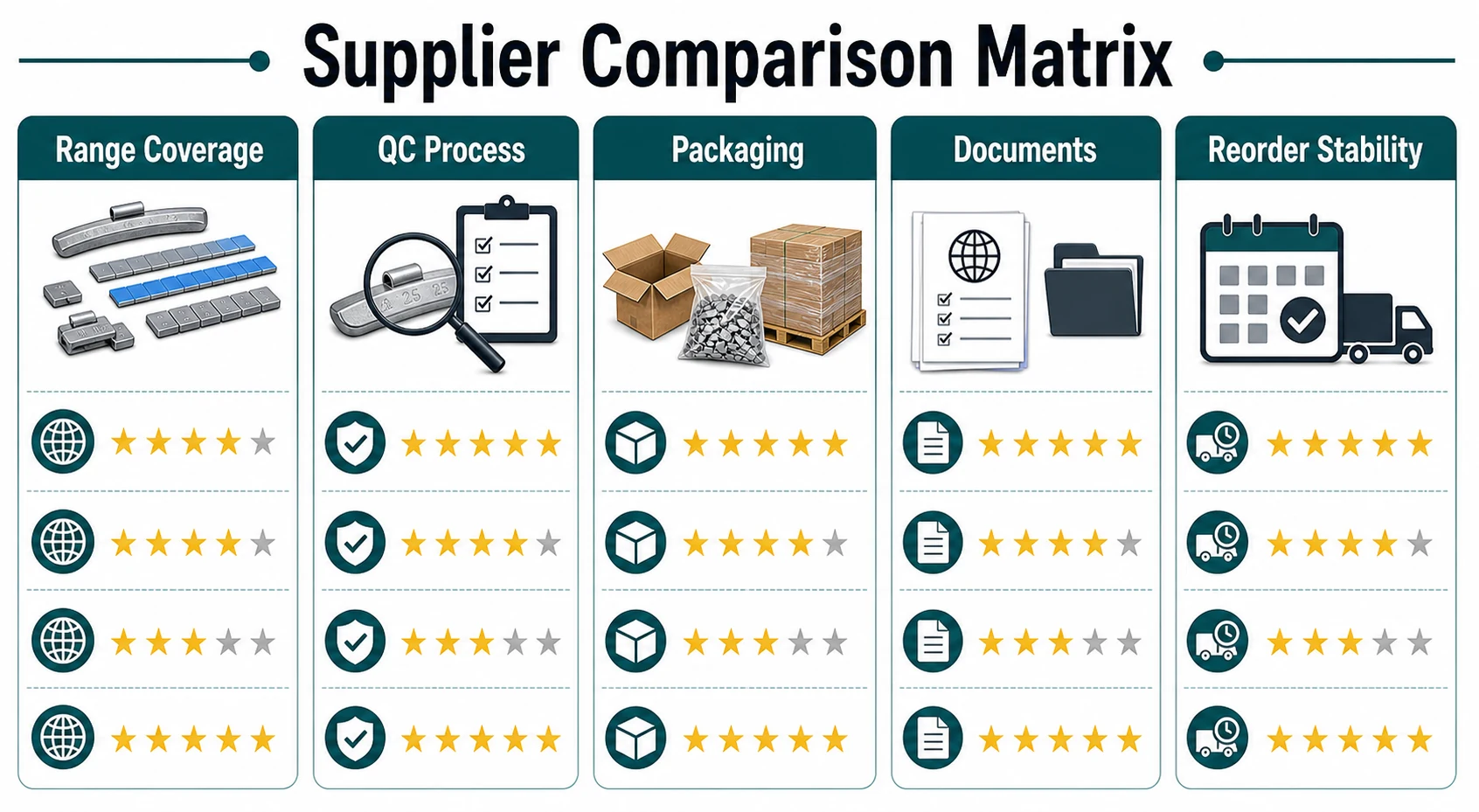
A useful supplier matrix starts with the buyer's sales channel. A distributor serving tire shops needs a dependable assortment of common sizes and formats. A distributor serving export markets may need lead-free documentation, country-specific labels, pallet rules, and reliable carton specifications. A distributor serving private-label customers may care about label accuracy, artwork control, and repeat packaging.
| Comparison area | What to check | Why distributors should care |
|---|---|---|
| Range coverage | Clip-on, adhesive strips, steel, zinc, lead-free, gram or ounce sizes | Prevents gaps in the product line |
| Fitment support | Clip profiles, strip formats, low-profile options, wheel applications | Reduces customer complaints and wrong-stock problems |
| QC process | Incoming material checks, weight tolerance, coating, tape, packing inspection | Protects repeat-order consistency |
| Packaging | Inner bags, cartons, barcode labels, pallet plan | Reduces shipping damage and warehouse confusion |
| Documents | Material statements, test reports if needed, packing list, label files | Supports export and customer requirements |
| Reorder stability | Lead time, stock plan, repeat SKU control, communication | Keeps customer replenishment predictable |
Size coverage is especially important because distributors do not sell one universal weight. They sell a working range. Before comparing offers, buyers should define the size coverage needed for wholesale range planning so quotes can be compared against the same gram or ounce increments, not against mismatched assortments.
Which supplier comparison factors matter first?
The first comparison factors should be customer demand, product coverage, repeatability, and support for the buyer's market. A low price only matters after the distributor knows the supplier can cover the correct wheel applications and deliver the same approved product repeatedly.
Start with the customer base. If the distributor mainly supplies tire shops, the supplier should support high-turnover clip-on and adhesive SKUs. If the buyer sells to alloy-wheel installers, adhesive tape quality and strip profile may matter more. If the distributor serves regions that prefer or require lead-free products, the supplier's material route and documents become early filters.
The shop-level demand behind a distributor's range helps distributors connect supplier offers to the sizes and formats tire shops actually reorder. That matters because a supplier with a wide catalog may still be a poor fit if the fast-moving SKUs, labels, or packaging do not match the distributor's customers.
| Distributor situation | Supplier strength to prioritize | Risk if ignored |
|---|---|---|
| Tire shop supply | Common sizes, fast replenishment, clear labels | Stock gaps in high-turnover SKUs |
| Alloy-wheel channel | Adhesive tape, low-profile strips, clean packaging | Weights fall off or create clearance complaints |
| Steel-wheel channel | Clip profiles, flange fit support, coating consistency | Poor fit and customer returns |
| Export distributor | Documents, pallet plan, destination label support | Customs, receiving, or customer approval delays |
| Private-label program | Repeat carton artwork, barcode control, stable SKU setup | Repacking, relabeling, and brand inconsistency |
Good supplier comparison is partly a self-diagnosis exercise. The distributor should know which customer problem it is solving before asking suppliers to quote.
What should distributors compare besides unit price?
Distributors should compare total landed practicality, not only unit price. Packaging, carton weight, MOQ, defect handling, documents, reorder lead time, and slow-SKU exposure can all change the real cost of a wholesale wheel weight program.
A quote with the lowest price per piece may become expensive if cartons break, adhesive strips arrive dusty, labels are wrong, or the supplier cannot repeat the same size mix on the next order. A quote with a slightly higher unit price may be better if it reduces warehouse handling, customer complaints, and relabeling work. Distributors should ask suppliers to quote the same SKU mix, same carton plan, same label requirement, and same sample approval criteria.
| Cost factor | What to compare | Why it changes the real buying decision |
|---|---|---|
| MOQ | By SKU, by material, by packaging style, or by total order | Determines whether the distributor must overbuy slow items |
| Carton plan | Quantity per inner bag, master carton weight, dimensions | Affects freight, warehouse handling, and customer delivery |
| Label accuracy | SKU, size, unit, barcode, material, language | Prevents picking errors and repacking |
| Lead time | Sample time, production time, transit readiness | Controls replenishment planning |
| Defect response | Replacement, credit, inspection evidence, claim process | Reduces dispute cost |
| Repeatability | Same tape, same coating, same carton, same label | Protects downstream customer trust |
The bulk order planning behind supplier quotations is useful after a distributor has a shortlist, because MOQ and packaging only make sense when they are tied to a real SKU mix and replenishment plan.
For a more detailed order decision, distributors can use wholesale and bulk order planning for SKU mix, cartons, and replenishment to turn that comparison into a practical first-order and reorder plan.
How should distributors evaluate quality control?
Distributors should ask how the supplier controls material, forming, weight accuracy, coating, tape application, packing, and final inspection. A supplier's quality system does not need to be described in complicated language, but it should be visible enough for the buyer to trust repeat orders.
ISO 9001 is a widely recognized quality management standard, and ISO describes it as addressing consistent products and services that meet customer and regulatory requirements 1. A certificate alone does not prove every wheel weight shipment will be perfect, but it can be one piece of evidence when combined with process records, inspection checkpoints, and consistent samples.
For wheel weights, the buyer should ask practical questions: How is weight tolerance checked? Are clip profiles verified against references? How is coating adhesion or surface condition reviewed? How is adhesive tape stored and applied? Are cartons checked after packing? Can the supplier provide photos or inspection records from production, not just a polished sample tray?
The production and QC signals to verify before buying wholesale help distributors connect supplier claims to real manufacturing stages: raw material, stamping or forming, coating, tape application, marking, packing, and final inspection.
| QC area | Supplier evidence to request | Distributor benefit |
|---|---|---|
| Weight accuracy | Tolerance checks by size or batch | Fewer balancing complaints |
| Clip profile | Fitment reference or profile control | Lower risk of wrong-fit returns |
| Adhesive tape | Tape type, storage, liner condition, sample testing | Better installation reliability |
| Coating | Finish type, visual check, corrosion-related test if required | Better appearance and shelf performance |
| Packing | Carton weight, inner bag count, label verification | Easier warehouse receiving |
| Final inspection | Batch photos, check sheets, shipment sample record | Stronger claim handling and repeatability |
Quality comparison should not feel adversarial. A serious supplier should be able to explain its control points in plain terms and agree on what will be checked before shipment.
What documents should wholesale buyers request?
Wholesale buyers should request documents that match the product, destination, and customer requirement. Common needs include packing list, commercial invoice, material statement, carton and pallet details, label files, and any test or compliance documents required by the buyer's market.
For lead-free or non-lead programs, documents matter before the shipment leaves the factory. The U.S. Environmental Protection Agency has documented best management practices encouraging movement away from lead wheel weights because lost lead weights can enter the environment 5. Distributors should avoid vague claims such as "eco-friendly" or "compliant everywhere." Instead, ask for material statements tied to the exact product being quoted. The lead-free documentation questions for distributor programs help buyers frame those questions before approving a wholesale range.
Packaging documents can matter too. If wood pallets are used, ISPM 15 covers regulated wood packaging material in international trade 3. If a shipment requires formal package performance testing, ASTM D4169 provides a standard practice for performance testing shipping containers and systems 2. Not every wheel weight order needs full formal testing, but distributors should still define carton strength, pallet configuration, and destination handling expectations.
| Document or file | When it matters | What to verify |
|---|---|---|
| Material statement | Lead-free, steel, zinc, or customer-required programs | Product name, material route, batch or SKU relationship |
| Packing list | Every import shipment | Cartons, gross/net weight, dimensions, pallet count |
| Label artwork | Private label, barcode, multi-language markets | SKU, size, unit, barcode, material wording |
| Pallet information | Export shipments and warehouse receiving | Pallet type, treated wood mark if required, carton count |
| QC record | Supplier comparison and claim handling | Inspection date, checked items, shipment photos |
| Test report | Customer-specific requirements | Test method, product scope, date, issuing body |
Documents should be reviewed before production, not after the goods are packed. If a required document cannot be supplied, the distributor should know that before paying a deposit or promising customers a delivery date.
What should a distributor include in a wholesale RFQ?
A wholesale RFQ should define the actual program the distributor wants to buy: material, size mix, clip or adhesive formats, tape, coating, carton plan, label requirements, samples, documents, and target reorder pattern. A clear RFQ makes supplier quotes comparable.
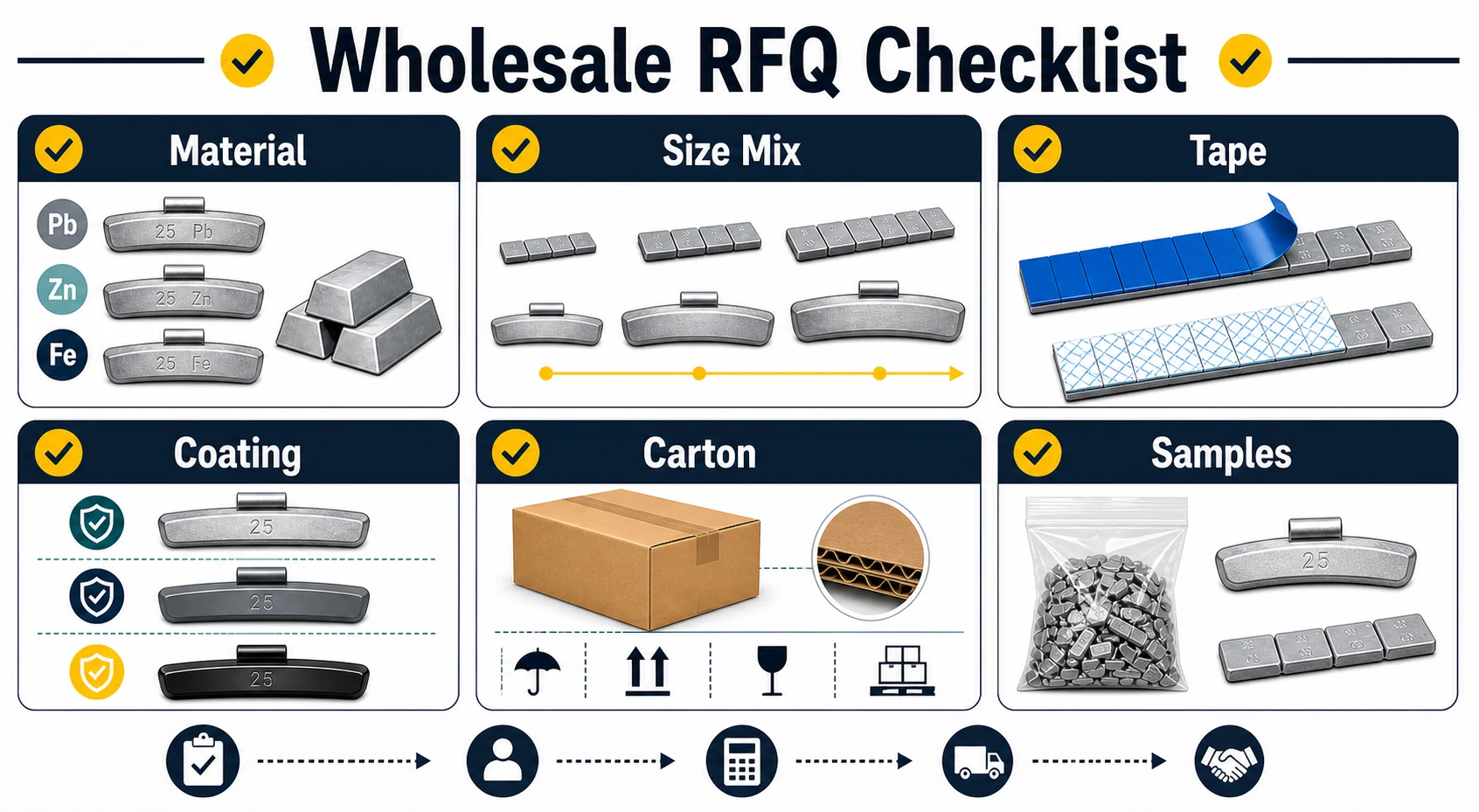
Distributors should not ask three suppliers for "wheel weights price" and expect usable comparison. One supplier may quote lead, another steel, another zinc. One may include premium tape, another generic tape. One may pack in manageable cartons, another may quote dense cartons that are difficult for warehouse staff and tire shop customers to handle. The RFQ should remove these hidden differences.
For adhesive products, tape should be defined and tested. General 3M guidance for VHB tape stresses clean, dry, contaminant-free bonding surfaces and application pressure for adhesive contact 4. That principle does not turn every wheel weight tape into a branded VHB product, but it does remind buyers that tape performance depends on surface condition, handling, storage, and installation. For coated products, distributors should also connect finish choice with coating and carton-rub checks for stocked wheel weights so samples are checked after handling and packing, not only when freshly made.
| RFQ field | Detail to include |
|---|---|
| Product formats | Clip-on profiles, adhesive strips, rolls, low-profile strips if needed |
| Material | Lead, steel, zinc, lead-free requirement, or customer-specific route |
| Size mix | Gram or ounce increments with expected quantities by SKU |
| Tape and coating | Tape requirement, liner, coating type, color or finish expectation |
| Packaging | Inner bag count, master carton quantity, gross weight target, barcode label |
| Documents | Material statement, packing list, pallet details, test reports if required |
| Samples | Product sample, packed sample, label proof, approval timeline |
| Reorder plan | First order quantity, expected repeat order, slow SKU treatment |
The better the RFQ, the easier it is to see which supplier is truly competitive. It also gives the supplier a chance to suggest a more efficient MOQ, carton plan, or SKU mix.
How should samples be checked before choosing a supplier?
Samples should be checked against the final RFQ, not treated as loose showroom pieces. A distributor should test sample weights, adhesive strips, carton labels, and packing format before deciding whether a supplier can support repeat wholesale orders.
A useful sample review includes both product and packaging. For clip-on weights, check profile, grip, markings, coating, and size accuracy. For adhesive weights, check segment separation, liner cleanliness, tape behavior, strip height, and installation on representative wheel surfaces. For cartons, check quantity, gross weight, label clarity, barcode scan, carton strength, and whether the product rubs or shifts inside the pack.
| Sample check | What to compare | Pass signal |
|---|---|---|
| Product match | Same material, size, format, and coating as quoted | Sample matches the RFQ, not a substitute item |
| Fitment | Clip profile or adhesive strip placement on real wheels | Installation is practical for target customers |
| Tape | Liner, adhesion after proper preparation, storage condition | No obvious contamination or weak bonding behavior |
| Finish | Coating appearance after handling and packed movement | No abnormal rubbing, peeling, or corrosion signs |
| Label | SKU, size, unit, barcode, material wording | Warehouse and customer labels are usable |
| Packed sample | Inner bag, carton, gross weight, pallet plan if needed | Distributor can receive and resell without repacking |
The final supplier choice should be based on the supplier's ability to repeat the approved sample in bulk. If the supplier changes tape, coating, packaging, label, or material after approval, the distributor loses control of the program.
If you are comparing wholesale wheel-weight suppliers, send us your target applications, materials, formats, order volume, and documentation needs. We can help you build a like-for-like sample and quotation brief before you choose a source.
Conclusion: compare the supplier, not only the quote
Wheel weights wholesale buying works best when distributors compare suppliers through range coverage, QC, packaging, documents, sample consistency, and reorder stability. Price is important, but price only becomes meaningful after the buyer confirms that each supplier is quoting the same product, pack, and service expectation.
Before choosing a supplier, distributors should define the customer channel, size mix, material requirement, carton plan, label needs, and sample approval process. Once those details are clear, requesting wholesale wheel weight samples matched to a distributor's RFQ makes the product review more precise and gives both sides a practical basis for quotation, testing, and repeat orders.
Frequently Asked Questions
How should distributors compare wheel weight wholesale suppliers?
Distributors should compare suppliers by product range, material options, size coverage, quality control, packaging, documentation, lead time, sample consistency, and reorder stability. Unit price should be compared only after the RFQ details are consistent.
Why is the cheapest wheel weight supplier not always the best option?
The cheapest quote may exclude important costs such as poor cartons, weak labels, inconsistent tape, missing documents, high MOQ by slow SKU, or unreliable repeat supply. These issues can create customer complaints and extra warehouse work.
What samples should a distributor request before a wholesale order?
A distributor should request samples that match the planned order: clip-on or adhesive formats, target materials, size mix, coating, tape, inner packaging, carton label, and a packed sample if packaging is part of the buying decision.
What documents matter for wholesale wheel weight orders?
Common documents include packing list, material statement, commercial invoice, carton and pallet details, label artwork, and any customer-required test reports. Lead-free or export programs may require additional material or destination-specific documentation.
Should distributors compare wheel weight suppliers by MOQ?
Yes, but MOQ should be compared by SKU, material, packaging style, and total order. A low MOQ is useful only if the supplier can still provide the right size mix, carton plan, labels, and repeat supply.
How can a distributor reduce risk when changing suppliers?
Use a written RFQ, compare samples against the final specification, approve packed samples, verify documents before production, and start with a controlled order before moving all replenishment to the new supplier.
References
[1] ISO. “ISO 9001 Quality Management.” 2026.
[2] ASTM International. “ASTM D4169-23: Standard Practice for Performance Testing of Shipping Containers and Systems.” 2023.
[3] International Plant Protection Convention. “ISPM 15: Regulation of Wood Packaging Material in International Trade.” 2019.
[4] 3M. “VHB Tape Surface Preparation Technical Bulletin.” 2020.
[5] United States Environmental Protection Agency. “Best Management Practices for Lead Wheel Weights.” 2015.