




A wheel weight supplier scorecard should compare shortlisted candidates against one requirement list: product fit, sample quality, documents, process evidence, packaging capability, commercial terms, response quality, and delivery risk. Scoring candidates after the sourcing model is chosen prevents a low initial price from masking a poor fit for the actual program.
The scorecard is not a way to make a subjective decision look mathematical. It is a record of what the buyer needs, what each candidate can prove, which gaps remain, and why the final shortlist is suitable for the product and market. Start with requirements that cannot be traded away, then score meaningful differences among the candidates that meet them.
Table of Contents
- What does a supplier scorecard decide?
- How should buyers build a wheel weight supplier scorecard?
- How should product fit be scored?
- How should samples evidence and response quality be scored?
- How should commercial support and delivery risk be scored?
- How should the scorecard weight risk?
- What does a complete A B C supplier comparison look like?
- How should buyers select the shortlist?
- Conclusion: use the scorecard to explain the decision
- Frequently Asked Questions
- References
What does a supplier scorecard decide?
A scorecard decides which actual candidates deserve deeper qualification, samples, negotiation, or approval. It does not decide whether the buyer should source through a manufacturer, trader, or distributor in the first place. That choice should already be made using the sourcing route selected before candidates are scored.
Before any candidate is scored, settle the product requirements. The product requirements that should be settled before the shortlist help define application, attachment, material, increments, packaging, and channel needs. A supplier cannot be scored fairly against an unformed idea of “wheel weights.”
Use threshold requirements first. Examples include an appropriate product family, ability to provide a representative sample, required material or document scope, viable packaging, and a delivery route acceptable for the market. A candidate that misses a threshold is not necessarily poor; it belongs in an alternative or clarification group rather than a price-ranked shortlist.
How should buyers build a wheel weight supplier scorecard?
Build the scorecard with the buyer's requirement in the first column and a separate evidence-based score for each candidate. Assign weights only after the team agrees which factors are important for this program.
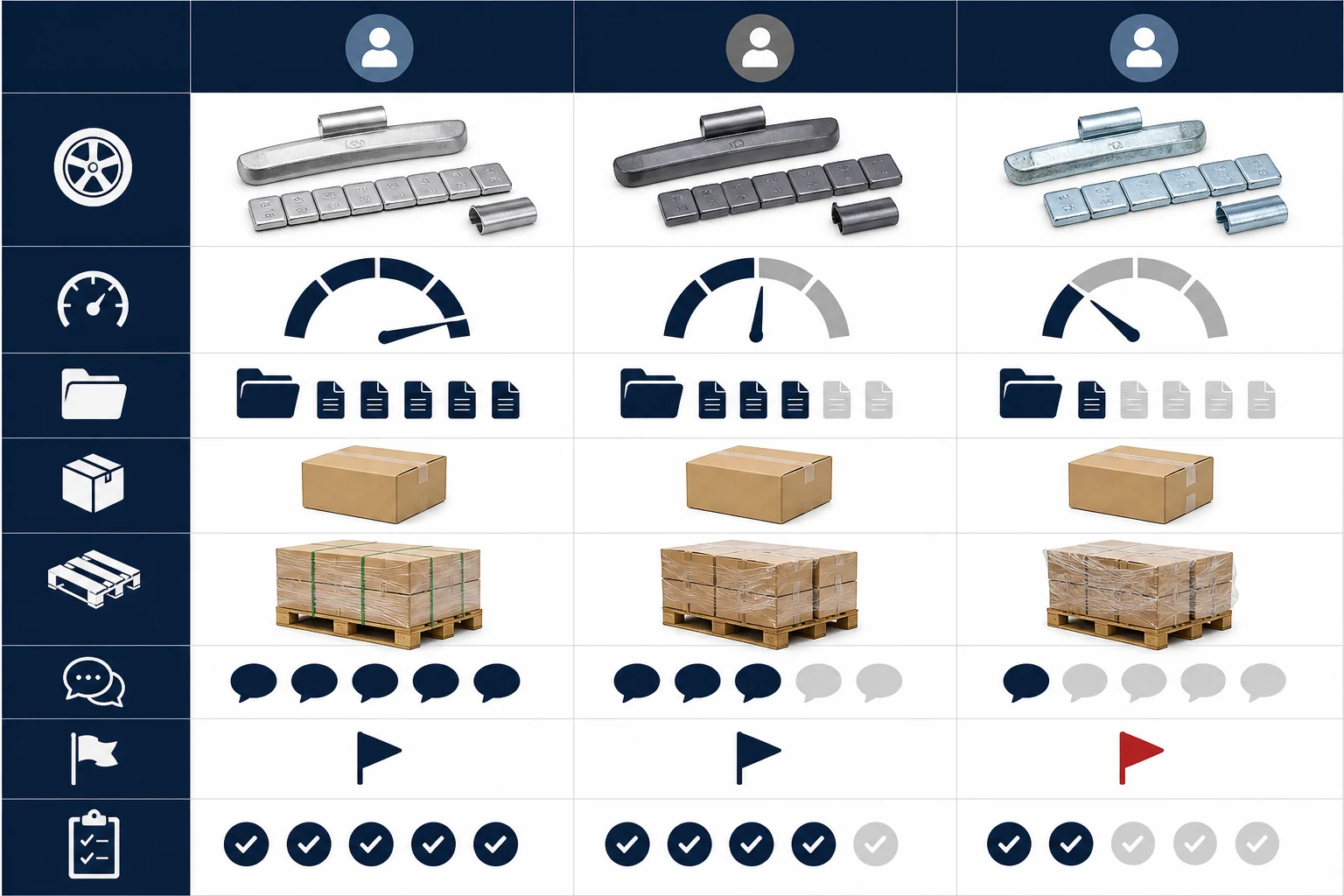
The first pass should use the same brief for every company. Buyers can begin with initial manufacturer checks before scorecard review, then record the answer and supporting evidence, not simply a supplier's marketing claim.
| Score area | Suggested question | Evidence to record |
|---|---|---|
| Product fit | Can this candidate supply the requested clip-on or adhesive SKU for the intended wheels? | Identified SKU, drawing or application statement, sample availability |
| Material and finish | Does it state the requested material and finish, and any document scope? | Written configuration and relevant declaration |
| Samples and checks | Can it provide representative samples and explain inspection? | Sample code, measurement or test record, response to questions |
| Process evidence | Can it identify the stages that affect the requested item? | Relevant process description, control point, or factory evidence |
| Packaging | Can it meet inner, carton, label, and pallet needs? | Packing data, sample carton, label fields |
| Commercial support | Are MOQ, quote, lead time, and alternatives stated clearly? | Written terms, exceptions, and valid assumptions |
| Delivery and risk | Does it define responsibility, documentation, and repeat-order process? | Named delivery scope, change process, claim route |
Do not force every program to use the same weights. A branded launch may weight packaging and change control highly; a tire-shop distributor may weight range coverage, carton logic, and replenishment. Record the reason for the weight so the decision remains understandable.
How should product fit be scored?
Score product fit against the actual application, not the number of catalog pages or the supplier's general automotive experience. The candidate should show that it understands the requested attachment, material, profile or strip, increments, and package family.
Give a high score only when the requested product is identified and the supplier can explain any difference. A lower score may be appropriate when a candidate has a plausible alternative but cannot yet show fitment or a matching sample. Treat unsupported “universal” claims as clarification needs.
Product fit should also consider the intended order structure. A supplier with a suitable single SKU but no workable assortment, carton, or replenishment plan may not fit a distributor program. Conversely, a supplier with a broad range but weak evidence for the critical profile should not score highly merely for breadth.
Direct wheel-weight product ranges show why breadth and fit must be scored separately. Plombco lists passenger-car and truck products across clip-on, adhesive, assortment, material, and application families, while directing users to an application chart or rim gauge for profile selection.4 A candidate can therefore receive credit for relevant range coverage only when it also identifies which actual product fits the buyer's requested applications.
How should samples evidence and response quality be scored?
Score samples, evidence, and response quality by how well they connect the candidate's answer to the requested SKU and the buyer's approval path. A quick reply is useful, but it is not equal to a clear reply supported by a relevant sample, configuration record, packing information, and stated limitations.

The process evidence behind the requested wheel weight configuration helps buyers ask about the relevant manufacturing and control stages, while packaging and approval controls for a branded supplier program help them see whether a candidate can preserve the right label, carton, and approval version.
For the actual release criteria, score whether the candidate can provide supplier evidence for wheel weight QC approval: an identified SKU, sample plan, tolerance or retention method, tape and finish evidence, packaging checks, batch record, and clear disposition for an exception.
ISO 9001's documented-information principle supports a practical scorecard rule: give credit for evidence that identifies the product, not for a generic certificate detached from the quoted SKU.1
How should commercial support and delivery risk be scored?
Score commercial support and delivery risk by whether the supplier makes the terms, packaging, delivery boundary, and repeat-order conditions clear. A low price or MOQ is not a complete advantage if the candidate cannot explain what is included, what can be mixed, or who owns an issue after shipment.
For repeat order planning, use carton pallet and SKU-mix capacity for repeat supply and the range and reorder needs behind a distributor supplier decision to assess whether the supplier's offer works after the first shipment.
Review MOQ per SKU or carton, quote validity, lead time, payment and delivery terms, export documents, sample and inspection scope, pack labels, claims route, and change notification. GS1's logistic-label guidance is a reminder that handling-unit labels have operational value; carton and pallet identity should be clear enough for receiving and investigation.2
How should the scorecard weight risk?
Weight risk according to the cost of being wrong for this specific program. A buyer launching a branded range may give more weight to carton control, sample approval, and change notification; a regional distributor may give more weight to SKU coverage, delivery reliability, and replenishment flexibility. The weights should be decided before individual candidates are scored.
One practical method is to use a five-point evidence score for each category, then multiply it by a program-specific weight. For example, product fit, evidence, and delivery risk can carry higher weights than response speed or presentation quality. Add a notes field beside every score: “identified sample received,” “carton data not supplied,” “standard alternative only,” or “lead time based on unconfirmed mix.” The notes prevent a total score from hiding why a candidate is ahead or behind.
Do not use the weighted total to override a threshold failure. A supplier may achieve a strong overall number through price and response quality while still lacking the profile, material statement, packaging capability, or delivery boundary required by the program. Keep pass-fail gates separate from the weighted comparison, and record the owner and deadline for every open risk.
Review the scorecard with the people who will receive, sell, install, or support the range after purchase. A sourcing lead may see a competitive quotation, while a warehouse team sees an unusable carton count and a technical team sees an unproven clip profile. Bringing these observations into the same record turns the shortlist into an operating decision rather than a purchasing-only choice.
Finally, date the scorecard and state which supplier documents, sample revisions, and quotations were reviewed. A score only remains useful while its underlying evidence is current; a revised quote, different packaging plan, or new sample should trigger an update rather than being treated as the same candidate response.
What does a complete A B C supplier comparison look like?
A complete comparison shows the threshold result, program-specific weights, evidence score, weighted total, open actions, and final disposition for every candidate. The example below is illustrative and does not represent actual suppliers or universal category weights.
Assume a distributor needs a lead-free program containing identified adhesive strips and selected clip-on profiles, representative samples, controlled cartons, a workable mixed-SKU order, and a stated delivery route. Three candidates answer the same brief.
Step 1: apply pass-fail thresholds
| Threshold | Supplier A | Supplier B | Supplier C |
|---|---|---|---|
| Requested adhesive and clip-on families identified | Pass | Pass | Pass |
| Representative sample tied to quoted SKU | Pass | Pass | Fail: clip-on sample has no SKU/profile identity |
| Requested lead-free material statement | Pass | Pass | Fail: general claim only |
| Workable carton and delivery route | Pass | Pass | Pass |
| Threshold result | Continue | Continue | Exclude until corrected |
Supplier C should not enter a normal price-ranked shortlist yet. Its failure is not that the catalog is too small or the price is too low; the buyer cannot connect the critical clip-on sample and material claim to the quoted configuration.
Step 2: score the candidates that passed
Use a 1-to-5 evidence score, where 1 means unsupported or materially weak and 5 means the requirement is clearly supported for the requested program. Multiply each score by its weight and divide by five. The example weights total 100%.
| Score area | Weight | Supplier A | Supplier B | Supplier C* |
|---|---|---|---|---|
| Product fit | 25% | 5 | 4 | 5 |
| Samples and evidence | 20% | 4 | 5 | 3 |
| Packaging capability | 15% | 4 | 3 | 5 |
| Quality and traceability | 15% | 4 | 4 | 2 |
| Commercial clarity | 15% | 3 | 5 | 5 |
| Delivery and replenishment | 10% | 4 | 3 | 4 |
| Weighted total | 100% | 82 | 82 | 81* |
Supplier A total = (5 x 25 + 4 x 20 + 4 x 15 + 4 x 15 + 3 x 15 + 4 x 10) / 5 = 82
Supplier A and Supplier B tie numerically, but they do not present the same decision. A has the strongest product fit and more stable standard-carton evidence, while its MOQ and commercial flexibility need negotiation. B has the strongest identified samples and clearest quotation, while its custom carton and replenishment timing need confirmation.
Supplier C's theoretical score is shown only to demonstrate why thresholds matter. It remains excluded despite an 81 total because price, packaging, and catalog breadth cannot compensate for an unidentified application-critical sample and unsupported material statement.
Step 3: record evidence and disposition
| Candidate | Evidence that drove the result | Open action | Disposition |
|---|---|---|---|
| Supplier A | Identified clip-on and adhesive samples; material and process records; standard carton data | Clarify mixed-SKU MOQ and price validity | Shortlist for commercial clarification |
| Supplier B | Strong sample package; clear quote; documented material; workable product range | Approve carton mockup and confirm replenishment lead time | Shortlist for packaging confirmation |
| Supplier C | Broad range and attractive commercial offer, but critical evidence is not tied to the SKU | Supply identified clip sample and SKU-specific material statement | Exclude; rescore only after threshold evidence arrives |
The scorecard should preserve this explanation beside the total. Without the evidence notes and disposition, an 82-to-82 tie tells the next reviewer almost nothing about what must happen before approval.
How should buyers select the shortlist?
Select the shortlist by removing candidates that fail threshold requirements, then comparing the weighted scores and unresolved risks of the remaining candidates. A high score should not erase one serious gap in fitment, material, documentation, or delivery responsibility.
The IATF sub-tier requirements emphasize communicating customer requirements, controlling changes, and maintaining traceability. A buyer can use that lesson without imposing an audit: ask whether the candidate can tie the approved sample, quoted SKU, packed lot, and change process together.3
Record the selected candidates, their score, key evidence, open actions, and owner. Request specification-matched sample families for a shortlisted supplier only after the requirement and scorecard identify which samples will genuinely reduce a decision risk.
Before approval, use factory-audit checks for a shortlisted wheel weight supplier to turn the open actions into a focused review of production, material control, QC, packing, and traceability evidence.
If you are shortlisting wheel-weight suppliers, share your must-have criteria, target applications, evidence requirements, volume, and timeline. We can help you organize a focused sample and supplier review around the risks that matter most.
Conclusion: use the scorecard to explain the decision
A wheel weight supplier scorecard gives buyers a repeatable way to compare candidates after the sourcing route is chosen. It starts with one product and commercial brief, removes candidates that miss critical requirements, then scores product fit, evidence, packaging, support, and risk.
Request a supplier-scorecard worksheet for your shortlist and keep the evidence beside each score. The final decision will then show not only who offered an attractive price, but who can support the exact wheel weight program through approval, shipment, and repeat supply.
Once the winning candidate is ready for commercial clarification, a copyable RFQ worksheet for the exact product and commercial scope helps keep the approved specification, packaging, documents, quantity, and quotation assumptions aligned.
Frequently Asked Questions
What should be a pass-fail requirement in a wheel weight supplier scorecard?
Use pass-fail requirements for application-critical product fit, material or document requirements, representative sample availability, viable packaging, acceptable delivery scope, and any buyer requirement that cannot be traded for a lower price.
How should suppliers be scored when they offer alternatives?
Record the alternative separately, state how it differs from the requested configuration, and score it against the requirement only after the buyer decides it is acceptable. Do not silently treat an alternative material, profile, tape, or carton as equal.
Should price have the highest weight?
Not automatically. Price should be compared only after the product, package, documents, delivery scope, and risk are normalized. The right weight depends on the program; a low price cannot compensate for a product that does not fit or a supplier that cannot support repeat orders.
What evidence is most useful before shortlisting a supplier?
Useful evidence identifies the requested SKU and explains its material, attachment, packaging, sample, inspection, and change-control path. Generic certificates and catalogs can support a conversation, but they should not replace product-specific answers.
References
[1] International Organization for Standardization. “ISO 9001:2015 – Quality management systems – Requirements.” 2015.
[2] GS1. “GS1 Logistic Label Guideline.” n.d.
[3] International Automotive Task Force. “Minimum Automotive Quality Management System Requirements for Sub-Tier Suppliers.” 2017.
[4] Plombco. “Plombco Wheel Balancing Weights.” 2026.