
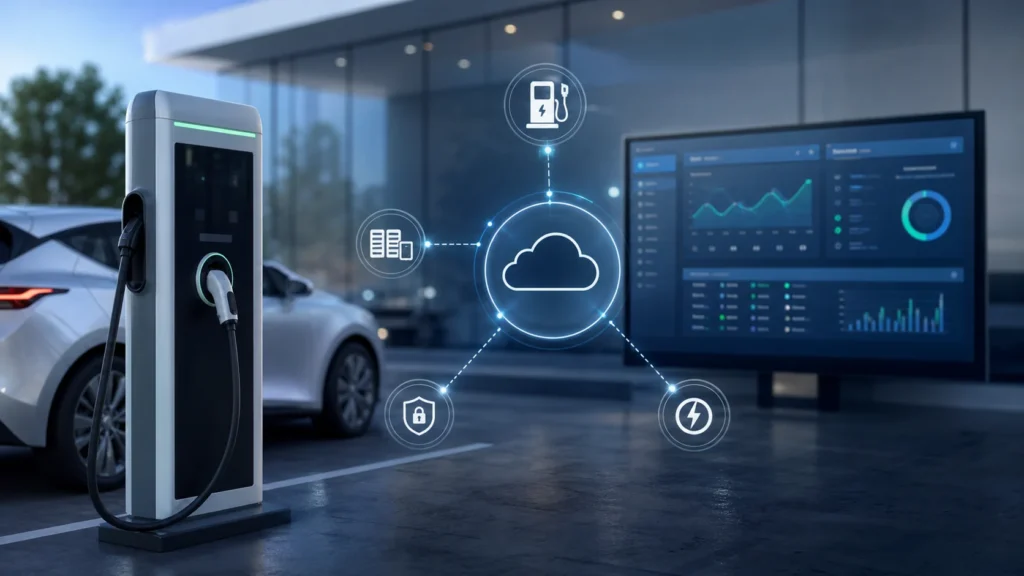
OCPP, or Open Charge Point Protocol, is the communication standard that lets an EV charger talk to a charging station management system. It matters because a charger and a backend platform can come from different vendors and still exchange the messages needed for authorization, charging sessions, status updates, meter data, faults, firmware, smart charging, and remote operation.
For drivers, OCPP usually stays invisible. They plug in, start a session, and see charging status in an app or on a payment screen. For charge point operators, fleets, property owners, retailers, and EV hardware buyers, OCPP is one of the biggest decisions behind the scenes. It can affect whether a charger can be connected to the preferred network, whether the operator can switch software later, and whether a charging project becomes manageable as it grows.
The Open Charge Alliance describes OCPP as a uniform method of communication between charge points and central systems, with the goal of connecting any central system with any charge point regardless of vendor 1. That idea is simple, but the real-world details are not. Version support, security profiles, backend testing, firmware quality, charger hardware, connector type, and local market rules all matter. For companies choosing EV charging accessories, OCPP should be treated as part of the product specification, not just a marketing line.
Table of Contents
- What is OCPP in EV charging?
- How does OCPP work between an EV charger and a central system?
- What can OCPP do for charging station operators?
- Which OCPP versions matter now?
- Is OCPP the same as ISO 15118, OCPI, or a payment system?
- Is OCPP secure?
- What should buyers check before choosing an OCPP charger?
- Conclusion: OCPP is the language behind manageable EV charging networks
- Frequently Asked Questions
- References
What is OCPP in EV charging?
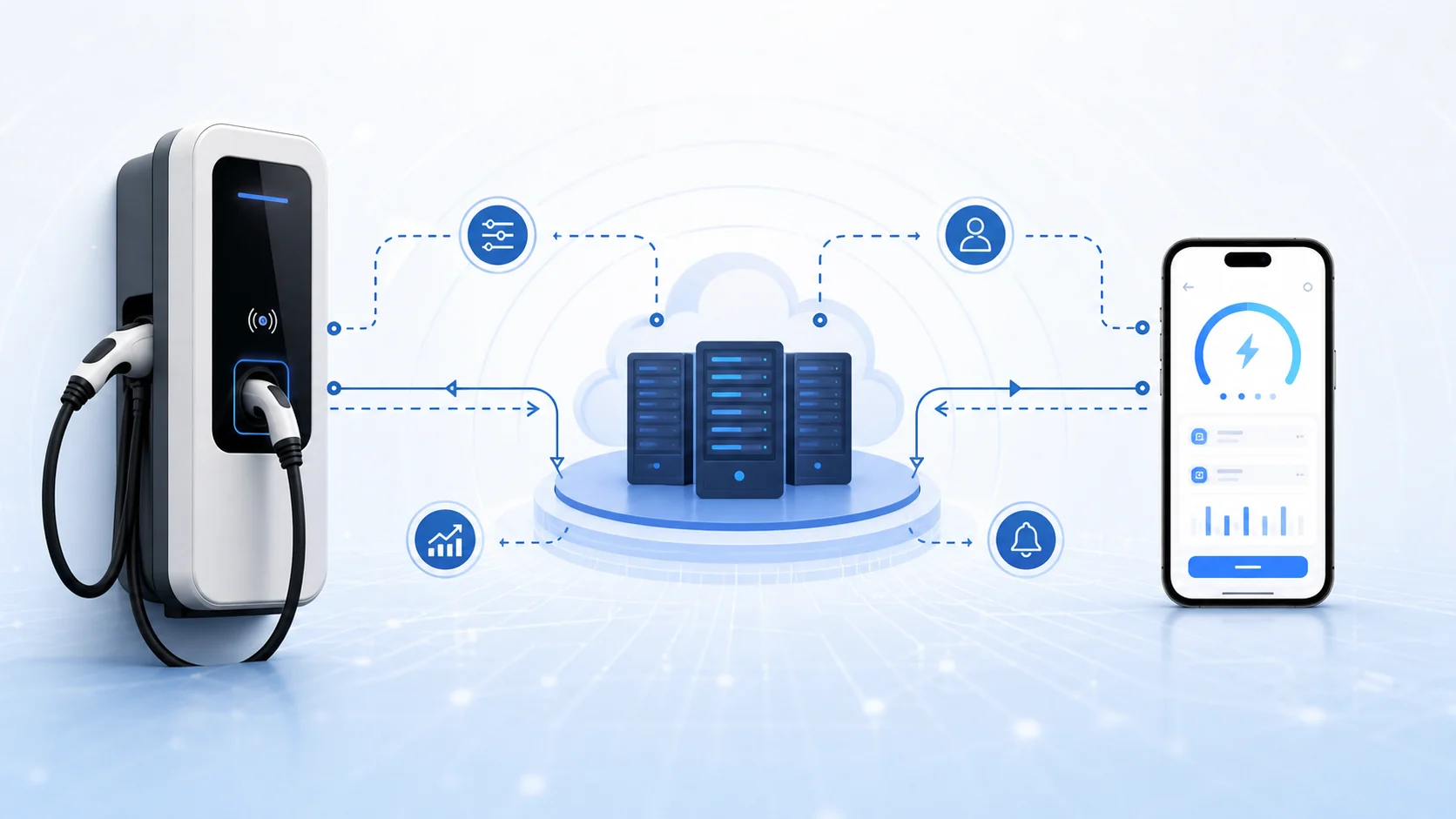
OCPP is an open communication protocol for EV charging stations and the software platforms that manage them. In everyday language, it is the shared language that helps a charger report what is happening and lets the backend send commands back to the charger.
A charging station may look like a simple electrical product from the outside, but a networked charger is also a connected device. It needs to tell the backend when it starts up, whether it is available, whether a connector is plugged in, how much energy has been delivered, whether an error occurred, and whether a charging session should be allowed. OCPP defines how those kinds of messages are structured and exchanged.
This is different from the physical connector or the charger category itself. If the reader is still sorting out the hardware side, a basic EV charging station guide helps explain levels, station types, and how the equipment is used. A Type 1 vs Type 2 EV charger decision is about the vehicle-side charging interface and regional compatibility. OCPP is about charger-to-backend communication.
OCPP also does not replace the charger hardware. A wallbox, DC charger, or portable EV charger still needs correct electrical design, cable rating, thermal behavior, enclosure quality, and market documentation. OCPP sits on top of that hardware layer and helps make the charger operable as part of a managed network.
How does OCPP work between an EV charger and a central system?
OCPP works through structured messages between the charging station and a Charging Station Management System, often shortened to CSMS. The charger sends messages about its status and charging activity, while the CSMS sends messages for authorization, configuration, remote commands, profiles, and updates.
The easiest way to understand it is to follow a charging session:
- The charger boots and connects: The charging station tells the CSMS that it is online and provides basic information.
- The charger reports status: It can show whether a connector is available, occupied, faulted, or unavailable.
- The driver starts charging: The charger may ask the CSMS whether an RFID card, app user, or other identifier is authorized.
- The session begins: The charger sends transaction information and meter readings.
- The backend monitors the session: The CSMS can display energy use, session state, and charger availability.
- A problem occurs or settings change: The charger can report faults, and the backend may send configuration or reset commands.
- The session ends: Final meter data and transaction details are sent for records, billing, reporting, or operations.
OCPP is usually discussed as a charger-to-backend protocol, but the backend may connect to many other systems: driver apps, payment processors, roaming platforms, fleet software, energy management tools, and reporting dashboards. That is why a good OCPP implementation is not just about passing a basic connection test. It needs to behave predictably during real operations.
For product teams, this is where firmware quality becomes important. Two chargers can both claim OCPP support, yet handle reconnection, offline authorization, fault reporting, firmware updates, and smart charging differently. The buyer should ask which OCPP version is supported, which transport and security profile are used, which messages are implemented, and which backend systems have been tested.
What can OCPP do for charging station operators?
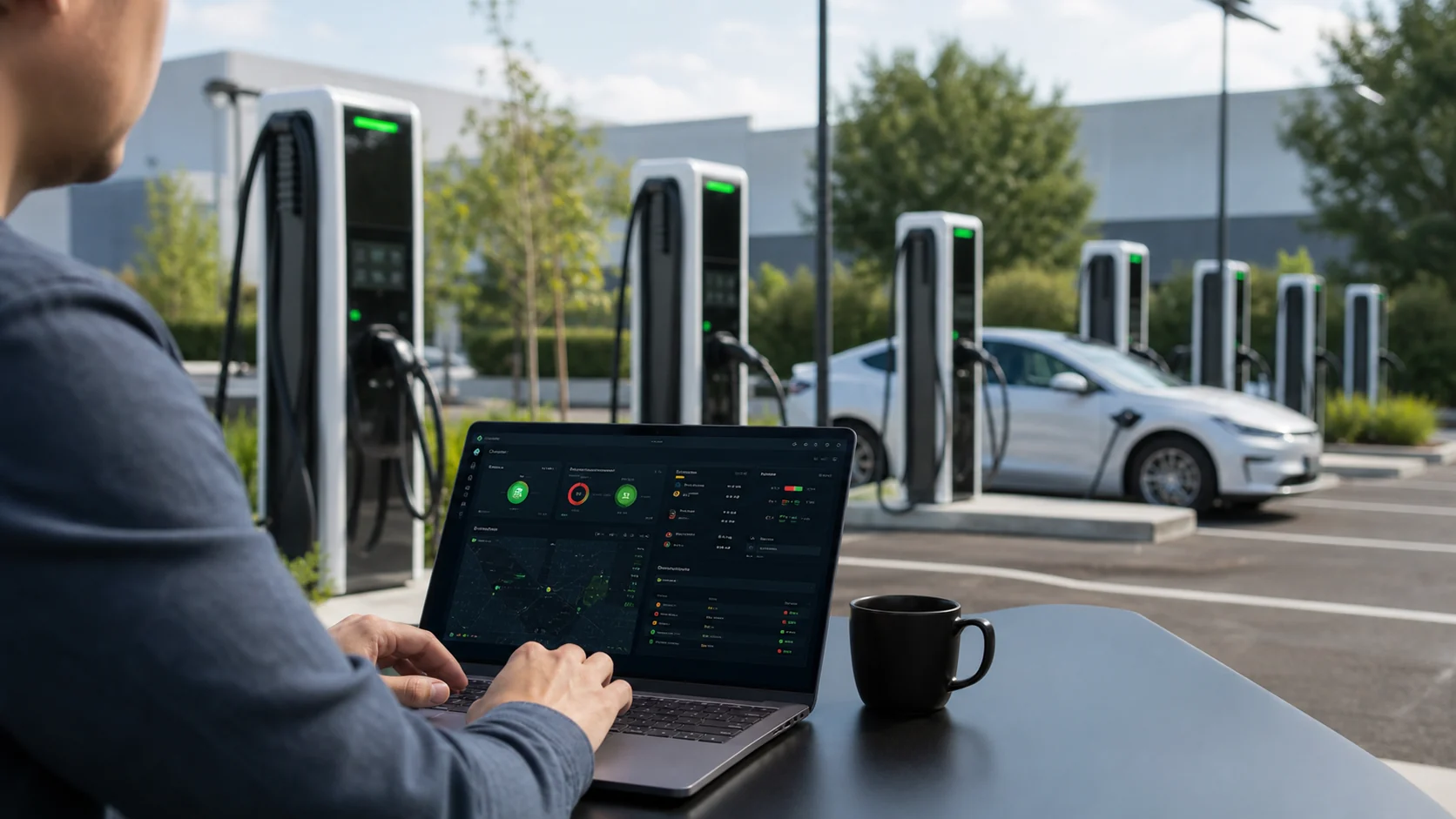
OCPP helps operators manage charging stations remotely instead of treating every charger as a standalone device. The practical value is visibility, control, interoperability, and a path to scaling a charging network without locking every decision to one hardware supplier.
For a small site, OCPP may seem like extra complexity. If there is only one private wallbox, the owner may care more about plug type and electrical installation. Once there are many chargers across homes, workplaces, parking lots, hotels, depots, or retail sites, OCPP becomes much more useful because the operator needs a central way to see and manage the network.
Common OCPP-supported operations include:
| Operator need | How OCPP helps | Why it matters |
|---|---|---|
| Charger monitoring | Sends availability, connector status, and fault messages | Operators can see which chargers are usable |
| User authorization | Supports backend approval for cards, apps, or identifiers | Charging access can be controlled centrally |
| Meter data | Sends energy readings during or after sessions | Useful for billing, reports, and fleet tracking |
| Remote commands | Allows actions such as remote start, stop, reset, or unlock where supported | Reduces site visits and support calls |
| Configuration | Lets the backend read or change settings | Helps maintain consistent deployments |
| Firmware management | Supports update workflows in supported versions and implementations | Keeps devices maintainable over time |
| Smart charging | Allows charging limits or schedules to be managed | Helps reduce peak load and balance sites |
For distributors and site owners, the biggest value is optionality. If a charger uses an open, well-tested OCPP implementation, the operator may have more freedom to choose software. That does not mean every charger works perfectly with every backend out of the box. It means the integration has a common protocol foundation instead of being entirely proprietary.
That is why OCPP often appears beside app control, Wi-Fi, Bluetooth, RFID, and backend-dashboard claims on product pages. For readers comparing connected portable products, the related guide to smart portable EV chargers is a useful next step because it looks at the user-facing controls that sit on top of the charger hardware and software stack.
Which OCPP versions matter now?
The OCPP versions that matter most today are OCPP 1.6, OCPP 2.0.1, and OCPP 2.1. OCPP 1.6 is widely used in existing networks, OCPP 2.0.1 is the modern reference point for richer functionality and IEC standardization, and OCPP 2.1 adds newer features for bidirectional charging, DER control, and more advanced smart charging.
The Open Charge Alliance currently lists three supported versions: OCPP 1.6, released in 2015; OCPP 2.0.1, released in 2020; and OCPP 2.1, released in 2025 2. OCA also makes protocol downloads and errata available, including current package listings for OCPP 2.1, OCPP 2.0.1, and OCPP 1.6 3.
| Version | Why it matters | Typical buyer takeaway |
|---|---|---|
| OCPP 1.6 | Very common in installed networks and supported by many chargers and platforms | Still relevant, especially for compatibility with existing backends |
| OCPP 2.0.1 | Adds broader modern functionality and is the basis for IEC 63584:2024 | Strong choice when backend and charger support are mature |
| OCPP 2.1 | Builds on 2.0.1 with added support for newer use cases such as bidirectional charging and DER control | Watch closely for future-ready projects, but confirm real backend support |
OCPP 2.0.1 has a special role because OCPP 2.0.1 Edition 3 was approved as IEC 63584 in 2024 2. IEC 63584:2024 defines an international standard for communication between a Charging Station and a Charging Station Management System and is based on OCPP 2.0.1 5. For public tenders, government-linked projects, and long-term network planning, that standardization can matter.
Still, version choice should not be made from a version number alone. An excellent OCPP 1.6 implementation may perform better in a specific backend environment than an immature OCPP 2.x implementation. A practical buyer should ask which version is supported by the charger, which version is supported by the CSMS, which optional functions are implemented, and whether the exact combination has been tested.
Is OCPP the same as ISO 15118, OCPI, or a payment system?
OCPP is not the same as ISO 15118, OCPI, or a payment system. OCPP mainly connects the charging station to the charging management system, while other standards and systems handle vehicle-to-charger communication, roaming, tariffs, payments, or driver-facing services.
This distinction saves a lot of confusion. EV charging has several communication layers:
- Vehicle to charger: This can include signaling and, in advanced cases, ISO 15118 features such as Plug & Charge or bidirectional charging support.
- Charger to backend: This is where OCPP sits.
- Backend to roaming platform: This may involve protocols such as OCPI in some markets.
- Backend to payment provider: This is usually handled by payment integrations, not OCPP alone.
- Backend to driver app: This depends on the charging network's app and API design.
OCPP 2.1 includes improved support for ISO 15118-20, bidirectional energy flows, distributed energy resource control, and smart charging functions compared with earlier versions 1. That does not mean OCPP and ISO 15118 are the same thing. It means modern charging networks increasingly need these communication layers to work together.
The same is true for hardware accessories. Choosing the cable and connector is still a physical compatibility decision. Choosing OCPP support is a software and operations decision. A complete charging product plan needs both.
Is OCPP secure?
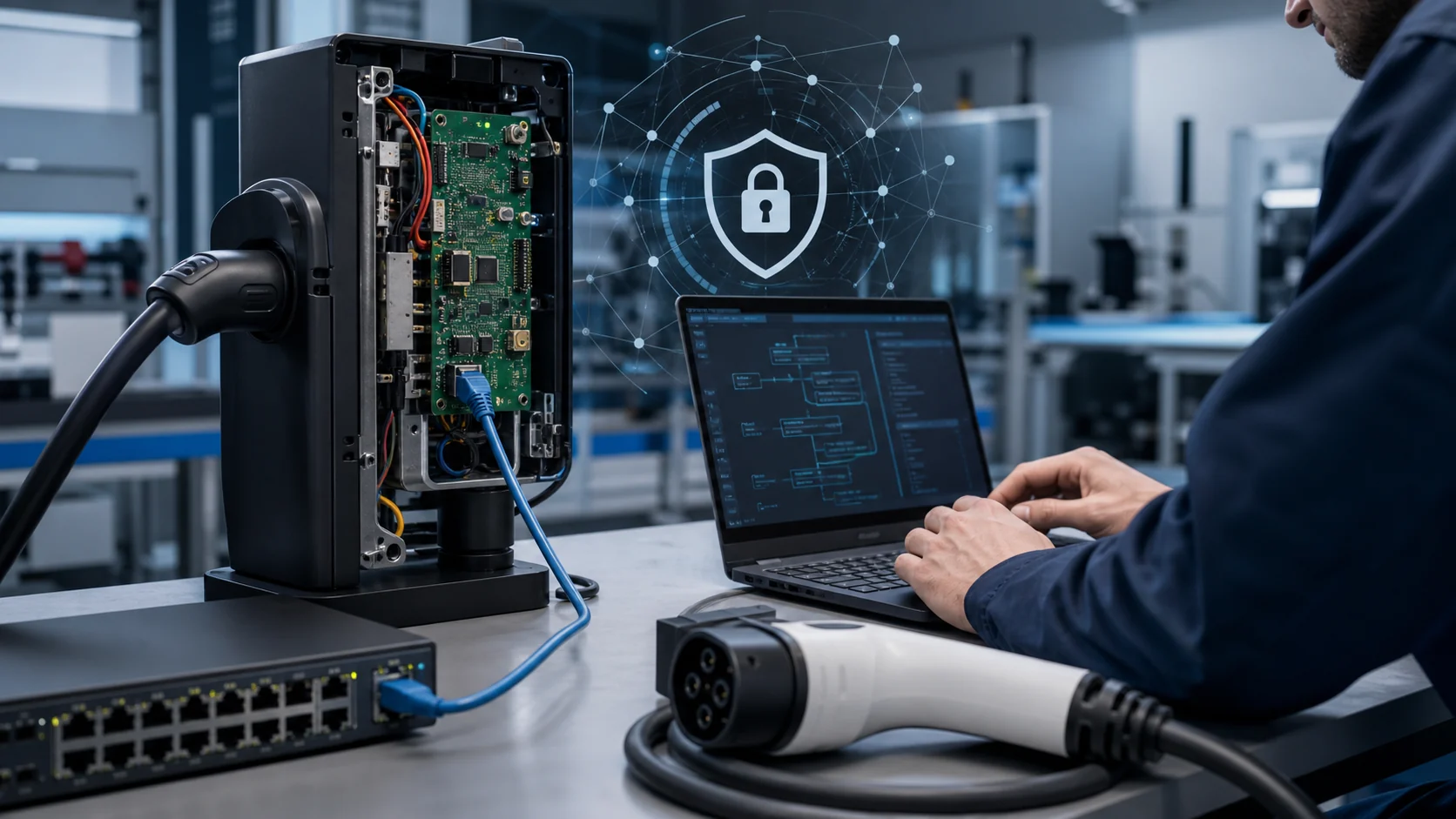
OCPP can support secure communication, but security depends on the version, security profile, configuration, certificates, firmware, backend implementation, and operating process. An OCPP label by itself is not enough to prove that a charger is secure.
This matters because EV chargers are connected infrastructure. They can be installed in public places, depots, parking facilities, homes, and commercial sites. If they are poorly configured, the risks are not limited to a broken app screen. Operators may face unavailable chargers, inaccurate status, failed authorizations, unreliable firmware updates, or exposure of operational data.
OCA's OCPP 2.0.1 certification structure shows how broad the topic has become. For OCPP 2.0.1 certification, Core is mandatory, while other profiles are optional; the Core profile includes basic charging station functionality for booting, authorization, configuration, transactions, remote control, and basic security 4. OCA also lists optional certification profiles such as Advanced Security, Smart Charging, ISO 15118 Support, and others for OCPP 2.0.1 4.
For buyers, the practical security checklist should include:
- Security profile: Confirm what the charger and backend support, not only the OCPP version.
- Transport security: Ask how TLS, certificates, and authentication are handled.
- Firmware update process: Confirm how updates are signed, delivered, and recovered if interrupted.
- Credential handling: Check how backend URLs, certificates, and access credentials are stored.
- Offline behavior: Ask what happens when the network is unavailable.
- Backend testing: Test with the real CSMS, not only a simulator.
- Operational ownership: Decide who manages certificates, firmware, and backend configuration after shipment.
Security is also a documentation issue. A charger that ships with unclear setup instructions can create insecure field behavior even if the hardware is capable. Good manuals should explain network setup, backend URL configuration, certificates, firmware, reset behavior, and support channels in plain language.
Safety documentation should also stay aligned with the electrical product, not only the software. A networked charger still needs credible enclosure, cable, connector, and testing information, so a related guide to portable EV charger safety standards can help buyers connect OCPP claims with the safety checks expected for EVSE products.
What should buyers check before choosing an OCPP charger?
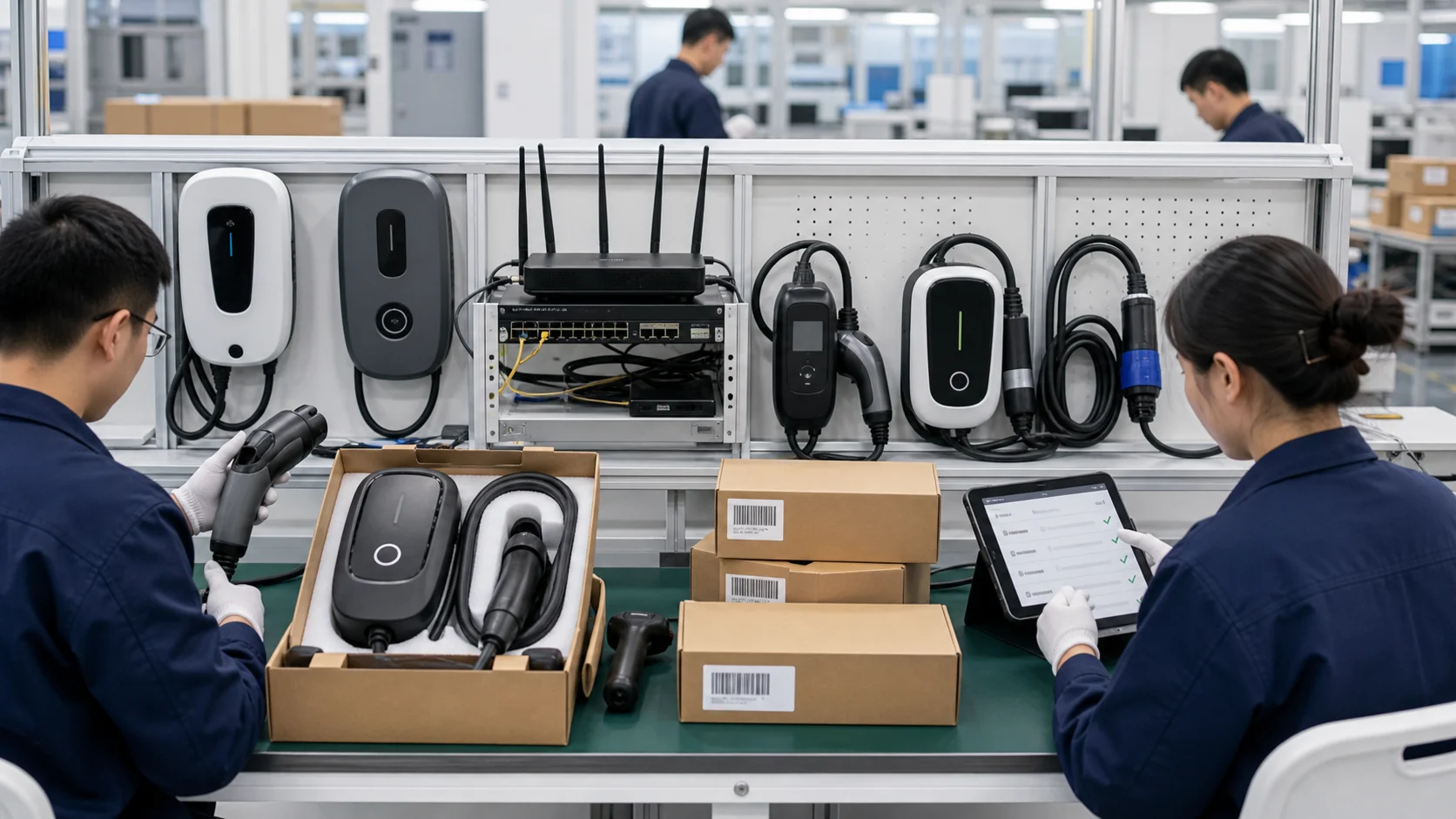
Buyers should check OCPP version support, certification status, backend compatibility, security profile, firmware maturity, connector configuration, electrical rating, documentation, and after-sales support before choosing an OCPP charger. The safest approach is to treat OCPP as one part of a complete charger program.
Start with the backend. If the buyer already has a CSMS, the charger should be tested against that platform before a bulk order. If the buyer has not chosen a backend, they should shortlist software and hardware together. OCPP improves interoperability, but it does not remove the need for integration testing.
Then check the physical charger. A network-ready wallbox still needs the right connector, cable, enclosure, current rating, markings, and packaging. For regional programs, the buyer may need Type 1, Type 2, socketed, tethered, or market-specific variants. This is where the related guide to EV charging cable connector types fits naturally: OCPP can manage the charger, but it cannot fix the wrong connector, cable rating, or market configuration.
A practical OCPP buying checklist includes:
- OCPP version: Confirm OCPP 1.6, 2.0.1, or 2.1 support and whether the backend supports the same version.
- Certification and profiles: Ask whether the product has official OCA certification and which profiles are covered.
- Backend test record: Test boot, authorization, transaction, meter data, fault, reset, firmware, and offline cases.
- Security setup: Confirm TLS, certificates, credential storage, and operator responsibilities.
- Connector and cable fit: Match the product to local vehicle inlets and charging habits so a software-ready charger is not physically wrong for the market.
- Documentation: Require clear setup manuals, configuration steps, LED/display meanings, and support process.
- Current and load settings: If the product supports adjustable output, compare it with real use cases for adjustable current portable EV chargers so the current settings are clear to buyers.
- Firmware roadmap: Ask how updates are delivered and how long the model will be supported.
- Packaging accuracy: Make sure labels and manuals do not overpromise universal backend compatibility.
For a product category page or related product page, the safest wording is specific rather than broad: say which OCPP version is supported, which backend has been tested, and which connector or cable configuration is included. Broad "works with every network" language creates avoidable returns and support tickets.
Conclusion: OCPP is the language behind manageable EV charging networks
OCPP is the open communication layer that lets EV chargers and charging station management systems work together. It helps operators monitor chargers, authorize sessions, collect meter data, handle faults, manage settings, support firmware workflows, and build networks that are less dependent on a single closed hardware-and-software bundle.
The important versions today are OCPP 1.6, OCPP 2.0.1, and OCPP 2.1. OCPP 1.6 remains common in existing networks. OCPP 2.0.1 is a modern baseline and the basis for IEC 63584:2024. OCPP 2.1 points toward newer smart charging, bidirectional energy, and distributed energy use cases. The right version depends on the backend, charger firmware, project requirements, and real integration testing.
For buyers and distributors, the practical rule is simple: don't buy an "OCPP charger" by the label alone. Check the version, certification, optional profiles, security setup, backend compatibility, connector type, cable quality, documentation, firmware support, and packaging claims. If the next step is building a product range, start from related OEM EV charging accessories and keep the software claim tied to the actual charger, cable, connector, and market use case.
Frequently Asked Questions
What does OCPP stand for?
OCPP stands for Open Charge Point Protocol. It is a communication protocol used between EV charging stations and charging station management systems.
Is OCPP required for every EV charger?
No. A private standalone charger may not need OCPP. OCPP becomes much more important when chargers need remote monitoring, network management, user authorization, billing data, firmware support, or integration with a third-party backend.
What is the difference between OCPP 1.6 and OCPP 2.0.1?
OCPP 1.6 is widely deployed and still common in many charging networks. OCPP 2.0.1 is a newer, broader version with more modern functional blocks and is the basis for IEC 63584:2024.
Is OCPP 2.1 the latest version?
Yes. The Open Charge Alliance lists OCPP 2.1 as released in 2025, building on OCPP 2.0.1 with added functionality such as better smart charging, ISO 15118-20 support, bidirectional charging, and DER control.
Does OCPP handle payment?
OCPP can support transaction data and authorization flows, but it is not a complete payment system by itself. Payment processing usually depends on the charging management platform, payment provider, local regulations, and any roaming or app integrations.
Can any OCPP charger work with any OCPP backend?
OCPP is designed to improve interoperability, but real compatibility still needs testing. Version support, optional features, security profiles, backend interpretation, firmware behavior, and configuration details can affect whether a charger works smoothly with a specific CSMS.
How do I know if an OCPP charger is certified?
Ask for official OCA certification details and confirm which OCPP version and profiles are covered. Certification is more useful when it matches the exact model, firmware family, and functions needed for the project.
What should a distributor ask a supplier about OCPP?
A distributor should ask for the OCPP version, certification status, supported profiles, tested backends, security configuration, firmware update process, connector options, cable ratings, manuals, packaging files, and after-sales support plan.
References
[1] Open Charge Alliance. (2026). Open Charge Point Protocol.
[2] Open Charge Alliance. (2026). OCPP Protocols.
[3] Open Charge Alliance. (2026). Download OCPP.
[4] Open Charge Alliance. (2026). Certification OCPP 2.0.1.
[5] IEC. (2024). IEC 63584:2024 Open Charge Point Protocol.