




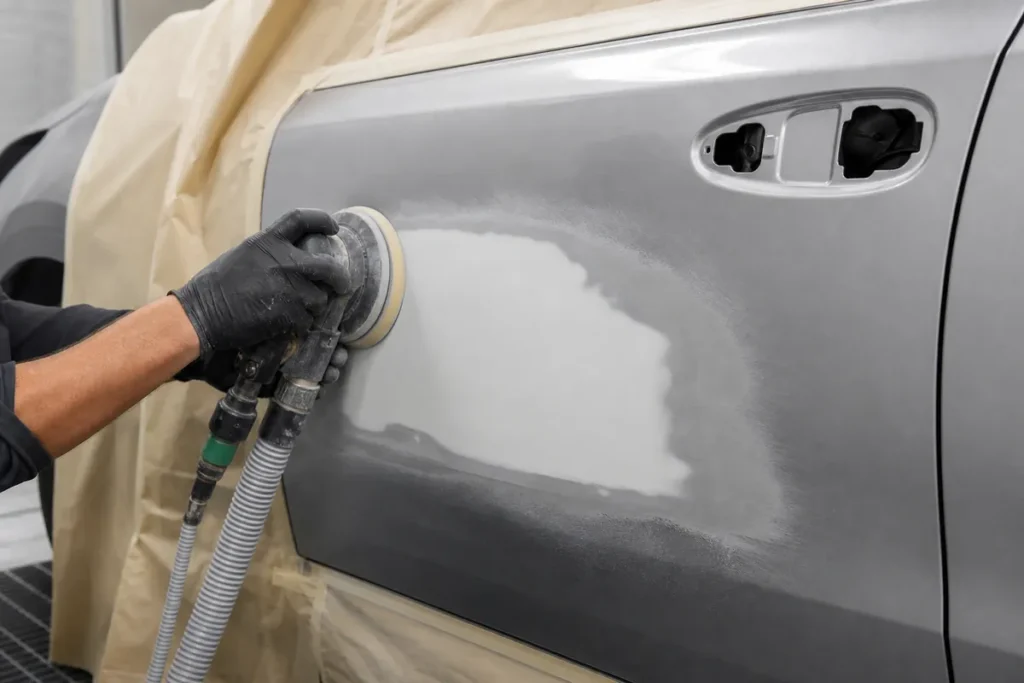
Feathering in auto body work usually means featheredging: sanding the edge of a damaged coating into a gradual taper so primer and paint do not reproduce a hard step. This guide uses feathering in that sense. It does not mean feathering a spray-gun trigger during a blend, tire feathering, or the estimating operation called feather, prime and block.
The distinction matters because stopping a repair outline requires control of the coating edge and scratch pattern below the paint—not simply fading sprayed color farther across the panel.
Table of Contents
- What does feathering mean in auto body repair?
- Why do paint edges need to be feather sanded?
- How do you feather sand a paint edge step by step?
- What sandpaper grit should you use for feathering?
- Should you feather edges by hand or with a DA sander?
- How can you tell whether the featheredge is good enough?
- What mistakes cause edge mapping or visible repair lines?
- Featheredge Abrasive Supplier Test Sheet
- Conclusion: Feathering hides the repair edge before paint does
- Frequently Asked Questions
- References
What does feathering mean in auto body repair?
Featheredging turns the abrupt edge between coating layers into a smooth ramp. A repair may contain bare metal, filler, old primer, old color, clear coat, and new primer. The job is not to sand the whole panel thin, but to make the change gradual enough for the specified coating system to cover.
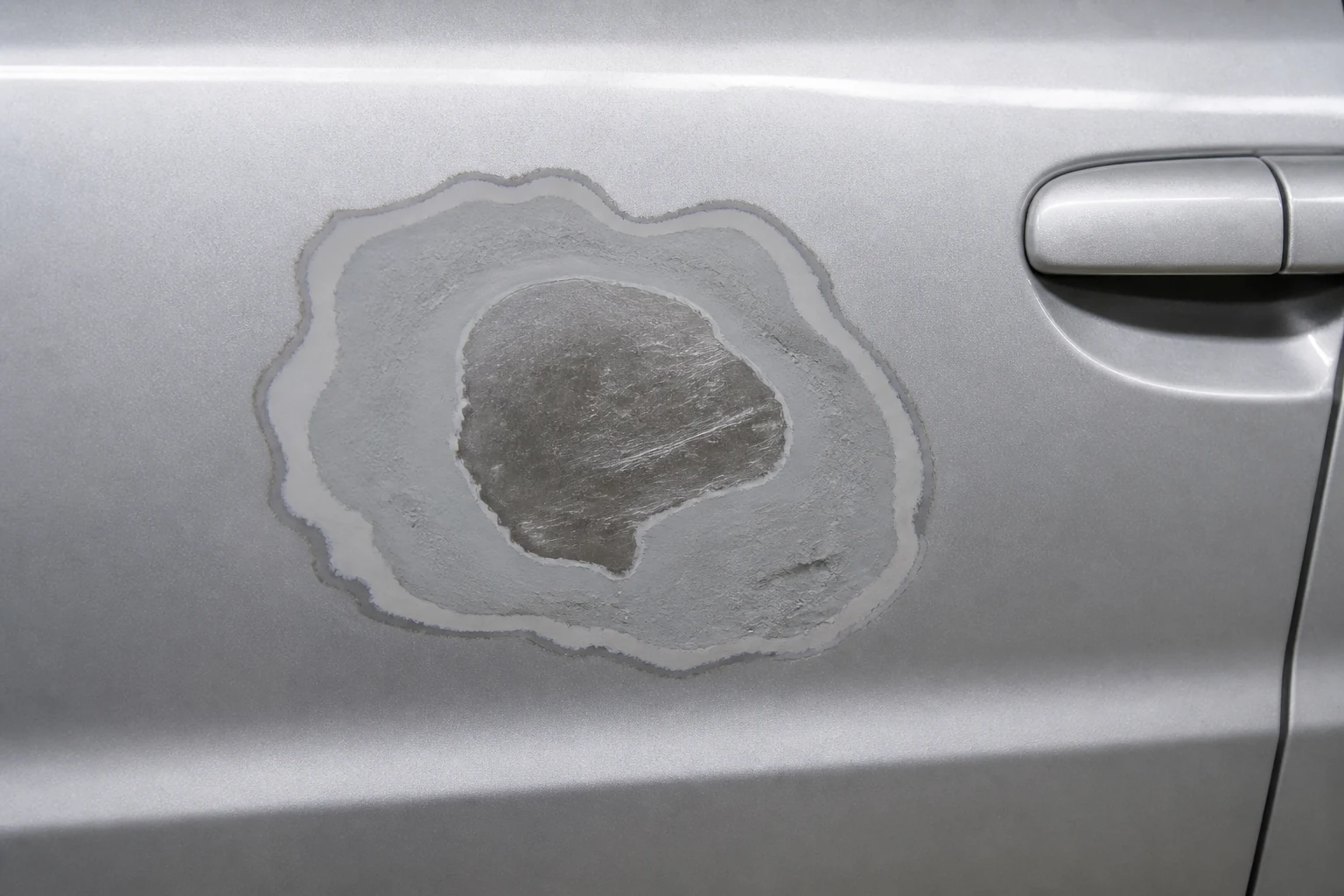
This is separate from spray feathering, where a painter eases off the trigger to control overlap, and tire feathering, uneven tread wear. I-CAR describes featheredging as a standard surface-preparation technique that gradually tapers the repair area so lines do not show through the refinish coating 1.
Why do paint edges need to be feather sanded?
Paint edges need feather sanding because primer and topcoat do not reliably hide a sharp coating step. A steep edge can show later as a ring, a mapping line, a shadow change, or a repair outline after the materials cure and are viewed under raking light.
Feathering also prepares the adjacent coating for the next layer. A clean, properly profiled transition supports adhesion; a rough or sharply stepped edge asks primer to hide a problem it was never meant to correct. 3M's 288U technical data sheet lists P180 for feathering around the repair area and final featheredging/refinement before primer as a DA-disc application 2.
The correct width is not a universal measurement. It depends on the damage, panel shape, substrate, abrasive, and paint system. What is universal is the inspection standard: no catch under a fingertip or nail, no persistent ring in guide coat, and no abrupt light break across the transition.
How do you feather sand a paint edge step by step?
A controlled sequence prevents two expensive outcomes: leaving a hard edge and enlarging the repair unnecessarily. The six images below follow one door repair from the visible hard edge through primer inspection and show what a failed mapping line looks like.
1. Clean and identify the actual edge
Remove wax, silicone, dust, and loose coating before choosing a grit. Find the stable coating boundary; sanding over an unsound edge only moves the failure outward.
2. Shape the edge with a controlled first cut
Use light pressure, keep the abrasive moving, and work outward from the repair. Stop regularly; that matters more than tool speed.
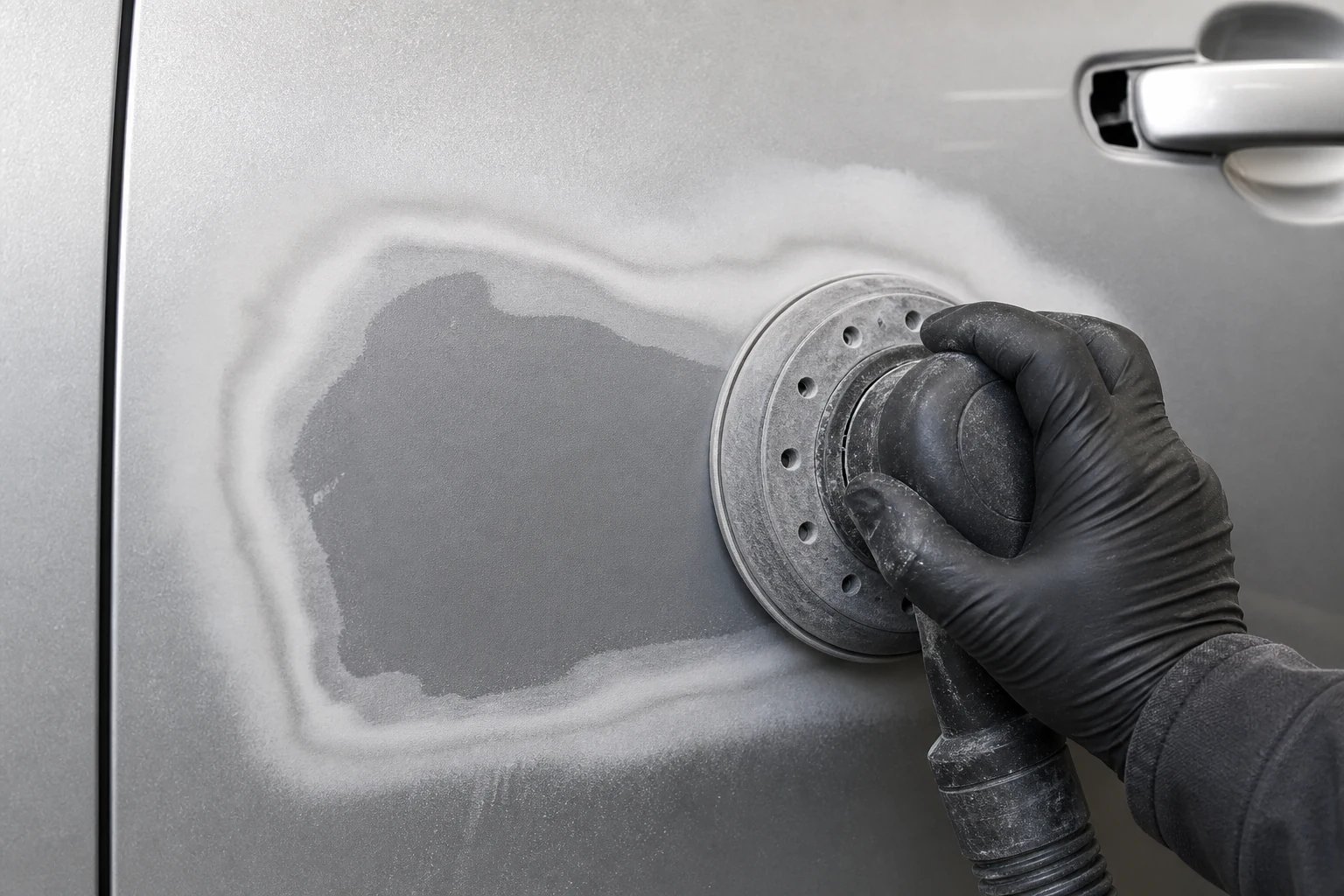
3. Use guide coat to find the edge your hand can miss
Apply guide coat as directed. A remaining dark ring means the transition is still abrupt or low; refine it rather than covering it with more primer.
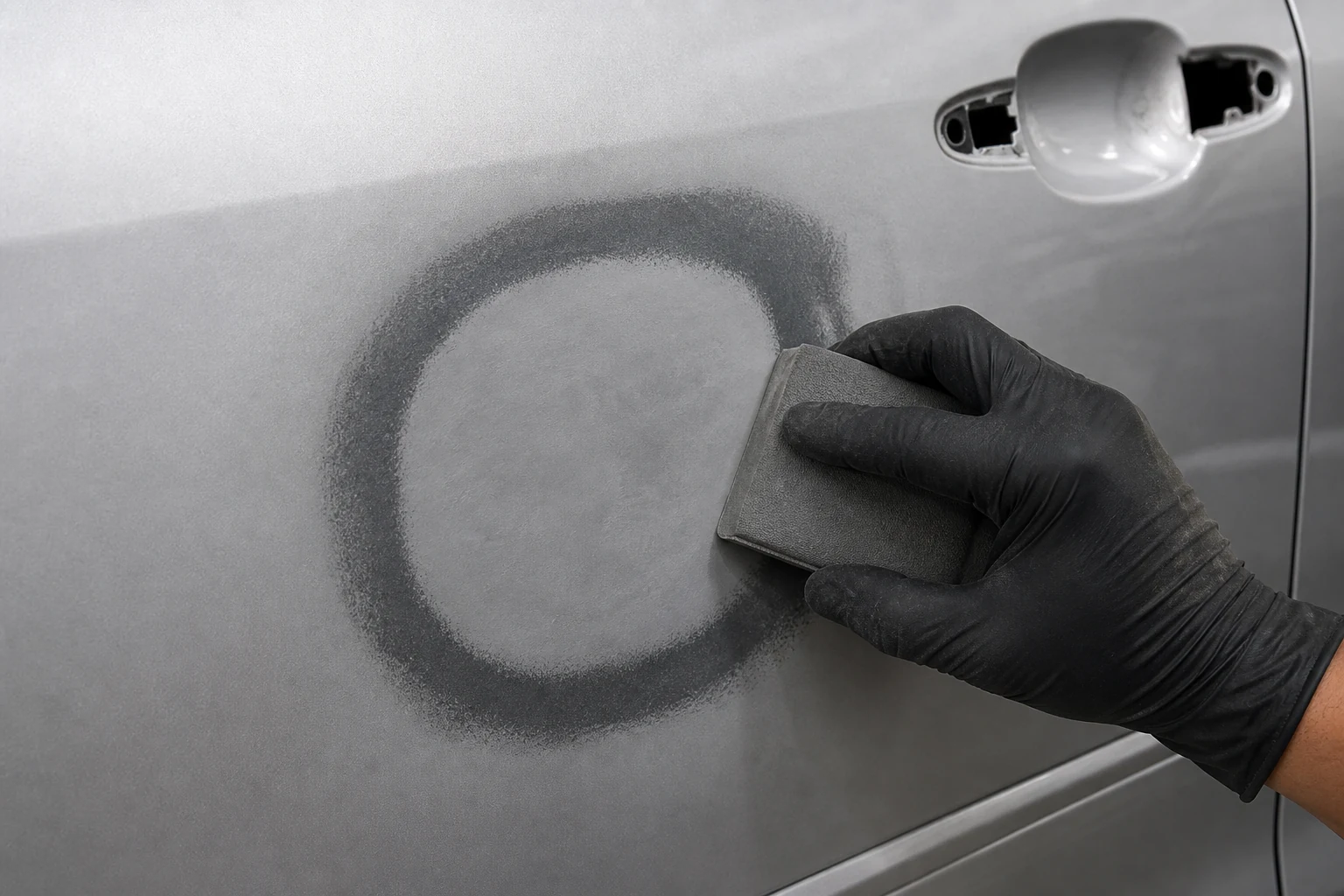
4. Refine the taper and scratch pattern
Step through the next grit rather than trying to erase a coarse scratch with a finish grit. On curves, body lines, and the final edge, use a small block or hand method. The related wet sanding vs dry sanding guide explains why dry sanding is often easier to read with guide coat, while wet sanding can suit permitted fine-finishing stages.
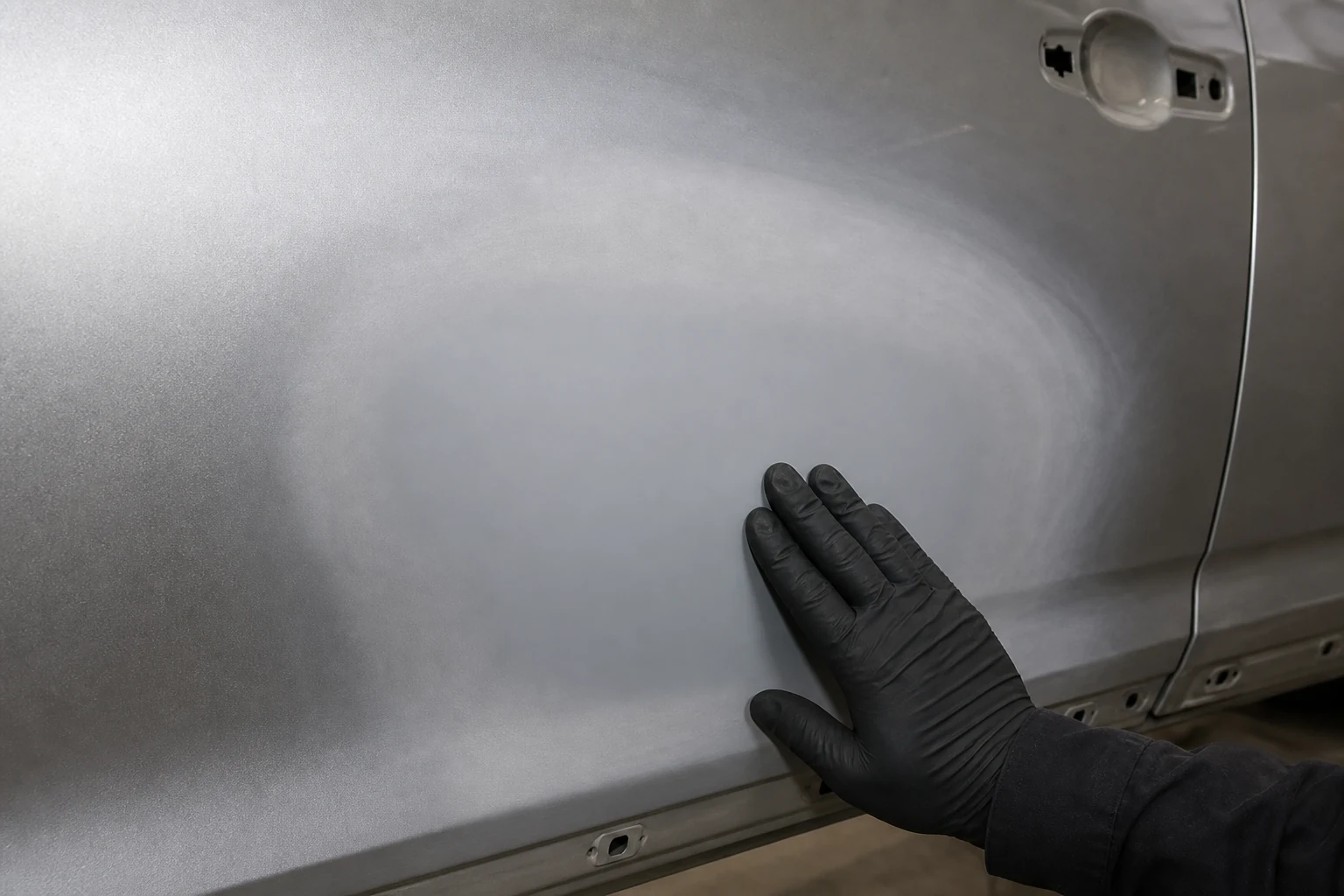
5. Prime, then inspect again before color
Primer is a check, not a concealment strategy. After it cures as specified, inspect under a line light. If an edge maps through, sand, refine, and reprime before base coat and clear make the repair more costly.
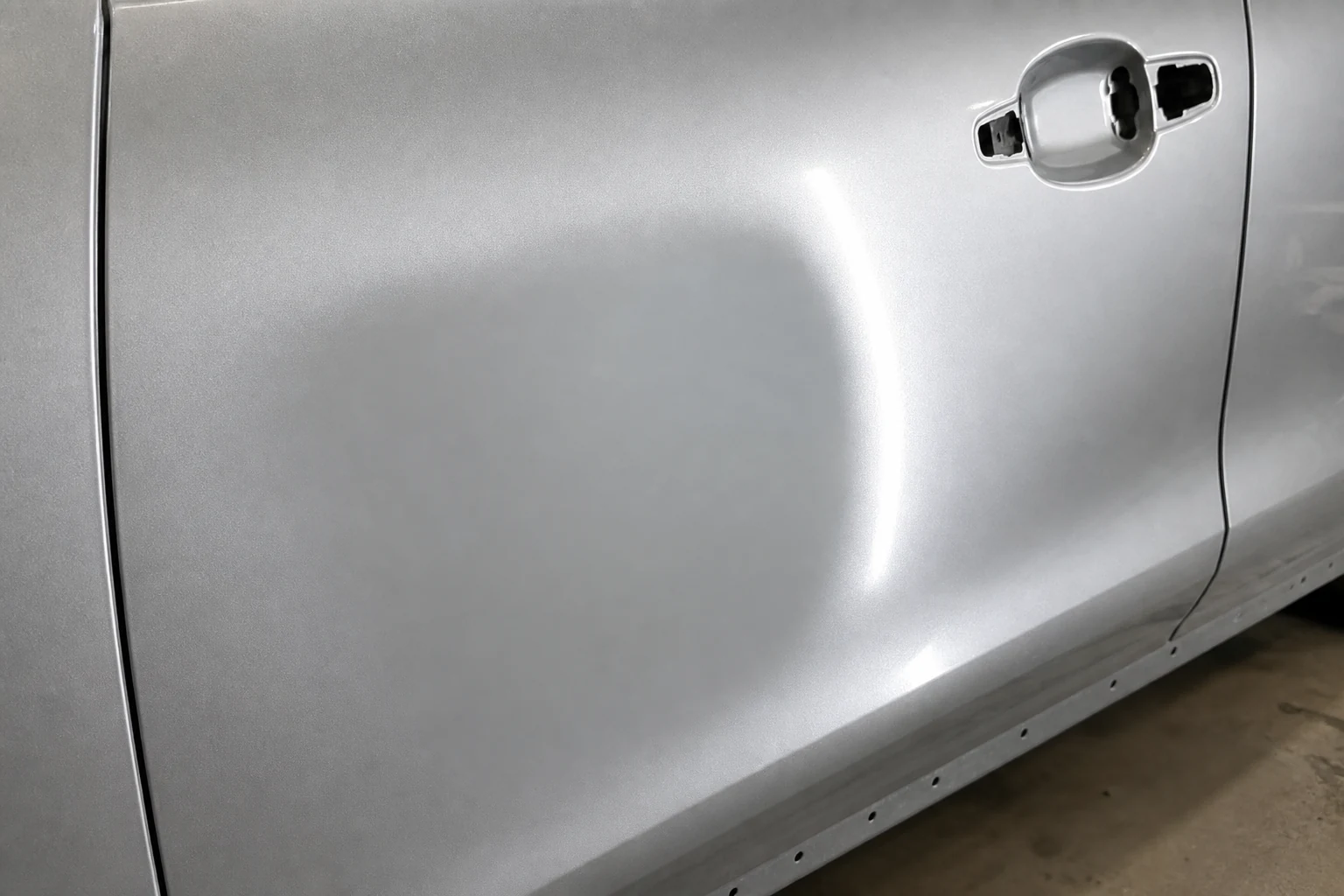
6. Learn to recognize the failure you are preventing
A halo in the finished surface is evidence, not bad luck. Start diagnosis below the finish: check for a narrow featheredge, a remaining coarse scratch, contamination, unsuitable primer build, or an incorrect recoat/refinement sequence.
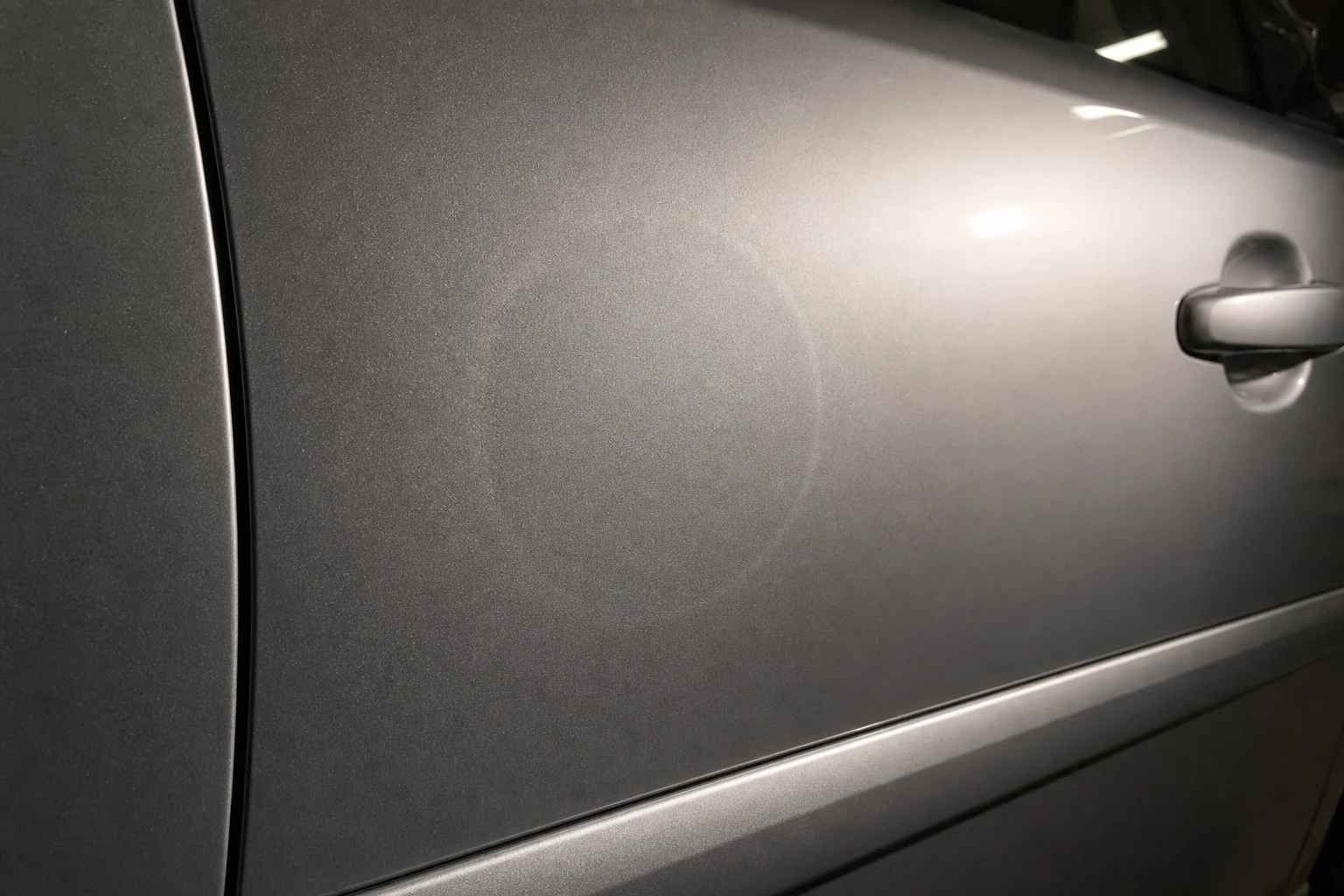
What sandpaper grit should you use for feathering?
Use a grit progression that fits the coating manufacturer's repair procedure, not a fixed recipe copied from another job. P180 is commonly used to feather around a repair, while later steps must remove that scratch pattern and leave the profile required by the primer, sealer, or color system.
| Feathering stage | Typical working range | What to inspect before moving on |
|---|---|---|
| Initial edge shaping | P180–P240 | The hard step is gone; no deep gouges or dig-in marks |
| Edge and scratch refinement | P240–P320 | The previous scratch is fully removed and the taper is still wide |
| Primer or sealer preparation | P400–P600 | The substrate and coating instructions match the final scratch |
| Fine blending preparation | P800 and finer | The surface has adequate bite for the next specified material |
For abrasive ranges, use the sandpaper grit chart. For paper, film, foam-backed formats, sheets, and discs, see the automotive sandpaper guide. The next material's technical data sheet decides the acceptable scratch.
Should you feather edges by hand or with a DA sander?
Use a DA sander for controlled speed on broad areas and hand sanding for feel at edges, tight curves, and shape-sensitive zones. The strongest process often uses both.
A DA can produce a consistent scratch quickly, but pad angle, orbit, pressure, and disc condition determine whether it feathers or digs. The related DA sander guide explains those controls; the sanding disc guide helps match attachment and hole pattern to the tool and extraction.
Hand work is slower but gives immediate feedback at a panel break or tight repair. A backing pad or block distributes pressure better than fingertips alone. The sanding block guide explains where shape and stiffness matter.
How can you tell whether the featheredge is good enough?
A finished featheredge feels continuous, reads gradual under light, and survives guide-coat and primer inspection without a ring. Look across the panel because a curved door or fender can hide a defect from one angle and reveal it from another.
Use this release check before primer or sealer:
- Wipe clean, then run a gloved fingertip and a fingernail across the edge. Neither should catch.
- View under direct and low-angle light. There should be no abrupt shadow line.
- Apply and sand guide coat as appropriate. It should fade evenly, not leave a circular edge.
- Confirm the final scratch and cleanliness against the next coating's technical data sheet.
- Inspect after primer. Do not ask color or clear coat to disguise an edge that primer already exposes.
Dry sanding dust is a safety and quality issue as well as a cleanup problem. OSHA's autobody repair and refinishing guidance addresses sanding and refinishing hazards 3. NIOSH guidance on dust control in auto body repair shops recommends ventilated mechanical sanders and reports substantially lower total dust concentrations with high-velocity, low-volume local exhaust systems than with unventilated tools 4. Use suitable extraction, ventilation, and PPE for the materials and workplace.
What mistakes cause edge mapping or visible repair lines?
Mapping usually begins below the visible paint: a narrow featheredge, unreduced coarse scratch, contamination, poor surrounding-coating preparation, or an incompatible coating sequence.
Do not diagnose a visible circle by immediately adding more finish. Inspect in reverse order: finished line, primer, guide coat, scratch pattern, then original edge. If the repair grew too large, do not compensate by making the remaining edge steep.
Featheredge Abrasive Supplier Test Sheet
An abrasive sample is not proven by how quickly it sands a flat coupon. A featheredge test must show how it behaves across old paint, primer, filler, and curves—and whether the next grit and primer can erase its work. Use this sheet with a known in-house abrasive as the control and retain the sample and labels with the results.
Test setup: use a representative steel or e-coated panel with sound aged coating, a primed repair patch, one curved or body-line area, the intended DA/vacuum setup, and the actual primer system. Test at least two samples from each candidate grit. For batch consistency, repeat with separate production lots.
| Test item | Record on every sample | Pass decision to document |
|---|---|---|
| Sample identity | Supplier, product code, stated grit, backing, attachment, hole pattern, lot code, date received | Identity and packaging match the quotation and approved sample |
| Repair panel and setup | Substrate/coating stack, DA orbit, pad, vacuum, hand block, operator, ambient conditions | Same setup is used for control and candidate samples |
| Initial cut | Time or passes to remove the hard step; pressure needed; whether the disc skates or grabs | Candidate reaches a smooth taper without extra force or localized digging |
| Edge control | Width and smoothness of the taper; effect at curves and body lines | No gouges, torn edge, flattened line, or abrupt remaining step |
| Loading and dust extraction | Loading after a defined work interval; disc cleanliness; hole alignment and extraction performance | Loading and dust control are acceptable relative to the control sample |
| Scratch handoff | Whether the next nominated grit removes the prior scratch cleanly | No deep random scratch remains after the specified refinement step |
| Primer recheck | Guide-coat result, primer appearance, edge mapping under line light | No ring, edge print-through, or visible repair outline |
| Physical durability | Backing tear, hook-and-loop retention, curl, disc edge wear, label readability | Disc stays usable through the defined test; labels remain unambiguous |
| Batch and commercial review | Carton count, grit separation, lot traceability, repeat-sample result, variance from control | Release only when the delivered batch matches the approved result |
This sheet does not make one grit or supplier suitable for every coating system. Compare results with your control rather than inventing a universal pass number. For sample formats, the Yirox automotive sandpaper and abrasives range is a starting point for discs, sheets, and related options.
If you are choosing sanding or refinishing supplies for an auto-body workflow, tell us the repair stage, abrasive format, grit range, backing, and shop conditions you need to support. We can help you identify a practical sample and supply brief.
Conclusion: Feathering hides the repair edge before paint does
Featheredging is not spray blending or tire feathering. It is controlled sanding of a repair edge into a gradual transition, followed by scratch refinement and inspection before the final finish makes mistakes expensive.
Start with the actual stable edge, use the coating system to choose the grit progression, inspect with guide coat and light, and treat primer as a checkpoint. For a product program, use the supplier test sheet on real repair panels and compare every candidate against a retained control sample. That gives the technician and buyer evidence of edge control, scratch consistency, dust performance, and batch repeatability—not just a claim on a carton.
Frequently Asked Questions
Is featheredging the same as spray-gun feathering?
No. Featheredging is surface preparation: sanding a coating edge into a taper. Spray-gun feathering is a paint-application technique used to control the end or overlap of a sprayed pass.
What grit should I start with for a paint-edge feather?
P180 is commonly listed for feathering around a repair, but the correct starting grit depends on the damaged coating, substrate, and the next coating product. Follow the repair and coating technical data, then refine the scratch before primer or color.
Can I featheredge an entire repair with a DA sander?
Use a DA on broad, accessible areas, then check the edge frequently and hand-refine curves, panel breaks, or tight spots as needed. The goal is a smooth taper, not maximum sanding speed.
Why did a ring show after the repair was painted?
The ring usually began under the finish: a hard or narrow edge, unreduced scratch, contamination, primer issue, or incorrect preparation sequence. Diagnose from the finished line back through primer and guide coat before repainting.
Should feather sanding be wet or dry?
Both can be useful when the coating system permits them. Dry sanding is often easier to inspect with guide coat and dust extraction; wet sanding can be useful in later fine-finishing stages but slurry can hide surface detail.
References
[1] I-CAR. “Surface Preparation and Masking (REF02e).”
[2] 3M. “3M 288U Gold Abrasives Technical Data Sheet.”
[3] Occupational Safety and Health Administration. “Autobody Repair and Refinishing.”
[4] National Institute for Occupational Safety and Health. “Control of Dusts From Sanding in Auto Body Repair Shops.” 1996.