




Wheel weight range planning turns local wheel applications into a workable SKU mix. Buyers should start with steel versus alloy wheel share, clip-profile needs, adhesive demand, gram or ounce system, material requirements, and packaging before using reorder data to refine the assortment.
The most complete catalog is not automatically the best range. A distributor or tire-service supplier needs enough coverage to solve common correction work quickly, while keeping each SKU identifiable, stockable, and worth replenishing. The right mix is therefore a local operating decision, not a universal list copied from another market.
Table of Contents
- What does wheel weight range planning solve?
- How should buyers turn local wheel demand into an SKU mix?
- When should a range include adhesive and clip-on weights?
- How should buyers choose clip profiles and unit coverage?
- How do material and packaging change the range?
- How should buyers use reorder data to refine the range?
- What should buyers ask before building the first order?
- Conclusion: Build depth around real service work
- Frequently Asked Questions
- References
What does wheel weight range planning solve?
Wheel weight range planning solves the gap between a broad product catalog and the smaller collection of items a local warehouse or service channel can use repeatedly. It defines which attachment formats, profiles, units, materials, increments, and pack sizes deserve a SKU, how deep each SKU should be stocked, and what should remain available only by special order.
The first question is not “Which weights can the supplier make?” It is “Which wheel and balancer situations does this market create?” A market with many alloy wheels and modern service bays may need strong adhesive-strip coverage. A market with a recurring steel-wheel repair channel may need selected clip-on profiles. Mixed fleets, light trucks, or specialty vehicles can add demand, but they should not automatically force a distributor to stock every possible variation.
When setting those first product families, the attachment formats buyers may include in a service range help distinguish the commercial choice of clip-on, adhesive, or a controlled mix before individual increments and packaging are added.
Use the wheel weight choices that shape an assortment to identify the variables that must remain connected: attachment, material, mass unit and increments, rim/flange application, finish, and packaging. The range becomes workable when those variables create a small number of clearly defined products rather than a crowded set of near-duplicates.
Planning also protects service quality. A technician should be able to select a required correction mass with a product that fits the wheel and is familiar to the workshop. A warehouse should be able to receive the same product without confusing gram and ounce lines, similar clips, or adhesive strips with different dimensions. Good range planning supports both jobs.
How should buyers turn local wheel demand into an SKU mix?
Buyers should turn local wheel demand into an SKU mix by mapping the vehicles and wheel-service work they actually expect, then building only the product families needed to cover those cases. Begin with customer records, workshop interviews, sample orders, or a review of the wheel types and balancer units used by target accounts. Do not begin with a supplier’s longest SKU spreadsheet.
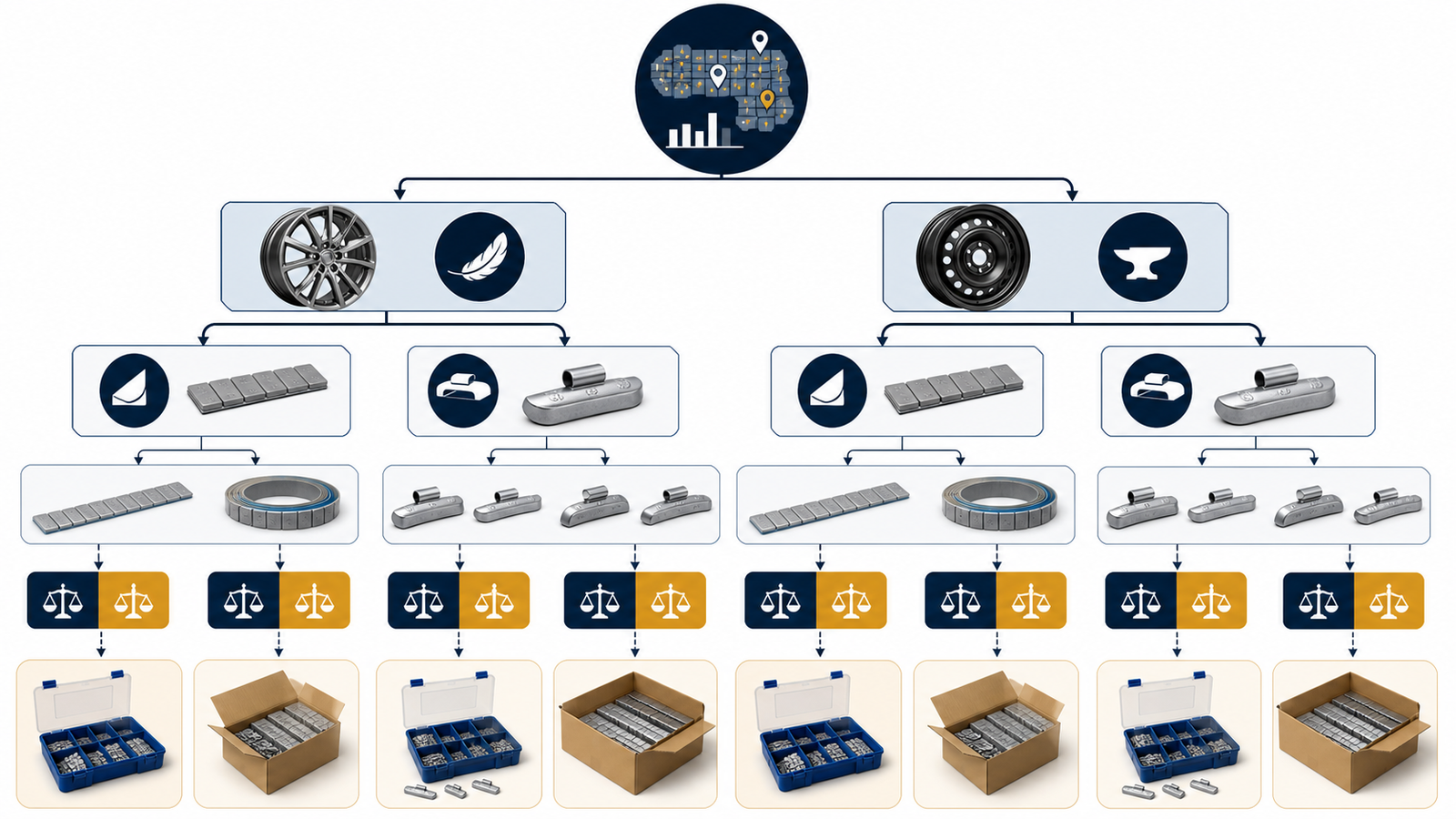
Plan from real wheel-service demand to attachment type, fitment, unit coverage, and a stockable packaging format.
Group demand into practical service situations: alloy-wheel passenger cars, steel-wheel passenger cars, light commercial or fleet work, and special applications only if they recur. Within each group, record the attachment type technicians use, the unit system displayed by their balancers, common correction ranges, wheel/rim profiles, and any customer material restriction. That produces a useful planning brief without pretending to forecast every individual vehicle.
| Planning input | What to establish | SKU decision it affects |
|---|---|---|
| Wheel and service mix | Alloy versus steel wheel work, passenger versus commercial, and recurring special cases | Whether adhesive, clip-on, or both formats need stock depth |
| Balancer output | Grams, ounces, or controlled need for both | Unit markings, increment coverage, and risk of selection errors |
| Fitment evidence | Wheel samples, rim/flange profiles, or known service applications | Which clip profiles can be approved and stocked |
| Correction behavior | Frequently requested small, medium, and higher corrections | Segment layout, clip increments, and range depth |
| Commercial constraints | Order MOQ, carton quantities, shelf space, and target customers | Whether an item is stocked, shallow-stocked, or special order |
The result should be an initial SKU hypothesis, not a permanent promise. Test it with representative accounts and a small sample set where possible. Ask technicians whether common corrections can be assembled quickly, whether the product fits as expected, and whether labels make selection obvious at the bench. A range that looks logical in a spreadsheet can still fail if it ignores local tools and service habits.
When should a range include adhesive and clip-on weights?
A range should include adhesive and clip-on weights when the target wheel mix and service workflow require both attachment methods. The decision is driven by fitment and installation context, not by a desire to make the catalog look comprehensive. Many markets will need a core adhesive range for alloy-wheel work plus selected clip-on families for steel-wheel or specific flange applications; the correct balance must follow local evidence.
Adhesive products can make sense where technicians regularly use the wheel’s inner barrel and need flexible increments or a low-profile appearance. Buyers considering adhesive strip formats for alloy-wheel work should specify segment mass, strip length, tape system, liner handling, material, packaging, and the wheel surfaces used for sample approval. The range should provide useful correction combinations without creating too many slow-moving strip variants.
Clip-on products can make sense where the market serves steel wheels or established flange-specific applications. Their planning challenge is not just mass: the clip must match the intended rim profile and be carried in a format that prevents similar clips from being mixed. SAE J1986 is a recommended practice that addresses balance-weight and rim-flange features, configurations, installation and retention considerations for applicable passenger-car, light-truck, and multipurpose-vehicle uses.1 Buyers should use the actual target wheel and agreed product specification when approving a clip family.
Before expanding clip coverage, compare clip-on fitment and profile choices against the wheel types that target workshops really see. A smaller set of proven profiles with adequate stock depth is often more useful than a full set of untested clips that ties cash up in the wrong applications.
How should buyers choose clip profiles and unit coverage?
Buyers should choose clip profiles and unit coverage by connecting actual rim fitment with the balancer unit system and the correction increments technicians use. The two choices are related but separate: a product may have the right nominal mass but the wrong clip profile, or the right profile but a unit system that encourages selection mistakes.
Start with the balancer display. If target accounts work mainly in grams, make the primary labels, catalogue references, and pack identification follow grams. If the service channel works in ounces, maintain an ounce-based range. Carrying both can be justified when the buyer supports genuinely different workshop systems, but it should be a controlled decision with visibly distinct labels and bins, not an accidental duplication of every SKU.
The unit and increment coverage for a stock list help buyers decide whether the planned increments let technicians build common corrections without awkward combinations. Define the smallest practical increment, the useful middle range, and the upper correction coverage for each product family. Then test common combinations on a representative balancer and wheel; numerical coverage alone does not prove physical fitment.
For clip-on weights, create a matrix that lists approved profile, target rim or sample wheel, mass increments, material/finish, pack quantity, and storage bin. For adhesive strips, list strip format, segment increment, roll or strip count, tape/liner reference, and intended installation zone. That record prevents a correct mass value from hiding an unapproved attachment difference.
How do material and packaging change the range?
Material and packaging change the range because they affect market suitability, handling, product identification, shelf space, and reorder economics. Buyers should confirm the material required by their target market and customers, then specify packaging that keeps the chosen products distinguishable and usable through receiving, storage, and service.
Market rules and customer requirements can vary, so material choice should not be assumed from a generic product name. In the United States, EPA notes that alternatives such as steel, zinc alloy, and plastic-metal composite are widely available and reports that lead wheel weights are no longer used on new vehicles in the United States; it also notes that state and Canadian restrictions differ from a single federal rule.2 Importers and distributors should verify their own destination-market and customer requirements before setting a material range.
Buyers evaluating lead-free material options for the target market should link material choice to fitment, coating, package markings, and customer documentation. Do not substitute one material for another in a repeat order without an agreed sample or specification review; density, formability, finish, and installation behavior can affect the usable SKU design.
Packaging is the range-control layer. Separate similar clip profiles, identify unit systems clearly, protect adhesive liner and strips, and state carton quantity and SKU on every stockable pack. The initial ordering quantity must reflect the supplier’s carton configuration and the buyer’s shelf space, not merely the theoretical demand for a SKU. Before a bulk purchase, use carton depth and MOQ planning for a bulk range to decide whether deep stock, shallow stock, or a special-order route fits each family.
How should buyers use reorder data to refine the range?
Buyers should use reorder data to refine the range by reviewing which SKUs move, which are repeatedly requested but absent, which create selection or return issues, and which remain idle despite being technically valid. The aim is to adjust depth and coverage based on actual service work, not to discard a line after one quiet month or expand it because of a single unusual request.
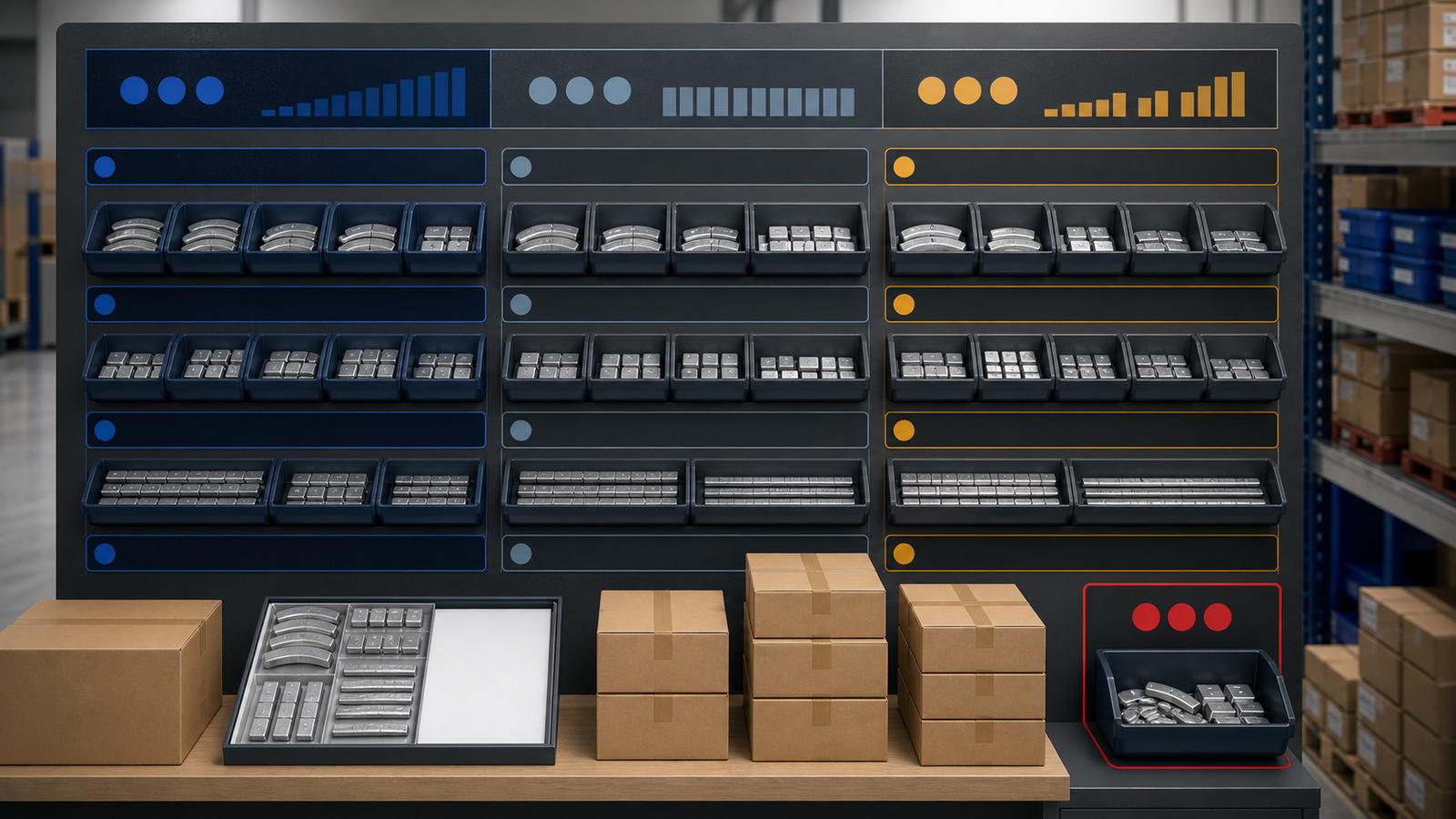
Reorder records should refine range depth and reveal slow or wrong-market SKUs without assuming every local market needs the same assortment.
Keep a simple record by SKU: receipts, sales or consumption, stockouts, customer requests, returns, wheel/fitment complaints, pack damage, and substitution behavior. Review it at an interval that matches the buyer’s order cycle. A high-use line may deserve deeper safety stock or a different carton size. A slow line may remain necessary for a profitable customer segment, but should be ordered less deeply or moved to special order rather than treated as a core stock item.
Also watch the quality of demand. If technicians frequently combine small pieces because an intermediate correction is missing, the range may have an increment gap. If they avoid a product because the clip profile is unclear or the adhesive pack is difficult to use, the issue could be fitment, labeling, packaging, or training rather than lack of demand. Speak with accounts before adding SKUs simply to solve a symptom.
The first repeat order is a good time to re-check samples, labels, pack counts, and product consistency. Request a market-specific wheel weight SKU recommendation supported by the buyer’s wheel mix, unit system, initial order plan, and feedback from target workshops.
What should buyers ask before building the first order?
Before building the first order, buyers should ask enough questions to make every proposed SKU answerable: Which wheels and accounts does it serve? Which balancer unit and correction increments does it support? Which attachment type and profile apply? What material, finish, tape, pack size, label, and MOQ are being quoted? How will it be sampled, received, and replenished?
Use a staged order where practical. Approve representative products first, including the actual clip profiles and adhesive packs intended for sale. Then translate the approved range into a list with SKU, description, unit system, increment coverage, application, packaging, carton quantity, MOQ, and target stock depth. Keep a separate list for products that will be available only by special order.
Before the range is released to production, carry those fields into the QC checks that preserve a market-specific wheel weight SKU range. The goal is to prevent a correct-looking carton, unit, or profile from being approved under the wrong SKU.
Avoid forcing every account into one range. A general tire shop, a fleet workshop, and an alloy-wheel specialist can all be good customers while needing different core stock. The best starting range is the one that gives each target channel useful coverage with minimal selection ambiguity, then expands only when evidence supports it.
When the range will carry a distributor’s own brand, use private-label product and artwork approvals to control the launch. The selected SKU mix should also translate into carton-label and packing rules that keep each stockable configuration identifiable.
Conclusion: Build depth around real service work
Wheel weight range planning converts local wheel service into a focused SKU mix. Start with the wheel and workshop reality, choose attachment formats, confirm clip profiles or adhesive strips, set a controlled unit and increment system, then align material, packaging, MOQ, and stock depth. Use reorder evidence to improve the range after it reaches the market.
Before placing a first bulk order, request a market-specific wheel weight SKU recommendation and sample set. Confirm the target wheel applications, unit system, material requirements, approved profiles or tape formats, carton depth, and plan for review. That process produces a range technicians can use, warehouses can control, and buyers can replenish with confidence.
Frequently Asked Questions
How many wheel weight SKUs should a distributor stock?
There is no fixed number. Stock the attachment formats, clip profiles, unit coverage, and materials that target workshops use repeatedly, then use special order for low-frequency applications until the demand justifies depth. A focused range is usually easier to control than a broad untested catalog.
Should a market carry both gram and ounce wheel weights?
Carry both only when target workshops genuinely use both balancer systems or a customer requirement makes it necessary. Otherwise, choose the primary local unit, label it clearly, and avoid duplicate items that create receiving and technician-selection mistakes.
How should buyers choose clip-on wheel weight profiles?
Use representative rim or wheel samples and the actual applications served by target accounts. Approve the clip profile, mass range, finish, and packaging together. Do not treat a similar-looking clip as interchangeable without fitment evidence.
When should a slow-moving wheel weight SKU be removed?
Review its demand, customer value, stockouts, returns, and application coverage before removal. If it serves an important but infrequent application, reduce stock depth or make it special order. Remove it only when the range can still serve the intended market without a meaningful gap.
References
[1] SAE International. “SAE J1986: Balance Weight and Rim Flange Design Specifications, Test Procedures, and Performance Recommendations.” 2025.
[2] U.S. Environmental Protection Agency. “EPA Decides Not to Proceed with Proposing Lead Wheel Weight Rulemaking.” 2024.