



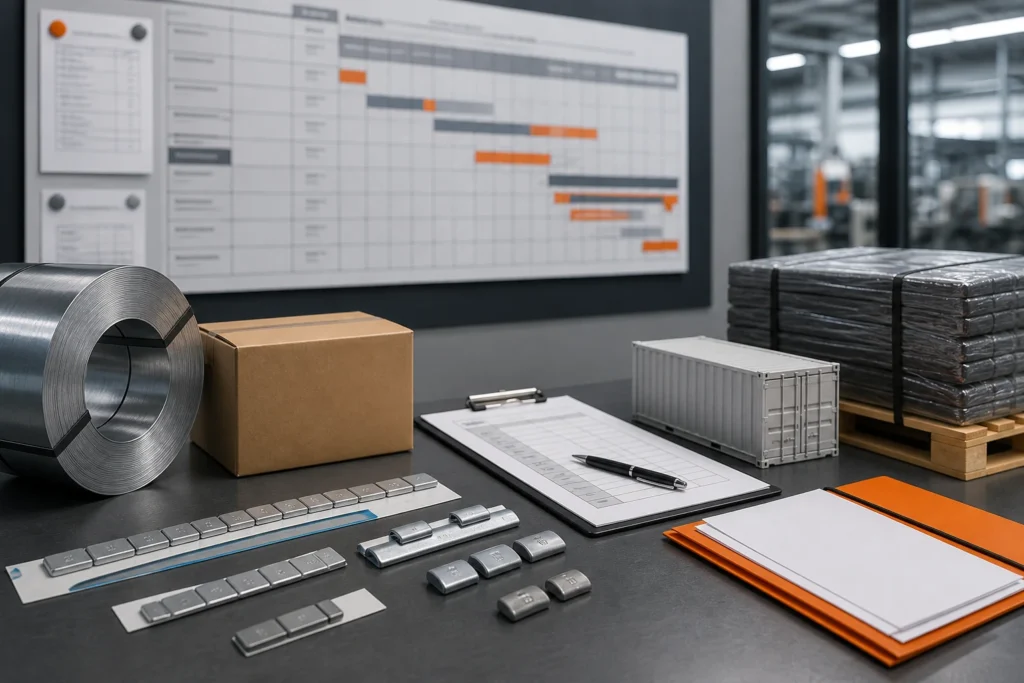
Wheel weight order lead time depends on whether the program uses standard or custom SKUs, sample and artwork approval, material availability, production scheduling, packaging, inspection, and shipment planning. Buyers should separate factory production time from transit and clearance time when setting a market launch or replenishment date.
Table of Contents
- What is included in a wheel weight order lead time?
- Why should buyers separate production from transit and delivery?
- What changes between standard and custom wheel weight timing?
- How do approval dependencies affect the critical path?
- How do capacity and seasonality change the plan?
- How should buyers plan a realistic wheel weight order?
- Conclusion: plan delivery from milestones, not one lead-time number
- Frequently Asked Questions
- References
What is included in a wheel weight order lead time?
Wheel weight order lead time is the chain from a usable specification to the milestone the buyer actually needs. It can include RFQ clarification, sample or artwork approval, material preparation, production scheduling, forming or conversion, coating or tape application, packing, inspection, booking, cargo handover, transit, customs, and final receiving. A supplier's factory lead time usually covers only part of that chain.
Before requesting dates, settle the product and range choices that must be fixed before a lead-time request. The supplier cannot give a dependable plan when the buyer is still changing adhesive versus clip-on format, material, profile, increment list, tape, carton count, label language, or destination. A date offered against an open specification is a planning placeholder, not a production commitment.
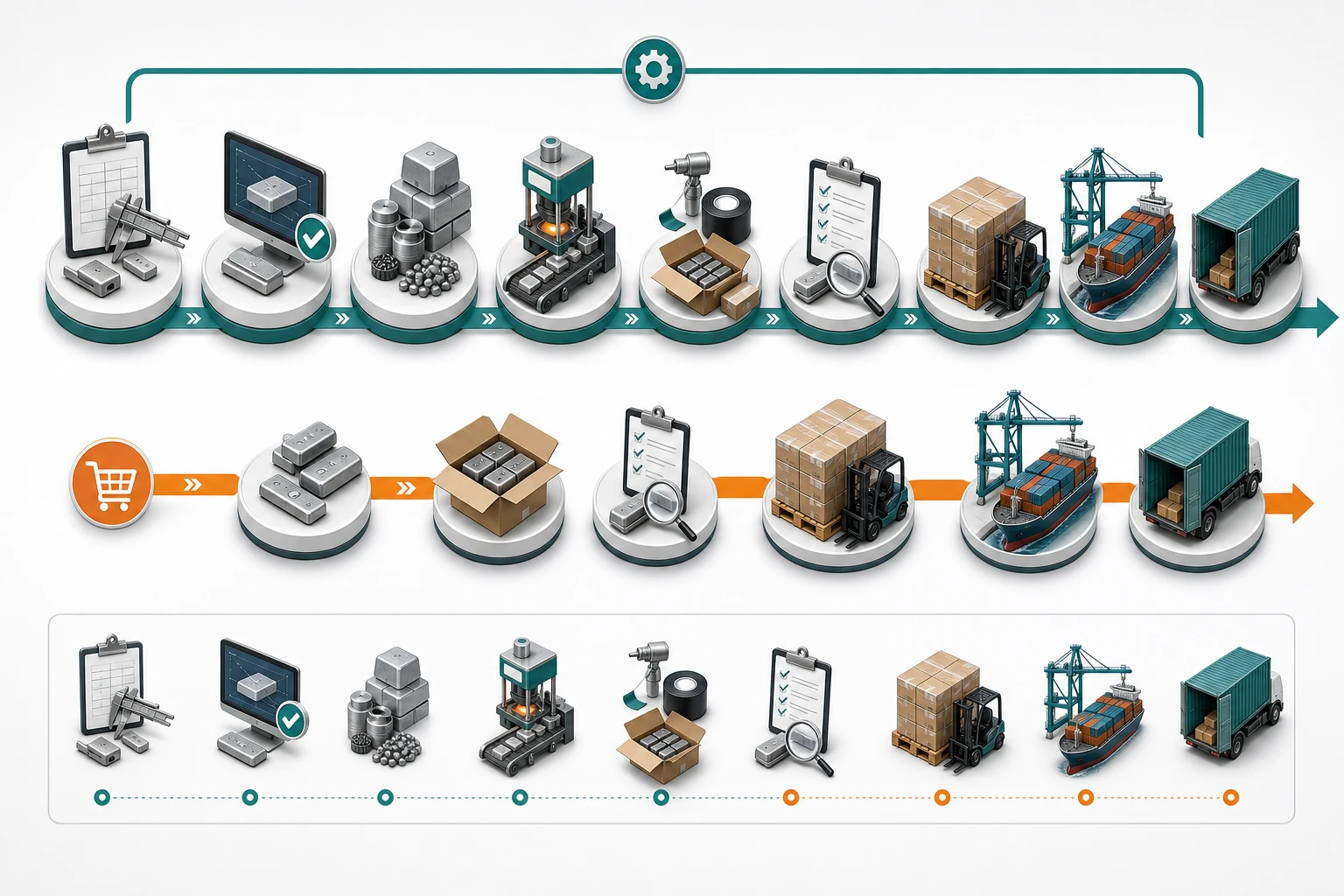
Standard and custom orders can share the same milestones but spend different amounts of time waiting for approval, materials, or setup.
| Lead-time stage | What should be complete | Buyer milestone to request |
|---|---|---|
| Specification freeze | SKU list, material, format/profile, increments, finish, packaging, and documentation request | Written specification and revision number accepted by both sides |
| Commercial release | Quantity, MOQ basis, price scope, payment condition, and delivery term agreed | PO accepted or pro forma invoice confirmed |
| Approval release | Samples, artwork, label data, and packed sample approved where applicable | Dated approval record and change-control point |
| Production readiness | Materials, components, and production slot available | Supplier confirms planned production start and factory-ready window |
| Packing and inspection | Product, labels, cartons, pallet, and records match the approved order | Goods-ready and inspection-release date |
| Cargo handover | Booking, pickup, export process, and handover details arranged | Actual handover date and transport reference |
| Transit and destination | Carrier movement, arrival, clearance, and local delivery planned | Estimated arrival, clearance responsibility, and receiving date window |
Use the word "date" carefully. Ask whether it means production start, factory-ready, pickup, port handover, departure, arrival at port, or arrival at the buyer's warehouse. Those milestones may be days or weeks apart depending on the order and delivery arrangement.
Why should buyers separate production from transit and delivery?
Buyers should separate production from transit and delivery because each period has different owners and risks. Factory production is shaped by the specification, supplier capacity, materials, packaging, and internal approval. Transit is shaped by the transport plan, routing, carrier schedules, port or terminal operations, and the agreed delivery term. Clearance and final delivery add destination-side parties and requirements.
A quotation should state the quotation scope that should state the factory-ready and delivery assumptions. This is especially important when two suppliers use the same phrase, such as "lead time 30 days," but one means 30 days to factory-ready and the other includes delivery to a named port. The buyer should normalize the milestones before promising availability to its sales team or customers.
| Question | Factory lead time | Transit and delivery time |
|---|---|---|
| Main owner | Supplier and buyer approval team | Forwarder/carrier, buyer, seller, customs broker, and destination parties |
| Starts when | Specification, commercial terms, and required approvals are released | Cargo is handed over under the agreed transport arrangement |
| Typical dependencies | Materials, production slot, tape/coating, packaging, inspection | Booking, route, departure, transfer, port/terminal, clearance, local transport |
| Useful evidence | Production plan, goods-ready date, inspection record | Booking confirmation, transport document, carrier milestone, clearance status |
| Buyer planning use | Reorder release and product launch readiness | Arrival window, warehouse capacity, and customer availability date |
In international trade, "delivery" under an Incoterms rule can refer to the agreed point where delivery and risk transfer occur, which may not be the same as arrival at the buyer's final destination. 1 This article is not legal advice; buyers should state the precise named place/port and version of the trade term in the sales contract, then confirm logistics and customs responsibilities with their qualified advisers and service providers.
For example, a factory can finish cartons on schedule while the buyer still waits for a suitable pickup or vessel booking. The reverse can happen too: a booking may exist, but the supplier cannot release cargo because labels, documents, inspection, or pallet details remain unresolved. Treat both sides as separate calendar lines.
What changes between standard and custom wheel weight timing?
Standard and custom programs share a production path, but custom programs usually add decisions before the supplier can release materials or schedule a stable run. A standard SKU may use an established profile, material, tape, coating, inner pack, and carton. A custom program may require artwork, barcode validation, new carton printing, a different tape or liner, special packaging, new product geometry, or sample testing. Each additional variable can become a dependency.
The branded-launch approvals that can extend the first production cycle are a useful example. A private-label product may remain technically standard while its inner-box graphics, carton marks, barcode, language, and approved sample create a longer first-order critical path. That does not mean private label is slow by definition; it means the buyer should not treat a repeat-order standard SKU date as a baseline for a first branded launch.
| Program type | Timing characteristics | Buyer action before scheduling a launch |
|---|---|---|
| Standard repeat SKU | Established product/pack configuration; fewer approval gates | Confirm current stock/material status, production slot, and existing label revision |
| Standard product with custom labels | Product may be stable; print and label data still need approval | Freeze artwork and barcode data early; define how label proof is signed off |
| Private-label packaged range | Product, inner pack, carton, and label versions must align | Approve packed sample and retain the revision-controlled artwork record |
| Modified tape, coating, or packaging | Changes may require material sourcing, trial production, or test review | Ask which item drives the new minimum and critical path |
| New profile or custom product | Development, tooling/process decisions, and validation may precede production | Use a staged feasibility and sample plan rather than a standard lead-time promise |
Buyers can shorten avoidable delay by freezing the requirements that they control. Provide clean artwork files, confirmed barcode data, target labels, required documents, pack counts, and destination information in the first workable brief. Late comments after printing or materials release may change the schedule even if the product itself is unchanged.
How do approval dependencies affect the critical path?
Approval dependencies determine the critical path because production cannot safely proceed past certain points without a buyer decision. Examples include a product sample that must match the requested clip profile or tape, an artwork proof that has to carry the correct buyer SKU and pack count, or a carton label that needs a destination-specific field. If any required approval is open, an otherwise available production slot may not produce a releasable order.

Goods-ready status should be supported by a product, packing, and release check before the transport handover is treated as scheduled.
Use pre-shipment release checks before a booking is treated as secure to define the final buyer-controlled checkpoint. The inspection is not merely a final quality exercise. It also checks whether the product, labels, carton counts, packing documents, and pallet condition are aligned enough for the order to move.
| Dependency | What delays it | How the buyer can manage it |
|---|---|---|
| Specification confirmation | Open material, profile, tape, increment, or pack questions | Issue one dated SKU sheet and control revisions |
| Product sample | Wrong configuration or unclear pass/fail test | Test a representative sample and document the accepted configuration |
| Artwork proof | Missing assets, unapproved wording, barcode or language corrections | Assign one approver and return consolidated comments by an agreed date |
| Packaging sample | Carton count, label, protection, or pallet plan unclear | Request a packed sample or documented packout before bulk packing |
| Inspection release | Product or records do not match the approved order | Schedule the check against the goods-ready window, not after pickup |
| Booking information | Missing named place, pickup date, consignee, or route confirmation | Confirm handover details before goods are treated as ready to dispatch |
Put approvals on the buyer's calendar, not only the supplier's. If the buyer needs five working days to review a label proof and two weeks to test samples, that time belongs in the launch or replenishment plan. A supplier cannot recover a customer-side approval delay simply by working faster after the release.
How do capacity and seasonality change the plan?
Capacity and seasonality can change a sound plan even after the specification is frozen. The factory may have competing material demand, production slots shared across formats, coating/tape conversion limits, or packaging print windows. Logistics providers may have capacity, equipment, route, or terminal constraints. Public holidays and seasonal demand surges can affect several points simultaneously.
Do not respond by asking for a blanket "fastest lead time." Instead, ask what the supplier knows today and what is still conditional:
- Which materials and standard components are available, allocated, or still to be ordered?
- Is a production slot tentatively held, and what buyer action releases it?
- Which packaging or label item has the longest current procurement or print cycle?
- What is the supplier's factory-ready window after all approvals are complete?
- Which inspection and pickup dates are feasible before the booking cutoff?
- Which part of the destination timeline is an estimate from the carrier or forwarder rather than a supplier commitment?
Create a baseline date and a buffer rather than assuming every dependency will finish exactly on the first expected day. The size of that buffer is a commercial decision based on the cost of stockout, the order's novelty, the route, and the buyer's ability to use alternate stock. It should not be a random number copied from an unrelated order.
How should buyers plan a realistic wheel weight order?
Plan backward from the market date, but keep factory, transport, and destination milestones separate. Decide when inventory must be available to the buyer's warehouse or customer, then work back through clearance/local delivery, estimated transit, cargo handover, inspection release, factory-ready, production, and the buyer's own approval window. Add buffer at the parts of the chain that are genuinely uncertain.
The order plan should include shipment-document preparation before cargo handover. Even when documents do not extend the factory operation itself, missing or inconsistent product/packing information can delay a cargo handover, customs process, or destination receiving action. Define the required document list and buyer review point while production is underway.
Use an RFQ/PO milestone table such as this:
| Milestone | Party to confirm | Required evidence or decision |
|---|---|---|
| Specification frozen | Buyer and supplier | Approved SKU sheet, packaging/label revision, required documents |
| PO and payment release | Buyer and supplier | Commercial confirmation and start condition |
| Production start window | Supplier | Capacity/material confirmation and expected sequence |
| Factory-ready window | Supplier | Product and packout complete, awaiting final release where required |
| Inspection/release date | Buyer/supplier/third party | Inspection scope, pass status, exceptions, and corrective action if needed |
| Cargo handover date | Seller/buyer/forwarder as agreed | Booking/pickup reference and named handover location |
| Departure/arrival estimate | Carrier or forwarder | Current transport milestone and route assumption |
| Clearance/warehouse receipt | Importer/broker/warehouse | Destination responsibilities and receiving plan |
Illustrative backward schedule
The following example shows the calculation method, not a standard lead time or a delivery promise. Assume a buyer wants a mixed adhesive and clip-on wheel-weight order available in its warehouse on November 30. The supplier and forwarder provide the planning durations below, and the buyer works backward from that date.
| Backward-planning step | Planning duration | Latest milestone in this example | Evidence needed before the date is accepted |
|---|---|---|---|
| Warehouse receipt target | Fixed market requirement | November 30 | Receiving capacity and stock-availability requirement |
| Clearance and local-delivery allowance | 7 calendar days | Destination arrival by November 23 | Broker and local carrier planning assumption |
| Main transit estimate | 35 calendar days | Planned departure by October 19 | Forwarder route and sailing estimate |
| Booking, cutoff, and cargo-handover allowance | 5 calendar days | Cargo handover by October 14 | Booking reference, named handover point, and cutoff |
| Final inspection and correction allowance | 5 calendar days | Factory-ready by October 9 | Inspection result and closure of any agreed correction |
| Production and packing | 20 working days, shown here as about 28 calendar days | Production release by September 11 | Material, capacity, packout, and production confirmation |
| Sample, specification, and artwork approval | 10 working days, shown here as about 14 calendar days | Complete approval package submitted by August 28 | Dated SKU sheet, accepted sample, and approved pack/label files |
This model makes August 28 the latest planning date for a complete approval package under the stated assumptions. It does not mean every factory can meet that date or that every 35-day route will depart on October 19. The buyer must replace each duration with current supplier, forwarder, broker, and internal approval data, then recalculate for weekends, holidays, sailing frequency, customs conditions, and the cost of missing the target.
Use two lines for every milestone in the first order: planned date and actual date. On the reorder, add the actual approval, production, inspection, handover, transit, and receiving durations. After two or three orders, the buyer can stop using a generic lead-time promise and build a program-specific range with visible causes for variation.
ICC guidance notes that Incoterms rules allocate tasks, costs, and risks between buyer and seller, and that the precise named place matters. 2 For containerized cargo, ICC Academy also notes that delivery terms and the point of cargo handover should fit the actual transport arrangement rather than be chosen casually. 3 Confirm the named place, the Incoterms version, and who arranges each transport/customs step in the contract; use qualified trade and legal advice for the buyer's situation.
Finally, compare the first order with its first reorder. Record how long each milestone actually took, why any date moved, and which approval or supplier condition caused the shift. This turns later lead-time estimates into evidence-based planning instead of a recycled headline number.
If delivery timing is part of your wheel-weight sourcing decision, share the product format, tooling status, order volume, destination, and required arrival window. We can help you map a realistic sample, production, and shipping timeline before the order is placed.
Conclusion: plan delivery from milestones, not one lead-time number
Wheel weight order lead time becomes reliable when a buyer separates factory production from cargo handover, transport, clearance, and final receipt. Freeze the product and packaging specification early, assign approval owners, request dated factory-ready and release milestones, and state the delivery term and named place precisely.
The practical goal is not a deceptively short promise. It is a plan that shows what has to happen before stock can be sold or a launch can begin. Request a lead-time estimate for the specified SKU and destination once the buyer can provide a completed specification, quantity, packaging plan, approval requirements, and delivery basis.
Frequently Asked Questions
Does a wheel weight production lead time include ocean or air transit?
Usually, no. A production lead time commonly refers to the factory portion of the order, often ending at goods-ready or an agreed handover point. Confirm the supplier's exact endpoint, then plan transit, clearance, and local delivery as separate milestones.
Why can a private-label wheel weight order take longer than a standard order?
Private label can add artwork, label, barcode, carton, packed-sample, and approval dependencies even when the wheel weight itself is a standard configuration. The buyer should freeze those inputs early and ask which one controls the first production release.
When should a buyer book inspection for wheel weights?
Book it against the supplier's factory-ready window and the agreed pre-shipment release process. Do not wait until the pickup date to discover that labels, carton counts, documents, or the product configuration do not match the approved order.
Can a supplier guarantee the final warehouse arrival date?
The supplier can commit to the contractual milestones it controls, subject to the agreed terms, but final arrival can depend on carrier operations, route, port/terminal conditions, customs, and local delivery. Set a destination arrival window and buffer with the logistics provider and qualified advisers rather than treating factory lead time as a guarantee.
What information should a buyer send to request a lead-time estimate?
Send the SKU list, material, format/profile, increment range, finish, tape or clip needs, packaging/label requirements, quantity, sample/approval requirements, destination, requested delivery term, named place, and target receiving date. This lets the supplier distinguish a standard repeat order from a custom launch.
References
[1] International Chamber of Commerce. “Place of Delivery and Risk Transfer in International Trade Contracts.” 2025.
[2] International Chamber of Commerce. “Incoterms 2020 Checklist and Flowcharts.” 2024.
[3] International Chamber of Commerce. “Incoterms 2020 FAS or FOB.” 2025.