



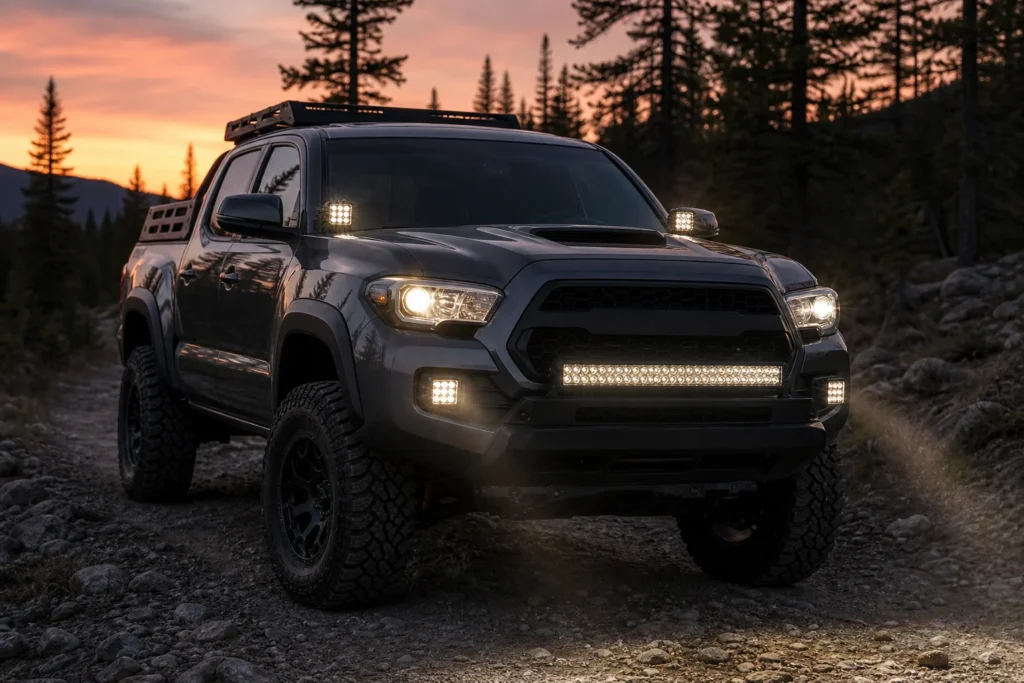
LED pods are compact auxiliary LED lights, usually sold as small square, round, cube, flush-mount, or scene-light units. They are not simply tiny light bars; they are better understood as zone lights that can add side visibility, ditch lighting, bumper-corner fill, reverse lighting, work lighting, or close-range trail lighting where a long light bar would be too large or too broad.
That is why pods show up on A-pillars, bumpers, roof racks, rear racks, ATVs, UTVs, farm vehicles, service trucks, and overland builds. A light bar may handle the main forward beam, while pods solve the awkward dark areas around the vehicle.
Table of Contents
- What are LED pods?
- What types of LED pods are available?
- Where are LED pods used on off-road vehicles?
- How are LED pods different from LED light bars?
- Are LED pods bright enough for off-road driving?
- What should buyers check before choosing LED pods?
- Conclusion: Use LED pods for controlled zones, not just extra brightness
- Frequently Asked Questions
- References
What are LED pods?
LED pods are small, self-contained auxiliary lamps that use LED chips, reflectors or lenses, a sealed housing, brackets, and a wiring pigtail. Their compact size lets installers place light in specific positions instead of relying on one long lamp across the front of the vehicle.
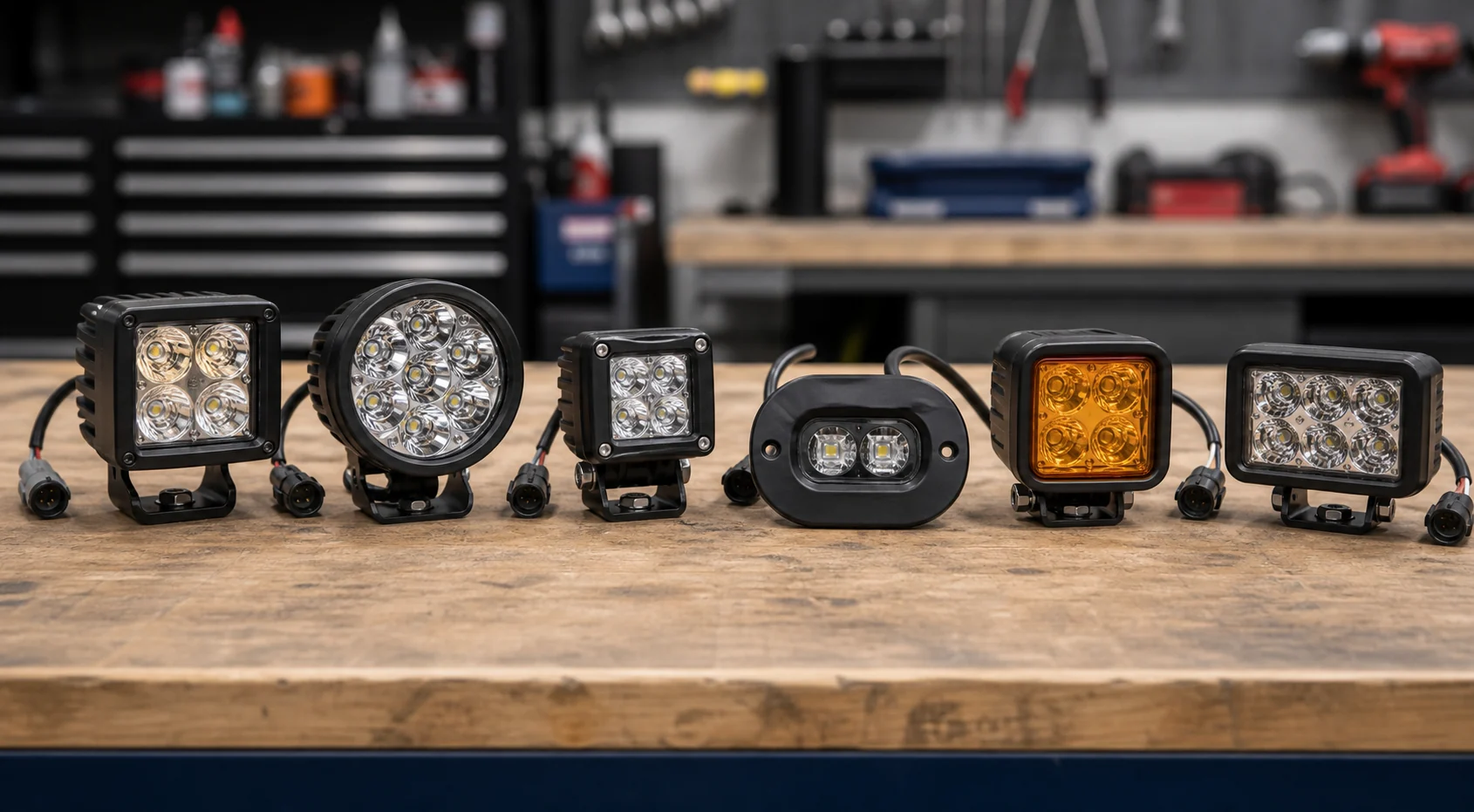
Most pods are sold in pairs because they often work symmetrically: left and right ditch lights, bumper corner lights, rear work lights, or side scene lights. They may use spot, flood, combo, driving, fog-style, amber, or diffused optics. The housing can be surface-mounted with a bracket or recessed into a bumper, grille, rack, or rear panel.
The key idea is control. A pod can be aimed slightly outward, downward, rearward, or toward a work zone. That makes it useful when a full-width light bar would create glare, block airflow, look oversized, or send light into the wrong area.
What types of LED pods are available?
Common LED pod types include square pods, round pods, cube pods, flush-mount pods, amber pods, scene pods, and small work-light pods. The right type depends on the beam pattern, mounting space, and whether the light is used for driving, work, reverse, or visibility.
| LED pod type | Best use | Main benefit | Main caution |
|---|---|---|---|
| Spot pod | Longer throw from a small housing | Helps reach farther than flood optics | Narrow beam can miss shoulders |
| Flood pod | Work areas, slow trails, reverse lighting | Wide close-range coverage | Can create glare if aimed high |
| Combo pod | General trail support | Mixes reach and side fill | Beam design varies by brand |
| Amber pod | Dust, fog, snow, marker-style accents | Less harsh reflected glare in some conditions | Not a fix for poor aiming |
| Flush-mount pod | Bumpers, rear panels, racks | Clean protected installation | Requires cutting or panel fitment |
| Scene/work pod | Campsites, loading, recovery, job sites | Soft wide-area light | Not for high-speed forward driving |
Beam pattern matters more than the pod shape alone. If the buyer is choosing between spot, flood, and mixed optics, the related guide to spot, flood, and combo beam patterns is a useful next step because the same logic applies to pods and bars.
Where are LED pods used on off-road vehicles?
LED pods are used anywhere a compact, aimable light solves a specific visibility problem. Popular positions include A-pillars, bumper corners, grille edges, roof rack sides, rear racks, spare-tire mounts, trailer areas, UTV roll cages, and work-truck beds.
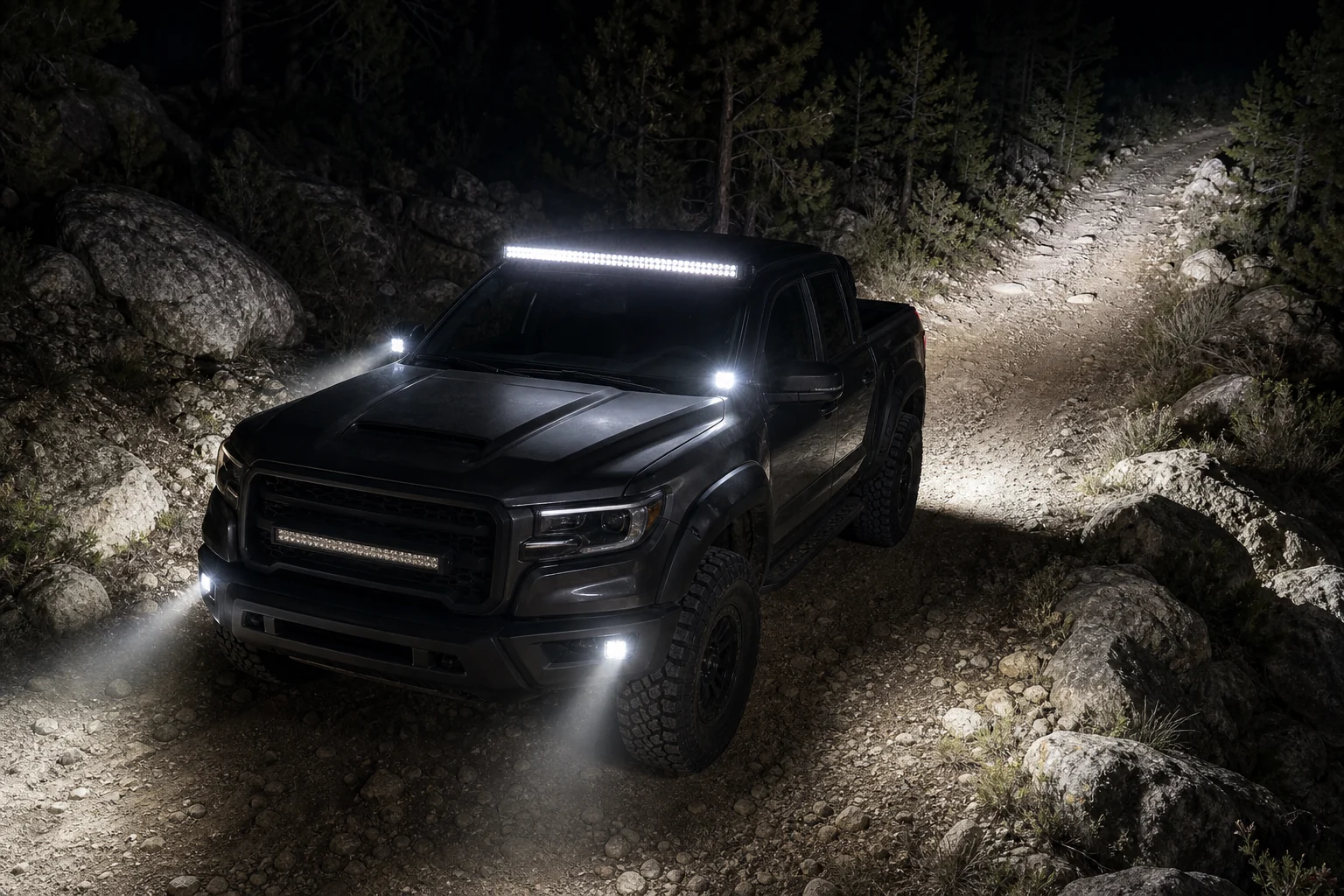
A-pillar pods are often called ditch lights because they can aim toward the shoulder of a trail or road edge. They help the driver read turns, rocks, ruts, brush, and trail entrances that a straight forward light may miss.
Bumper-corner pods fill the close front-left and front-right zones. They are useful on slower trails, tight forest roads, and recovery situations where the driver needs to see around the tires and bumper line.
Rear pods and scene pods serve a different job. They help with reverse lighting, loading, campsite setup, tool use, agricultural work, construction equipment, and recovery. They should not be treated as forward driving lights unless the beam pattern and mounting position are designed for that purpose.
How are LED pods different from LED light bars?
LED pods are different from LED light bars because pods are compact, directional, and modular, while light bars are longer lamps designed to cover a broader forward or work area. A light bar often acts as the main auxiliary light; pods usually fill the zones the main light misses.
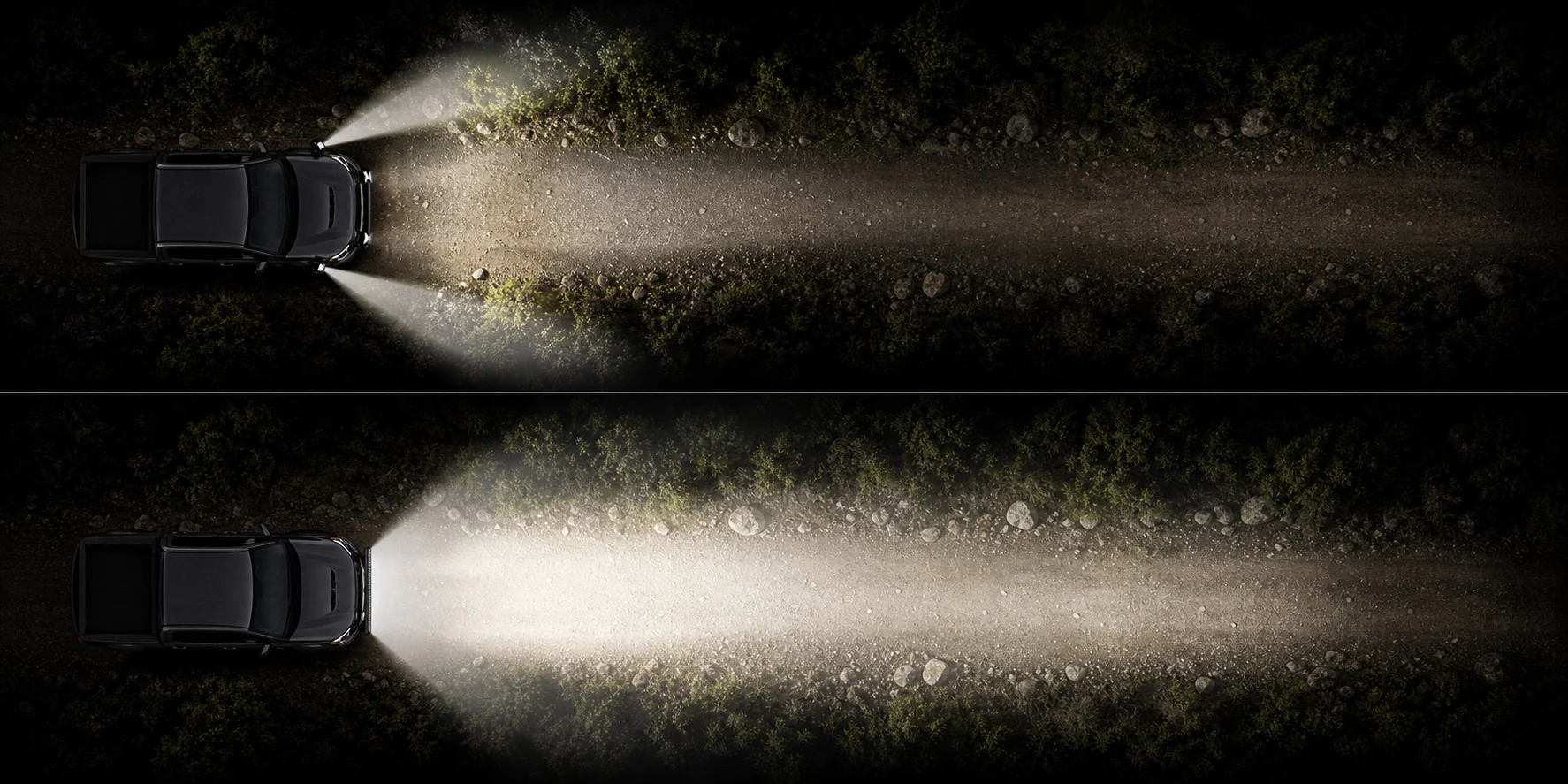
A light bar can be the better choice when the driver wants one clean forward beam across a bumper, grille, roof rack, or bull bar. If the reader is still choosing that category, the related guide to off-road LED light bars explains the broader light-bar system: size, row count, beam pattern, mounting, wiring, and durability.
Pods are better when the vehicle needs several smaller lighting zones. They can be placed lower, higher, wider, rearward, or at an angle. That flexibility is why many well-planned builds use both: a light bar for the main forward beam and pods for corners, sides, and work areas.
Are LED pods bright enough for off-road driving?
LED pods can be bright enough for many off-road support tasks, but one pair of pods usually should not be expected to replace a properly chosen main light bar or headlamp system. Brightness depends on optics, LED quality, current regulation, housing design, and aiming.
This is where lumen claims can mislead. A small pod may advertise a high lumen number, but real visibility depends on how much light reaches the useful zone. The related guide to LED lumen output explains why lumens should be read together with beam pattern, candela, lux, mounting height, and glare control.
For slow technical driving, two well-aimed flood or combo pods can be extremely useful. For higher-speed open terrain, a longer spot or combo light bar may give better forward reach. For fog-style use, the optic, cutoff, mounting height, and local regulations matter more than the word "pod" on the listing.
SAE J581 covers auxiliary upper beam lamps, while SAE J583 covers front fog lamps 1 2. Those standards are useful reminders that lamp function and beam shape matter. A pod housing does not automatically make a lamp suitable for every driving function.
What should buyers check before choosing LED pods?
Buyers should check beam pattern, housing size, bracket strength, lens material, IP rating, wiring load, cable exit, connector quality, voltage range, heat control, and packaging before choosing LED pods. The small size does not make quality less important.
Start with the job. A ditch light, reverse light, scene light, and bumper-corner light should not all use the same optic by default. Then check whether the bracket allows proper aiming and whether the cable can be routed away from heat, sharp metal, and moving parts.
Electrical planning matters too. Pods are often sold in pairs or sets, so the current draw can add up. If the buyer is planning switches, relays, fuses, and connectors, the related light bar wiring harness guide gives a practical wiring foundation that also applies to pods.
Sealing is another common return issue. A compact housing still faces vibration, rain, pressure washing, mud, dust, and cable strain. The related guide to IP ratings for LED lights helps buyers read waterproof and dustproof claims with more caution.
For product-range planning, the Yirox Team usually checks pods as a kit, not as a lamp alone: pod pair, brackets, harness, switch, hardware bag, label, instruction sheet, foam protection, and carton strength. A bright pod can still create customer trouble if the bracket vibrates, the harness is too short, or the package lets lenses rub during shipping.
Public-road use needs careful wording. U.S. commercial vehicle rules describe auxiliary driving and fog lamps as lamps used with required headlamps, not replacements 3. NHTSA has also discussed supplemental lighting in terms of whether it impairs required lighting equipment 4. Local laws vary, so off-road pods should be marketed and used responsibly.
Conclusion: Use LED pods for controlled zones, not just extra brightness
LED pods are best when the vehicle needs compact, aimable lighting for a specific zone: ditch lighting, bumper corners, reverse work, side scene lighting, recovery, loading, or equipment use. They are not automatically better or worse than a light bar; they solve a different problem.
The smart choice starts with the dark area the driver is trying to fix. If the need is broad forward lighting, a light bar may be the main answer. If the need is side fill, close-range control, work lighting, or a clean modular setup, pods are often the better tool.
If the next step is comparing auxiliary lighting families, the related off-road LED light bar product range is a useful place to review bars, pods, mounting options, beam styles, wiring, and packaging expectations together.
Frequently Asked Questions
Are LED pods better than light bars?
LED pods are better for compact, angled, side, rear, or work-zone lighting. Light bars are usually better for a wider main forward beam. Many off-road builds use both.
Can LED pods be used as ditch lights?
Yes. A-pillar LED pods are commonly used as ditch lights because they can aim toward trail shoulders, turns, and side obstacles that a forward light bar may miss.
Are amber LED pods worth it?
Amber pods can be useful in dust, fog, snow, or marker-style applications, but they still need the right beam pattern and aim. Color alone does not fix glare or poor optics.
Do LED pods need a relay?
Many pod kits should use a relay and fuse, especially when running pairs or multiple zones. Always match the harness to the current draw and installation plan.
Can LED pods be used on public roads?
That depends on lamp function, beam pattern, mounting, color, aim, and local law. Many off-road pods should be switched off or covered on public roads unless they are approved for the intended road-use function.
References
[1] SAE International. (2020). *[SAE J581: Auxiliary Upper Beam Lamps](https://www.sae.org/standards/content/j581_202009/)*.
[2] SAE International. (2020). *[SAE J583: Front Fog Lamp](https://www.sae.org/standards/content/j583_202009/)*.
[3] Electronic Code of Federal Regulations. (2026). *[49 CFR 393.24 Requirements for head lamps, auxiliary driving lamps and front fog lamps](https://www.ecfr.gov/current/title-49/section-393.24)*.
[4] NHTSA. (2019). *[FMVSS No. 108 interpretation on supplemental lighting](https://www.nhtsa.gov/interpretations/571108-supplement-beam-boykin-16-0884)*.