




Wheel weight quotations should be normalized against one product and commercial brief before their prices are compared. Buyers should align attachment, material, increments, packaging, evidence, MOQ, and delivery fields; classify every omission or alternative; and score unresolved quotation risk separately from the supplier's overall capability or landed cost.
Once suppliers have replied, it is tempting to sort the quotations by price and work down the list. That approach is quick, but it can turn a missing material statement, a different clip profile, or an unpriced carton into an invisible exception. A better method is to make every supplier answer the same requirement list, record what is different or missing, and then decide whether that difference is acceptable for the market being served.
Table of Contents
- What does a comparable wheel weight quotation look like?
- How do you normalize quotations before comparing them?
- How do you compare the product scope in each quotation?
- What evidence should buyers check before choosing a supplier?
- How should MOQ delivery and commercial terms be compared?
- Which omissions and exceptions should change the decision?
- How should buyers score quotation risk?
- Conclusion: select the quotation that matches the requirement
- Frequently Asked Questions
- References
What does a comparable wheel weight quotation look like?
A comparable quotation answers the same product, quantity, packaging, evidence, delivery, and commercial questions as the other offers. It does not need to use identical formatting, but it must make clear what is included, what is optional, what is assumed, and what differs from the buyer's requested scope.
Before scoring any response, check that your underlying requirement is stable. The selection decisions that should already be settled before a quote is scored help the buyer define applications, attachment formats, materials, increments, and product families before a numerical comparison starts. A quote cannot be made comparable if the buyer is still unsure whether the market needs a clip-on profile, adhesive strip, steel, zinc, or a mixed range.
The basic principle is simple: compare like with like, label every non-like item, and do not turn an unanswered field into an assumed inclusion. A blank line is commercially meaningful. It may mean the supplier did not understand the request, does not offer that scope, expects to charge later, or needs clarification. None of those possibilities should silently become “yes.”
Use a master comparison sheet with the buyer's requirement in the first column and a separate column for each supplier. The sheet can be a spreadsheet, purchasing system, or controlled document. The discipline matters more than the software.
| Comparison area | Buyer requirement | Supplier response to capture | Decision rule |
|---|---|---|---|
| Product identity | Attachment, material, finish, profile or strip construction, increments | Exact quoted part, alternative part, or no response | Mark “different” rather than silently accepting a substitute |
| Quantity and unit | Required SKU quantities and price unit | MOQ, unit, mix rule, and pack conversion | Normalize to the same usable unit and order quantity |
| Packaging | Inner and outer count, labels, cartons, pallets | Included pack, optional pack, or supplier standard | Check whether receiving and resale can work as quoted |
| Evidence | Samples, drawings, tests, documents, inspection and change control | Included, optional, unavailable, or not answered | Do not score missing evidence as equal to evidence supplied |
| Delivery and terms | Currency, named delivery term and place, lead time, payment request | Actual term, location, cost inclusions, validity, and exceptions | Show remaining buyer costs and responsibilities separately |
| Risk and service | Claim handling, repeat-order process, ownership of custom materials | Written process, named contact, or assumption | Treat unclear responsibility as a decision risk, not a neutral item |
How do you normalize quotations before comparing them?
Normalize quotations by converting them to the same product definition, unit basis, quantity, packaging plan, delivery term, and evidence scope. Only then can a buyer tell whether a price difference is a genuine commercial advantage or simply a different offer.
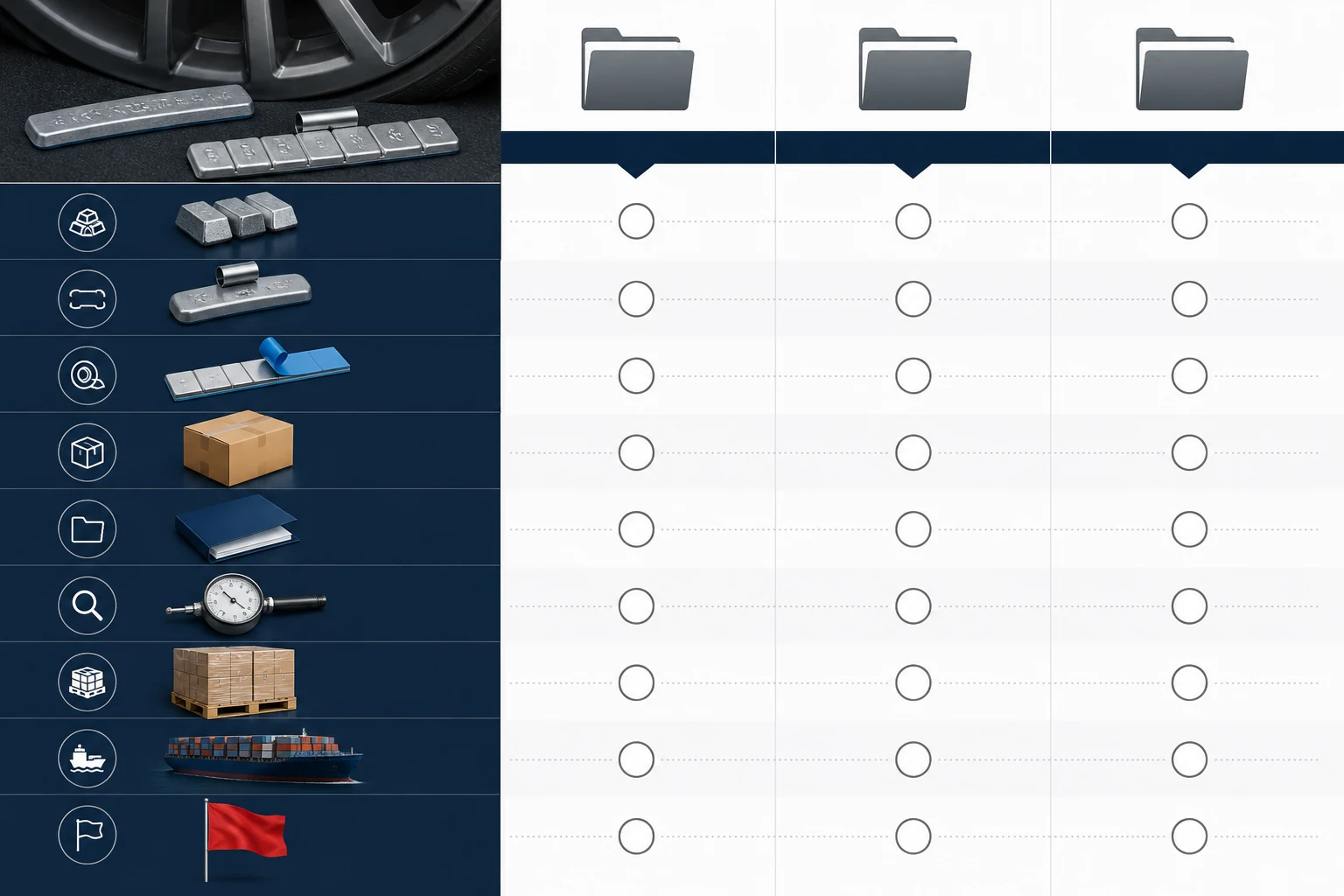
Start with the quantities the business will actually order, not the quantity that gives one supplier its best theoretical price. If the request is for a launch assortment, record both the per-SKU requirement and the total; if it is a replenishment order, record the normal carton and pallet pattern. Then translate every price to the same agreed unit, such as price per identified piece, per defined strip, or per specified carton, while retaining the supplier's original unit in a notes column.
Unit and increment differences are easy to miss. A strip may contain a different number of breakable segments; a mixed carton may omit values common in the buyer's service market; a price per kilogram may not reflect the same number of usable parts. The weight-unit and increment reference for checking quote coverage helps buyers verify that gram or ounce coverage and segment logic are aligned before the price is normalized.
Do the same with delivery terms. The International Chamber of Commerce explains that Incoterms rules allocate tasks, costs, and risks between the parties at specified points. A quotation should therefore state both the Incoterm and the named place, rather than use phrases such as “delivered” or “shipping included” without a boundary.1
Normalize these items first:
- Product and SKU: attachment, material, finish, profile or strip construction, and increment set.
- Commercial unit: piece, segment, strip, roll, inner pack, carton, kilogram, or mixed assortment.
- Quantity: per-SKU quantity, permitted mix, MOQ basis, carton count, and total order quantity.
- Packaging: inner pack, carton, label fields, pallet pattern, and any branded components.
- Quality scope: samples, drawings, inspection, material or compliance statements, and test basis.
- Delivery scope: currency, payment term, quote validity, Incoterm and named place, lead time, and costs excluded.
If a supplier proposes a technically valid alternative, keep it in the sheet as an alternative column or separate line. It may become the best solution, but it should not be mistaken for the originally requested SKU.
Direct wheel-weight catalogs demonstrate why a quotation needs precise item identity. The Perfect Equipment catalog uses product references, grammage selections, material and product-family distinctions rather than one generic "wheel weight" line.5 A buyer does not need to copy that catalog structure, but every quoted line should be identifiable at a comparable level before numerical prices are placed side by side.
How do you compare the product scope in each quotation?
Compare product scope by checking whether every supplier is offering the same attachment, material, profile or strip geometry, increment coverage, finish, and intended application. The quotation title is not enough; a “wheel weight” can describe products with very different fitment and service behavior.
For clip-on offers, confirm the profile or intended rim family, weight body, clip configuration where relevant, material, finish, value range, and pack configuration. A different-looking clip or a generic “universal” statement should trigger a sample or drawing question, not an automatic substitution. For adhesive offers, check strip dimensions, segment pattern, weight material, coating, tape, liner, expected storage or application conditions, and package format.
When the offer mixes attachment families, use the attachment decision that prevents clip-on and adhesive offers from being mixed together to separate the rim-flange and wheel-surface questions. A buyer may decide to purchase both types, but each needs its own fitment and commercial comparison rather than one blended unit price.
Material language requires the same care. A lead-free program should identify the quoted material, any relevant declaration, the specific SKU to which it applies, and whether it is included in the stated price. The material and declaration checks for a lead-free supply program help buyers ask the right questions before treating an unspecified material option as equivalent to the requested range.
| Scope check | What to look for | What to do when answers differ |
|---|---|---|
| Attachment | Same clip profile or adhesive strip construction for the target application | Request an identified alternative, physical sample, or drawing before scoring it equal |
| Material and finish | Exact material, coating or plating, and declared configuration | Keep a separate line for a different metal or finish, even if the price is lower |
| Increment coverage | Requested values, units, segments, and assortment ratio | Calculate whether the quoted range supports the intended service work |
| Tape or clip detail | Named tape and liner for adhesive; profile and retention detail for clip-on | Ask whether the proposed component is standard, substituted, or sample-matched |
| Packaging | Actual contents and labels at inner, carton, and pallet level | Normalize to the same usable package and note repacking work |
| Alternatives | Supplier-proposed material, pack, or delivery change | Treat it as an option with its own price and risk, not as a response to the original request |
The most helpful suppliers make exceptions visible themselves. A buyer should reward that clarity, even when it reveals a limitation, because it is easier to manage a known difference before an order than discover it when goods arrive.
What evidence should buyers check before choosing a supplier?
Buyers should check evidence that ties the quoted product to an identifiable configuration and a repeatable approval process. Photos, generic certificates, and a low price can support a conversation, but they do not prove that the quoted profile, tape, finish, carton, and documentation will remain the same through production and repeat orders.
Start with the supplier's response to the actual requirement. Can it provide an identified sample for the quoted profile or strip? Does it know what will be measured and what is simply a reference image? Does it distinguish a material declaration from a general statement? Can it show the packed configuration, not only loose product on a table?
For private-label work, the branded packaging and approval controls that belong in the quote comparison help separate one-time artwork review and sample-pack work from the recurring product and carton program. This is important because two quotations may show the same base price but offer very different control over carton labels, buyer SKUs, barcode fields, approvals, and later changes.
The International Automotive Task Force's sub-tier supplier requirements emphasize communication of customer requirements, change control, and traceability through the supply chain. A buyer does not need to demand every internal document to use that lesson: ask how the supplier links the approved sample, product specification, inspection points, and packaged lot to the order.2
Evidence to compare includes:
- An identified product sample, drawing, or part record for each application-critical clip or adhesive configuration.
- Material and finish statement for the quoted SKU, especially where the destination or customer requires a defined option.
- Inspection method, sample basis, and records available for mass, dimensions, clip or strip features, finish, tape, and packing as relevant.
- Sample-pack or packing evidence that shows inner count, carton construction, label fields, and protection.
- Process for approving artwork, labels, or new product variants and notifying the buyer about changes.
- Traceability or lot approach sufficient for the buyer's receiving and claim process.
ISO 9001 includes the control of documented information. In a quotation decision, that supports a practical rule: do not let the sample, specification, and commercial offer drift apart into three unconnected records.3
How should MOQ delivery and commercial terms be compared?
MOQ, delivery, and commercial terms should be compared as conditions of the quoted offer, not as small print after the product price. They determine the cash required for the first order, the buyer's logistics exposure, the ability to replenish, and the cost of any late change.
First, identify the MOQ boundary. Is the minimum per SKU, material, finish, profile, tape, carton artwork, or whole order? Can values be mixed? Does an outer-carton minimum still apply after the product MOQ is met? A low price can be less useful if it depends on a quantity that creates unwanted stock or splits the launch range into too many minimums.
For a carton or container program, the carton and pallet assumptions behind a bulk wheel weight offer help a buyer compare inner packs, cartons, gross weights, pallets, labels, and SKU mix against real receiving and replenishment needs. That context makes it easier to see when a supplier's package proposal is a genuine efficiency and when it shifts work to the buyer's warehouse.
Then compare the commercial terms in a separate block:
| Commercial field | What to capture | Risk if it is unclear |
|---|---|---|
| MOQ and mix | Minimum per SKU or order, mix rules, carton requirements, and unused customized-material policy | First order may require unwanted stock or trigger later charges |
| Lead time | Time for samples, approval, production, packing, and dispatch | Buyer may promise stock before the full order timeline is realistic |
| Currency and validity | Quote currency, expiry, payment schedule, and assumptions | Price can move before approval or become hard to reconcile |
| Delivery term | Named Incoterm and named place, seller inclusions, and buyer exclusions | Freight, insurance, handling, or clearance responsibility may be misunderstood |
| Claims and changes | Contact route, evidence needed for a claim, change notification, and remedy approach | A nonconformance may become a dispute over what was approved |
| Repeat ordering | Price review, packaging balance, revised MOQ, and specification revision control | A successful first order may not be repeatable on the same basis |
Logistics labels are part of this comparison, too. GS1's logistic-label guidance reinforces why an order's handling-unit identification needs to remain clear through storage and transport. A price that omits workable carton and pallet labeling can create a receiving problem even when the product itself is acceptable.4
Which omissions and exceptions should change the decision?
An omission or exception should change the decision whenever it affects product fitment, material, serviceability, traceability, legal or customer requirement, first-order cost, or the party responsible for a foreseeable problem. Not every gap is a rejection, but every gap needs an owner, a resolution path, and an explicit place in the comparison.

Classify findings as one of four types:
| Finding type | Example | How to handle it |
|---|---|---|
| Clarification needed | The quote shows a tape-backed strip but does not identify the tape or liner | Ask for a written clarification before assigning a score |
| Acceptable alternative | A supplier proposes a standard carton that meets the buyer's handling need | Price and score it as an identified alternative, not as the requested pack |
| Commercial exception | Inspection, artwork, export packaging, or freight is optional or separately priced | Add the actual cost and responsibility to the total comparison |
| Material risk | The clip profile, material declaration, packaging count, or delivery term cannot be confirmed | Do not treat the quote as comparable until evidence or a revised offer is received |
Avoid overreacting to honest disclosure. A supplier that says it needs a different MOQ for printed cartons may be easier to work with than one that leaves the packaging line blank. The priority is to make the requested and offered scopes visible, then decide whether the alternative still meets the buyer's commercial and technical need.
How should buyers score quotation risk?
Quotation risk should be scored by field after normalization, with threshold failures kept separate from correctable omissions. This score evaluates the completeness and comparability of the offer; it is not a supplier scorecard and should not decide factory approval by itself.
Use a simple four-level scale:
| Risk score | Quotation condition | Required treatment |
|---|---|---|
| 0 | Requirement is stated and aligned | Accept the field for comparison |
| 1 | A clearly stated alternative appears commercially usable | Record the difference and obtain buyer acceptance |
| 2 | A material field is missing, ambiguous, or unsupported | Clarify before treating the quotation as comparable |
| 3 | The offer conflicts with a threshold requirement or assigns an unacceptable responsibility | Exclude that line or request a revised quotation |
Score the product identity, unit, quantity/MOQ, packaging, evidence, and delivery boundary separately. Do not average away a score of 3 on application, material, or another mandatory field. A quotation with five complete sections and one wrong clip profile is not 83% acceptable; it is unsuitable until the conflicting product line is corrected.
For example, a quotation may score 0 for material and price unit, 1 for a different but acceptable plain carton, 2 for an unidentified adhesive tape, and 3 for a clip-on profile that does not match the required rim family. The tape question requires clarification. The clip-on line requires replacement or exclusion. The plain carton can remain as an accepted alternative with any handling consequence recorded.
Physical evidence is appropriate when a quotation risk cannot be resolved on paper. Request specification-matched clip-on and adhesive samples for resolving quote risk when the offer depends on an unverified profile, strip construction, finish, tape, or package. The sample should answer the named uncertainty rather than become a general supplier test.
The completed comparison sheet should record the quotation revision, normalized field, supplier response, risk score, clarification owner, due date, and final disposition. Once the quotes are comparable, landed-cost analysis and supplier shortlisting can be performed in their own decision records without being mixed into this worksheet.
Conclusion: select the quotation that matches the requirement
Wheel weight quotations should be compared after the buyer normalizes product scope, unit, quantity, packaging, evidence, delivery responsibilities, and commercial terms. A lower offer may be excellent, but only if its material, clip or tape configuration, documents, inspection, cartons, and risk allocation meet the same requirement as the alternatives.
Use the quotation-comparison worksheet before calculating landed cost or selecting a supplier. Mark unanswered fields, separate alternatives from the requested SKU, score unresolved risks, and record accepted exceptions. The result is a clean set of comparable offers that can feed the next purchasing decision without hiding scope differences.
Frequently Asked Questions
What is the first thing to check when comparing wheel weight quotations?
Check whether every supplier quoted the same product and price unit. Confirm attachment type, material, profile or strip construction, increment coverage, quantity, and pack unit before comparing the numerical price.
How should I treat a supplier quotation with missing fields?
Treat missing fields as clarification items, not implied inclusions. Ask the supplier to confirm the requirement in writing or state an alternative. Do not rank a quotation as fully comparable until application-critical product, packaging, evidence, and delivery fields are resolved.
Should a lower wheel weight quotation always be rejected if it uses a different package?
No. A different package can be an acceptable alternative if it meets receiving, warehouse, and sales-channel needs. Record it separately, calculate any repacking or handling effect, and decide whether it remains suitable instead of assuming it is equal to the requested pack.
What documents matter when comparing wheel weight suppliers?
The relevant documents depend on the product and destination, but buyers commonly compare material or compliance statements, product records or drawings, sample identification, inspection information, packaging labels, and the supplier's process for approving changes. Ask for the documents that support the requirement you actually have.
How do Incoterms affect a wheel weight quote comparison?
The named Incoterm and place show where seller and buyer tasks, costs, and risks change hands. Compare quotations at the same delivery point or list the additional freight, insurance, clearance, duty, tax, and local costs needed to bring each offer to the same destination.
References
[1] International Chamber of Commerce. “Incoterms 2020 Rules.” 2020.
[2] International Automotive Task Force. “Minimum Automotive Quality Management System Requirements for Sub-Tier Suppliers.” 2017.
[3] International Organization for Standardization. “ISO 9001:2015 – Quality management systems – Requirements.” 2015.
[4] GS1. “GS1 Logistic Label Guideline.” n.d.
[5] WEGMANN automotive. “Perfect Equipment Product Catalogue.” 2023.