



Automotive Product Sourcing
Start with your sourcing need, not a product name.
Get a category shortlist, then request samples or pricing.
- No exact SKU required
- Sample-first discussion
- Requirements sent with your inquiry
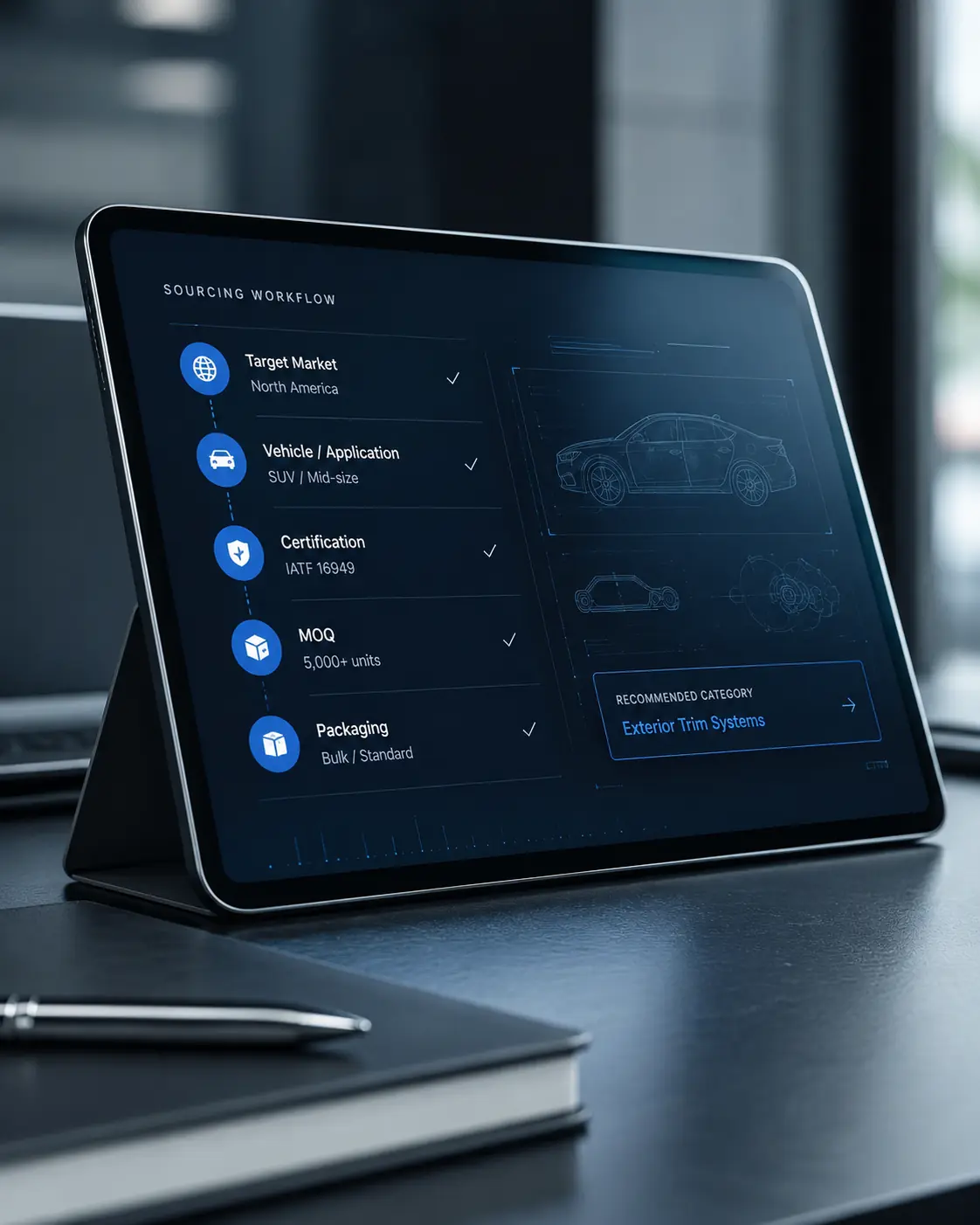
Sourcing Path Finder
Choose the way you prefer to buy.
Choose one main priority first. Add one secondary condition only when it improves the buying decision.
The selector does not send data. Your details are submitted only after you open and complete the inquiry form.
What are you trying to achieve?
Choose the commercial outcome that best describes this project.
Choose one main priority. Only one primary goal is allowed.
Your sourcing path
A category shortlist based on your starting point and buying context.
Procurement Scenarios
Choose the sourcing program that matches your buying plan.
Different buying programs require different specifications, samples, documents and packaging inputs. Choose the situation closest to your project, review the buyer checklist, then continue to a category, sample request or quotation.
Private-Label Automotive Products
Build a branded assortment without beginning from a fixed SKU list.
Open the private-label buying brief
Procurement process
- Define the target channel, price position and first category.
- Lock the product specification before artwork work begins.
- Review product and packaging samples together.
- Use the approved sample, artwork and packing file as the bulk-order reference.
Selection table
| Decision | Buyer input |
|---|---|
| Brand level | Logo only, branded label, retail box or full OEM presentation |
| Product control | Material, finish, fitment, dimensions and performance targets |
| Order plan | Trial quantity, annual forecast, SKU count and reorder rhythm |
Common mistake
Starting box artwork before the product, SKU structure and market wording are fixed creates rework and sample delays.
Specification requirements
- Product drawing, reference sample or controlled specification
- Logo file, barcode system, languages and carton marks
- Target market, sales channel and document checklist
Buyer FAQ
Should the first trial use full custom packaging? A neutral or label-based trial can reduce artwork cost while the buyer validates product demand. Full retail packaging is more useful when shelf presentation and channel approval must be tested with the product.
Low-MOQ Automotive Product Testing
Test demand with samples or a controlled trial order before scaling.
Open the low-MOQ testing brief
Procurement process
- Select one use case and a narrow SKU set.
- Request representative samples in the intended material and format.
- Record fit, performance, packaging and customer-feedback results.
- Scale only the SKUs that meet the agreed acceptance criteria.
Selection table
| Test area | Buyer input |
|---|---|
| Demand test | Channel, test period, target customer and sell-through target |
| Product test | Critical dimensions, installation, material and performance checks |
| Commercial test | Trial quantity, landed-cost ceiling and reorder threshold |
Common mistake
Testing too many SKUs at once makes it difficult to identify which product, price or packaging decision caused the result.
Specification requirements
- Reference product or clear application description
- Sample quantity and acceptance checklist
- Destination, delivery requirement and target launch date
Buyer FAQ
Does a low trial quantity guarantee the same MOQ for branded production? No. Standard products, custom colors, printed packaging and tooling create different production thresholds. Use the trial to validate the product first, then build the branding scope around the expected reorder volume.
EU Automotive Aftermarket Sourcing
Begin with the destination market and product-specific documentation needs.
Open the EU market buying brief
Procurement process
- Identify the exact product type and economic-operator role.
- Map the product to applicable EU rules and market languages.
- Review product, label, instructions and document set as one package.
- Keep the approved technical and packaging records with the purchase file.
Selection table
| Area | Buyer check |
|---|---|
| Product rules | Applicable EU legislation, standards and product-specific markings |
| Materials | Restricted substances, material declarations and market-specific preferences |
| Market file | Labels, instructions, declarations, reports and traceability information |
Common mistake
Requesting a generic “CE certificate” without first identifying whether CE marking applies to that exact product creates false assurance and an incomplete market file.
Specification requirements
- Destination countries and importer information
- Product function, electrical data, material and model list
- Required languages, labels, instructions and document format
Buyer FAQ
Does every automotive accessory require CE marking? No. CE marking only applies when specific EU legislation requires it. Buyers should classify the exact product first, then build the applicable conformity, material, labeling and technical-documentation checklist for that product and destination.
US Automotive Aftermarket Sourcing
Shape the shortlist around vehicle application, sales channel and program scale.
Open the US market buying brief
Procurement process
- Define the product as general accessory or regulated motor-vehicle equipment.
- Lock fitment, measurement system and channel packaging.
- Review applicable federal, state and customer requirements.
- Approve sample, labels, cartons and receiving information before bulk production.
Selection table
| Area | Buyer check |
|---|---|
| Fitment | Year, make, model, trim, bed size or mounting application |
| Format | Inch or ounce units, electrical rating, barcode and instruction format |
| Market | Applicable FMVSS, NHTSA, state, retailer and warranty requirements |
Common mistake
Using a product photo as the fitment specification leads to quotation gaps, missing hardware and avoidable returns.
Specification requirements
- Vehicle application and controlled dimensions
- Material, finish, electrical or installation requirements
- UPC, carton marks, instructions and warehouse pack plan
Buyer FAQ
Is DOT wording enough for US market access? No. The buyer should identify the exact product and applicable legal requirements. A logo, supplier statement or generic report does not replace product classification, required manufacturer registration, labeling, testing or record obligations.
EV Aftermarket Product Sourcing
Translate charging, connection or EV-use requirements into a product direction.
Open the EV product buying brief
Procurement process
- Define vehicle-side and infrastructure-side connection requirements.
- Lock voltage, current, phase, cable length, environmental and protection requirements.
- Test representative samples under the intended operating conditions.
- Approve labels, instructions, packaging and the product-specific document set.
Selection table
| Decision | Buyer input |
|---|---|
| Interface | Connector type, vehicle inlet, supply side and regional use |
| Electrical | Voltage, current, phase, power, protection and cable length |
| Environment | Indoor or outdoor use, temperature, ingress target and storage |
Common mistake
Choosing by connector appearance alone ignores electrical rating, communication, protection, cable construction and destination-market requirements.
Specification requirements
- Connector standard and vehicle or charger reference
- Rated voltage, current, phase, power and cable length
- Operating environment, labels, instructions and packaging
Buyer FAQ
Can one EV charging product be sold unchanged in every market? No. Connector conventions, electrical supply, labels, instructions, plugs, conformity routes and customer expectations vary. Build the product and document checklist around the destination and intended use before artwork or bulk planning.
Workshop Consumables Sourcing
Build a replenishment program around repeat use, pack size and service workflow.
Open the workshop supply buying brief
Procurement process
- Map the workshop task and current consumption pattern.
- Select the narrowest usable size, grit, weight or accessory range.
- Run a branch or technician trial with recorded acceptance criteria.
- Set pack size, reorder point and repeat-batch reference.
Selection table
| Area | Buyer input |
|---|---|
| Task | Surface preparation, wheel balancing, tire service or work lighting |
| Format | Grit, dimensions, attachment, weight profile, pack and dispenser |
| Replenishment | Monthly use, branch count, safety stock and reorder frequency |
Common mistake
Buying the lowest unit-price pack without measuring technician use, failure rate and restocking effort can increase total workshop cost.
Specification requirements
- Task, machine or wheel application
- Current SKU, consumption and accepted performance reference
- Inner pack, carton quantity, label and warehouse requirements
Buyer FAQ
Should a distributor launch the full range immediately? Start with the highest-use formats and use real branch consumption to expand. A focused trial makes pack size, performance differences and reorder economics easier to evaluate than a broad mixed launch.
Off-Road Vehicle Accessories
Start from vehicle, mounting position and operating environment.
Open the off-road buying brief
Procurement process
- Define vehicle, mounting position and operating environment.
- Lock material, load, finish, electrical and hardware requirements.
- Test installation, vibration, clearance, sealing and packaging protection.
- Approve the complete hardware kit and instruction set with the product.
Selection table
| Area | Buyer input |
|---|---|
| Vehicle | Year, make, model, trim, cab, bed or bumper configuration |
| Environment | Road, off-road, mud, water, corrosion, temperature and load |
| Installation | Mounting points, harness, hardware, clearance and tools |
Common mistake
Assuming a universal mounting claim removes the need to inspect vehicle variation, hardware completeness and installation clearance.
Specification requirements
- Vehicle fitment file and mounting photographs
- Material, coating, load and environmental target
- Hardware list, wiring, instructions and protective packaging
Buyer FAQ
What should be tested before a bulk off-road order? Test fitment, mounting stability, hardware completeness, clearance, electrical operation where applicable, finish durability and carton protection. Use the approved vehicle application and installation file as the repeat-order reference.
Vehicle-Specific Product Sourcing
Use exact vehicle and installation details to narrow the category first.
Open the vehicle-fitment buying brief
Procurement process
- Build the exact year, make, model and body-configuration list.
- Collect mounting, dimensions, connector and hardware references.
- Install the sample on a representative vehicle and document results.
- Freeze the approved fitment table and revision for bulk and repeat orders.
Selection table
| Area | Buyer input |
|---|---|
| Coverage | Model years, trims, body styles, regional variants and exclusions |
| Interface | Mounting holes, dimensions, connector, harness and hardware |
| Evidence | Vehicle photos, reference part, scan, drawing or measured sample |
Common mistake
Using only a model name ignores trim, body, bed, regional and mid-cycle differences that can change fitment.
Specification requirements
- Controlled vehicle application table
- Reference dimensions, photographs, drawing or sample
- Installation method, hardware list and acceptance criteria
Buyer FAQ
Is one vehicle sample enough for a wide fitment claim? It supports only the tested configuration. Buyers should document the intended coverage, exclusions and variation points, then expand the fitment claim with evidence from representative vehicles or controlled technical references.
Buyer Decision Guides
Make the commercial decisions before comparing unit prices.
A useful quotation depends on a controlled product brief, an approval process and a repeat-order reference. Use these four guides to prepare the project before supplier comparison.
How to Choose an Automotive Product Supplier
Compare suppliers by control of the specification and repeat order, not by catalog size alone.
- Identify who owns manufacturing, partner-factory coordination and final inspection.
- Ask how drawings, approved samples, revisions and batch records are controlled.
- Review sample capability, quality checkpoints, packaging ownership and available documents.
- Use one quotation template so price differences are not caused by missing specifications.
Specification Confirmation Checklist
Turn product descriptions into measurable purchase requirements before sampling.
- Application, target vehicle, intended use and destination market
- Dimensions, material, finish, electrical data and performance criteria
- Hardware, installation, accessories, labels and instructions
- Acceptance criteria, sample record, revision number and inspection scope
Sample to Bulk Order Process
The sample should become a controlled purchasing reference, not only a visual approval.
- Test the sample in the intended application and environment.
- Record dimensions, fit, function, appearance, packaging and document results.
- List approved changes before issuing the bulk purchase order.
- Use the signed sample, specification and artwork as repeat-order references.
OEM Packaging Requirements
Packaging must protect the product, support the channel and keep SKU information consistent.
- Define inner pack, retail pack, master carton and pallet requirements.
- Prepare logo, barcode, language, warning, instruction and carton-mark files.
- Check product protection, hardware separation and warehouse handling.
- Approve artwork version, packing photos and final carton data before shipment.
Category Buying Matrix
Compare categories by application, specification and buying risk.
Each automotive category needs a different quotation brief. Use this matrix to decide what your team should prepare before requesting samples or bulk pricing.
| Category | Suitable buying scenario | Material and specification decisions | Market and document checks | Sample checklist |
|---|---|---|---|---|
| Auto Exterior Accessories | Vehicle styling, protection, private label and vehicle-specific programs | Vehicle coverage, material, finish, mounting, dimensions and hardware | Product safety, material, labels, instructions and destination requirements | Fit, gaps, finish, mounting, hardware and carton protection |
| Automotive Lighting | Replacement, auxiliary, off-road and application-led lighting programs | Voltage, output, beam use, connector, housing, sealing and mounting | Applicable vehicle-lighting, electrical, labeling and market requirements | Electrical function, mounting, beam application, sealing and harness |
| Sandpaper and Abrasives | Body shops, workshop distributors and private-label consumable ranges | Grit, mineral, backing, size, attachment, dust extraction and pack | Material information, safety data where applicable, labels and languages | Cut rate, scratch consistency, backing, attachment and packaging |
| EV Aftermarket Accessories | Charging, connection and EV-use product programs | Connector, voltage, current, phase, power, cable and protection | Electrical conformity route, labels, instructions and destination standards | Interface, electrical function, temperature, cable, enclosure and packaging |
| Truck Accessories | Pickup, cargo, off-road and vehicle-specific programs | Vehicle fitment, bed or body type, load, material, mounting and hardware | Product-specific safety, instructions, warnings and market requirements | Fitment, clearance, hardware, operation, finish and carton protection |
| Wheels and Tire Accessories | Tire stores, workshop chains, distributors and lead-free programs | Material, gram or ounce system, weight profile, coating, tape and pack | Restricted-substance, material, automotive and buyer document requirements | Weight, clip fit, tape, coating, labels, pack count and batch record |
Choose by Application
Start from the vehicle, workshop task, installation or charging use case. A broad category name is not enough for an accurate product match.
- Identify the end user and operating environment.
- State vehicle or equipment compatibility.
- Separate universal products from fitment-controlled products.
Choose by Material
Material changes cost, durability, finish, weight, corrosion performance and market suitability.
- Define the required material or acceptable alternatives.
- Set coating, color, hardness or construction requirements.
- Request material information that matches the supplied configuration.
Build the Market Checklist
Product rules depend on the exact item and destination. Start with classification, then build labels, instructions and documents around it.
- List destination countries and sales channels.
- Map applicable product and chemical requirements.
- Record importer, language, label and traceability needs.
Prepare the Purchase File
Keep one controlled file that purchasing, quality, logistics and the supplier use throughout the project.
- Specification and approved sample record
- Artwork, packing method and carton data
- Inspection checklist, document list and revision history
Sourcing Evidence
Build each order around samples, records and buyer-approved specifications.
Yirox supports OEM/ODM development, sample and selected trial-order planning, traceable quality control, private-label packaging, pre-shipment checks and document-availability reviews. Use the records below to define the project scope from inquiry to repeat order.
Sample Approval Process
- Share category, application, market, quantity and reference information.
- Receive product direction, MOQ direction and sample options.
- Test product, fitment, function, appearance and packaging.
- Record the approved sample and revision for bulk production.
Quality Inspection File
Buyers can add the following records to the purchase file according to the product and order scope.
- Incoming material or component checks
- In-process dimensions, function and appearance checks
- Batch inspection results and packing verification
- Pre-shipment photos, labels, cartons and quantity records
Partner-Factory Sourcing Checklist
When a project involves a source factory or partner manufacturer, the buyer should document:
- Which party owns the specification and production communication
- Factory product scope, sample source and revision control
- Inspection responsibility, traceability and document source
- Escalation route for nonconforming products and repeat orders
OEM Packaging Capability
Published Yirox options include logo application, labels, manuals, color or material adjustments, retail packaging, carton labels and shipping marks.
- Buyer supplies controlled logo, language, barcode and artwork files.
- Product and package samples are reviewed together.
- Final packing layout and carton data become order records.
Document Request Checklist
Build the request around the exact product configuration and destination, then ask for the matching available file set.
- Product specification and material information
- Applicable declarations, reports or certificates
- Inspection record, packing details and shipment documents
- Labels, instructions and product-specific traceability information
Published Program Example
Yirox's wheel-weight program illustrates how a category can be controlled from quotation to repeat order.
Buyer Reference Sources
Use product-specific rules and current source documents.
The links below support buyer research. They do not replace product classification, legal review, laboratory work or the responsibilities of manufacturers, importers and distributors.
Buyer Preparation
Prepare these four inputs before samples or pricing.
A complete brief helps purchasing, quality and the supplier work from the same product, market and commercial requirements.
Fitment and use case
Provide the vehicle, model year, mounting position, environment and intended use.
Material and performance
List dimensions, material, finish, electrical data and measurable acceptance criteria.
Documents and destination
Identify the destination, product rules, labels, languages and document checklist.
Quantity and packaging
Provide sample quantity, forecast, branding, pack structure and delivery requirement.
Buyer Questions
You can begin before every product detail is fixed.
A clear use case is often a better starting point than a final SKU list.
Do I need an exact product name or SKU?
No. Begin with the buying objective, application, vehicle, destination market or technical constraint. Yirox uses that information to identify a suitable category and the next specification questions. An exact SKU becomes necessary later, when samples, pricing, packaging and repeat-order records are prepared.
Can I request a sample before a bulk order?
Yes. Select Sample / trial order and use Request Samples. Send the intended application, critical specification and destination with the request. Test fit, function, material, appearance, packaging and available documents, then record the approved sample and revision as the reference for bulk production.
What information improves the recommendation?
Provide the target market, use case, vehicle or equipment, dimensions, material, electrical data, quantity and packaging plan. Add photographs, drawings, reference parts or current SKU specifications when available. The most useful information is measurable and helps the supplier compare like-for-like products.
Does the category match confirm fitment or compliance?
No. A category match identifies the starting point for procurement. The buyer should test product fitment and performance, classify the exact product, map destination-market obligations and review the corresponding labels, instructions and documents before placing a bulk order or making a market claim.
How should I compare automotive product suppliers?
Compare suppliers using one controlled quotation brief. Review specification ownership, manufacturing responsibility, sample capability, revision control, inspection records, packaging ownership, document sources and repeat-order support. A lower quotation is not equivalent when material, hardware, testing, packaging or document scope is missing.
Which documents should I request?
Start with the exact product, configuration and destination. Build a checklist covering product specifications, material information, applicable declarations or reports, inspection records, labels, instructions, packing details and shipping documents. CE, RoHS, E-mark, DOT or other references should only be requested when relevant to that product.
Not sure which product category fits your buying plan?
Send the category, market, quantity and requirement. Yirox reviews feasibility, MOQ direction, available document options and next steps within one business day.
Send Your Sourcing Request
Your category and buying brief are included automatically for feasibility, sample and quotation review.
General product recommendation request
shortcode inside this HTML widget.