



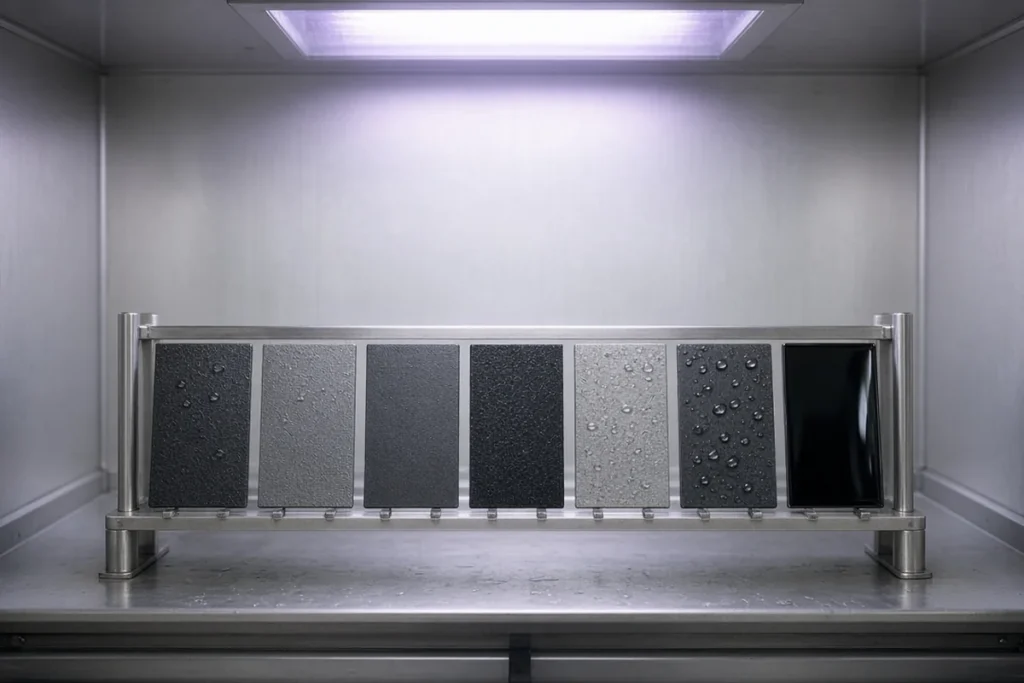
A weathering test exposes a material to controlled UV light, heat and moisture so that sun and rain damage shows up in weeks instead of years. For exterior car plastics, the two main lab methods are fluorescent UV (QUV) and xenon arc. This guide explains how they differ, which standards apply and how to specify one.
Scope: this article covers accelerated laboratory weathering of exterior automotive plastic parts: unpainted ASA and PP/TPO, painted ABS and PP, and chrome plated trim. It is written for brands and buyers who need to put a weathering requirement into a drawing or RFQ. For how the base materials compare, see our materials and finishes guide.
What does a weathering test actually do?
Sunlight, heat and water are what age an exterior part. UV radiation breaks polymer chains and pigments, heat speeds up the reactions, and water from rain and dew carries away the damaged surface and adds stress as the part swells and dries. The result is the familiar set of failures: black trim that turns grey, gloss that drops, paint that chalks or cracks, and clear coats that peel.
An accelerated weathering test reproduces those three stresses in a chamber, under controlled conditions and with more intensity or more time than a normal day outdoors. ASTM describes the fluorescent UV method as intended to induce property changes consistent with end use, including the effects of the UV part of sunlight, moisture and heat 1. The same standard is clear about what it does not cover: local effects such as air pollution, biological attack and salt water exposure. Salt and corrosion need their own tests.
The other option is natural outdoor exposure, usually in hot, sunny sites such as Florida or Arizona. Outdoor testing is the real thing, but it takes years. Most exterior part programs use accelerated lab tests for development and supplier approval, and keep outdoor exposure for long-term validation of new materials.
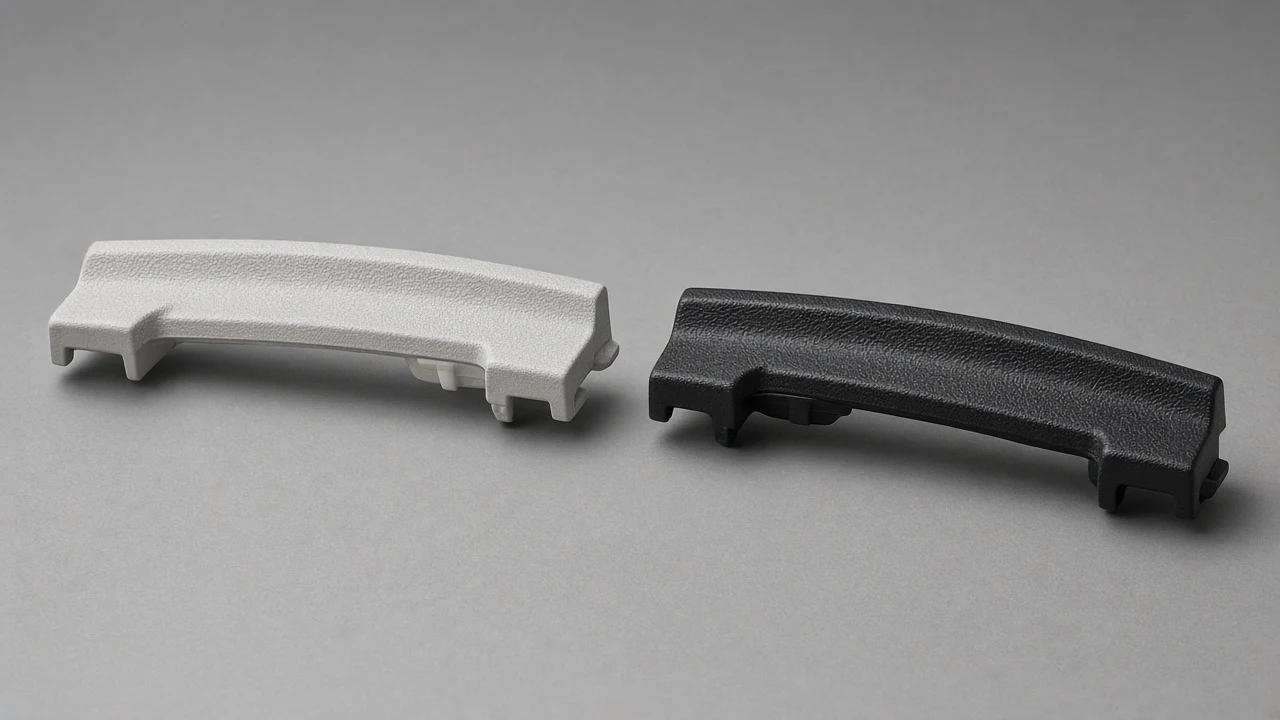
QUV vs xenon arc: how do they differ?
The two common accelerated methods use different light sources and different ways of adding water. You may also see a third, older light source on legacy specifications: the carbon arc, which still has its own ASTM practices, G152 for open-flame and G153 for enclosed carbon arc apparatus 9. Neither of the two common methods is “better” in general. They answer slightly different questions, and many vehicle maker specifications name one or the other 38.
| Feature | Fluorescent UV (often called QUV) | Xenon arc |
|---|---|---|
| Light source | Fluorescent UV tubes, such as UVA-340 | Filtered xenon arc, close to full sunlight |
| Spectrum | Short-wave UV only; little visible light or infrared | UV, visible and infrared light |
| Moisture | Condensation (warm dew on the specimen face) | Water spray and controlled humidity |
| Main standards | ASTM G154, ISO 4892-3, SAE J2020 | ASTM G155, ISO 4892-2, SAE J2527 |
| Best at showing | UV damage to the surface: gloss loss, chalking, cracking | Color change and fade, plus UV damage, closer to real sunlight |
| Typical result unit | Hours of exposure (for example 500 or 1,000 h) | Radiant exposure (kJ/m² at a set wavelength) or hours |
The practical rule: when color match matters, as it does on painted and molded-in-color trim, xenon arc is usually the better choice because it includes visible light, which drives many pigment and dye changes. Fluorescent UV is a strong, lower-cost screen for surface durability and for comparing material grades against each other. A common example is ASTM G154 Cycle 1, which runs 8 hours of UVA-340 light at a 60 °C black panel temperature followed by 4 hours of condensation at 50 °C 6.
Which weathering standards apply to exterior car parts?
There are two layers of documents. The general practices describe how to operate a weathering device. The automotive methods fix the cycle for exterior parts, and the vehicle maker’s material specification then adds the duration and the pass criteria.
| Standard | Type | What it covers |
|---|---|---|
| ASTM G154-23 | General practice | Operating fluorescent UV and condensation apparatus |
| ASTM G155-25 | General practice | Operating xenon arc apparatus |
| ISO 4892-3:2024 | Plastics method | Fluorescent UV exposure of plastics |
| ISO 4892-2:2013 (+ Amd 1:2021) | Plastics method | Xenon arc exposure of plastics |
| SAE J2527 | Automotive exterior | Controlled-irradiance xenon arc exposure of exterior materials |
| SAE J2020 | Automotive exterior | Fluorescent UV and condensation exposure of exterior materials |
Two lines in these documents matter for buyers. ASTM G154 says that no result from the practice should be quoted unless it comes with a report of the specific operating conditions 1. And SAE J2527 says that sample preparation, test duration and performance evaluation are covered by each vehicle maker’s material specification 3. In other words, “tested to SAE J2527” means nothing without the dose and the pass criteria. ISO 4892-2 and ISO 4892-3 play the same role for plastics in ISO-based specifications 4, and SAE J2020 is the fluorescent UV counterpart of J2527 for exterior parts 8.
ASTM G154 vs G155: how do the two practices compare?
ASTM G154 uses fluorescent UV tubes with condensation; ASTM G155 uses a filtered xenon arc source with water spray and humidity control. Both are practices for operating the apparatus, with numbered cycles to choose from, so a drawing that names either one must also name the cycle.
| Feature | ASTM G154 (fluorescent UV) | ASTM G155 (xenon arc) |
|---|---|---|
| Light source | UVA-340 tubes in cycles 1, 4, 6 and 7; UVB-313 tubes in cycles 2, 3, 5 and 8 6 | Xenon arc through daylight filters (cycles 1, 2, 3, 7A, 9, 12, 13), window glass filters (4, 5, 6, 10, 11) or extended UV filters (7, 8) 10 |
| Irradiance control | Not required by the standard, but recommended 6 | 340 nm, 420 nm or broadband TUV control point, depending on the cycle 10 |
| Black panel temperature | Typically 60 °C in light steps, some cycles 70 °C; dark condensation at 50 °C 6 | 53 to 89 °C in light steps, depending on the cycle 10 |
| Water | Hot condensation is the main method 6 | Front spray in some cycles, front and back spray in cycles 7 and 7A, and humidity control in all cycles except 1 and 2 10 |
| Automotive link | SAE J2020 is the automotive fluorescent UV method 8 | Cycles 7 and 8 have historically been used by the automotive industry 10; SAE J2527 is the usual automotive xenon method |
| Best at | Fast, low-cost screening of surface damage | Color and appearance, because it includes visible light |
For a buyer, the practical point is the cycle number. “ASTM G155” alone could mean a window glass test meant for interior materials, while “ASTM G155 Cycle 1” or “SAE J2527” names an outdoor sunlight test.
How does the SAE J2527 xenon cycle work?
SAE J2527 is the most common xenon method on North American exterior part drawings. It replaced the older, equipment-specific SAE J1960 and was last revised in 2017 5. Its cycle runs for 180 minutes and repeats 5:
| Step | Duration | Light | Water | Radiant dose at 340 nm |
|---|---|---|---|---|
| 1 | 60 min | Dark | Front and back spray | 0 |
| 2 | 40 min | Light | None | 1.32 kJ/m²/nm |
| 3 | 20 min | Light | Front spray | 0.66 kJ/m²/nm |
| 4 | 60 min | Light | None | 1.98 kJ/m²/nm |
The default irradiance is 0.55 W/m²/nm at 340 nm, with a 70 °C black panel temperature in the light steps and 95% relative humidity in the dark step 5. Because J2527 fixes the irradiance, you can turn a dose into time. At 0.55 W/m²/nm, each hour of light adds about 1.98 kJ/m²/nm, and each full 3-hour cycle adds about 3.96 kJ/m²/nm, the sum of the step doses in the table 5.
That gives a useful sanity check. A specification of 2,500 kJ/m² measured at 340 nm needs roughly 1,260 hours of light, or about 1,890 hours of total chamber time on the J2527 cycle (2,500 ÷ 1.98 ≈ 1,263 light hours, and the cycle is two-thirds light). If a quote promises that dose in a few hundred hours, either the irradiance is higher than the default or the dose is measured over a different wavelength band. Both are allowed if agreed, but they are not the same test, so ask.
The same arithmetic works for other doses. On the default J2527 cycle, total chamber time is about 1.5 times the light hours, because one hour in three is dark.
| Specified dose at 340 nm | Light hours at 0.55 W/m²/nm | Total chamber hours (J2527 cycle) |
|---|---|---|
| 500 kJ/m² | about 250 | about 380 |
| 1,000 kJ/m² | about 505 | about 760 |
| 1,500 kJ/m² | about 760 | about 1,140 |
| 2,000 kJ/m² | about 1,010 | about 1,515 |
| 2,500 kJ/m² | about 1,260 | about 1,890 |
Example figures at the default irradiance; a lab running a higher irradiance reaches the same dose sooner.
Which test fits which exterior part?
The right test depends on what fails first on that part. The table below covers common exterior plastic parts. Agree the final method with your engineers or your customer’s specification.
| Part and finish | Main weathering risk | Suggested method | What to measure |
|---|---|---|---|
| Unpainted ASA trim (grille, mirror base, pillar trim) | Color shift and gloss loss of the molded-in color | Xenon arc (SAE J2527 or ISO 4892-2) | ΔE, gloss retention, visual chalking |
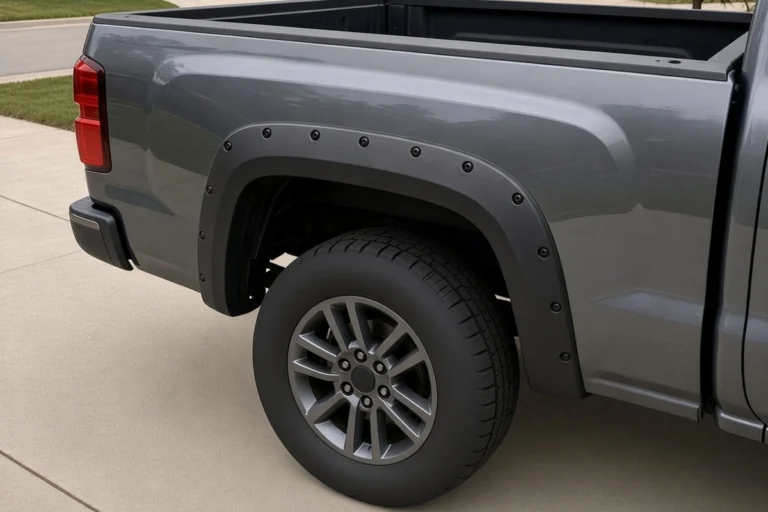
| Unpainted black PP/TPO (bumper lower, fender flares) | Greying, chalking, surface cracking | Xenon arc; fluorescent UV for grade screening | ΔE, gloss, visual rating |
| Painted ABS or PP (spoilers, mirror caps, lips) | Clear coat loss of gloss, cracking, adhesion loss | Xenon arc or fluorescent UV per paint spec, then adhesion test | Gloss retention, ΔE, cross-cut adhesion after exposure |
| Chrome plated ABS (emblems, trim strips) | Corrosion and blistering more than UV | CASS or neutral salt spray, plus thermal cycling | Blistering, corrosion spots, plating adhesion |
| Carbon pattern or film finishes | Yellowing of the clear layer, delamination | Xenon arc | ΔE (yellowness), gloss, edge lifting |
Two notes on materials. Unpainted ABS is a weak choice for sun-facing parts, which is why most exterior ABS parts are painted or plated; our ABS page explains why. ASA is made for unpainted outdoor use, and our ASA page covers how it compares with ABS. For bumpers and flares, see PP and TPO. A side-by-side weathering, paint and RFQ comparison of the three resins is in ASA vs ABS vs PP for exterior car parts.
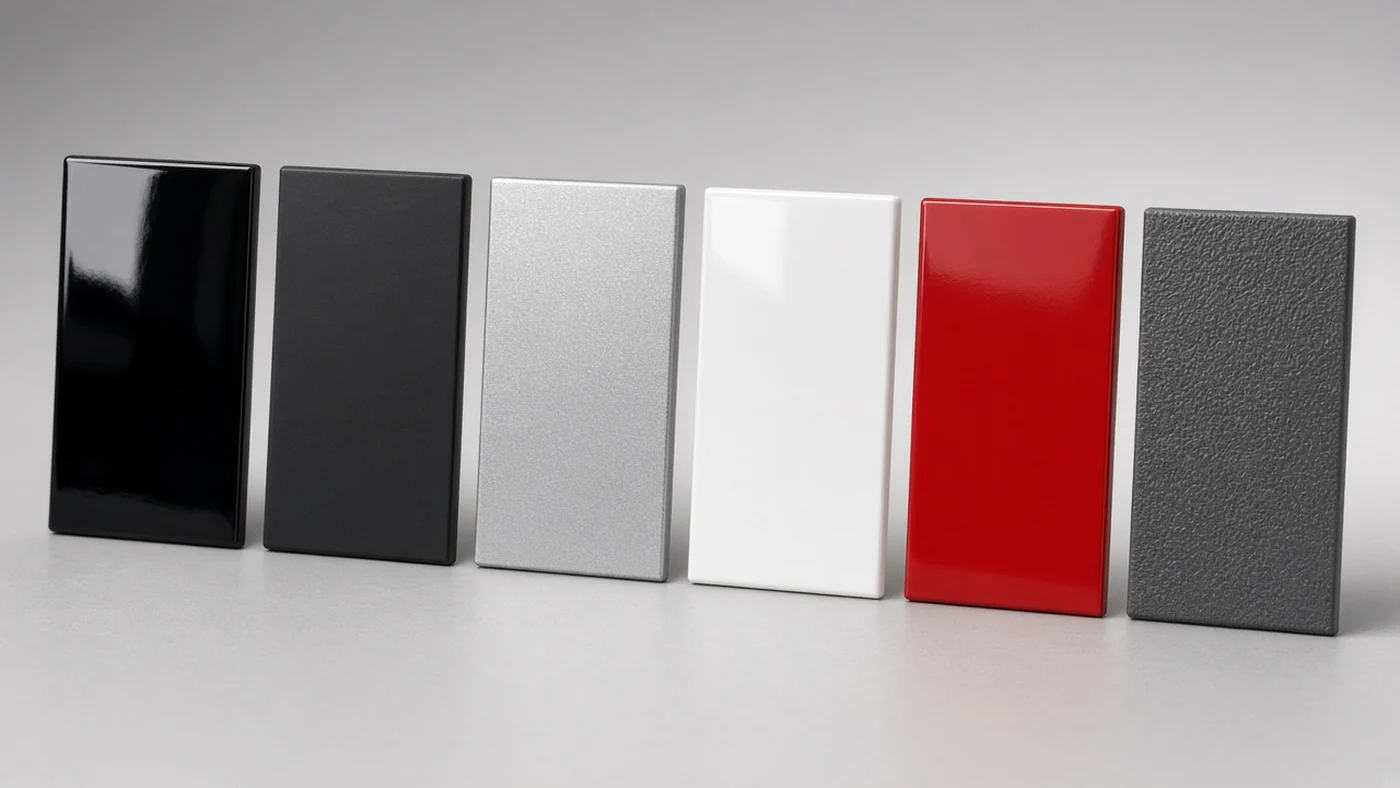
For painted parts, run the adhesion test after the weathering exposure, not only on new panels. A paint that passes cross-cut adhesion on day one can lose it after UV and moisture cycling. Our painting and surface finishing page lists the adhesion and weathering methods we use. For chrome, our chrome plating page sets out our CASS 48 h standard with no blistering.
How do you read a weathering test report?
A useful report has three parts: the exact conditions, the measurements before and after, and the visual assessment. If any of these is missing, ask for it.
Conditions
The report should name the standard and cycle, the light source and filter or tube type, the irradiance and its control wavelength, the black panel temperature, the total hours or dose, and the lab. ASTM G154 also recommends exposing a control material of known performance alongside the samples, ideally one good and one poor, and using at least three replicates of each material 1. A single panel with no control is weak evidence.
Color change (ΔE)
Color is measured with a spectrophotometer before and after exposure, and the difference is reported as ΔE. ASTM D2244 sets out how color differences are calculated and covers several formulas, including CIELAB ΔE*ab and CIEDE2000 7. Make sure the report names the formula, because values from different formulas cannot be compared. The pass limit itself comes from the specification; there is no universal “good” ΔE.
Gloss retention
Gloss is measured with a glossmeter to ASTM D523, usually at 60°, before and after 7. Retention is the after value as a percentage of the before value. On textured and matte parts the starting gloss is low, so small absolute changes can look like large percentages. Read both the raw values and the percentage.
Visual rating
Look for chalking, cracking, blistering, peeling and loss of grain definition. Good reports include photos of exposed and unexposed areas of the same panel, under the same light.
Report acceptance checklist
| Item | Accept when the report shows | Query when |
|---|---|---|
| Method | Standard, cycle number and revision | Only “UV tested” or a standard with no cycle |
| Exposure | Hours or dose with units and control wavelength | Hours with no irradiance, or dose with no wavelength |
| Specimens | Production finish and color, with replicates and a control | One panel, or bare resin for a painted part |
| Results | ΔE with its formula, and gloss before and after | “No significant change” with no numbers |
| Lab | Lab name and accreditation | No lab named |
Can test hours be converted into years outdoors?
No, not in general. This is the most common misunderstanding about weathering tests. Q-Lab, which makes both QUV and xenon equipment, states that it is theoretically impossible to have a single “magic number” that turns tester hours into years outdoors 2. Outdoor exposure depends on latitude, altitude, season, orientation, whether the part is insulated and year-to-year weather, which Q-Lab notes can vary degradation by as much as 2:1 at the same site.
What accelerated tests do well is ranking. If formulation A holds color for twice as long as formulation B in the same test, it will very likely outlast B on the car too. That is why weathering data should be treated as comparative, not absolute. A supplier who claims “1,000 hours equals five years” without outdoor data on that exact material is overselling. Our manufacturing capabilities page shows how materials and inspection are handled in production.
The workable approach is to test against a reference. Expose your candidate part next to a part whose real-world history you know, such as the current production part or an OEM part, and require the new part to perform at least as well.
How do you write a weathering requirement into an RFQ?
A clear requirement saves weeks of back-and-forth. Include these points on the drawing or in the RFQ:
- Method and cycle. For example, “SAE J2527, default cycle” or “ASTM G154 Cycle 1.”
- Duration or dose, with units. “2,500 kJ/m² at 340 nm” or “1,000 h,” not “long-term UV test.”
- Specimens. Production parts or flat plaques, which finish, which color, and how many replicates.
- Reference. A control part or material exposed at the same time.
- Measurements and limits. ΔE formula and maximum value, gloss geometry and minimum retention, visual criteria.
- Post-exposure tests. For painted parts, cross-cut adhesion after exposure.
- Lab. Accredited third-party lab or customer-approved lab, and the report format.
- When to retest. After a change of resin, colorant, paint system or finish supplier.
Weathering results also belong in a PPAP package, as part of the material and performance test results. If your program needs one, our guide to quality inspection and PPAP shows how the reports fit together, and what PPAP is explains where test results sit among the 18 elements.
What are the most common weathering test mistakes?
- Testing a flat plaque of the resin when the part is painted, textured or plated. The finish is what weathers.
- Testing one color and assuming the others behave the same. Black, grey and bright colors can age very differently.
- Comparing results from different machines or labs. ASTM G154 warns that results from different apparatus models should not be compared unless correlation has been established 1.
- Using weathering to judge corrosion. UV and moisture tests do not replace salt spray or CASS on plated or metal parts.
- Accepting a pass statement without numbers. “No significant change” is an opinion; ΔE and gloss values are data.
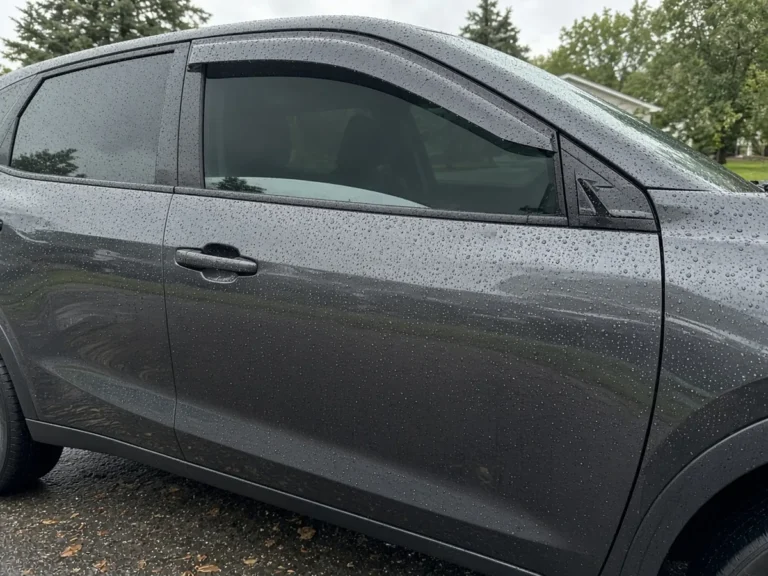
Spoilers and lips show these issues well, because they mix painted surfaces, carbon pattern finishes and sun exposure. Our comparison of carbon fiber, ABS and fiberglass spoilers covers the material side, and the chrome delete guide compares vinyl wrap, paint and black replacement trim. Tinted acrylic rain guards and window visors are another sun-facing exterior plastic; mount and fitment checks are covered in rain guards and window visors.
Conclusion
A weathering test is only as useful as its specification. Fluorescent UV is a fast screen for surface damage, while xenon arc, usually to SAE J2527 for exterior car parts, is the better tool when color and appearance matter. Both give comparative results, so test against a reference part and do not convert hours into years.
When you write the requirement, state the method, the dose with units, the specimens, the measurements and the limits. Then a report can tell you something you can act on.
Next step
If you are specifying exterior trim or body parts, send us the part and your weathering requirement. We arrange QUV (500 or 1,000 h) and xenon (2,500 kJ/m²) exposure, salt spray, CASS and humidity tests through SGS and CTI, CNAS-accredited labs, and supply the reports with your program. You can browse our exterior trim range and body kit and aero parts.
Frequently asked questions
What is a QUV test?
QUV is a common name for fluorescent UV weathering, after Q-Lab’s QUV tester. Specimens are exposed to UV from fluorescent tubes and to condensation in repeating cycles, usually to ASTM G154 or ISO 4892-3.
What is the difference between ASTM G154 and ASTM G155?
ASTM G154 covers fluorescent UV apparatus, which uses short-wave UV and condensation. ASTM G155 covers xenon arc apparatus, which reproduces UV, visible and infrared sunlight with water spray.
What is SAE J2527?
SAE J2527 is the SAE method for controlled-irradiance xenon arc exposure of automotive exterior materials. It sets a 180-minute cycle at 0.55 W/m²/nm at 340 nm; the dose and pass criteria come from the vehicle maker’s specification.
How many hours of QUV equal one year outdoors?
There is no fixed conversion. Outdoor exposure varies with location, season and mounting, so accelerated results should be used to rank materials against a known reference, not to predict years.
Is salt spray a weathering test?
Not in the UV sense. Salt spray and CASS are corrosion tests for metal and plated parts. Exterior chrome trim usually needs both a corrosion test and a check of appearance after exposure.
Which plastic holds up best in weathering tests?
For unpainted exterior parts, UV-stabilized ASA is designed for outdoor color stability. Unpainted ABS weathers poorly and is usually painted or plated for exterior use. Results always depend on the grade and color.
Which ASTM G155 cycle is used for automotive exterior parts?
Q-Lab notes that cycles 7 and 8, which use extended UV filters, have historically been used by the automotive industry. Today most North American exterior part drawings call for SAE J2527 instead, so check the drawing.
How many hours is 2,500 kJ/m² on a xenon test?
At the default SAE J2527 irradiance of 0.55 W/m²/nm at 340 nm, about 1,260 hours of light, or roughly 1,890 hours of total chamber time including the dark steps. A higher irradiance shortens this.
References
[1] ASTM International. ASTM G154-23: standard practice for operating fluorescent UV exposure apparatus. Scope and significance and use; see also ASTM G155-25 for xenon arc apparatus.
[2] Q-Lab. “How many hours in a Q-SUN or a QUV equals a year of outdoor exposure?” Technical article on correlation and acceleration factors.
[3] SAE International. “SAE J2527 (2017-09): Performance Based Standard for Accelerated Exposure of Automotive Exterior Materials Using a Controlled Irradiance Xenon-Arc Apparatus.”
[4] ISO. “ISO 4892-2:2013, Plastics: Methods of exposure to laboratory light sources, Part 2: Xenon-arc” and “ISO 4892-3:2024, Part 3: Fluorescent UV.”
[5] Q-Lab. “SAE J2527.” Summary of the J2527 cycle, irradiance, temperatures and humidity set points.
[6] Q-Lab. “ASTM G154.” Summary of G154 cycles, including Cycle 1.
[7] ASTM International. “ASTM D2244-25, Calculation of Color Tolerances and Color Differences from Instrumentally Measured Color Coordinates” and “ASTM D523, Standard Test Method for Specular Gloss.”
[8] SAE International. “SAE J2020 (2022-10): Accelerated Exposure of Automotive Exterior Materials Using a Fluorescent UV and Condensation Apparatus.”
[9] ASTM International. “ASTM G153: Standard Practice for Operating Enclosed Carbon Arc Light Apparatus for Exposure of Nonmetallic Materials.” See also ASTM G152 for open-flame carbon arc apparatus.
[10] Q-Lab. “ASTM G155.” Summary of the G155 cycles, optical filters, irradiance control points, black panel temperatures and water spray.