42Machines
90–2,500 tClamp force
3Two-shot machines
~1.5 MParts per month
±0.5 mmCritical features
01 — Capability

Injection Molding at a Glance

ItemYirox capability
Machines42 injection molding machines, clamp force 90–2,500 t (largest are two-platen)
Two-shot (2K) molding3 machines: 280 t and 380 t rotary-table, 530 t rotary-core
AutomationTake-out robots on all 42 machines (30 three-axis, 12 five-axis); 6 with in-mold monitoring
Monthly capacityAbout 1.5 million parts and 520 t of resin, two shifts of 16 hours
MaterialsABS, PP, modified PP, TPO, ASA, PC, PC/ABS; 2K combinations PC+PMMA, ABS+TPE, PC/ABS+TPU
Accuracy±1.0 mm general, ±0.5 mm on critical features, seams ±0.1 mm, part weight ±1 g
Mold shopIn-house, 6–8 molds per month, molds up to 25 t, P20/H13 steel
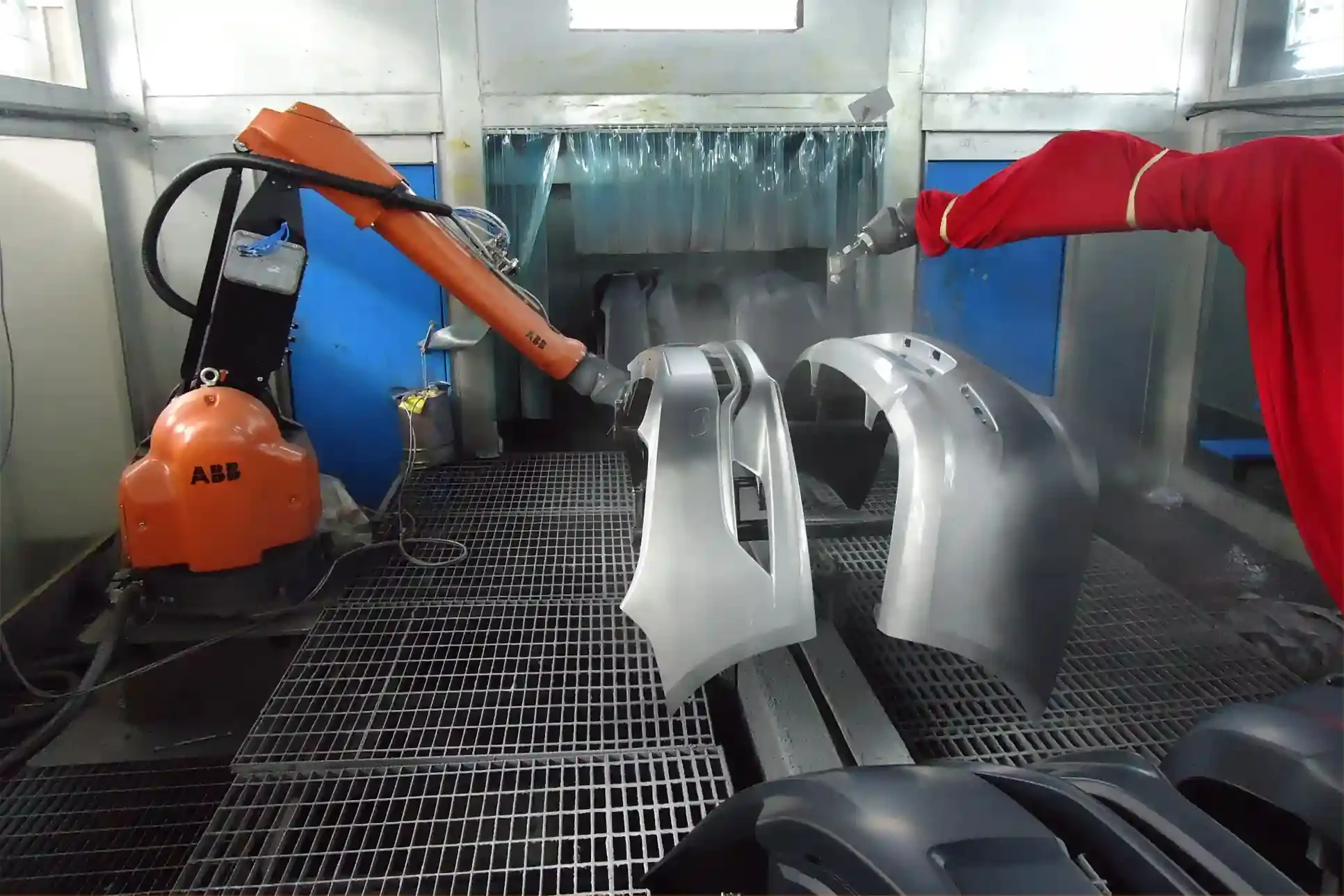
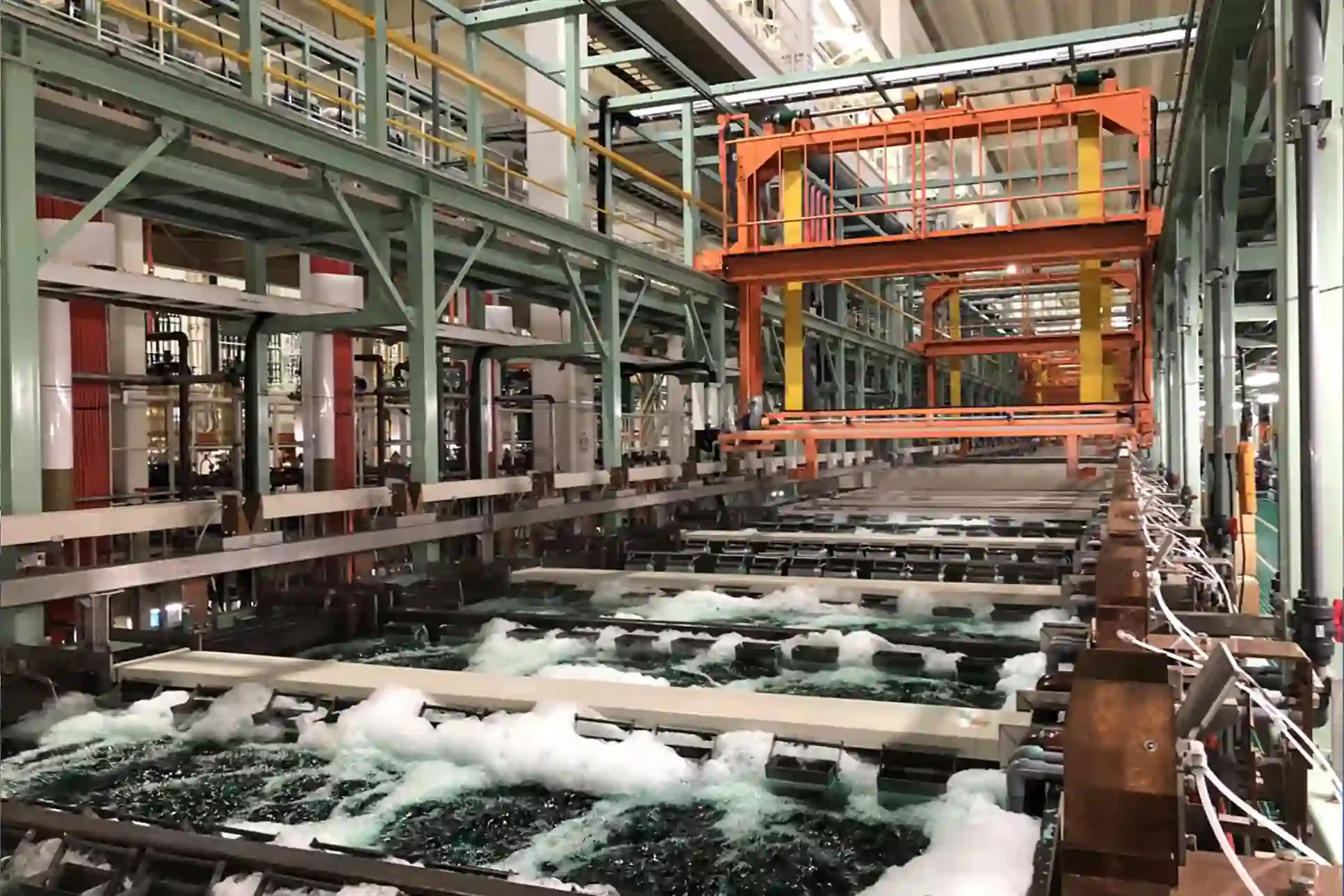
FinishingIn-house painting lines and chrome plating line
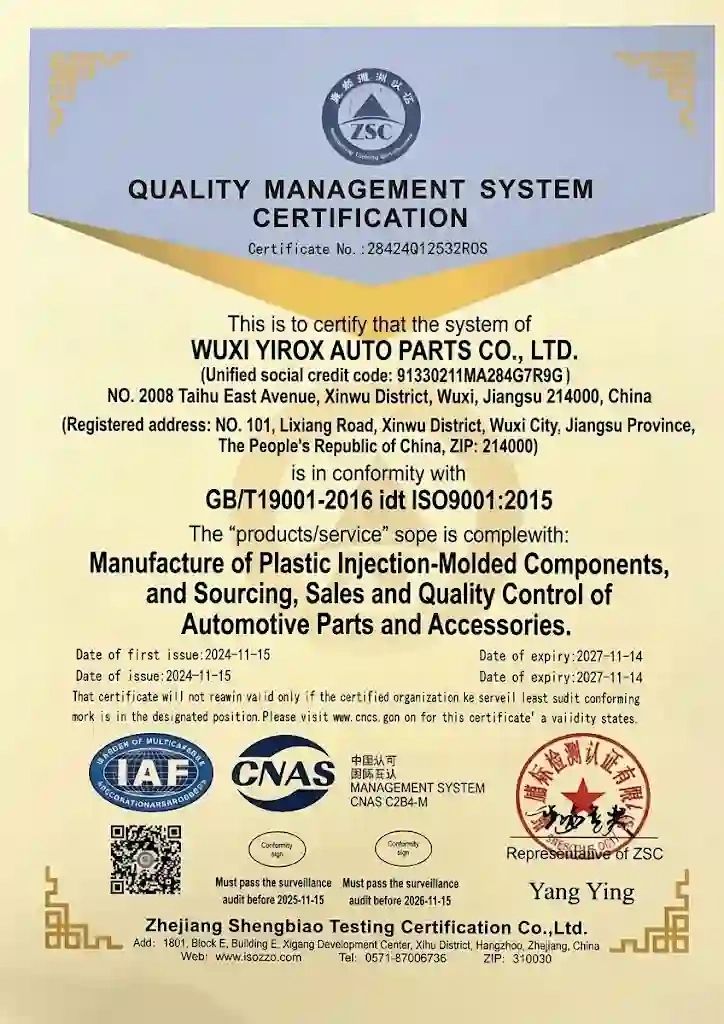
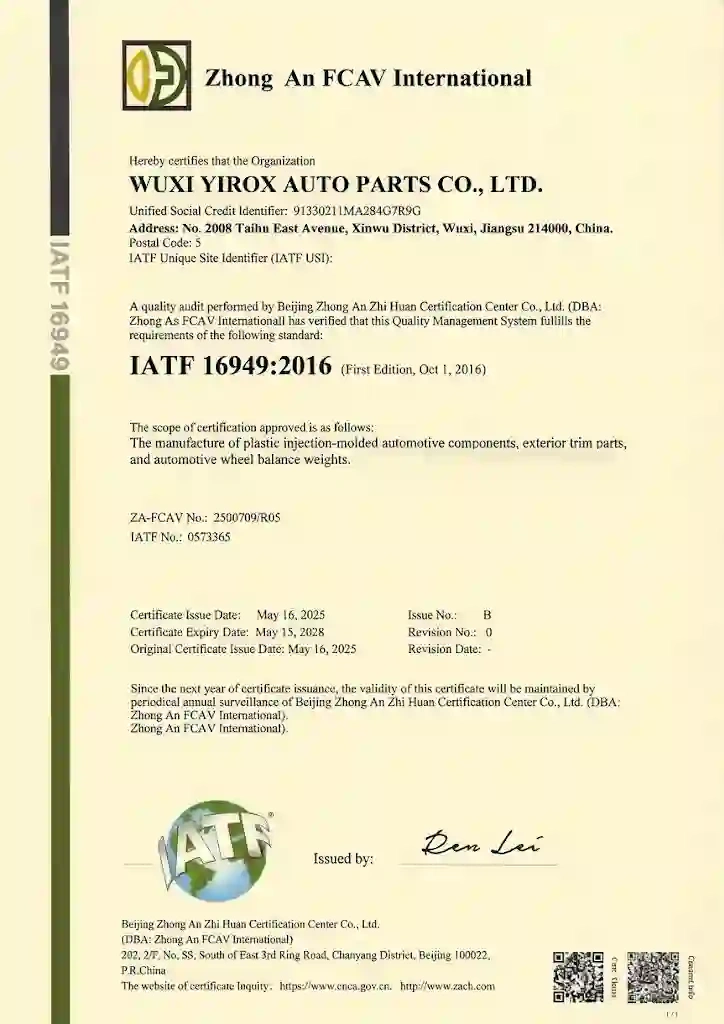
QualityISO 9001, IATF 16949, FAI, CMM, PPAP up to Level 3
Order sizeLow MOQ on selected items; confirmed in your quote
02 — Explainer

What Is Plastic Injection Molding?

Plastic injection molding is a manufacturing process that melts plastic pellets and injects the melt under high pressure into a closed steel mold. The plastic cools inside the cavity, the mold opens and a finished part is ejected.

The same mold then repeats the cycle, which is why injection molding is the standard process for plastic parts made in thousands or millions of identical pieces. Automotive injection molding adds tougher demands on fit, finish and weathering than most consumer parts.

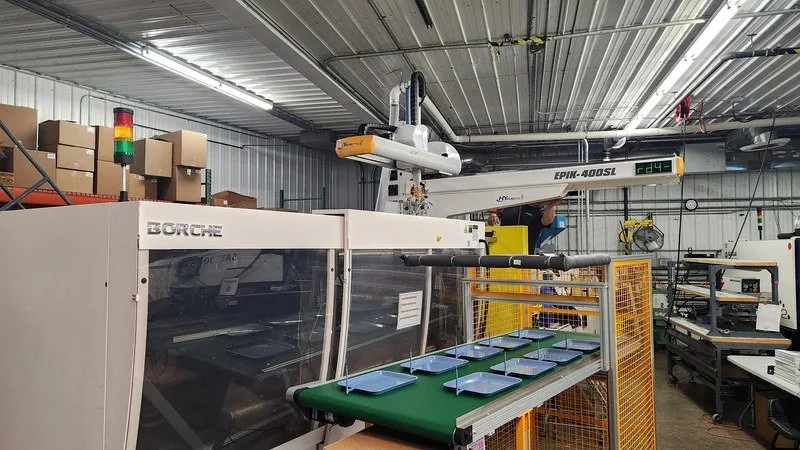
Injection molding machine with a take-out robot placing molded parts on a conveyor

For automotive exterior parts the process matters for more than cost. A front lip, grille or bumper trim must hold its shape on the vehicle, line up with body panels and keep a clean surface for paint or chrome.

Those results depend on how the part is designed, how the mold is built and how the molding process is controlled shot after shot. This page explains each step and shows the equipment Yirox uses to make it work.

If you want a longer guide to the process, defects and history of molding in the car industry, read our article on automotive injection molding. The rest of this page focuses on what you need to know as a buyer of molded exterior parts.

03 — Explainer

How the Injection Molding Process Works

Every injection molded part goes through the same four stages. The settings for each stage are developed during mold trials and then locked into the production process sheet.

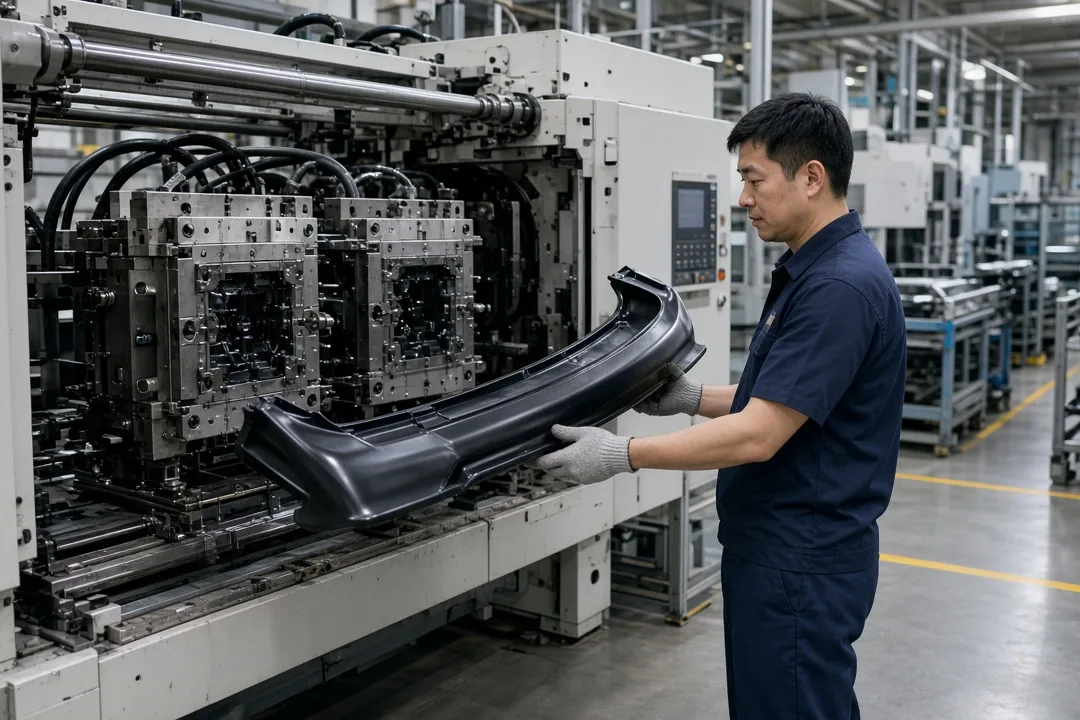
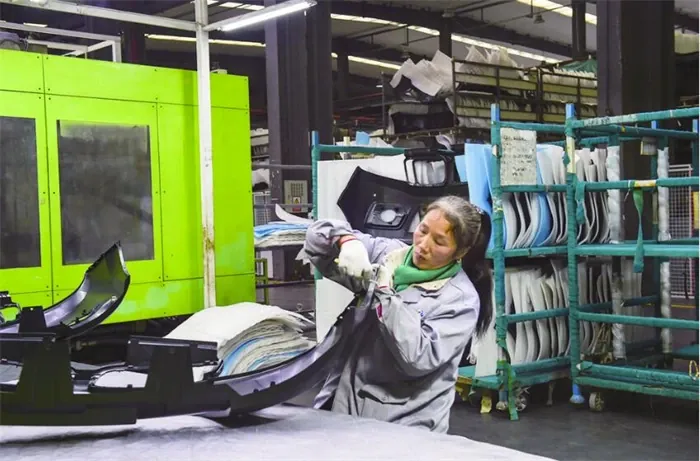
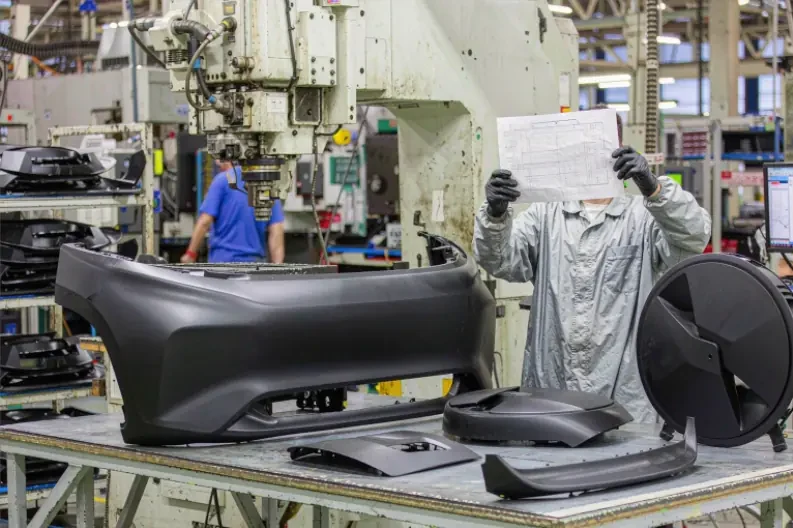
Technician removing a molded bumper part from an injection molding machine
  1. 01

    Clamping

    The two halves of the mold close and the machine holds them shut with clamp force. Large exterior parts need more tonnage because the projected area of the part is bigger.

  2. 02

    Injection

    Dried resin is melted in the heated barrel. The screw pushes the melt through the nozzle, runner and gates until the cavity is full.

  3. 03

    Packing and cooling

    Pressure is held while the plastic shrinks, then cooling water in the mold removes heat. Cooling is usually the longest part of the cycle.

  4. 04

    Ejection

    The mold opens and ejector pins or a robot remove the part. Runners are separated and the part moves to trimming, inspection or finishing.

Before any of this happens, the resin must be dried. Materials such as ABS, PC and PC/ABS absorb moisture from the air, and wet resin causes silver streaks on the surface. Mold temperature also matters: a stable, correct mold temperature gives an even gloss and reduces warpage on long parts like side skirts.

04 — Explainer

Types of Injection Molding We Use

Standard single-shot molding

One material, one cavity or family of cavities, one cycle. This covers most exterior parts: grilles, mirror housings, door handle covers, fender flares, side skirts and spoiler bodies.

Two-shot (2K) injection molding

Two materials are molded into one part in a single cycle. A rotary table or rotary core moves the first shot to a second cavity, where the second material is molded onto it. We use it for combinations such as PC+PMMA, ABS+TPE and PC/ABS+TPU, for example a hard part with a soft seal or grip.

Overmolding with soft materials

Like two-shot molding, overmolding bonds a soft TPE or TPU layer to a rigid substrate. It adds sealing, grip or noise damping without a separate assembly step. The material pair must be chosen for chemical bonding.

Large-part molding on two-platen machines

Bumper trim and large rear spoilers need high clamp force and long mold openings. Our 1,300–2,500 t two-platen machines are used for these parts.

05 — Explainer

Pros and Cons of Injection Molding

Injection molding is the right choice for most plastic exterior parts, but not for every quantity. Here is a fair summary.

AdvantagesLimitations
Low cost per part once the mold is madeThe mold is an up-front investment
Repeatable dimensions and weight from shot to shotDesign changes after the mold is cut cost time and money
Molded-in texture, color and clip features with no extra stepsWall thickness, draft and ribs must follow design rules
Wide choice of engineering plastics for weather and impactVery low quantities may suit other processes better
Parts can go straight to painting, chrome plating or assemblyLarge parts need high-tonnage machines and big molds

For very small quantities or early design checks, other processes may be better. We have an SLA printer for quick form checks, and partner factories for vacuum casting and vacuum or thermoforming. When volumes are steady, injection molding gives the lowest cost and the most consistent parts.

06 — Explainer

Design Guidelines for Injection Molded Exterior Parts

Good design for manufacturing (DFM) is the cheapest way to avoid problems. These are general guidelines used across the injection molding industry. Our engineers check each one against your part in the DFM report.

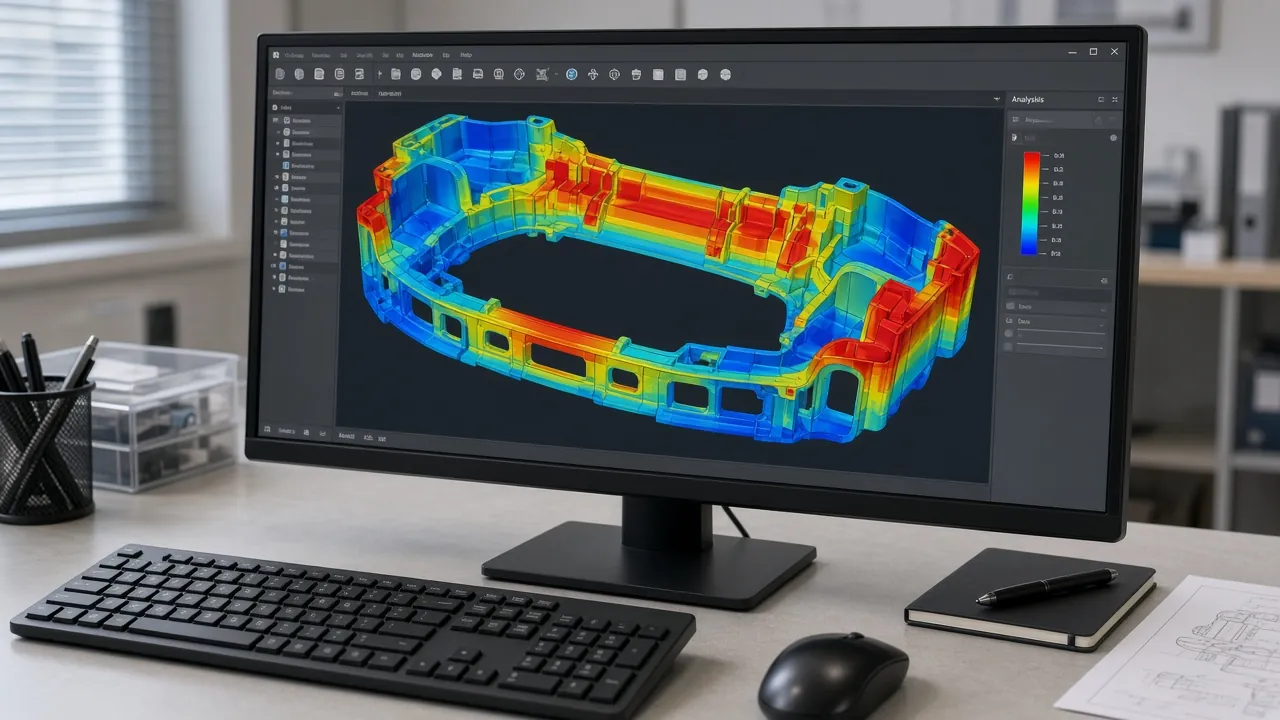
DFM wall-thickness analysis of an exterior plastic part on a monitor

Keep wall thickness uniform

Thick and thin areas cool at different speeds, which causes sink marks and warpage. Keep walls as even as possible and core out thick sections. Change thickness gradually rather than in a step.

Add draft to vertical walls

Draft is a small taper that lets the part release from the mold. Smooth surfaces need less draft than textured surfaces, because texture grips the steel. Deep textures need extra draft, which we confirm against the texture you choose.

Design ribs and bosses correctly

Ribs add stiffness without making walls thick. A rib that is too thick shows as a sink mark on the visible face. Clip towers and screw bosses should connect to walls with ribs rather than solid plastic.

Plan clips and fasteners early

Exterior trim often uses clips or tape. Clip features need room for slides or lifters in the mold. Deciding fixing points early avoids expensive mold changes.

Choose gate locations with the finish in mind

The gate is where plastic enters the part. Gate marks and weld lines should sit on hidden faces, or where paint or texture can cover them. On painted or chrome plated parts this matters even more.

Allow for shrinkage and warpage

Every plastic shrinks as it cools, and long thin parts tend to bow. Mold flow analysis, rib layout and cooling design help keep a side skirt or spoiler straight enough to fit the car.

07 — Explainer

Mold Flow Analysis and DFM Before Steel Is Cut

Mold flow analysis is a computer simulation of how molten plastic fills, packs and cools inside the mold. It is run during DFM, before the mold steel is cut, so problems are fixed on screen instead of in a hardened tool. For long exterior parts such as side skirts, spoilers and bumper trim, it is one of the most useful checks in the whole project.

What the simulation looks at

  • Fill. How the melt front moves through the cavity, where it fills last, and whether any thin area risks a short shot.
  • Pack. How much pressure is needed to pack the part, and whether thick areas can be packed out before the gate freezes.
  • Cool. How evenly the part cools, and where hot spots in the mold may slow the cycle or cause distortion.
  • Warp. A prediction of how the part will bend or twist after ejection, based on shrinkage, fiber or flow direction and cooling.

Gate location and gate count

Gate position decides how the part fills, where weld lines appear and how it warps. On a visible gloss black part, gates are placed on hidden faces or edges, and on long parts several gates or a hot runner with sequential valve gates may be compared in the simulation.

Want risks found before steel is cut?Send your 3D file and we will review gates, wall thickness and shrinkage with a DFM report before injection molding tooling starts.

08 — Explainer

Defects Mold Flow Helps Predict

The simulation flags the defects below before the mold exists, so the fix is a design change rather than a tool correction.

RiskWhat the analysis showsTypical fix in design
Weld linesWhere two flow fronts meetMove the gate or add a flow leader so lines fall on hidden or painted faces
Sink marksThick areas that shrink after the surface setsCore out thick sections, thin ribs and bosses
WarpageUneven shrinkage along the partChange gate position, rib layout or cooling channels
Air trapsPockets the melt closes aroundAdd venting at the predicted spots
Short shotsAreas that fill last at low pressureAdjust wall thickness or add gates
Gate blush and jettingHigh shear near the gateChange gate type or size
09 — Explainer

From Simulation to the T1 Mold Trial

Results from the analysis go straight into the mold design and are checked again on the first trial shots.

  1. 01

    Part review

    Wall thickness, draft and ribs are checked against the material.

  2. 02

    Simulation

    Fill, pack, cool and warp are run with the planned gates.

  3. 03

    Design changes

    Gates, ribs, venting and cooling are adjusted on the CAD and mold design.

  4. 04

    Mold build

    The mold is built to the reviewed design.

  5. 05

    T1 trial

    First shots are compared with the predicted weld lines, sink and warpage.

  6. 06

    Correction

    Steel is adjusted where needed before the next trial and sample approval.

Simulation does not replace a mold trial, but it reduces the number of corrections after T1. Results and the agreed changes are shared with you in the DFM report.

10 — Explainer

Materials for Injection Molded Exterior Parts

The right resin depends on where the part sits on the vehicle, whether it will be painted or plated, and how much impact and sunlight it must handle. These are the materials we mold for exterior parts.

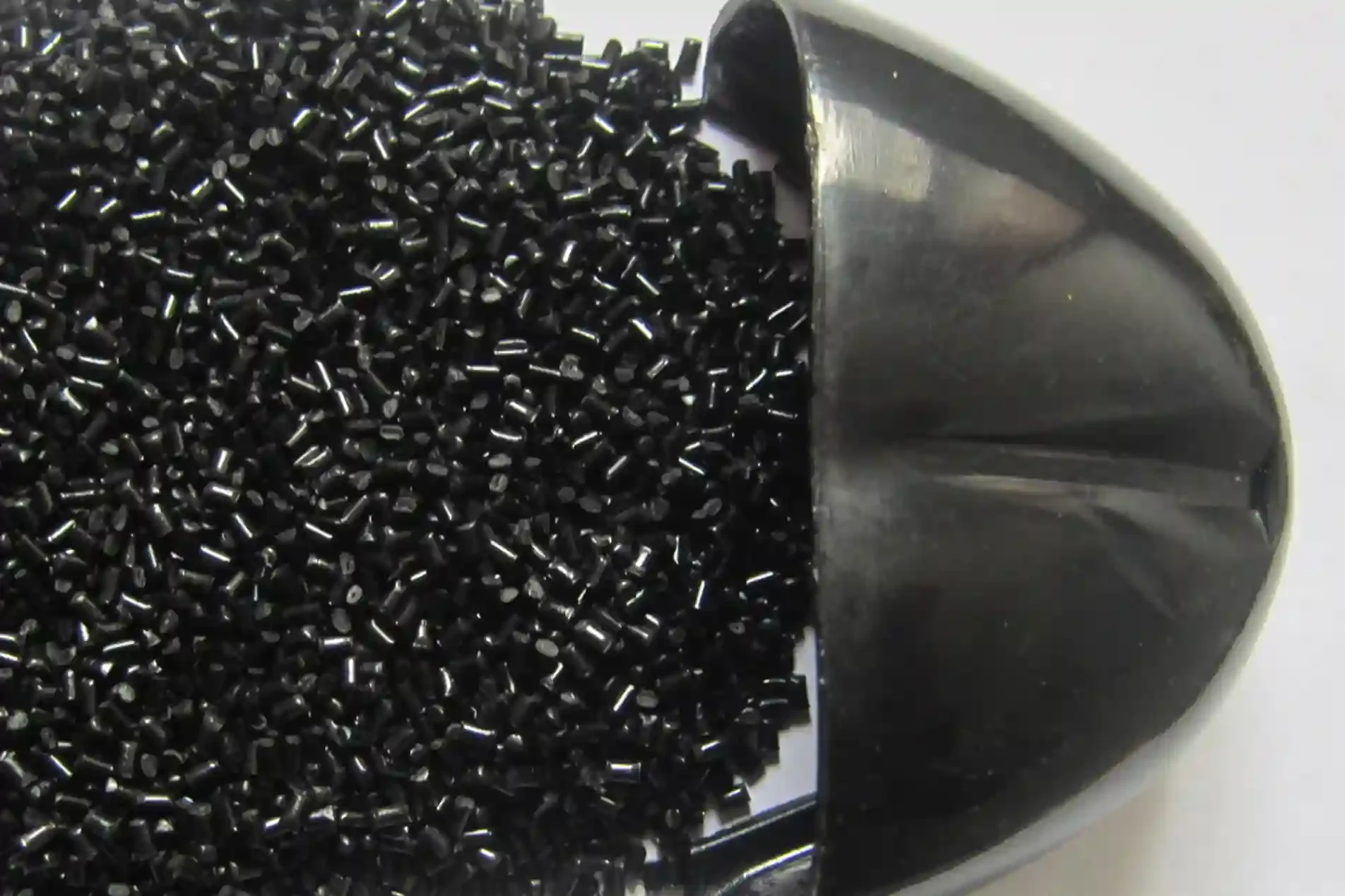
Black plastic resin pellets beside a gloss black molded part
MaterialTypical exterior usesNotes
ABSSpoilers, grilles, mirror housings, trimRigid and easy to paint; plating-grade ABS is used for chrome plated parts
PP and modified PPBumper trim, fender flares, mud flapsTough and flexible; needs surface treatment and primer before painting
TPOFlexible exterior trimGood impact resistance in cold weather
ASATrim left in molded blackBetter UV resistance than ABS for unpainted parts
PCClear or tough partsHigh impact strength; often used in two-shot with PMMA
PC/ABSHousings and structural trimBalance of toughness and heat resistance; not suitable for chrome plating
TPE and TPUSecond shot in 2K or overmoldingSoft seals, grips and edges bonded to ABS, PC/ABS or PC

If you are unsure which material to choose, send us the part function and the market it will be sold in. We will suggest a resin and finish in the DFM report.

11 — Explainer

Tolerances and Dimensional Accuracy

Exterior parts must fit the vehicle and line up with nearby panels. These are the accuracy levels we work to on molded exterior parts.

FeatureTolerance
General dimensions±1.0 mm
Critical features (clip points, mating edges)±0.5 mm
Seams and gaps between mating parts±0.1 mm
Part weight±1 g, with unit-to-unit variation of 0.3% or less

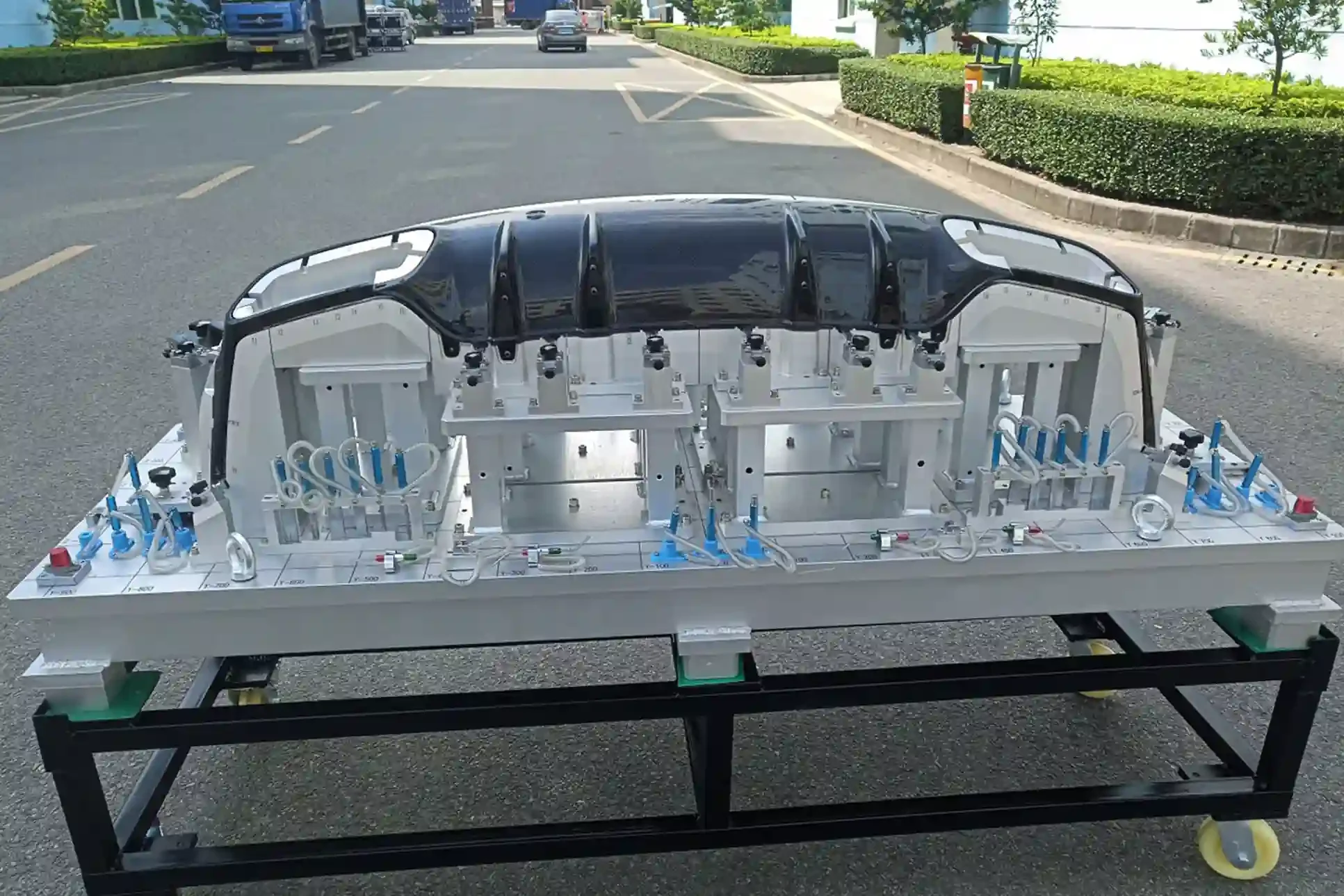
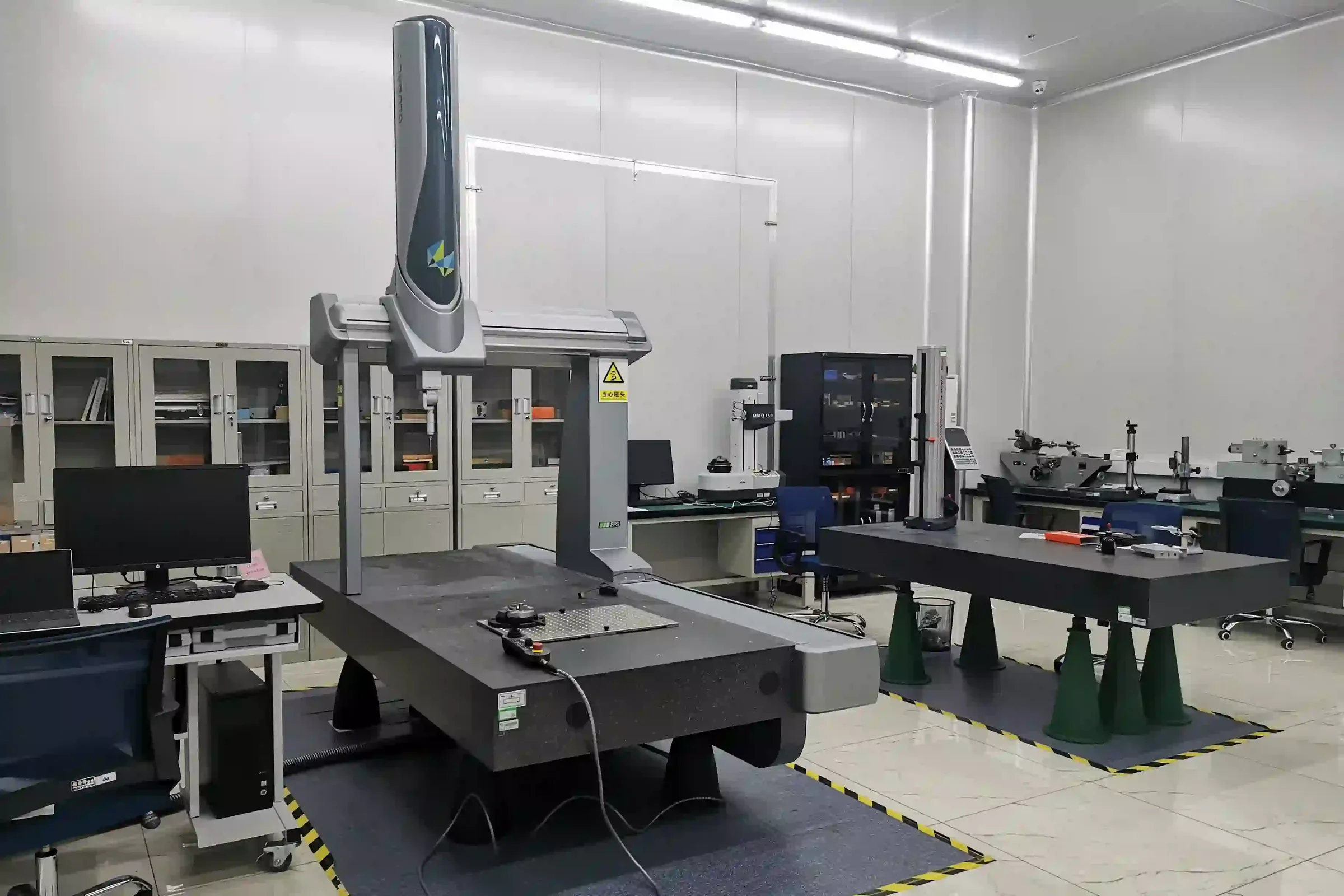
Critical features are agreed with you during DFM and marked on the inspection plan. They are checked by CMM at first article and by checking fixture during production. See our quality inspection and CMM page for how we measure.

12 — Explainer

Molded-in Finish vs Painted vs Chrome Plated

Many exterior parts can be finished straight from the mold. Others need paint or chrome. Choosing early affects material, gate location and texture.

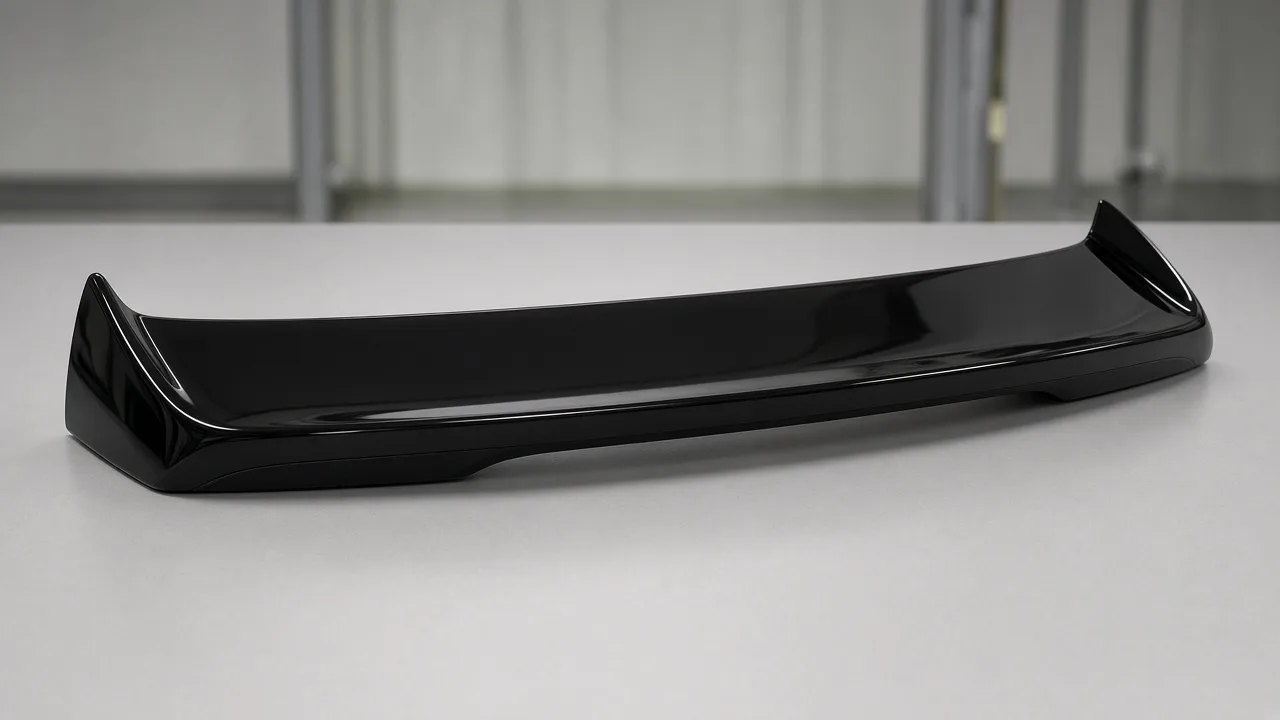
Gloss black injection-molded rear spoiler shown full length on an inspection table
Gloss black injection-molded rear spoiler

Molded-in color and texture

The part comes out of the mold in black or another color, often with a grained texture. This is common for trim and fender flares in ASA, PP or TPO. It is the lowest-cost finish.

Painted

Gloss black, body color or other colors are sprayed in our paint shop. Painted parts need clean, sink-free surfaces. Read more on our painting and surface finishing page.

Chrome plated

Grille bars, badges and trim can be chrome plated on plating-grade ABS. The part design and material must suit plating from the start. See chrome plating on plastic.

13 — Explainer

Common Injection Molding Defects and How We Prevent Them

Most defects come from part design, mold design or process settings. We review the risk in DFM and confirm the fix during mold trials.

Gloss black rear diffuser clamped on a checking fixture for dimensional inspection
DefectWhat it looks likeHow we prevent it
Sink marksShallow dents over thick areas or ribsEven wall thickness, correct rib ratio, adequate packing pressure
WarpageLong parts bow or twistBalanced cooling, rib layout, mold temperature control
FlashThin plastic film at the parting lineCorrect clamp force, mold fit and maintenance
Weld linesVisible line where melt fronts meetGate position, melt and mold temperature
Short shotsPart not fully filledGate size, venting, injection speed
Splay or silver streaksSilver streaks on the surfaceResin drying with desiccant dryers
Gloss variationUneven shine across the partStable mold temperature and polish
14 — Explainer

Exterior Parts We Mold

These are the exterior parts we mold most often, grouped by machine size.

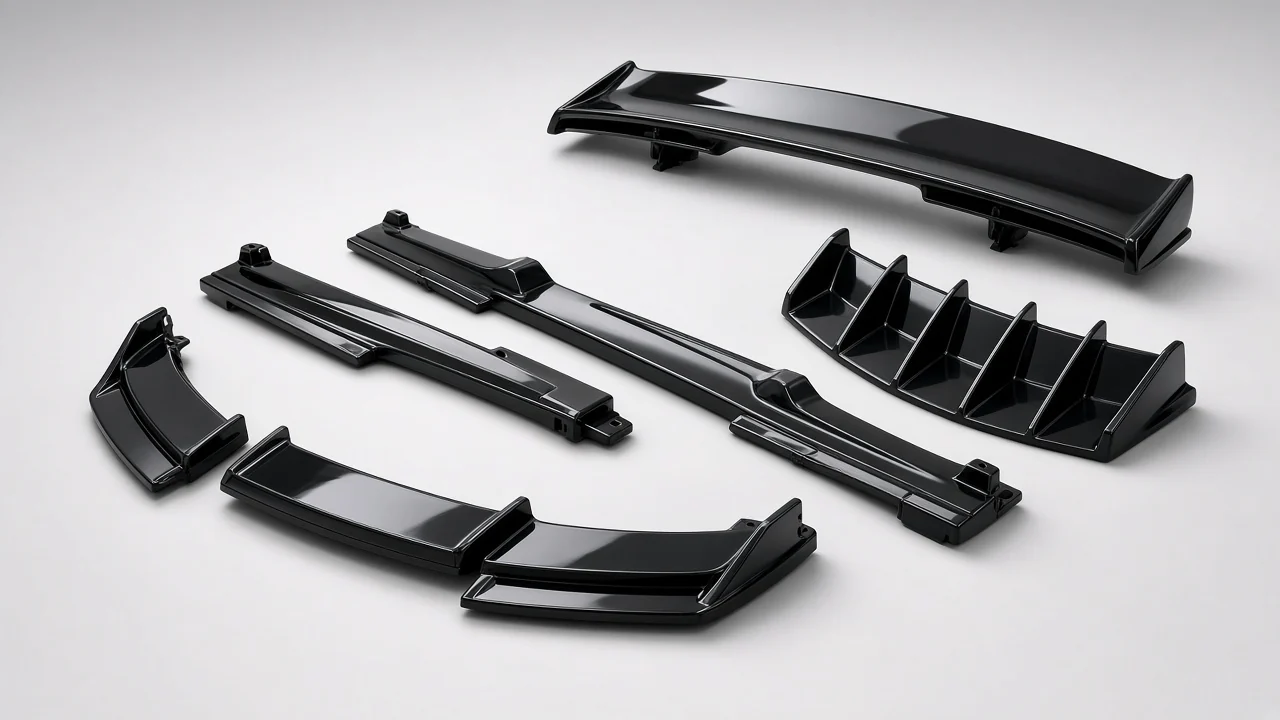
Gloss black front lip, spoiler, side skirts and rear diffuser

Clips, brackets and small trim

Small parts that hold larger parts in place or finish an edge. They run on 90–250 t machines, often in multi-cavity molds.

Grilles and mirror housings

Visible parts with fine detail and good surface quality. Many are painted gloss black or chrome plated after molding. They run on 250–450 t machines.

Door handle covers

Small visible covers that are often painted or chrome plated. Surface quality and fit to the handle are checked closely.

Fender flares and side skirts

Long parts where straightness and fit matter. They run on 450–800 t machines with careful cooling design to control warpage.

Spoiler bodies and front lips

Styling parts with large visible surfaces, usually painted. Front lips run on 800–1,300 t machines.

Bumper trim and large rear spoilers

The largest parts we mold, on 1,300–2,500 t two-platen machines.

15 — Service

Who Uses Our Injection Molding Services

We mold exterior parts for automotive brands, aftermarket brands and distributors. Some buyers bring a finished design; others need help from the first sketch.

Operator handling a black injection-molded bumper part beside a molding machine

Aftermarket brands

Body kits, spoilers, lips and trim for vehicle-specific product lines, often combined with our vehicle-specific development service.

OEM and ODM programs

Molded parts built to your drawings and standards, with PPAP documents. See OEM and ODM auto parts.

Distributors and private label

Repeat supply of molded and finished parts under your brand, packed for retail or warehouse. See private label and packaging.

16 — Service

What You Get When You Work With Us

DFM report

Comments on wall thickness, draft, gates, parting lines and texture before steel is cut.

Mold built in-house

Our mold shop builds and maintains the tool. See tooling and sampling.

Trial samples

T1 samples for fit and finish checks, with changes until approval.

FAI and CMM data

First article inspection against your drawing before production.

PPAP up to Level 3

When your program requires it.

Finishing in the same factory

Painting and chrome plating without shipping parts between suppliers.

17 — Service

From Drawing to Production: Our Workflow

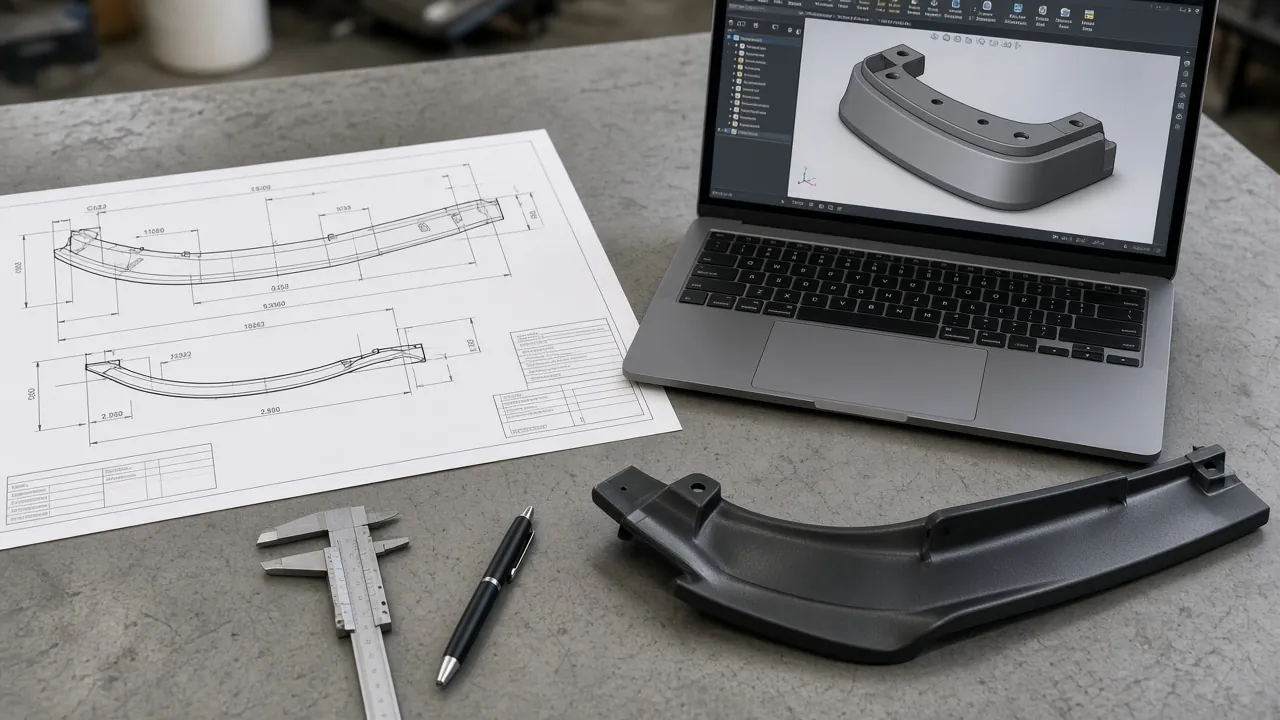
Technical drawing, 3D CAD model and front lip sample with calipers
  1. 01

    Quote and NDA

    You send 3D data or a sample. We sign an NDA if needed and quote the mold and part price.

  2. 02

    DFM review

    Our engineers send a DFM report and agree material, finish and critical features with you.

  3. 03

    Mold build

    The mold is built in our mold shop and checked before the first trial.

  4. 04

    T1 sampling

    First trial parts are molded, measured and sent for your review and test fit.

  5. 05

    Approval and FAI

    After any changes, final samples are approved with FAI, CMM data and PPAP if required.

  6. 06

    Production

    Process settings are locked and parts run with in-process checks, finishing and packing.

18 — Service

What to Send for an Injection Molding Quote

A complete request gets a faster and more accurate quote. If you do not have everything, send what you have and we will tell you what is missing.

  • 3D CAD files (STEP or IGES) and 2D drawings with tolerances
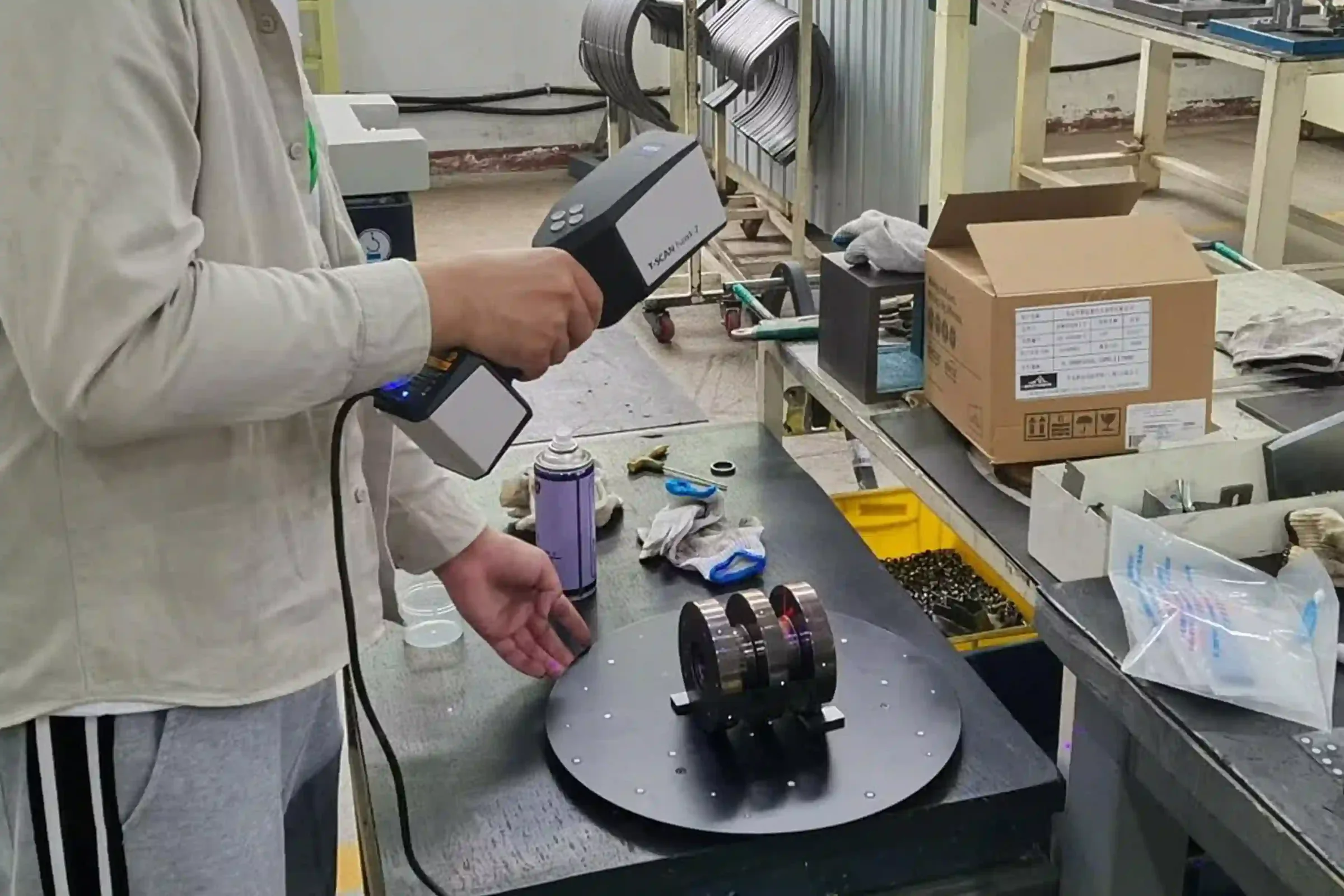
  • A sample part, if there is no CAD; we can 3D scan it
  • Material, color and finish requirements
  • Annual quantity and expected order size
  • Target market and any test standards
  • Packaging and labeling needs

Order quantity: we offer low MOQ on selected items. The exact quantity depends on the part, material and finish and is confirmed in your quote.

Have your injection molding files ready?Send them with the target quantity and we will quote plastic injection molding tooling and parts.

19 — Service

What Drives Injection Molding Cost

Buyers often ask why two similar-looking parts have different prices. These are the main cost drivers, in order of impact.

Cost driverWhy it matters
Mold size and complexitySlides, lifters and large steel blocks add machining time
Number of cavitiesMore cavities cost more up front but lower the part price
Part size and tonnageLarger machines cost more per hour
Cycle timeThick walls cool slowly, which lowers output per hour
MaterialEngineering resins such as PC/ABS cost more than PP
FinishPainting or chrome plating adds process steps and inspection
QuantitySet-up and inspection costs are shared across more parts

You can lower cost by keeping walls even, avoiding undercuts where possible and choosing molded-in finishes for hidden or textured parts. We point out these savings in the DFM report.

20 — Service

Choosing an Injection Molding Manufacturer in China

Many buyers search for an injection molding company in China because of cost and supply chain depth. Price is only part of the decision. These are the questions worth asking any supplier, including us.

Yirox headquarters and factory building in Wuxi, China
  • Does the factory own its molding machines, or subcontract molding?
  • Is there an in-house mold shop for repairs and changes?
  • Which tonnage range is available for your largest part?
  • Is painting or plating done in-house or by another company?
  • Which certifications does the quality system hold?
  • Can the factory supply FAI, CMM reports and PPAP documents?
  • Will they sign an NDA and agree mold ownership in writing?

At Yirox the answer to the first five is in-house: molding, mold shop, painting and chrome plating are all run in our own factory in Wuxi. Our quality system is certified to ISO 9001 and IATF 16949, and we supply FAI, CMM data and PPAP up to Level 3.

Processes we do not run ourselves, such as sheet metal and aluminum die casting, are handled by partner factories that we manage.

21 — Capability

Our Injection Molding Machines

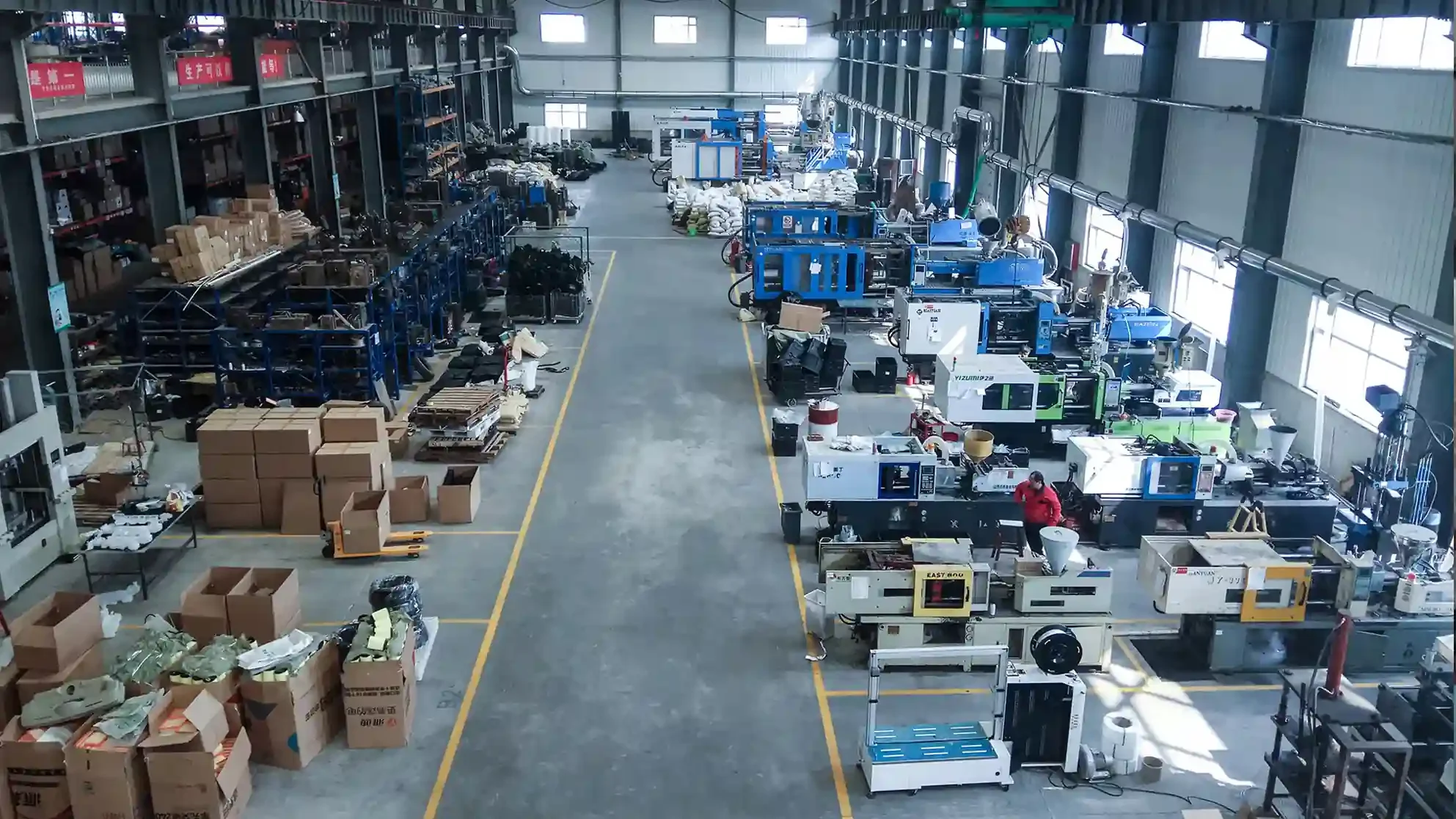
We run 42 injection molding machines with clamp force from 90 to 2,500 tons. Each tonnage group is matched to the size of the parts it molds.

Overhead view of the Yirox injection molding hall with molding machines and parts storage
Clamp forceMachinesTypical parts
90–250 t12Clips, brackets, small trim strips
250–450 t11Grilles, mirror housings, door handle covers
450–800 t10Fender flares, side skirts, spoiler bodies
800–1,300 t5Front lips, large trim panels
1,300–2,500 t (two-platen)4Bumper trim, large rear spoilers
22 — Capability

Two-shot Molding, Automation and Auxiliary Equipment

Consistent parts come from more than the molding machine. Robots, temperature control and dry resin all reduce variation.

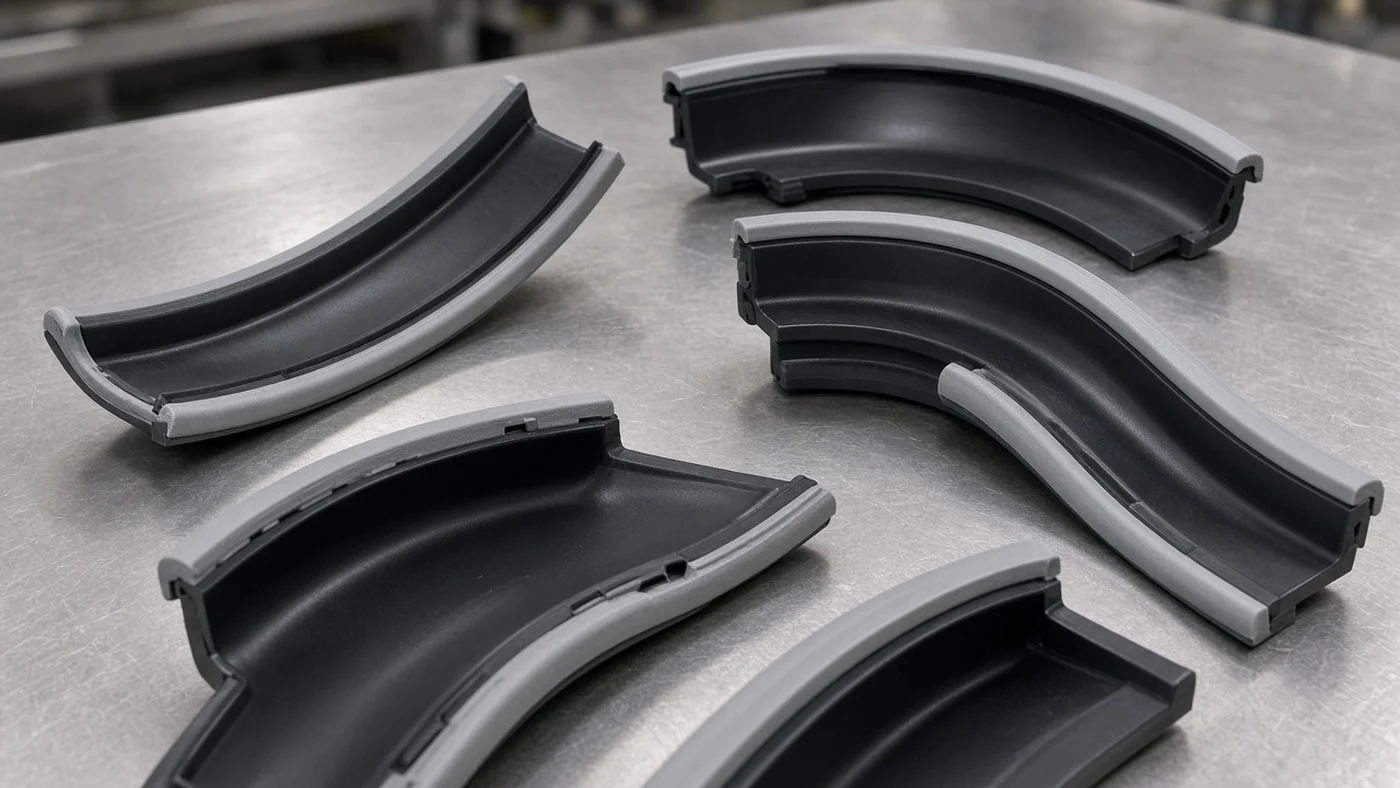
Two-shot molded parts with a rigid black body and soft grey TPE edge
EquipmentQuantity and details
Two-shot machines280 t rotary-table, 380 t rotary-table, 530 t rotary-core
2K material combinationsPC+PMMA, ABS+TPE, PC/ABS+TPU
Take-out robotsOn all 42 machines: 30 three-axis, 12 five-axis
In-mold monitoring6 machines
Mold temperature controllers46
Central chiller units8
Desiccant dryers30
ShiftsTwo shifts, 16 hours per day
Monthly outputAbout 1.5 million parts, 520 t of resin

Robots remove every part the same way, at the same time in the cycle, which keeps cooling and handling consistent. In-mold monitoring on selected machines watches each shot so a bad cycle is caught early.

23 — Capability

Mold Shop and Machining Support

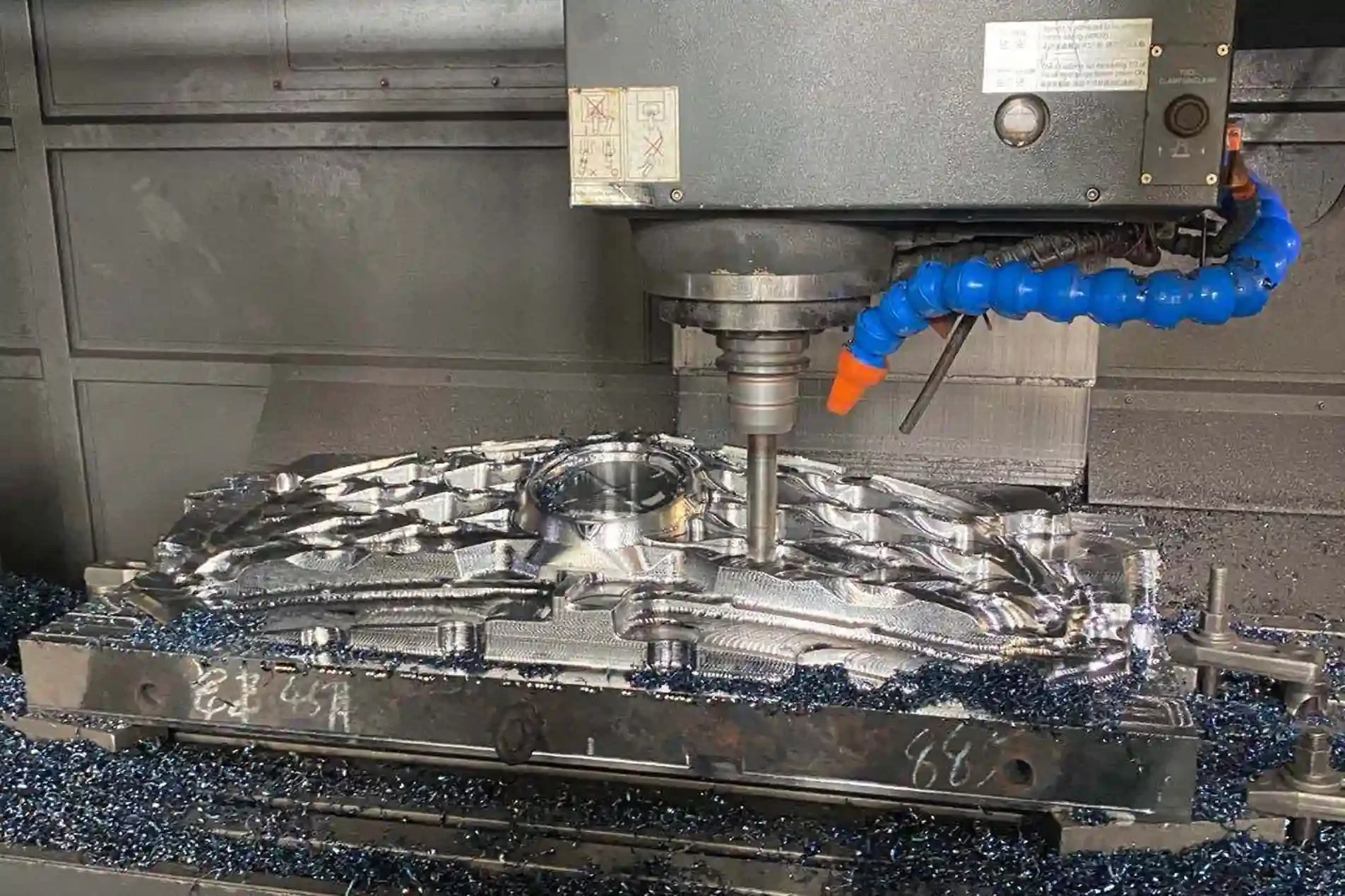
Our mold shop is in the same factory as molding, so tool changes and repairs are fast. It builds 6–8 molds per month, handles molds up to 25 t and uses P20 and H13 steel, with mold life of 300,000–500,000 shots depending on the steel and part.

The mold shop is supported by four 3-axis machining centers (800×500×500 mm, ±0.01 mm), two CNC lathes, two engraving-milling machines, two wire EDM machines, two EDM machines and two surface grinders. Our fixture shop builds checking fixtures with MSA %GRR of 10% or less. See tooling and sampling for how molds are developed and approved.

CNC machining center milling a steel injection mold cavity
24 — Capability

Quality Control for Molded Parts

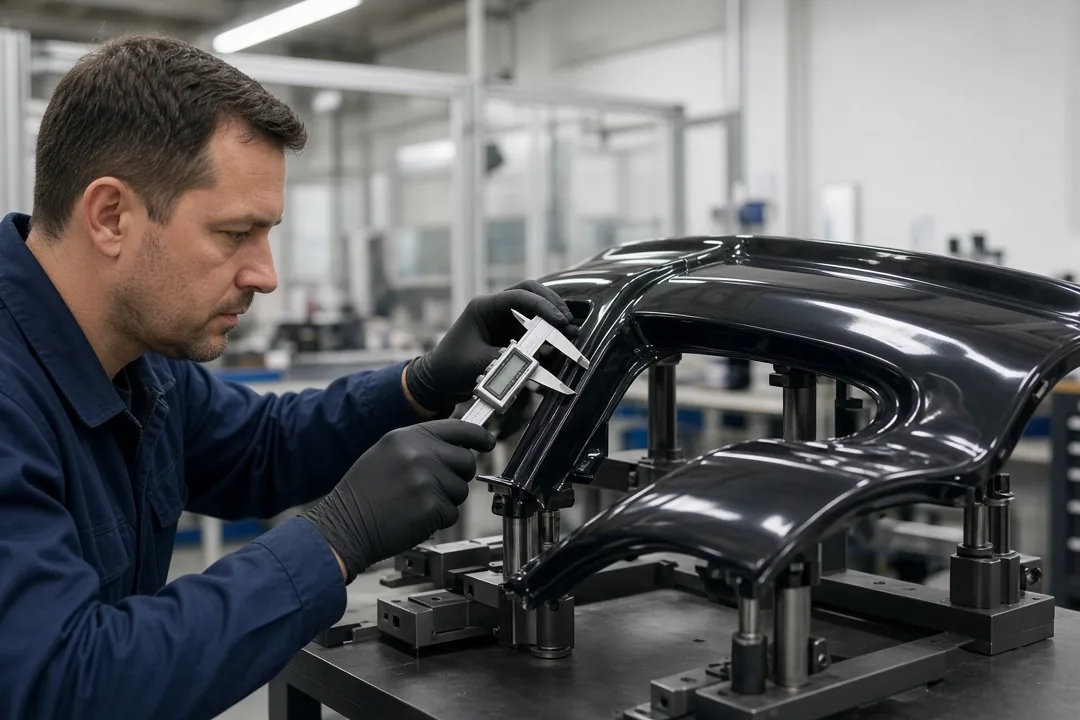
Every molded program has an inspection plan agreed with you. First articles are measured on our CMMs, production parts are checked on checking fixtures, and appearance is checked against an approved sample.

Inspector measuring a gloss black exterior part on a checking fixture
  • First article inspection (FAI) on the first approved samples
  • CMM measurement of critical features
  • Checking fixtures for fit during production
  • Part weight checks against the ±1 g limit
  • Appearance checks for sink, flash, weld lines and gloss
  • PPAP up to Level 3 when required

Our quality system is certified to ISO 9001 and IATF 16949. See our certifications.

FAIFirst article inspection
CMMCoordinate measuring machine records
PPAPUp to Level 3
NDASigned before drawing review
25 — Capability

Why Buyers Choose Yirox for Injection Molding

Range of tonnage

90 to 2,500 t covers small clips to bumper trim in one factory.

Finishing under one roof

Painting and chrome plating are in-house.

In-house tooling

Mold changes are handled by our own mold shop.

Documented quality

IATF 16949, FAI, CMM and PPAP up to Level 3.

Factory-direct from Wuxi

About 20,000 m² factory and partner factories for other processes.

Export experience

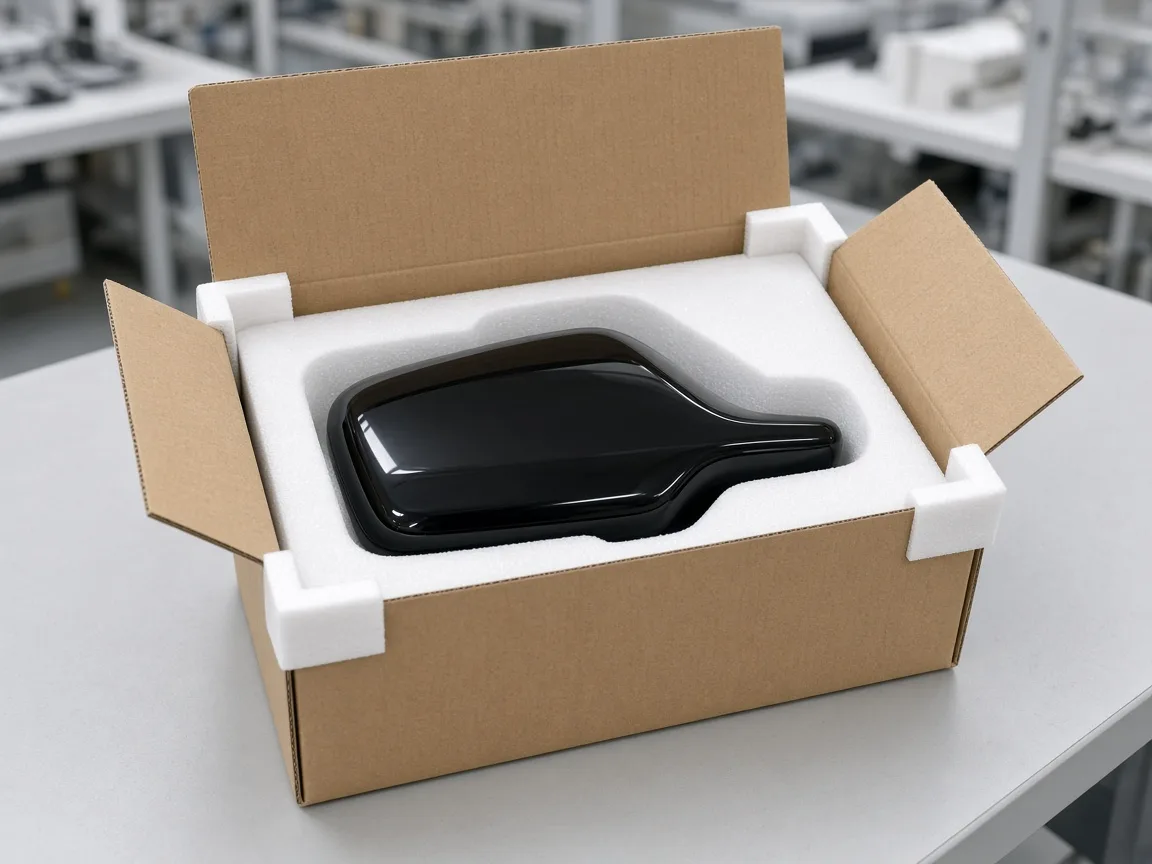
Packing and documents for overseas buyers.

What Buyers Say About Our Injection Molding

Buyers on the issues we flagged before tooling and how production held up.

“We started with one spoiler mould to test them. They flagged a weld line position in our drawing before quoting, which our previous supplier had missed. Three containers later, they are still quoting the same lead time they actually hold. Not the cheapest quote we received — the only one we stopped re-checking.”
Purchasing ManagerFrom first order to repeat orders
“We had been through a frustrating mold project with another supplier, so we were cautious this time. Having the sample inspection records and dimensions available made a real difference. We could review the actual parts instead of relying on promises.”
Technical Purchasing ManagerTooling and Sample Approval

Names and companies withheld at the customer’s request.

27 — FAQ

FAQ

How much does it cost to have something injection molded?

Cost has two parts: the mold and the price per part. The mold cost depends on part size, complexity, number of cavities and steel. The part price depends on material, cycle time, finish and quantity. Send us your CAD or a sample and we will quote both.

What is the difference between custom injection molding and standard parts?

Custom injection molding makes a part to your own design, using a mold built for that part. Standard parts come from existing molds. Most of our work is custom molding of exterior parts.

What tonnage do I need for my part?

Tonnage depends mainly on the projected area of the part and the material. Small clips run on 90–250 t machines, while bumper trim and large rear spoilers need 1,300–2,500 t two-platen machines. We choose the machine during DFM.

Can you do two-shot injection molding?

Yes. We have three two-shot machines (280 t, 380 t and 530 t) and mold combinations such as PC+PMMA, ABS+TPE and PC/ABS+TPU.

What tolerances can you hold on molded parts?

Our standard is ±1.0 mm, with ±0.5 mm on critical features and ±0.1 mm on seams. Part weight is held to ±1 g.

Who owns the mold?

Mold ownership is agreed in the quote and contract for each project. See our tooling and sampling page for details.

What is your minimum order quantity?

We offer low MOQ on selected items. The quantity for your part is confirmed in your quote.

What is DFM in injection molding?

DFM means design for manufacturing. It is a review of your part design before the mold is built, checking wall thickness, draft, ribs, gates, parting lines and texture so the part molds cleanly and fits. Every Yirox mold starts with a DFM report.

Can you injection mold PC and PC/ABS parts?

Yes. We mold PC and PC/ABS as well as ABS, PP, modified PP, TPO and ASA. PC/ABS is not suitable for chrome plating; plated parts use plating-grade ABS.

Do you sign an NDA?

Yes. We can sign an NDA before you share drawings or samples.

Get an Injection Molding Quote

Send your CAD files, drawings or a sample part. We will reply with a DFM review and a quote for the mold and parts.

Request a Quote

Tell us the part, vehicle and quantity. An engineer replies by email.

Tell Us About Your Sourcing Project