



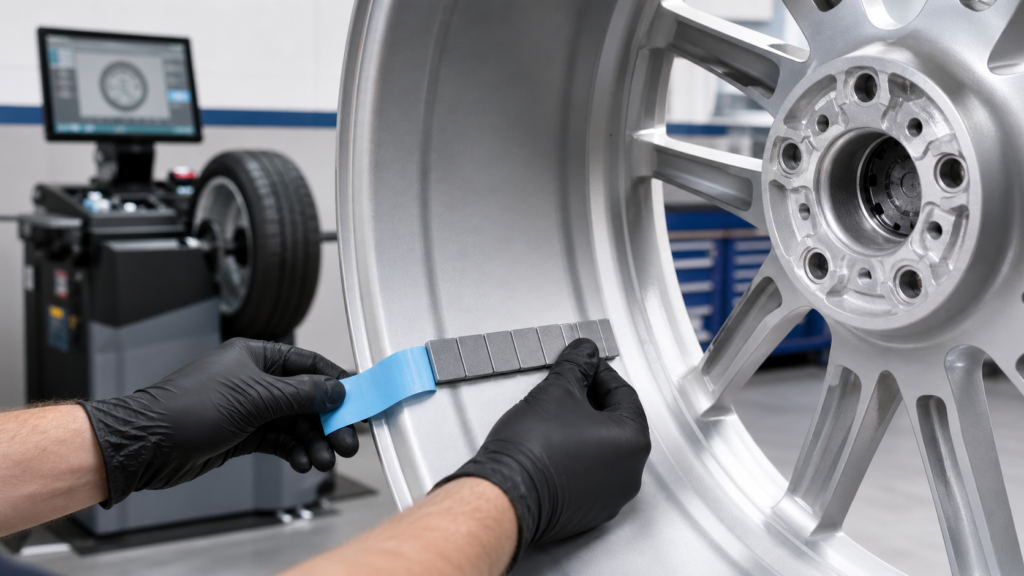
Stick-on wheel weights suit an alloy wheel when the strip fits its landing surface, clears nearby components, and uses tape compatible with the finish. Choose the correction mass and position from the balancer.2 Check the actual strip dimensions and follow its cleaning, temperature, and pressure instructions before installation.13
Table of Contents
- How do you choose stick-on weights that clear brake calipers?
- Segment size and correction mass
- Balancer-directed placement
- Preparing a coated wheel surface
- Product-specific temperature and pressure
- Installing and checking the selected strip
- Why do stick-on wheel weights keep falling off?
- What dimensions should you request for low-profile wheel weights?
- Conclusion: Approve the strip on the intended wheel
- Frequently Asked Questions
- References
How do you choose stick-on weights that clear brake calipers?
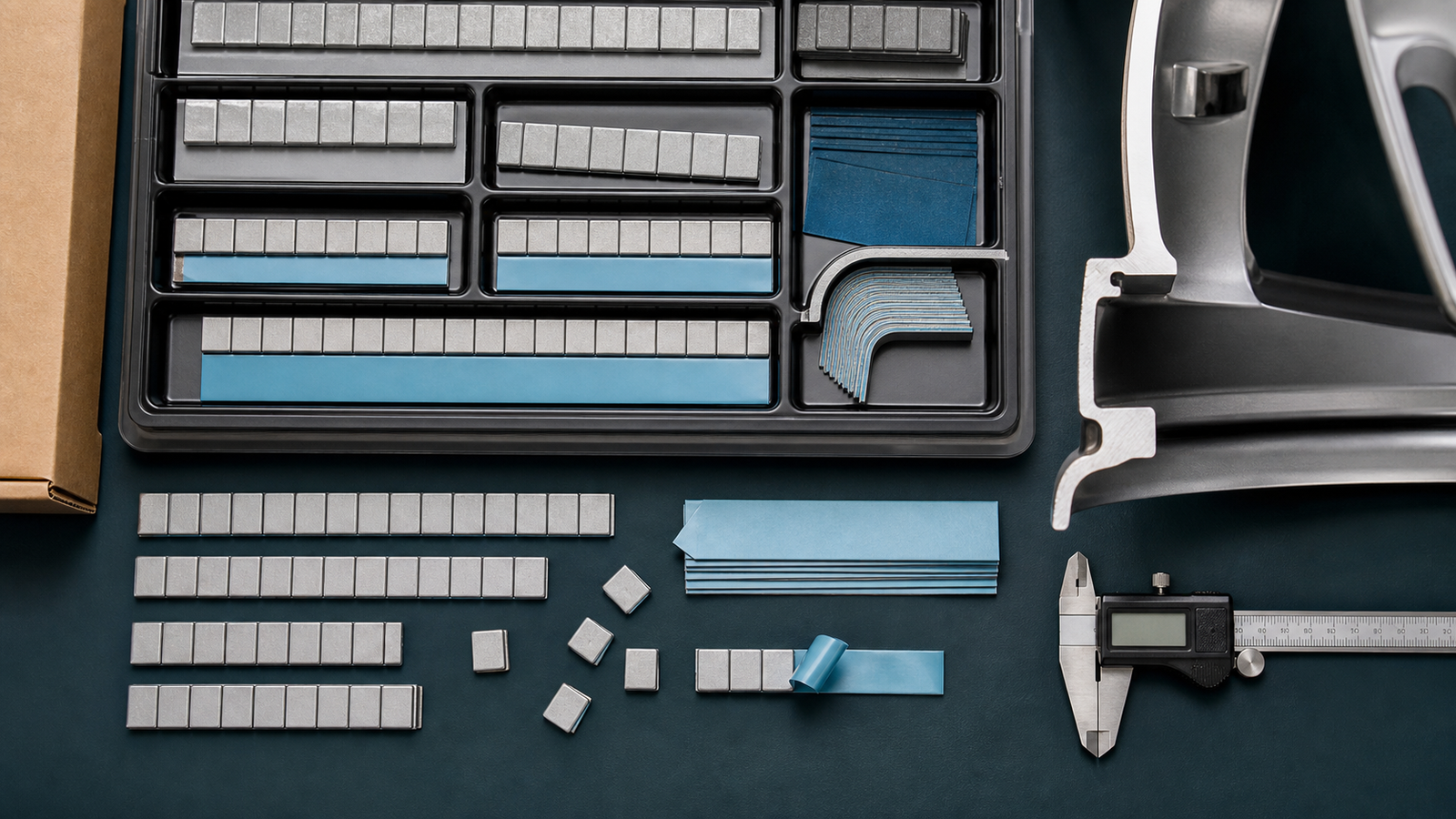
Compare the strip's complete installed height, including tape, with the available clearance at the intended position. Check its footprint against the wheel's landing area as well. A strip bridging a ridge is a fitment problem even if its mass is correct.1
Before selecting a sample, record these dimensions and observations:
| Check | Information to record | Reason to pause selection |
|---|---|---|
| Landing surface | Usable width, curvature, ridges, and finish condition | Part of the adhesive would sit unsupported |
| Strip footprint | Width and length of the required segment group | The selected group extends beyond the usable area |
| Installed profile | Weight-body height plus tape thickness | Clearance cannot be confirmed with the complete strip |
| Nearby components | Brake, spoke, and other relevant clearances at the intended position | Contact or uncertain clearance |
| Product instructions | Approved surfaces and application limits | Compatibility with the wheel finish is unconfirmed |
Ask for a drawing that states whether the quoted thickness includes tape. “Low profile” alone leaves that unanswered. Use a liner-on sample to check the intended location before bonding, and follow the vehicle or wheel service procedure for clearance verification.
If the attachment type is still undecided, start with choosing wheel weights for OEM alloy wheels.
Segment size and correction mass
Use segments in the balancer's displayed unit system that can provide its requested correction. Calculate the number of segments, then check the length of that group against the wheel. A strip's total mass describes the supplied product, not the amount every wheel needs.
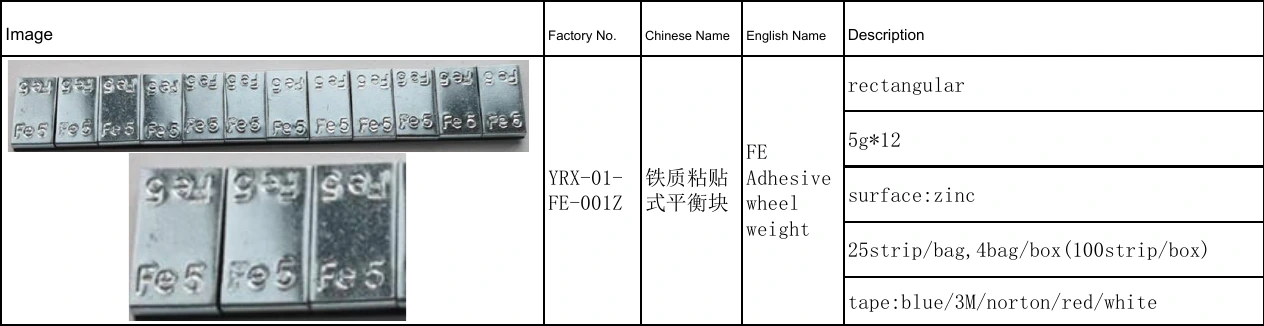
The Yirox catalog identifies YRX-01-FE-001Z as an FE adhesive configuration with a zinc finish and 5g × 12 segments. The nominal full-strip mass is therefore 60g. “Zinc finish” describes the surface treatment here, not a zinc weight body.
A 5g segment calculation
Calculation example only: if the machine requests 35g at one identified position, a 5g-per-segment strip supplies that nominal amount with seven segments. The values below illustrate arithmetic, not a test result or a recommended correction for your wheel.
| Nominal correction requested | 5g segments needed | Remaining segments from one twelve-segment strip |
|---|---|---|
| 20g | 4 | 8 |
| 35g | 7 | 5 |
| 60g | 12 | 0 |
Measure the selected group's actual length, including the relevant segment spacing. A seven-segment group still needs a fit check; a 35g calculation doesn't prove that it clears the brake assembly.
If the requested amount cannot be assembled from the available increments, follow the balancer's rounding or alternative-weight procedure. Don't arbitrarily change its target. For format differences, compare segmented strips and continuous wheel-weight rolls; use the wheel weight size chart for broader unit comparisons.
Balancer-directed placement
Place them at the correction plane and angular position indicated for the selected balancer program. If weights need to be hidden behind spokes, use the machine's supported split or spoke-placement function; Hunter documents these as calculated placement features.2
Record the program, indicated correction, and location before applying the strip. If that location has inadequate clearance or contact area, reassess the strip or use the machine's permitted placement adjustment. Check the new calculation before bonding.
Don't relocate a strip by eye merely to hide it. A visually discreet location is acceptable only when it also matches the selected balancing procedure and the wheel's physical constraints.
Preparing a coated wheel surface
Remove old tape residue and contamination using a cleaner compatible with the wheel coating and selected tape. Wipe away the loosened residue and leave the area dry before bonding. Wheel-weight cleaning guidance identifies oil, brake dust, and tape residue as relevant contaminants.4
Confirm cleaner compatibility before use; HOFMANN specifies a cleaner suitable for the wheel's varnish.3 Follow its label and the wheel-finish instructions rather than assuming any brake cleaner or abrasive is suitable.
Use a fresh cloth for the final wipe. Stop if the landing area has loose paint or a damaged coating requiring repair. Protect the prepared area from tire lubricant and dirty gloves, and keep the liner on the strip until it is ready to be installed.
Product-specific temperature and pressure
Use the selected product's documented application requirements for both the wheel and the weight. Check installation temperature separately from service temperature, and obtain the required pressure method and any time restriction before releasing the assembly.
Published instructions show why one universal temperature is misleading:
| Identified system | Published application-temperature instruction |
|---|---|
| 3M Wheel Weight System, January 2026 guidelines | Both wheel surface and weight material: 15–43°C (60–110°F).1 |
| HOFMANN POWER WEIGHT adhesive-weight assembly guidance | Processing temperature must not be below 10°C (50°F), with additional surface requirements.3 |
These are instructions for the named systems, not specifications for Yirox strips. Ask for the guidance covering the exact tape supplied with your sample. A tape brand name doesn't identify the adhesive construction or establish wheel-finish compatibility.
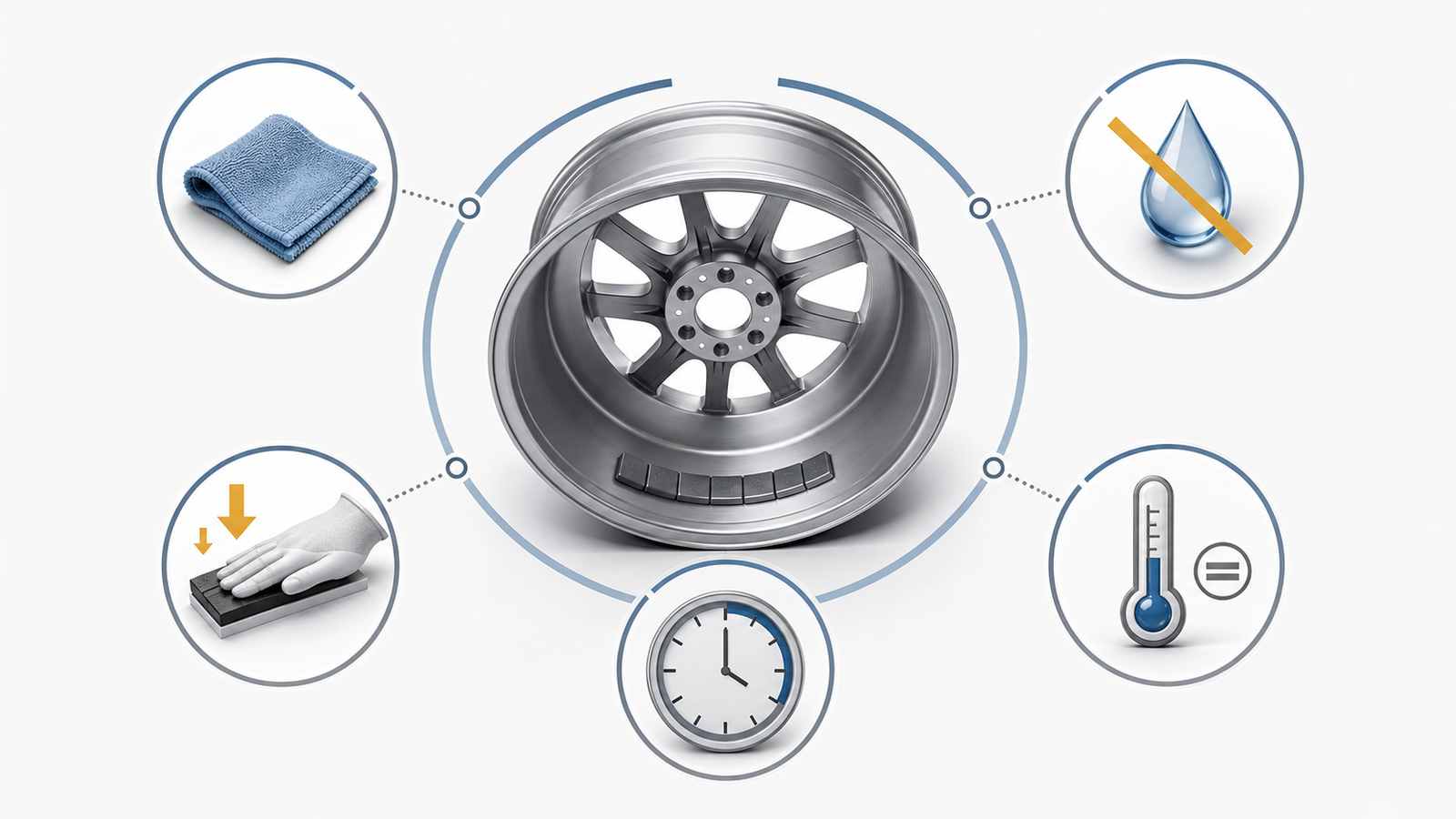
Apply pressure over the full strip, including its edges, using the specified method. 3M calls for pressure conditions to be evaluated for the application and identifies adhesive contact as the determining factor.1 Ask the supplier to distinguish application instructions from the later retention test: neither a quick hand pull nor a balancer check spin establishes long-term retention.
Installing and checking the selected strip
Prepare the measured correction, confirm its fit with the liner intact, clean the wheel, and attach it at the machine-indicated position. Complete the product's pressure procedure, then perform the balancer's check spin.23
- Select the program and correction. Record the indicated mass, unit, and position.
- Check the sample. Confirm configuration, segment count, footprint, and complete installed height.
- Prepare the surface. Use the compatible cleaning method described above.
- Fit the strip to the curve. Where its instructions require pre-bending, do so with the liner intact; avoid forcing segment joins.3
- Remove the liner and bond. Avoid touching the exposed tape; complete the specified pressure procedure across the strip.4
- Verify the assembly. Check seating, clearance, and the final balance using the applicable service and machine procedures.
Why do stick-on wheel weights keep falling off?
Check surface contamination, coating compatibility, installation temperature, pressure, and whether the strip bridges a wheel feature. These are identified application checks in 3M's wheel-weight guidance.1 A new-looking wheel still needs the specified surface preparation.
If the strip lifts or detaches repeatedly, identify the failed condition before replacing it. Use the separate explanation of why adhesive wheel weights fall off for the full diagnostic procedure.
What dimensions should you request for low-profile wheel weights?
Request the total installed height including tape, strip width, and length of the segment group needed for the correction. Confirm the drawing's measurement definitions and check a sample against the actual wheel; “low profile” alone doesn't establish clearance.
Include the wheel application, intended location, available landing dimensions, required mass increments, and body material in the inquiry. Ask for tape identification and its application instructions when comparing adhesive wheel-weight options.
Sample checks before purchase
For a sample comparison, agree the acceptance criteria first and keep a short record:
| Record | What to capture |
|---|---|
| Product identity | SKU, body material, finish, segment arrangement, tape identification, and lot |
| Dimensions and mass | Measured group dimensions and sampled mass against the agreed drawing and tolerances |
| Wheel and location | Wheel identification, coating condition, correction plane, and clearance observations |
| Installation and handling | Cleaner, temperatures, pressure method, segment separation, liner removal, and application time |
| Verification | Post-installation balance result and retention result under the agreed test conditions |
| Decision | Acceptance, corrective action, or further testing, with reviewer and date |
Include representative wheel finishes and intended installation conditions within the product's documented limits. A result on one painted wheel doesn't establish compatibility with every refinished wheel. Retain the approved configuration and review later tape, finish, or profile changes.
For an order, state strips per pack and quantity units explicitly. Identify any market-specific material documentation separately from the dimensional drawing.
Conclusion: Approve the strip on the intended wheel
Approve an adhesive strip after its required segment group fits the wheel, its installation conditions are documented, and the agreed sample checks are complete.
To request alloy-wheel weight samples, send the intended wheel applications, segment specification, dimensions, and workshop conditions. Ask Yirox to confirm the current configuration and tape instructions before sample approval.
Frequently Asked Questions
Do I need to rebalance a wheel if some stick-on weights fall off?
Have the assembly checked and rebalanced to determine its current correction. Don't guess the missing mass or stick a replacement onto an old outline. The balancer determines the weight amount and position.2
Does leftover adhesive mean a wheel weight has fallen off?
Not necessarily. Residue can remain after a previous weight was removed, so a glue patch alone doesn't establish when or why a weight disappeared. Ask the tire shop to inspect the assembly and check its balance if the current correction is uncertain.
What should I do if stick-on weights rub the brake caliper?
Have the interference corrected before using that installation. Check complete strip height, including tape, and clearance at the intended position. Any placement change must follow the balancer's permitted procedure and be rechecked.2
Why do new stick-on wheel weights fall off after balancing?
Inspect the cleaning process, coating compatibility, temperature, pressure, and strip contact. New wheels and new weights can still have application problems; follow the selected system's instructions rather than repeating the same installation.14
Should I ask for stick-on or clip-on weights on alloy wheels?
Ask the shop to select the attachment that matches the wheel and its approved service procedure. Adhesive weights need a compatible landing surface; clip-on weights need the correct rim profile.3 An alloy wheel alone doesn't settle the choice.
How long should stick-on wheel weights stay attached?
Don't assume a fixed replacement interval for every tape and wheel finish. Follow the exact product's documented service limits and installation guidance. Repeated lifting or detachment requires inspection.
References
[1] 3M. “3M Wheel Weight System: Application Guidelines for Wheel Balancing and Equipment.” January 2026.
[2] Hunter Engineering Company. “Road Force Elite Balancer Operations Manual, BM08068-00.”
[3] WEGMANN automotive. “HOFMANN POWER WEIGHT: Assembly of Adhesive Weights.”
[4] 3M. “3M Wheel Weight Surface Prep 2000, PN55453.”