


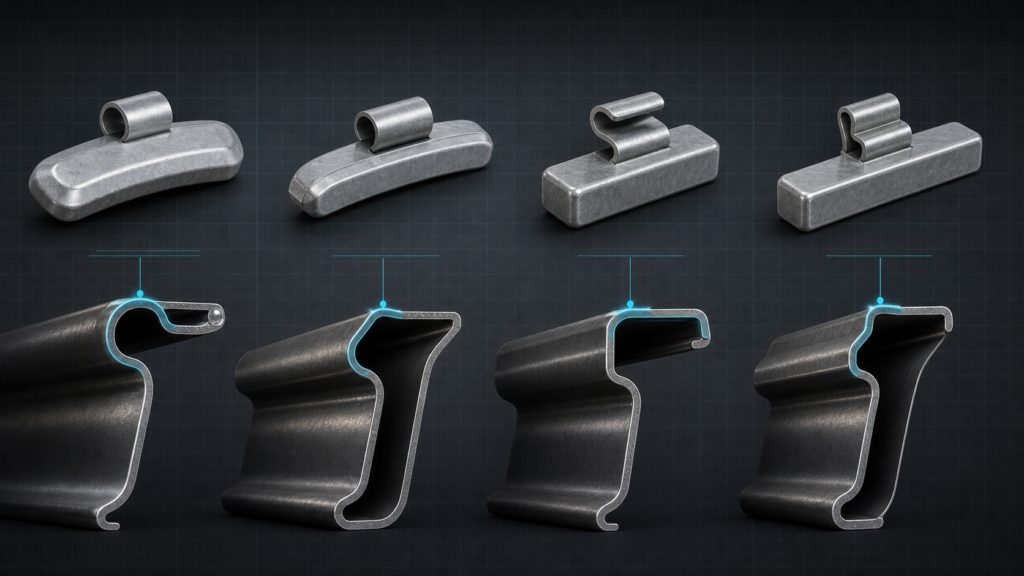
Clip-on wheel weight types are families of balance weights sorted by the shape of the spring clip that grips the rim flange. The common codes are MC, P, T, FN, IAW and EN, and each one suits a different flange shape. A code points to a likely fit; a gauge and a test fit confirm it.
This guide explains what each code usually means and which car brands used which series. It also covers when a flange needs an adhesive weight instead. Choosing between the two attachment methods is covered in clip-on vs stick-on wheel weights.
What are clip-on wheel weight types?
Clip-on wheel weight types are groups of balance weights that differ mainly in the shape and opening of the clip. Mass, material, coating and the unit system (ounces or grams) are separate choices.
The clip has to slide over the flange, sit at the balancing position and hold under wheel rotation without marking the rim. A weight that is the right mass but has the wrong clip is still the wrong part. That is why a single range often carries several clip families in the same material and size steps.
For range planning, start with the wheels you service, not with the codes. The wheel balance weights guide separates attachment style, material, size system and wheel use. When a code looks promising, the rim-flange application chart lists the dimensions to check before you approve it.
Why do clip-on wheel weight profiles differ?
Profiles differ because rim flanges differ in thickness, lip shape, depth, contour and finish. A clip that seats well on one flange can ride high, bottom out, scratch the finish or lose grip on a flange that looks almost the same.
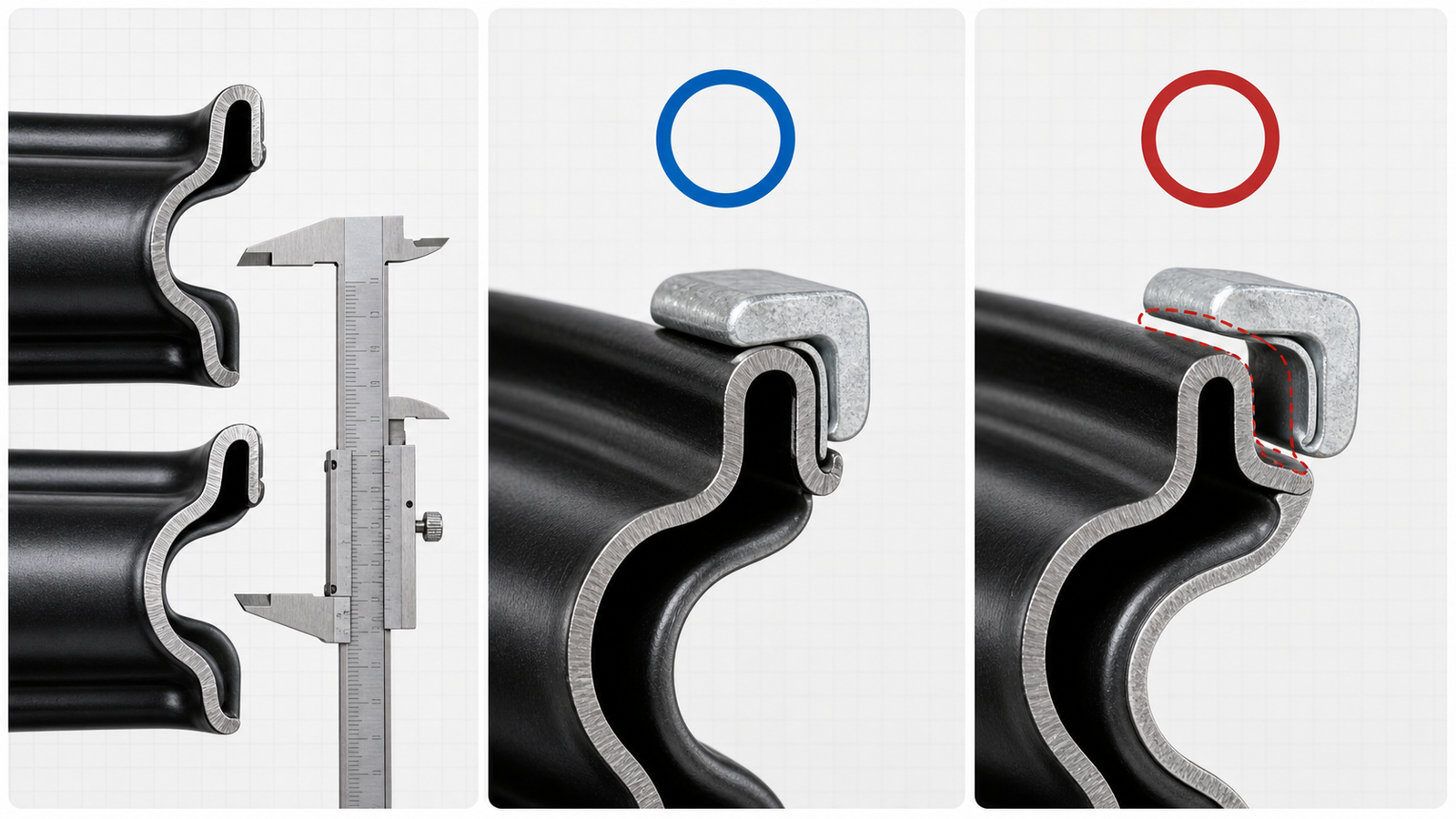
The goal is not simply a tight grip. The clip has to hold the weight and still go on without deforming or damaging the coating. SAE J1986 sets out matched rim-flange and balance-weight configurations, along with test procedures for installation and retention on passenger-car and light-truck wheels 1. ISO 13988 covers names and test methods for both clip and adhesive weights 2. Neither standard gives one worldwide list of catalogue letters, so letter codes are brand series, not a legal standard.
What do MC, P, T, FN, IAW and EN mean?
The codes name clip-profile series in a manufacturer’s catalogue. In North American practice, MC, FN, IAW and EN are mostly alloy-wheel series, while P and T are mainly steel-wheel series. A few special series cover chrome or unusual flanges. The table shows how one large supplier’s OEM guide uses them 3.
| Code | Usual wheel | Where the guide lists it | Check before use |
|---|---|---|---|
| MC | Alloy, domestic-style flange | Buick, Mercury, Saturn, Pontiac; many Chevrolet, Chrysler, Dodge and earlier Lincoln rows | Flange depth, coating, test fit |
| FN | Alloy, Japanese-style flange | Acura, Honda, Infiniti, Lexus, Nissan, Scion, Toyota; some Mazda, Subaru and Fiat rows | Often stocked in grams; not interchangeable with MC |
| IAW | Alloy, European and some Asian flanges | BMW, Jaguar, Kia, Land Rover, Mini, Saab, Suzuki, Volvo; several Ford and Hyundai rows | Confirm the inboard and outboard flange separately |
| EN | Alloy, German-style flange | Audi, Mercedes-Benz, Volkswagen | Later years often list adhesive |
| P | Mainly steel wheels | Also listed as an option on some later Honda, Subaru, Ford and Mitsubishi alloy rows | Do not assume “P = steel only” |
| T | Truck and heavier steel flanges | Truck rows such as Chevrolet Avalanche and Cadillac Escalade (MC/T) | Flange thickness; truck series LT1/LTZ and TAL/TALZ also exist |
| LH, TN, MCN | Special cases | LH on some Chrysler and Pontiac rows; TN for decorative chrome wheels; MCN on inside flanges | Read the guide footnote for the row |
“C” is not a series in that guide. When a catalogue lists a C profile, treat it as that supplier’s own code and ask for the profile drawing and an application list before you order. The same advice applies to any letter you cannot find in the manufacturer’s guide.
Which clip series did OEM alloy wheels use by brand?
For 2007–2020 OEM alloy wheels in North America, the series follows the brand’s home region. Japanese brands mostly use FN, German brands EN, European and Korean brands IAW, and US brands MC. The trend in the same guide is just as useful: in later model years, many brand-wide rows list adhesive weights, alone or as an alternative to the clip 3.
| Brand group (examples) | Main clip series, earlier years | Later-year pattern in the guide |
|---|---|---|
| Acura, Infiniti, Lexus, Nissan | FN | Adhesive alone (Acura) or FN with adhesive as an alternative |
| Honda, Toyota, Scion | FN | Honda adds P and adhesive options; Toyota lists FN or adhesive; Scion stays FN |
| Audi, Mercedes-Benz, Volkswagen | EN | Audi switches to adhesive; Mercedes-Benz lists EN or adhesive; Volkswagen stays EN |
| BMW, Jaguar, Kia, Mini, Volvo, Land Rover | IAW | BMW and Jaguar switch to adhesive; the others list IAW or adhesive |
| Buick, Lincoln, Mercury, Saturn | MC | Buick switches to adhesive; Lincoln moves to IAW or adhesive |
| Porsche | None | Adhesive in every year listed |
Brand groupings follow the brand-wide rows of the WEGMANN automotive USA OEM Alloy Wheel Weight Application Guide 2007–2020 (Form 18082, updated January 2020). Individual models and years can differ, so use the guide or a flange gauge for the exact car.
The pattern explains a common complaint in tire forums: a clip that “looks wrong” on a newer alloy wheel. Often the wheel was designed for an inner-barrel adhesive weight, and the clip was forced onto a flange that was never meant to hold one.
What can a profile code tell you, and what can it not?
A code tells you which family of samples to request and which bin an approved SKU belongs in. It cannot confirm the flange depth, the finish, the approved weight position or the retention on the wheel in front of you.
It answers questions like “Which series did we use on this wheel last time?” It cannot safely answer “Will this fit every 17-inch alloy?” When a code, a vehicle list and the physical rim disagree, the rim wins. Measure the flange at the planned position, compare it with the profile drawing and test-fit one weight. Record the result by wheel family and SKU so the next technician does not repeat the guesswork.
Which materials and units do clip-on weights use?
Clip-on weights are made mainly of zinc, steel or lead, and the clip profile is chosen separately from the material. Zinc and steel are the usual lead-free choices. Lead is still sold in some markets but is restricted in others, so check local rules first; our lead-free wheel weights guide sets out the market-specific requirements.
- Zinc: dense enough for compact weights and easy to shape around a clip. A comparison of density, size and corrosion trade-offs is in lead vs steel vs zinc wheel weights.
- Steel: lower density, so a weight of the same mass is larger. It relies on its coating for corrosion protection.
- Coating: the WEGMANN guide tells technicians to always use coated weights on OEM alloy wheels 3. Bare metal against a painted or clear-coated flange invites corrosion and marks.
- Units: North American ranges are usually sold in ounces, while FN and many export ranges come in grams. Keep the two systems in separate bins so a 5 g weight is never mistaken for a 0.25 oz one.
How should a technician choose and install a clip type?
Identify the wheel and the approved weight position first, then pick a candidate series from the guide and confirm it with a flange gauge and a test fit. The balancer tells you how much mass to add and where. It cannot make a clip fit a flange that is the wrong shape.
The application guide sets out several measurable rules that most short code lists leave out 3:
- Look up the make, model and year. Where a cell shows two series, the guide treats the left one as the primary application (typically the outboard flange) and the right one as typically the inboard flange.
- When in doubt, or on aftermarket and specialty wheels, confirm the series with a rim flange gauge (the guide’s part RGP-1).
- Use adhesive weights on flanges less than 3/16 in deep, because some flanges are decorative and not intended to hold a clip.
- Check that the installed weight clears the brake caliper by at least 1/8 in.
- Use coated weights, and the TN series on decorative chrome wheels.
- Hammer the clip, not the weight body. The guide warns that striking the body can cause clip retention failure.
Ignore the old weight as proof. It may have been the wrong series, badly installed or the only one in the drawer. For steel-wheel work, steel-wheel clip planning covers the flange, coating and increment choices.
When should a shop use adhesive weights instead?
Use adhesive weights when the flange is too shallow or decorative for a clip, when the finish must not be marked, or when the application guide lists adhesive for that model year. Moving the weight to a clean inner barrel brings its own surface-preparation and tape requirements.
The later-year rows in the brand table show why this matters: many current alloy wheels were designed around an inner-barrel adhesive weight. Do not force a clip just to stay inside an existing assortment. On low-clearance wheels, the low-profile wheel weights guide covers thinner adhesive options.
What are the risks and exceptions?
The main risks are a clip that lets go, a damaged finish and a weight that touches the brake caliper. The guide’s footnotes list the exceptions that most often cause them 3:
- No outside flange: some wheels have no usable outer flange. The guide lists adhesive weights inside the wheel and MCN weights on the inside flange.
- Two wheel sources for one model: some vehicles shipped with US-produced wheels that have different inboard and outboard configurations, so the guide says to verify the series with the gauge.
- Special editions: some trims use a different series from the rest of the model, for example LH on a Harley-Davidson Edition.
- Trucks: some rows may need LT1/LTZ or TAL/TALZ truck weights instead of the passenger series.
- Aftermarket wheels: OEM application lists do not apply, so measure every time.
How should buyers and distributors build a clip-profile range?
Build the range around the wheel brands your customers actually service, then use the codes as the stock language. A shop that mainly sees Japanese imports needs FN depth; a shop that sees German cars needs EN; a domestic-fleet shop needs MC, P and T.
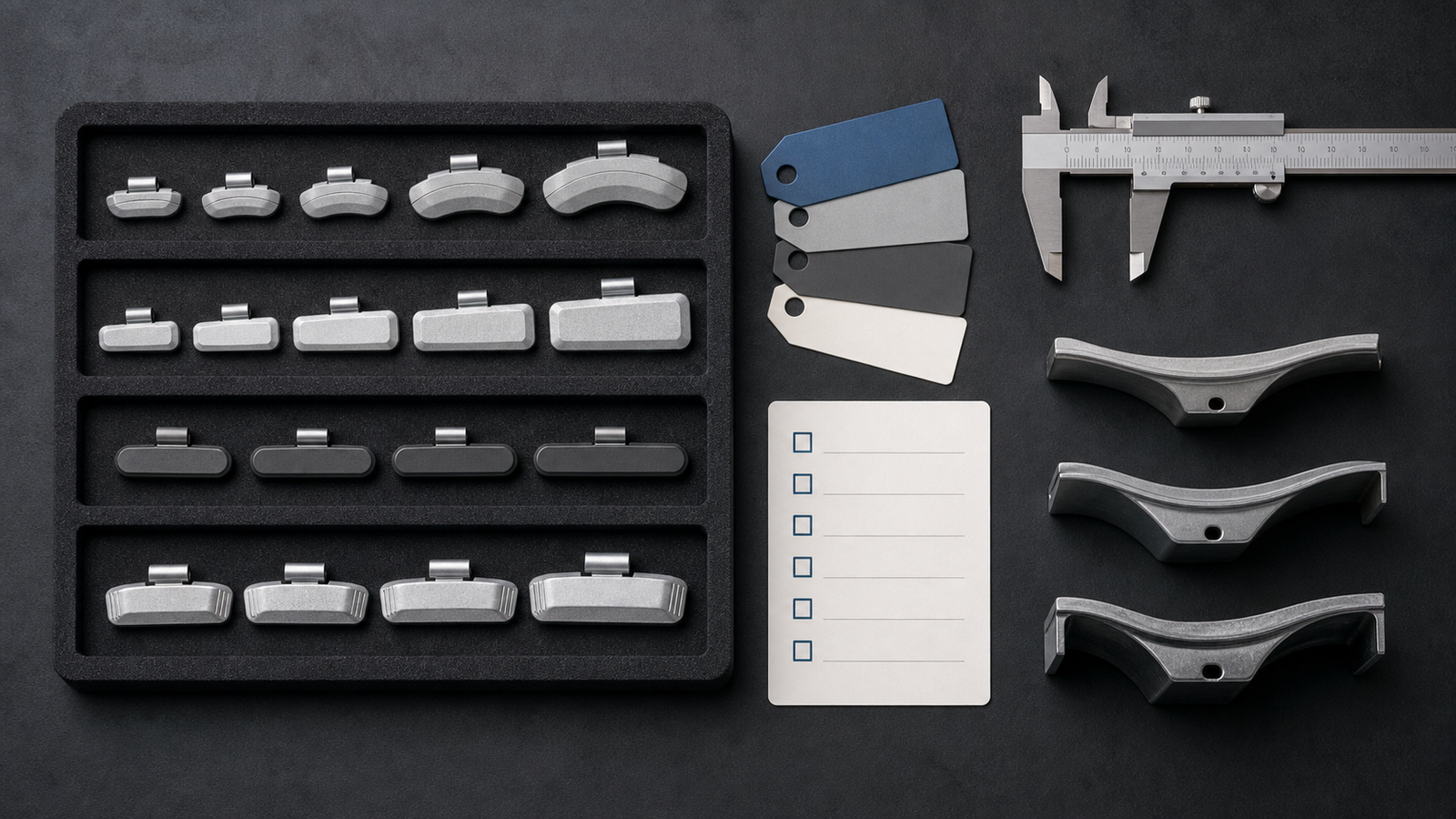
Ask each supplier for the profile drawing and application list behind every code, including any code missing from the major guides. Approve samples on real flanges with the wheel weight sample approval checklist, then size the bins with the wholesale clip-on assortment guide. Because later-year OEM wheels lean toward adhesive, plan the clip range and the adhesive range together, not as separate purchases.
Conclusion: Treat codes as a starting point
MC, P, T, FN, IAW and EN are useful because they turn flange shapes into a short stock language, and the OEM guide shows that the series largely follow brand origin. They are still catalogue names, not a standard, and some letters, including C, only mean something inside one supplier’s range.
The reliable sequence is to identify the wheel and position, pick the series from the guide and confirm it with a gauge. Then check the 3/16 in flange and 1/8 in caliper limits and switch to adhesive whenever the flange or the model year calls for it. Record each approved fit so the next job starts from evidence rather than an old weight.
Next step
List the wheel brands and series your customers use most, then compare them with our clip-on wheel weights. Yirox makes its own clip-on and adhesive balance weights and checks drawings and vehicle lists with buyers before sampling. When you are ready, ask for a clip-profile sample set.
Frequently Asked Questions
What does MC mean on a wheel weight?
MC is a clip series used mainly on alloy wheels from US brands such as Buick, Mercury and Saturn. In later model years, many of those wheels list adhesive weights instead, so check the year.
What does FN mean on a wheel weight?
FN is a clip series for Japanese-style alloy flanges. The WEGMANN USA guide lists it for Acura, Honda, Infiniti, Lexus, Nissan, Scion and Toyota, and FN weights are often sold in grams.
What does C mean on a clip-on wheel weight?
C is not a series in the major North American OEM application guide. Treat it as a supplier-specific code and ask for the profile drawing and application list before ordering.
Are MC, FN, P and T wheel weights interchangeable?
No. Each series has a different clip shape, and fitting the wrong one can let the weight shift or mark the rim. Confirm the series with the application guide or a flange gauge.
Can I identify the correct clip-on weight by looking at the old weight?
Only as a starting point. The old weight may have been the wrong series or badly installed, so confirm the current wheel’s flange and the approved position first.
References
[1] SAE International. “J1986_202510 Balance Weight and Rim Flange Design Specifications, Test Procedures, and Performance Recommendations.” 2025.
[2] International Organization for Standardization. “ISO 13988:2021 Passenger car and light truck vehicle wheels — Clip and adhesive balance weight and rim flange nomenclature, test procedures and performance requirements.” 2021.
[3] WEGMANN automotive USA. “OEM Alloy Wheel Weight Application Guide 2007–2020.” Form 18082, updated January 2020 (PDF hosted by All Tire Supply).
Last reviewed: October 30, 2026.