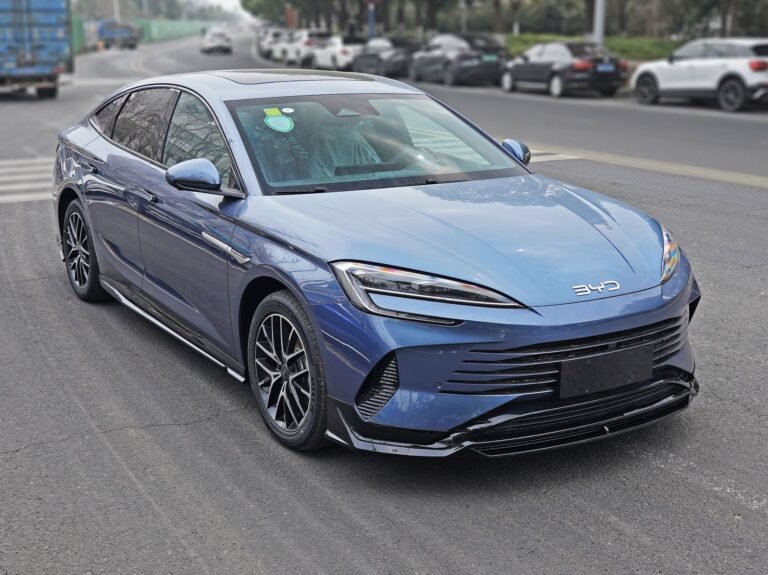




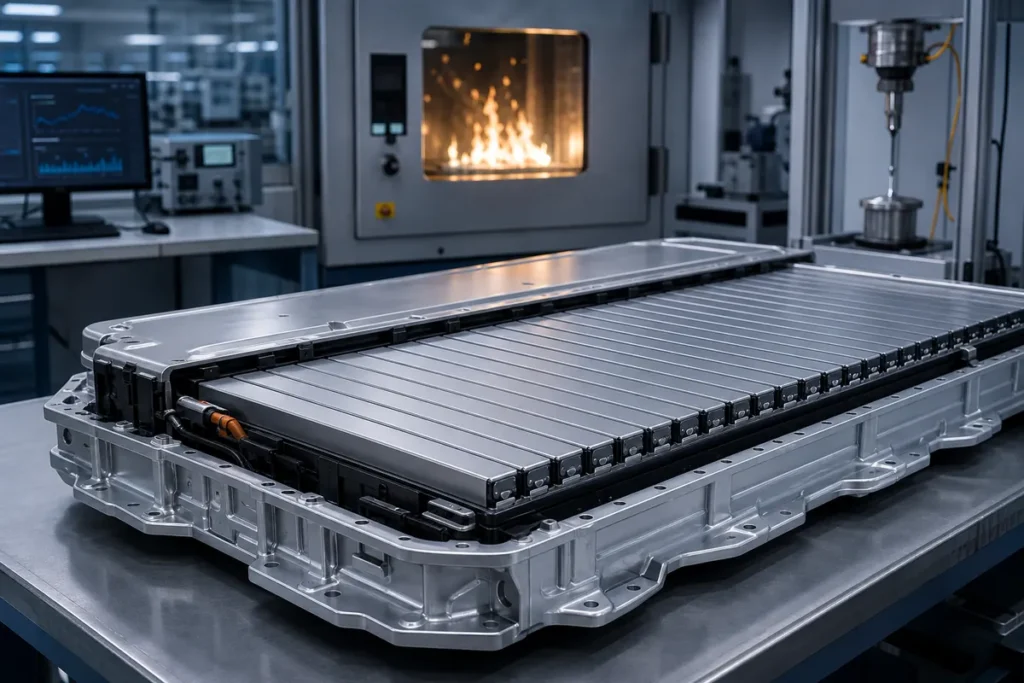
BYD Blade Battery is BYD's branded battery architecture built around long lithium iron phosphate (LFP) cells, not a separate battery chemistry. The name describes a BYD design and pack-integration approach; ordinary LFP batteries can use different cell shapes, modules, cooling layouts, and structural methods.
That distinction matters when comparing BYD vehicles. A Blade Battery label does not, by itself, tell you the exact pack capacity, charging curve, warranty, production generation, or market specification. Those details must be checked against the vehicle's model-year specification and local warranty document.
This guide separates chemistry from architecture, explains CTP and CTB, maps official model and market examples, and turns safety, lifespan, charging, and replacement claims into a checklist a buyer can verify.
Table of Contents
- What is BYD Blade Battery, and how is it different from ordinary LFP?
- How do CTP, CTB, and the honeycomb structure work?
- Which BYD cars use Blade Battery?
- Why is Blade Battery considered safer, and what does the nail test prove?
- How does Blade Battery compare with NMC and conventional LFP?
- How long does Blade Battery last, and what do warranty and SOH mean?
- Can Blade Battery charge to 100%, and how does cold weather affect it?
- Is Blade Battery 2.0 the same as the original Blade Battery?
- How to verify a Blade Battery claim
- Conclusion: Blade Battery is a pack-level safety and packaging idea
- Frequently Asked Questions
- References
What is BYD Blade Battery, and how is it different from ordinary LFP?
Blade Battery is BYD's named product architecture. LFP is the chemistry underneath it. The two terms should not be used as synonyms.
| What is being described? | Blade Battery | Ordinary LFP battery |
|---|---|---|
| Meaning | BYD's branded cell and pack architecture | A chemistry family used by many manufacturers |
| Chemistry | LFP in the official BYD descriptions used here | LFP, but with many possible cell formats and pack designs |
| Cell format | Long, flat cells associated with the Blade design | Pouch, cylindrical, prismatic, or other formats |
| Pack integration | May use cell-to-pack or, in some vehicle designs, cell-to-body integration | May use modules, CTP, or other layouts |
| What the label proves | The name of the BYD technology family | Only that the cathode chemistry is LFP; it does not prove a Blade architecture |
LFP is often valued for thermal stability, durability, and avoiding nickel and cobalt in the cathode chemistry. Its usual trade-off is lower cell-level energy density than many nickel-rich chemistries. BYD's design response is to improve pack-level space use rather than claim that chemistry alone solves every EV constraint 1.
If you are comparing the vehicle rather than the battery name, the related BYD model guide is the better next step. It keeps the battery discussion connected to model, body style, market, and fitment.
How do CTP, CTB, and the honeycomb structure work?
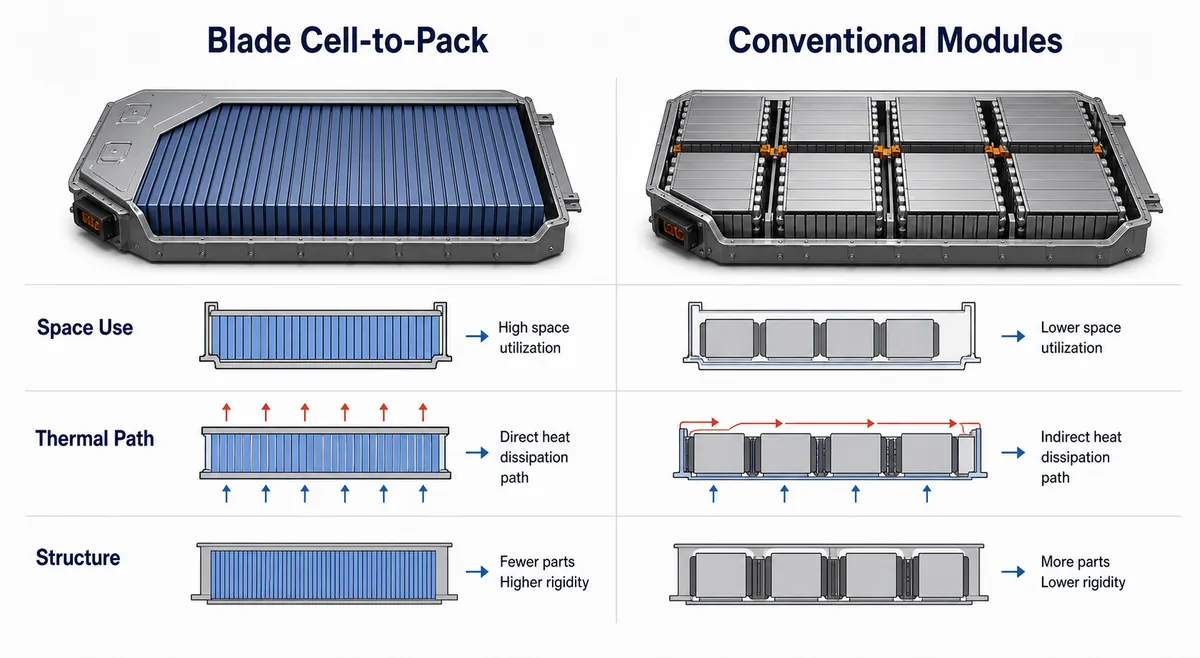
The main packaging idea is to reduce intermediate module layers and use long cells more directly in the pack. CTP and CTB describe different levels of integration, so a buyer should not treat them as interchangeable terms.
| Architecture | What is integrated? | What it can improve | What it does not prove |
|---|---|---|---|
| CTP, cell-to-pack | Cells are integrated into the battery pack with fewer conventional module layers | Pack space use, part count, and potentially pack-level energy density | That the pack is part of the vehicle body |
| CTB, cell-to-body | The battery pack is integrated into the vehicle body or floor structure | Structural packaging, cabin space, and vehicle rigidity | That every Blade Battery vehicle uses CTB |
BYD's official European material describes cell-to-body versions separately, which is why the exact vehicle platform matters 3. A Blade Battery may be discussed with CTP in one vehicle and with deeper body integration in another.
The honeycomb description refers to the way the long blades are arranged and supported. BYD presents this construction as a way to improve strength and use pack volume efficiently 1. That is a design advantage, not a guarantee that the complete vehicle will have the same crash result in every test.
The pack still needs cooling, battery-management software, electrical isolation, enclosure protection, crash engineering, and service controls. Cell shape cannot replace full-system validation.
Which BYD cars use Blade Battery?
The safest answer is model- and market-specific. BYD's own publications confirm several examples, but a buyer should still check the local specification sheet because battery capacity, charging limits, warranty language, and production generation can change.
| Vehicle example | Market/source context | Publication or model period | What can be verified |
|---|---|---|---|
| BYD HAN | BYD European official explainer | 2023 source | BYD lists HAN among models equipped with Blade Battery 2 |
| BYD TANG | BYD European official explainer | 2023 source | BYD lists TANG among models equipped with Blade Battery 2 |
| BYD ATTO 3 | BYD European official explainer | 2023 source | BYD lists ATTO 3 among models equipped with Blade Battery 2 |
| Current BYD electric and DM-i range | Current BYD Europe technology page | Page accessed in 2026 | BYD presents Blade Battery as a core technology, but exact version and local terms remain model-specific 3 |
This is where the related BYD Atto 3 battery details page fits naturally. Use it for the model-level conversation, then return to the local brochure or owner's manual before making a battery claim.
Why is Blade Battery considered safer, and what does the nail test prove?
Blade Battery's safety message combines LFP chemistry, cell geometry, pack structure, thermal control, and validation testing. The nail penetration test is evidence about one severe abuse condition; it is not a lifetime safety certificate.
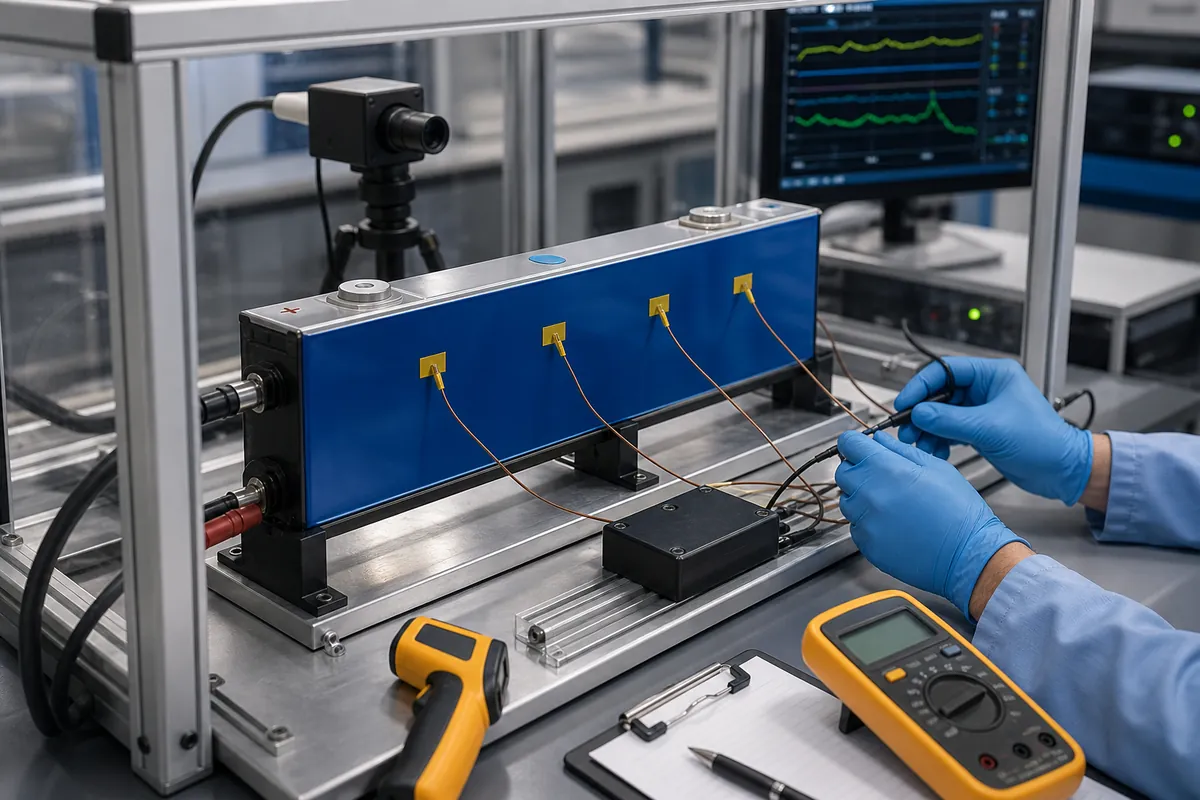
BYD's published explainer says the Blade Battery produced no smoke or fire in its nail test, reached a surface temperature of 30–60°C in that test, and also describes crush, bending, 300°C oven, and 260% overload tests 2. Those are concrete claims with a source, which is more useful than repeating that the battery is simply “safer.”
What the nail test can support:
- how the tested cell reacted to forced internal short-circuit conditions;
- whether smoke, flame, or rapid temperature escalation occurred in that test;
- a comparison under the same stated test setup.
What it cannot support by itself:
- a guarantee against crash damage, water ingress, manufacturing defects, or thermal runaway in every vehicle;
- a universal comparison with every NMC or LFP pack;
- a claim that the battery never needs cooling, monitoring, or service inspection.
NHTSA treats electric and hybrid vehicle safety as a system-level vehicle issue, so the vehicle's enclosure, crash structure, battery management, charging control, and service procedures still matter 4.
How does Blade Battery compare with NMC and conventional LFP?
Blade Battery is not automatically better in every category. The useful comparison separates chemistry, architecture, and the vehicle's actual software and thermal system.
| Comparison field | Blade Battery | Conventional LFP pack | NMC pack |
|---|---|---|---|
| Chemistry | LFP | LFP | Nickel-manganese-cobalt family |
| Architecture | BYD-branded long-cell architecture with pack integration | May be module-based, CTP, or another layout | Many cell and module layouts are possible |
| Cell-level energy density | Usually trades some chemistry density for pack-level packaging efficiency | Depends on cell and pack design | Often higher potential than LFP |
| Thermal behavior | LFP chemistry is generally valued for stability; full pack design still matters | Similar chemistry advantage, but packaging varies | Requires its own thermal and safety controls |
| Best question to ask | Which BYD model, market, generation, and warranty? | Which cell format and pack architecture? | What are the cooling, warranty, and charging limits? |
NMC can offer higher cell-level energy density, while LFP can offer stability and durability advantages. Neither chemistry determines the entire driving experience: pack size, cooling, software, vehicle weight, and charging infrastructure all contribute.
How long does Blade Battery last, and what do warranty and SOH mean?
BYD Europe currently states that its Blade Battery can exceed 5,000 charging cycles and lists an 8-year/250,000-km warranty with a guaranteed state of health above 70% on that regional page 3. Treat those as published regional claims, not a universal promise for every BYD vehicle worldwide.
SOH means state of health: an estimate of remaining usable battery capacity compared with the original reference condition. It is not the same as cycle count. A pack's result depends on temperature, charging behavior, depth of discharge, mileage, software limits, and measurement method.
Replacement cost is not a single Blade Battery number. It depends on model, pack capacity, market, labor, warranty status, and whether the service center replaces a module, a pack, or another high-voltage component. Ask for a vehicle-specific written quote rather than using a generic online estimate.
BYD's European material also says Blade Batteries are designed to be recyclable, but end-of-life handling still depends on the local dealer, approved recycler, and regulations 3. The battery name does not tell a buyer who will perform safe recovery work.
Can Blade Battery charge to 100%, and how does cold weather affect it?
Some BYD regional materials say vehicles using Blade Battery can be charged to 100% rather than following a blanket 80% ceiling 6. That is not permission to ignore the owner's manual: charging limits and recommended daily settings can still vary by model, market, software, and use case.
Charging speed is also a vehicle-system result. The charger, connector, battery temperature, state of charge, thermal preconditioning, and software limit all affect the DC curve. The related CCS connector guide and AC vs DC EV charging guide explain the infrastructure side. For multi-vehicle sites, the EV charging load management guide explains why available power can become the real constraint.
Cold weather can reduce available range and change charging behavior because battery temperature affects electrochemical performance and thermal management. The U.S. Department of Energy also notes that EV battery performance depends on design, temperature, and operating conditions 5. Do not promise one universal winter penalty from the Blade name alone.
Is Blade Battery 2.0 the same as the original Blade Battery?
Treat “Blade Battery 2.0” as a generation or marketing label until an official vehicle document identifies the actual pack specifications. There is no single global 2.0 table that automatically tells a buyer the capacity, chemistry, charging curve, warranty, or body integration of every vehicle using the name.
| Field to compare | What to request |
|---|---|
| Production date and market | Vehicle build date, country version, and homologation document |
| Pack identity | Battery part number, rated capacity, nominal voltage, and usable capacity |
| Integration | CTP, CTB, or another platform description |
| Charging | AC limit, peak DC rate, charging window, and thermal preconditioning |
| Warranty | Years, mileage, guaranteed SOH, and exclusions |
If a seller says “2.0” but cannot provide these fields, the label is not enough to support a performance comparison.
How to verify a Blade Battery claim
Use this checklist before repeating a battery claim in a product page, vehicle comparison, or buying guide:
| Claim | Evidence to request | Common mistake |
|---|---|---|
| It is a Blade Battery | Model-year specification, pack label, or official vehicle documentation | Treating every LFP pack as Blade |
| It uses CTP or CTB | Platform documentation for that exact model and market | Assuming all Blade packs are CTB |
| It is safer | Named test, test setup, result, and source | Turning one nail test into a lifetime guarantee |
| It lasts 5,000 cycles | Source region, test conditions, and whether the claim is cell- or pack-level | Treating a marketing cycle claim as a personal mileage prediction |
| It has 70% SOH coverage | Local warranty document and measurement definition | Importing a regional warranty into another market |
| It can charge to 100% | Owner manual or local BYD guidance | Applying one regional instruction to every model |
| It charges fast in winter | Temperature-specific charging curve and preconditioning rules | Comparing peak charger power only |
| It is recyclable | Approved service/recycling route in the buyer's market | Assuming the owner can dismantle a high-voltage pack |
For accessory distributors, the practical next step is the EV aftermarket accessories category, but the battery claim and the accessory claim should remain separate. An EV storage, charging, or protection product does not change the vehicle's chemistry, range, or safety rating.
Conclusion: Blade Battery is a pack-level safety and packaging idea
BYD Blade Battery is a BYD-branded LFP battery architecture built around long cells, pack integration, and a safety-focused design message. It is not a synonym for every LFP battery, and the same label does not guarantee identical specifications across models, markets, or production generations.
The useful comparison is evidence-based: identify the model and market, separate CTP from CTB, verify the test and warranty source, check charging and temperature conditions, and ask who supports the battery after the warranty period.
For readers comparing BYD vehicles or EV-related products, the battery name is a starting point. The specification sheet, local warranty, charging guidance, and approved service route are the documents that turn the name into a decision.
Frequently Asked Questions
What chemistry does BYD Blade Battery use?
BYD Blade Battery uses lithium iron phosphate chemistry, commonly called LFP. Blade Battery is BYD's branded architecture around that chemistry; ordinary LFP batteries can use different cell and pack designs.
Which BYD cars use Blade Battery?
BYD's official 2023 explainer lists the HAN, TANG, and ATTO 3 as Blade Battery-equipped examples, while current regional pages present Blade Battery as a core technology across BYD electric and hybrid vehicles. Check the local model specification because battery versions can vary by market and production date.
How long does Blade Battery last?
BYD Europe currently states a claim of more than 5,000 charging cycles on its regional technology page. Cycle claims are not the same as a guaranteed vehicle lifespan, so also check the local warranty and SOH definition.
Can a Blade Battery vehicle charge to 100%?
Some BYD regional guidance says charging to 100% is allowed, but the owner's manual for the exact vehicle and market should control the daily charging decision.
How does cold weather affect Blade Battery?
Cold temperatures can reduce range and change charging behavior. Battery temperature, preconditioning, driving conditions, and software matter more than the Blade label alone.
How much does it cost to replace a Blade Battery?
There is no universal replacement price. It depends on the model, pack, market, labor, warranty status, and whether the repair uses a component or a complete pack. Request a vehicle-specific quote from an approved service provider.
Is Blade Battery recyclable?
BYD says its batteries are designed to be recyclable, but the owner should use the approved dealer or recycling route in the local market rather than attempt high-voltage disassembly.
Is Blade Battery 2.0 the same as the original?
Do not assume that it is. Compare the exact vehicle, production date, pack specification, charging curve, integration method, and warranty instead of relying on the generation label alone.
Is Blade Battery only used by BYD?
Blade Battery is BYD's named battery technology. Other companies may use LFP or cell-to-pack ideas, but the Blade Battery name refers to BYD's design.
References
[1] BYD Media. (2026). Blade Battery technology: packaging efficiency, LFP chemistry, and safety.
[2] BYD. (2023). BYD's revolutionary Blade Battery: launch, nail penetration test, CTP, and models.
[3] BYD Europe. (2026). Blade Battery: cycle-life, warranty, SOH, and recycling claims.
[4] NHTSA. (2026). Electric and hybrid vehicle safety.
[5] U.S. Department of Energy. (2026). Electric vehicle battery basics.
[6] BYD Belgium. (2026). Blade Battery: charging to 100 percent and safety information.