



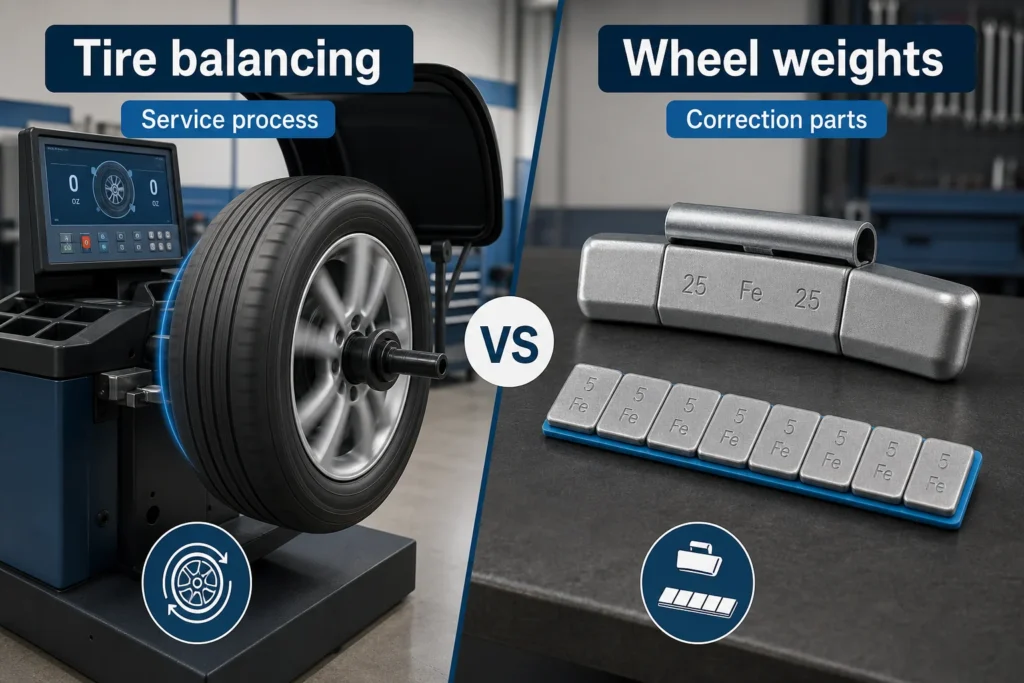
Tire balancing is the service process that measures and corrects uneven weight distribution in a tire and wheel assembly. Wheel weights are the physical products used to make that correction by adding precise weight at the positions identified by the balancing machine.
The two terms are closely related, so it is easy to mix them up. A driver may say a shop “put balancing on the tire,” while a buyer may search for “tire balancing weights” when they actually need clip-on or adhesive wheel weights. The clean distinction is simple: balancing is the diagnostic and correction procedure; wheel weights are one of the products used to complete the correction.
This article focuses on the balancing service and how weights fit into it. For what the weights themselves are, see what are wheel weights; for where they go on the rim, see the wheel weight placement guide.
Table of Contents
- What is the difference between wheel weights and tire balancing?
- What does tire balancing mean?
- What do wheel weights do in the balancing process?
- How does tire balancing use wheel weights?
- What is the difference between static and dynamic balancing?
- When are wheel weights installed or changed?
- What problems happen when balancing or wheel weights are wrong?
- What should buyers check when choosing wheel weights for balancing service?
- Conclusion: The service and the product work together
- Frequently Asked Questions
- References
What is the difference between wheel weights and tire balancing?
Tire balancing is the service, while wheel weights are the parts used to correct the measured imbalance. The balancing machine finds where the tire and wheel assembly is uneven; the technician then installs the right weight amount in the right position.
Think of tire balancing as the full workflow:
- Mount the tire and wheel assembly on a balancing machine.
- Spin the assembly and measure imbalance.
- Read the required correction amount and position.
- Install the proper correction product.
- Recheck the assembly to confirm a smoother result.
Wheel weights are only one part of that workflow, but they are the most common physical correction product. They may be clip-on weights attached to a rim flange, stick-on adhesive weights placed inside the wheel barrel, or another balancing solution for special applications.
That distinction matters for buyers. If a tire shop says it has a balancing problem, the issue may be the machine, mounting method, rim condition, tire condition, installer process, or the wheel weights themselves. If a distributor says it needs balancing weights, the product question is more specific: type, material, size, coating, clip fit, adhesive tape, carton labeling, and repeat supply.
Once the service requirement is understood, a buyer still has to decide which correction weights a shop network will actually use. Choosing a wheel-weight range for a service mix helps connect material, size systems, rim fitment, and lead-free options to the wheels those accounts balance.
What does tire balancing mean?
Tire balancing means measuring the rotating tire and wheel assembly and correcting uneven mass distribution so it rotates more smoothly. The goal is to reduce vibration, steering shake, uneven tire wear, and stress on related vehicle components.
A tire and wheel assembly can be slightly heavy in one area because of tire construction, wheel casting, valve stems, TPMS sensors, tread wear, repair patches, or mounting variation. When that heavy area spins, it can create periodic forces and ride disturbance; the vibration often becomes more noticeable as vehicle speed increases 1.
Balancing is usually performed:
- when a new tire is mounted
- after tire rotation when vibration appears
- after a puncture repair
- when a wheel weight falls off
- after curb impact or wheel repair
- when a driver reports highway-speed vibration
- when a shop verifies tire service quality before delivery
Tire balancing is also different from wheel alignment. Balancing deals with mass distribution around the rotating assembly. Wheel alignment deals with wheel angles such as toe, camber, and caster, which affect tracking, handling, and tire wear patterns 3. A vehicle can need balancing, alignment, or both, but they are not the same service.
The service measures the problem, while the physical correction weights used after imbalance is measured explain the consumable that is installed to correct it.
What do wheel weights do in the balancing process?
Wheel weights add precise mass at a specific position so the tire and wheel assembly can counteract a heavy or light spot. They do not “fix” the tire by themselves; they complete the correction calculated during balancing.
If the balancer shows that an assembly needs 15g on the inner plane and 10g on the outer plane, the technician chooses a product that can provide those corrections. On a steel wheel, that may mean clip-on weights on the rim flange. On an alloy wheel, that may mean adhesive weights inside the wheel barrel to avoid damaging the visible rim face.
Common wheel weight formats include:
| Wheel weight type | How it is used | Common fit |
|---|---|---|
| Clip-on wheel weights | Clipped to the rim flange | Steel wheels, some truck and shop applications |
| Stick-on wheel weights | Bonded to the inner barrel with adhesive tape | Alloy wheels, passenger cars, cleaner appearance |
| Balancing beads | Placed inside the tire | Selected truck, bus, off-road, and specialty applications |
The product must match the wheel and the correction need. A correct gram value with the wrong clip profile can still fail. A good adhesive strip can still fall off if the wheel surface is dirty, wet, cold, or poorly prepared. A balancing service is only as good as both the measurement and the physical correction.
How does tire balancing use wheel weights?
A tire balancer spins the assembly, measures where imbalance occurs, and displays how much correction weight is needed. The technician then installs wheel weights at the indicated positions and spins the assembly again to confirm the correction.
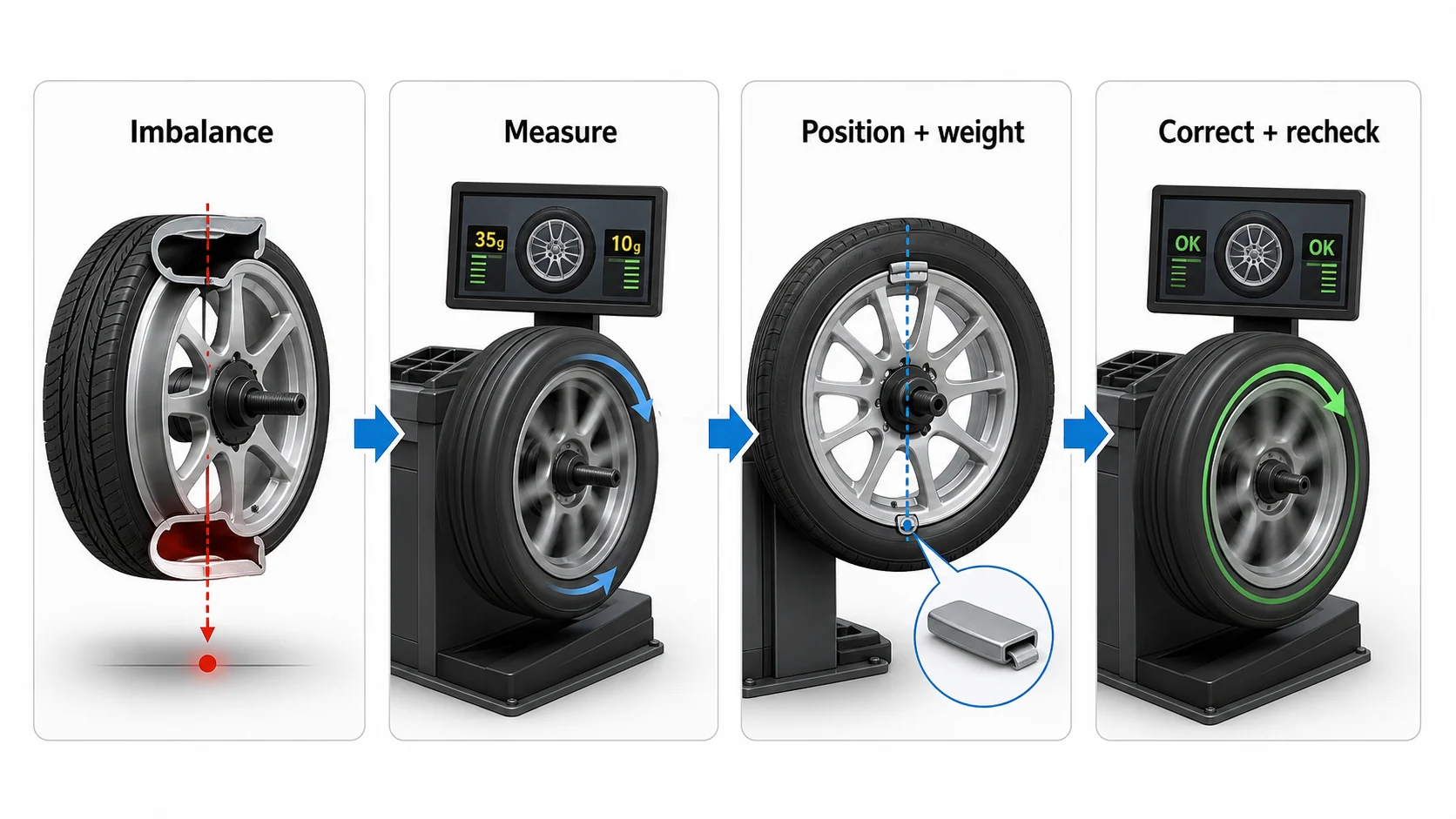
The process is practical rather than mysterious:
- Imbalance exists. The tire and wheel assembly has uneven mass distribution.
- The machine measures it. The balancer detects the amount and angle of imbalance.
- The display gives instructions. The technician sees the correction weight and placement plane.
- Wheel weights are installed. The selected product is attached to the rim or placed inside the tire.
- The result is checked. The assembly is spun again to confirm the remaining imbalance is acceptable.
For everyday passenger vehicles, this usually means external clip-on or adhesive weights. For some heavy-duty uses, internal balancing agents may be considered, but they are not a universal replacement for traditional wheel weights.
For buyers, the key point is that the balancer output must translate into available SKUs. A shop cannot apply 17g cleanly if the product range only supports awkward increments or poor strip break points. A distributor serving metric markets may prioritize 5g increments, while an ounce-based market may need 1/4 oz, 1/2 oz, 3/4 oz, and related sizes.
What is the difference between static and dynamic balancing?
Static balancing corrects imbalance in one plane, while dynamic balancing corrects imbalance across two planes of the rotating assembly. Dynamic balancing is more common in modern tire service because wider wheels can have both up-and-down and side-to-side imbalance.
Static imbalance is often imagined as one heavy spot around the wheel. If the assembly were allowed to settle freely, the heavy spot would tend to rotate downward. Correcting it can reduce vertical hop.
Dynamic imbalance is more complex because the mass is uneven across the wheel width. One side of the assembly may need correction in a different place than the other side. This can cause side-to-side wobble or steering wheel vibration. Tire balance is commonly measured in shops with static and dynamic balancers, and correction weights may be fitted to inner and outer planes of the wheel 1.
The distinction matters because it explains why weights may appear in more than one location. A driver might see one visible clip-on weight and assume that is the whole correction. On many alloy wheels, part of the correction may be hidden inside the barrel as adhesive weights.
When are wheel weights installed or changed?
Wheel weights are usually installed or changed whenever a tire and wheel assembly is balanced or rebalanced. They may also be replaced when old weights detach, corrode, lose adhesion, damage the rim, or no longer match the measured correction.
Common moments include:
- after mounting new tires
- after wheel repair or refinishing
- after tire rotation if vibration appears
- after a puncture repair changes the assembly
- after impact with a curb or pothole
- when adhesive residue shows a missing strip
- when old clip-on weights are loose or rusty
- when a shop switches from lead to lead-free steel or zinc weights
Technicians should not simply stack new weights over old ones without checking the balancer. The correct correction depends on current tire seating, rim condition, tire wear, valve position, and old weight removal. If a wheel needs an unusually large amount of correction, the shop may need to inspect tire mounting, wheel runout, or tire uniformity rather than keep adding weight.
What problems happen when balancing or wheel weights are wrong?
Incorrect balancing or poor wheel weight installation can cause vibration, steering shake, uneven tire wear, customer comebacks, or lost weights. The problem may come from the service process, the wheel condition, the tire itself, or the correction product.
Common service-side issues include:
- dirty wheel mounting surfaces
- wrong balancer setup or rim dimensions
- poor centering on the machine
- failing to remove old weights before correction
- ignoring bent wheels or tire defects
- confusing balancing symptoms with alignment or suspension problems
Common product-side issues include:
- adhesive tape that fails in cold, wet, or dusty conditions
- clip profiles that do not match the rim flange
- coating that rusts quickly in salt or coastal environments
- weak carton labels that cause size mistakes
- size ranges that do not match local service habits
- material choices that do not match market requirements
This is why the difference between tire balancing and wheel weights is more than a vocabulary issue. If the service process is wrong, changing supplier may not solve the complaint. If the wheel weight product is wrong, even a skilled technician may struggle to achieve reliable results.
What should buyers check when choosing wheel weights for balancing service?
Buyers should choose wheel weights based on the wheels being serviced, the balancing method, the local size system, material requirements, installation habits, and packaging workflow. The best product is the one that lets shops turn balancer output into repeatable corrections with fewer complaints.

Use this checklist before ordering:
| Buying question | Why it matters |
|---|---|
| Are target wheels mostly steel, alloy, truck, or mixed? | Wheel type affects clip-on vs stick-on demand. |
| Does the market use grams, ounces, or both? | Size systems affect SKU planning and carton labels. |
| Which clip profiles are needed? | Wrong clips can install poorly or damage rim finishes. |
| What tape quality is required? | Adhesive reliability affects field complaints and repeat orders. |
| Is lead-free material required? | Many markets and buyers prefer steel or zinc over lead. |
| What coating or surface finish is expected? | Corrosion resistance matters in wet, salty, or coastal conditions. |
| How should weights be packed and labeled? | Clear packaging reduces shop selection mistakes. |
| Are samples needed before bulk orders? | Trial installation reveals tape, clip, coating, and size issues early. |
For tire shops, the question is often “Can I balance this wheel correctly and quickly?” For distributors, the question is “Can my product range support that service across many wheel types and vehicles?” Those are related but not identical decisions.
After the service requirements are clear, a purchasing team can separate equipment or training issues from the correction parts it actually needs to stock. If the target shops mainly use conventional rim-mounted solutions, clip-on and stick-on correction weights are the relevant product group to compare against wheel type, installer workflow, and local vehicle mix.
A balancing machine does not decide whether a workshop needs clips or adhesive strips; the attachment route that fits the workshop's wheel mix turns service demand into a stock decision. To avoid a service kit with avoidable gaps, buyers can use mass increments that cover routine balancing corrections before setting gram or ounce coverage. Once the workshop's applications are known, wheel-balancing weight formats for an approved service assortment give buyers a focused place to review physical options.
If you are planning a wheel-balancing product or service program, share the wheel applications, balancing equipment, weight formats, size range, and workshop requirements you need to support. We can help you connect the balancing method to a practical product brief.
Conclusion: The service and the product work together
Tire balancing is the process that finds and corrects uneven mass distribution. Wheel weights are the correction parts that make the balancing result possible. The machine measures the problem, the technician chooses the correction, and the weight product must fit the wheel, the size requirement, and the service environment.
For drivers, the distinction helps explain why vibration diagnosis is not always solved by “more weights.” For shops and buyers, it helps separate equipment, process, and product decisions. A reliable balancing program needs accurate machines, trained installers, compatible wheel weights, clear packaging, and material choices that match the target market.
Frequently Asked Questions
Are wheel weights and tire balancing the same thing?
No. Tire balancing is the service process that measures and corrects imbalance. Wheel weights are the physical products installed during that process to add correction weight where the machine indicates.
Why does a tire need balancing after mounting?
A newly mounted tire and wheel assembly may have uneven mass distribution from the tire, rim, valve stem, TPMS sensor, or mounting position. Balancing measures that imbalance and corrects it before the vehicle returns to service.
Can tire balancing be done without wheel weights?
Some special applications use internal balancing agents or beads, but most passenger car and tire shop balancing still relies on clip-on or stick-on wheel weights for precise correction.
What is the difference between balancing and alignment?
Balancing corrects uneven mass in a rotating tire and wheel assembly. Alignment adjusts wheel angles such as toe, camber, and caster so the vehicle tracks correctly and tires wear more evenly.
Do wheel weights fix vibration every time?
No. Wheel weights help when vibration is caused by imbalance. Bent wheels, tire defects, worn suspension parts, brake issues, alignment problems, or road-force variation can create similar symptoms.
Which wheel weights should distributors stock for balancing service?
Most distributors should start with the wheel mix in their market. Steel wheel markets often need clip-on weights, alloy wheel markets usually need adhesive weights, and mixed markets may require both gram and ounce size systems.
References
[1] Wikipedia. “Tire balance.” 2025.
[2] Wikipedia. “Tire.” 2026.
[3] Wikipedia. “Wheel alignment.” 2026.