



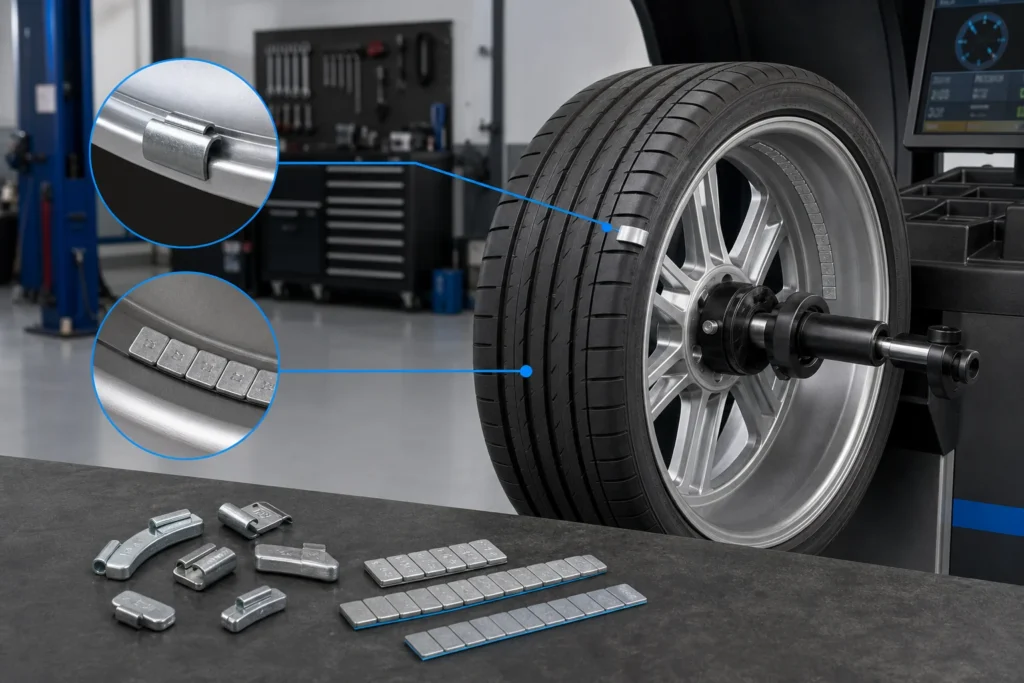
Wheel weights are small balancing weights installed on the rim or inside the tire to offset heavy and light spots in the wheel assembly. They are used after tire mounting, rotation, repair, or impact events to reduce vibration, protect tires and suspension parts, and help the vehicle drive smoothly at road speed.
Most drivers notice wheel weights only when one falls off or when a steering wheel starts shaking on the highway. For tire shops, parts distributors, and automotive buyers, they are a basic but precise product: the weight amount, attachment method, material, coating, tape, clip profile, and packaging all affect how well the part works in daily service.
This article is the quick beginner explanation. For the full reference on types, materials and sizes, see the wheel balance weights guide; for how a shop balances a tire, see wheel weights vs tire balancing.
Table of Contents
- What are wheel weights?
- What are wheel weights for?
- Why do wheel and tire assemblies become unbalanced?
- How does a balancing machine know where weights go?
- What are the common symptoms of missing or incorrect wheel weights?
- What are the main types of wheel weights?
- When should wheel weights be replaced?
- What should buyers check before ordering wheel weights?
- Conclusion: Small parts, precise job
- Frequently Asked Questions
- References
What are wheel weights?
Wheel weights are correction weights applied to a tire and wheel assembly after it has been measured for imbalance. The technician uses the amount and location shown by the balancer, then installs the correct weight on the rim flange, inside the wheel barrel, or inside the tire depending on the product type.
A wheel and tire assembly may look evenly round, but its mass is rarely perfect. The valve stem, tire construction, wheel casting, tread wear, repair patches, and small manufacturing tolerances can all create heavy and light points. When the assembly spins, those uneven points can generate vibration. Wheel weights add a small, measured amount of mass so the assembly rotates more smoothly.
The term can be confusing because people use several names for the same product family: wheel weights, tire weights, wheel balancing weights, tire balancing weights, rim weights, and balance weights. In professional sourcing, wheel balancing weights is often the broader category name because it covers clip-on weights, adhesive weights, and related balancing products.
If you are identifying small blocks inside a rim or a clip at its edge, the related rim weight identification guide shows what to look for, why block counts differ, and how to assess a suspected missing weight.
Once the basic definition is clear, buyers planning a first range need to decide which weight type, material, size system, and rim application their customers actually need. How to structure a wheel-weight assortment gives them a category-level starting point before they request samples or prepare a stock list.
What are wheel weights for?
Wheel weights are used to correct imbalance so the tire and wheel assembly can rotate with less vibration. They help improve ride comfort, reduce uneven tire wear, protect suspension and steering components, and support a more stable driving feel after tire service.
In a typical tire shop, wheel weights are installed after:
- a new tire is mounted
- tires are rotated and rebalanced
- a puncture repair changes the tire assembly
- an old weight falls off
- a wheel is repaired or refinished
- a vehicle hits a curb or pothole
- a vibration complaint needs diagnosis
The purpose is not to make the wheel heavier in a general sense. The purpose is to add a precise correction at a precise location. A 5g or 10g weight in the correct position can matter more than a much larger weight in the wrong position.
For drivers, the result is simple: less shake and smoother rotation. For buyers and distributors, the practical question is broader: which type of weight stays attached, fits the rim, meets local material expectations, and works with the installation habits of the target market?
Why do wheel and tire assemblies become unbalanced?
Wheel and tire assemblies become unbalanced because mass is not distributed evenly around the axis of rotation. Even small differences can become noticeable at speed because the rotating assembly creates repeated forces as it turns 3.
Common causes include:
- tire manufacturing variation
- wheel casting or stamping variation
- valve stem and TPMS sensor weight
- uneven tread wear
- puncture repairs
- mud, ice, stones, or debris stuck to the wheel
- bent wheels or curb impact
- old adhesive weights falling off
- clip-on weights installed on the wrong flange profile
There are two useful concepts. Static imbalance is a heavy spot in one plane, often associated with an up-and-down hop. Dynamic imbalance happens across the width of the wheel and can create side-to-side wobble or steering vibration. Many modern balancers measure both inner and outer correction planes, which is why weights may be installed on different sides of the wheel rather than in one visible place.
This is also why wheel weights and tire balancing are not exactly the same thing. Tire balancing is the service process that measures imbalance and confirms the correction. Wheel weights are the physical parts used to make that correction.
How does a balancing machine know where weights go?
A balancing machine spins the tire and wheel assembly, measures vibration or force variation, and calculates where correction weight is needed. The display usually tells the technician the weight amount and the installation position for the inner and outer correction planes.
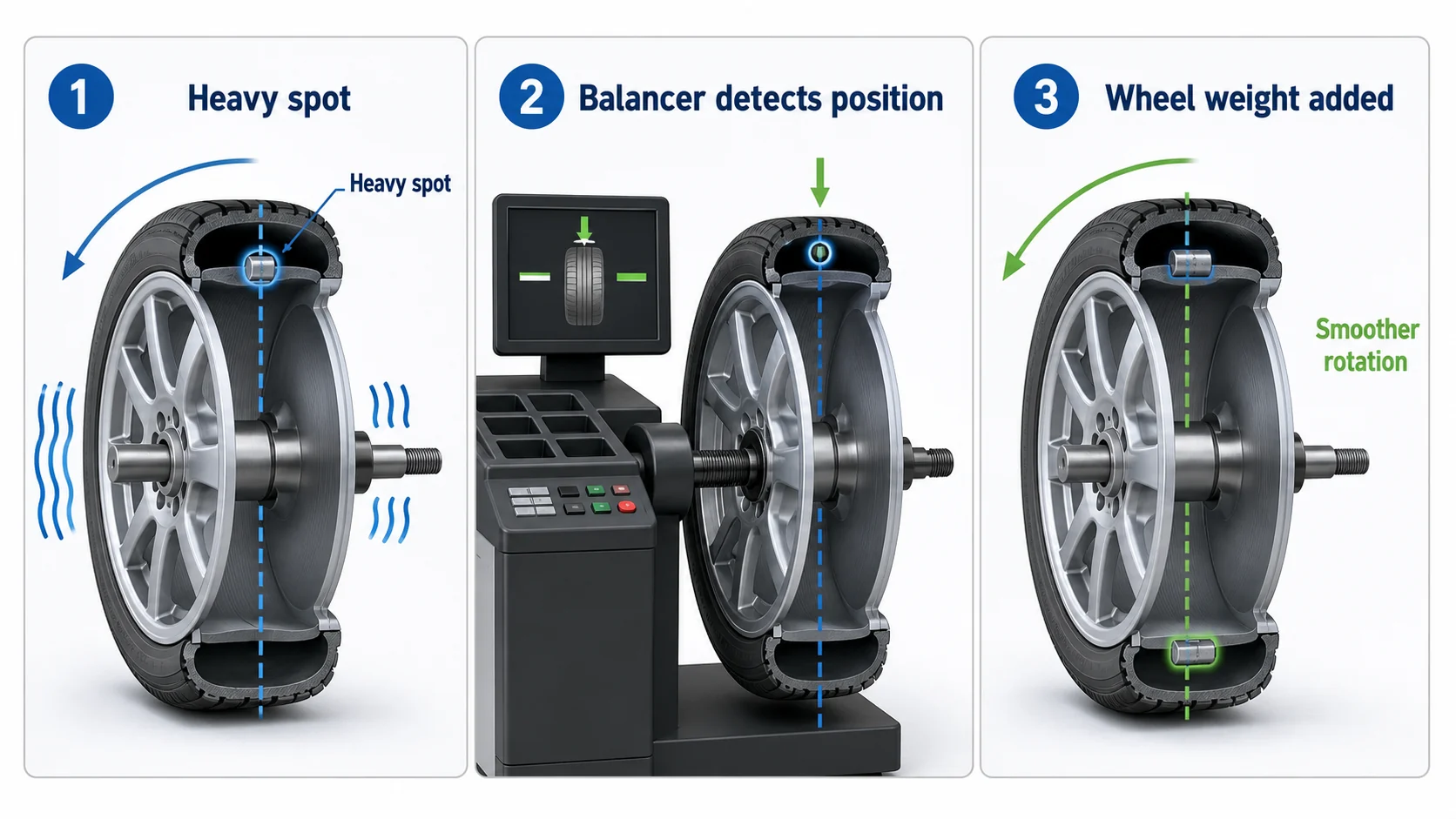
The basic process is:
- The technician mounts the tire and wheel assembly on the balancer.
- The machine spins the assembly at controlled speed.
- Sensors detect where the imbalance is strongest.
- The display shows the required correction amount and position.
- The technician applies clip-on, stick-on, or another balancing solution.
- The assembly is spun again to confirm the result.
The balancer does not choose the best product type by itself. That depends on the wheel, vehicle, installer preference, and available stock. A steel wheel may accept a clip-on weight on the flange. A premium alloy wheel often needs adhesive weights hidden inside the barrel. Some heavy-duty or off-road applications may use internal balancing beads when appropriate.
Accuracy depends on both the machine and the product. Poorly calibrated equipment, wrong cone mounting, dirty wheels, incorrect rim dimensions, weak adhesive tape, or a mismatched clip profile can all produce poor results even when the weight amount looks correct.
What are the common symptoms of missing or incorrect wheel weights?
Missing or incorrect wheel weights can cause vibration, steering wheel shake, uneven tire wear, noise, or a rough driving feel at certain speeds. The symptom often appears after tire service, a wheel impact, or after an adhesive strip or clip-on weight has detached.
Common signs include:
- steering wheel vibration at highway speed
- seat or floor vibration from rear-wheel imbalance
- uneven or cupped tire wear
- vibration that appears in a narrow speed range
- visible missing adhesive strip marks inside the wheel
- a clean spot on the rim flange where a clip-on weight used to sit
- repeated customer complaints after tire installation
Wheel weights are not the only possible cause. Bent wheels, damaged tires, worn suspension parts, brake rotor issues, wheel bearing problems, improper tire mounting, and road-force variation can create similar symptoms. If balancing does not solve the issue, the vehicle may need deeper inspection.
For product buyers, recurring field complaints can point to part quality rather than vehicle condition. Examples include adhesive tape that fails in cold or wet conditions, coating that rusts quickly, clip profiles that do not fit the local rim mix, or carton labels that cause shops to choose the wrong size.
What are the main types of wheel weights?
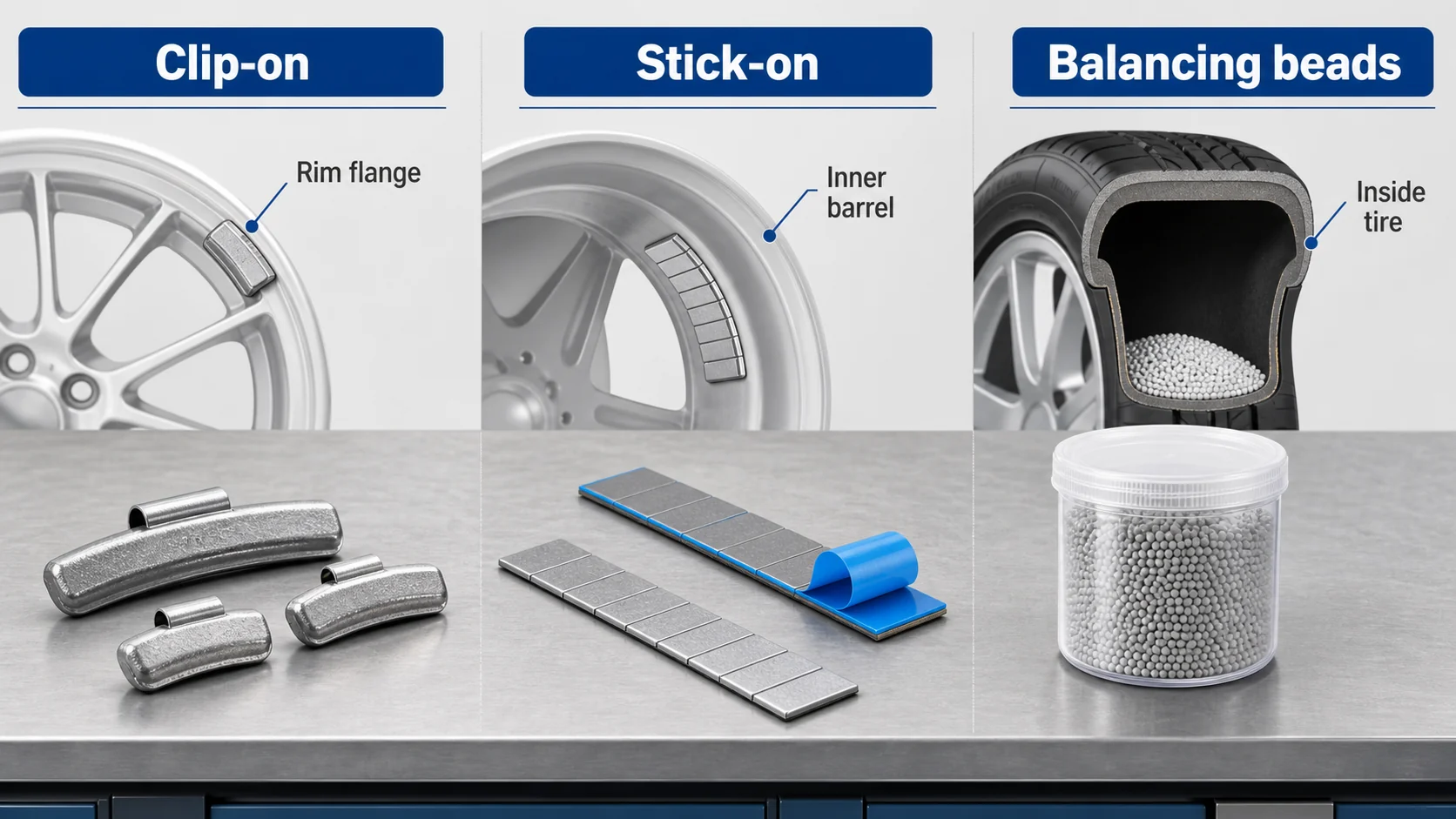
The main types are clip-on wheel weights, stick-on wheel weights, and balancing beads. Clip-on weights attach to a rim flange, stick-on weights use adhesive tape on the inner wheel barrel, and balancing beads move inside the tire to help counter imbalance dynamically.
| Type | How it attaches | Common use | Main buyer concern |
|---|---|---|---|
| Clip-on wheel weights | Metal clip grips the rim flange | Steel wheels, trucks, many shop applications | Correct clip profile and flange fit |
| Stick-on wheel weights | Adhesive tape bonds to the inner barrel | Alloy wheels, passenger cars, clean appearance | Tape quality, surface preparation, packaging |
| Balancing beads | Loose beads inside the tire | Heavy-duty, truck, bus, off-road, selected specialty uses | Tire compatibility and installation method |
Clip-on wheel weights are fast to install and remain common for steel wheels. They need the right clip shape for the rim flange. If the clip is mismatched, it may damage the wheel finish, install loosely, or detach in service.
Stick-on wheel weights, also called adhesive wheel weights, are widely used for alloy wheels because they can be placed inside the wheel barrel without marking the visible rim face. The tape must bond to a clean, dry surface. Moisture, brake dust, low temperature, and poor pressure during installation can reduce adhesion.
Balancing beads are installed inside the tire and move as the tire rotates. They are more common in heavy-duty or specialty applications than in ordinary passenger car tire service. They are useful in the right context, but they are not a universal replacement for external wheel weights.
Material is a second layer of selection. Lead was historically common because it is dense and easy to form, but lead wheel weights are restricted, banned, or discouraged in many markets because lost weights can enter the environment 1. The EU End-of-Life Vehicles Directive also addresses hazardous substances in vehicles and includes lead restrictions and exemptions that buyers should verify for the target application 2. Steel and zinc are common lead-free alternatives.
Buyers who already understand the attachment routes can use attachment choices for the wheels a service network handles to decide which format belongs in a practical range. The same format can be supplied in different materials, so how material affects the finished weight helps separate material choice from basic product function.
When should wheel weights be replaced?
Wheel weights should be replaced when tires are mounted, when a balance check shows a new correction is needed, when old weights are missing or damaged, or when adhesive, coating, clip fit, or corrosion condition makes the existing weight unreliable.
Replacement is normal during tire service. A technician may remove old weights, clean the wheel, balance the assembly, and apply new correction weights based on the current measurement. Reusing old adhesive weights is usually not practical because the tape has already been compressed and contaminated. Clip-on weights may also lose holding force or damage the rim if removed and reinstalled repeatedly.
Wheel weights may also need replacement after:
- tire rotation with a rebalance
- seasonal tire change
- wheel repair or repainting
- rim cleaning that removes adhesive residue
- a visible missing weight mark
- vibration after impact
- corrosion on old weights or clips
- switching from lead to lead-free material
Installers should avoid stacking random weights without checking the balancer. Too much correction in the wrong place can create new imbalance. If a wheel needs an unusually large amount of weight, the technician may need to inspect tire seating, rim condition, tire uniformity, or mounting position before simply adding more weight.
What should buyers check before ordering wheel weights?
Buyers should confirm wheel type, attachment method, material, size system, coating, adhesive tape, clip profile, packaging, compliance documents, and sample performance before placing repeat orders. The right product is not just the right gram value; it must fit the real wheels and service conditions in the target market.
For a basic ordering review, check:
| Buyer checkpoint | What to confirm |
|---|---|
| Wheel application | Steel wheels, alloy wheels, passenger cars, SUVs, trucks, EVs, or mixed market |
| Product type | Clip-on, stick-on, or specialty balancing product |
| Material | Steel, zinc, or another accepted lead-free material; lead only where allowed and requested |
| Size system | Metric grams, imperial ounces, or both |
| Clip fit | Rim flange profile, holding strength, and wheel-finish risk |
| Adhesive tape | Tape brand or grade, liner quality, temperature guidance, and clean-surface instructions |
| Surface finish | Galvanized, coated, epoxy-coated, or other corrosion protection |
| Packaging | Carton quantity, strip format, labels, barcode, private label, and shop usability |
| Documents | Material declaration, REACH/RoHS requests where applicable, test reports, or buyer-specific compliance files |
| Samples | Trial installation, adhesion check, corrosion check, and carton inspection before bulk order |
Distributors should also think in product-range terms. A market with many steel wheels may need a stronger clip-on program. A market focused on alloy wheels may need more adhesive strips, cleaner packaging, and stronger tape options. A region moving away from lead needs a clear steel or zinc plan before customers start asking for documentation.
When the wheel mix and buying requirements are known, buyers can compare clip-on and adhesive wheel-weight formats against their needed material, weight increments, tape or clip requirements, and packaging preference. The checklist above can then support a sample request or a more precise repeat-order specification.
Before asking for a carton count, buyers should define the size system behind the range being quoted so grams, ounces, and segment increments match the market served. After the application, attachment route, and unit system are clear, wheel-weight formats to review after the application is defined provide a focused product review instead of an unstructured category browse.
If you are deciding which wheel-weight formats to stock or source, share the wheel types, attachment method, material, size range, and service market you need to cover. We can help you narrow the options into a practical sample request.
Conclusion: Small parts, precise job
Wheel weights are small, but their job is exact. They correct mass imbalance in the tire and wheel assembly so the vehicle can run more smoothly, tires can wear more evenly, and shops can finish tire service with a measurable result.
The best choice depends on the wheel and market. Clip-on weights suit many steel wheel and fast-service applications. Stick-on weights are usually better for alloy wheels and clean appearance. Steel and zinc have become important lead-free choices where environmental expectations, regulations, or buyer requirements matter. Before ordering, confirm fitment, size range, material, coating, tape or clip quality, packaging, and compliance needs.
Frequently Asked Questions
What are wheel weights used for?
Wheel weights are used to correct imbalance in a tire and wheel assembly. They reduce vibration by adding a precise amount of weight at a specific position identified by a balancing machine.
Are wheel weights the same as tire balancing?
No. Tire balancing is the service process that measures and corrects imbalance. Wheel weights are the physical parts used during that process to add the required correction weight.
Do all wheels need wheel weights?
Most tire and wheel assemblies need some correction after mounting, but the amount varies. Some may need only a small adhesive segment, while others need multiple weights on inner and outer planes.
Can wheel weights fall off?
Yes. Clip-on weights can detach if the clip profile is wrong or the rim is damaged. Stick-on weights can fall off when the surface is dirty, wet, cold, poorly prepared, or when the adhesive quality is weak.
Which wheel weights are best for alloy wheels?
Stick-on adhesive wheel weights are commonly preferred for alloy wheels because they can be installed inside the wheel barrel and avoid scratching the visible rim flange.
Are lead wheel weights still used?
Lead wheel weights still exist in some markets, but many buyers have moved toward steel or zinc because lead is restricted, banned, or discouraged in various regions and supply chains. Always verify the target market before ordering.
References
[1] United States Environmental Protection Agency. “Best Management Practices for Lead Wheel Weights.” 2015.
[2] EUR-Lex. “Directive 2000/53/EC on end-of-life vehicles.” 2000.
[3] Wikipedia. “Tire balance.” 2025.