



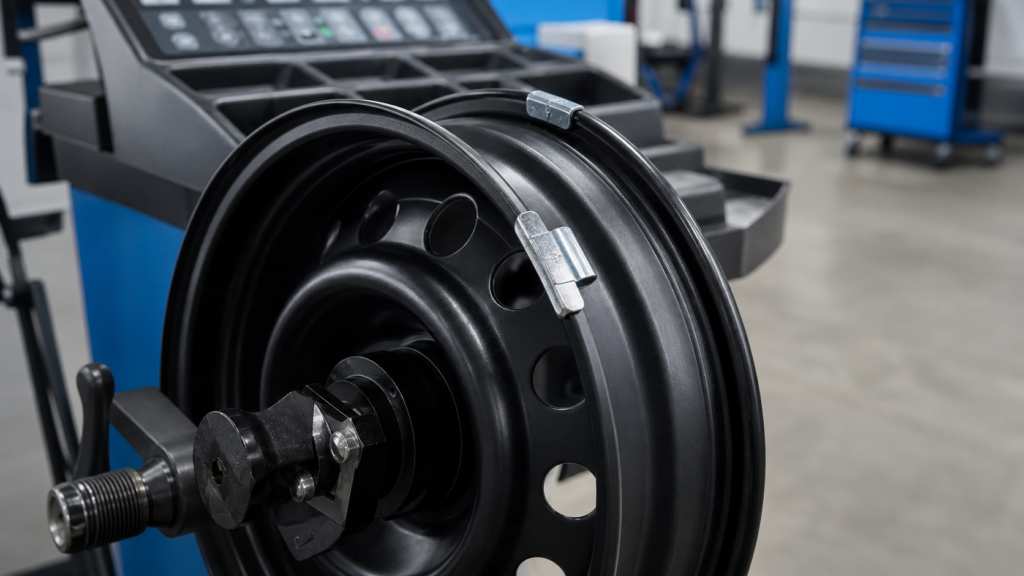
Wheel weights for steel wheels are usually clip-on balancing weights, but “steel wheel” is not a clip specification. The correct choice depends on the actual rim-flange profile, vehicle service class, clearance, and the correction requested by the balancer. Identify the wheel, match the profile, and approve a representative sample before treating a part number as a repeat-order fit.
This page focuses on steel-wheel clip selection and sample approval. For the broader choice of weight types and materials, use the wheel-balancing weights overview; for grams, ounces, and correction increments, use the wheel weight size chart.
Table of Contents
- What are wheel weights for steel wheels?
- How do you choose a clip-on weight for a steel wheel?
- What wheel weights fit steel wheels?
- What should a steel-wheel sample approval card record?
- What should buyers include in a steel-wheel weight specification?
- How should a clip-on weight be installed and checked?
- Which wheel-weight reference should you use next?
- Conclusion: Verify the clip, then approve the SKU
- Frequently Asked Questions
- References
What are wheel weights for steel wheels?
Wheel weights are small correction masses fitted where a balancing machine indicates to offset imbalance in the tire-and-wheel assembly. Steel wheels commonly use clip-on weights because a suitable rim flange can provide a mechanical attachment point, but the steel material alone does not identify the right clip.
A clip-on weight has at least two separate fit decisions: the mass must match the balancer’s correction request, and the clip must match the rim flange. A 25 g weight with the wrong profile is still the wrong part. Material and coating are additional specification choices; neither can compensate for a clip that does not seat correctly.
Steel wheels appear in passenger-car winter sets, fleet service, light trucks, trailers, and other cost-focused applications. These groups do not necessarily share one flange shape or one weight series. For a steel-wheel program, define the recurring wheel applications first, then identify the approved clip and mass range for each one.
How do you choose a clip-on weight for a steel wheel?
Choose a clip-on weight by identifying the actual wheel and flange, checking the relevant application chart or gauge, and confirming the candidate on a representative sample. A vehicle description or “for steel wheels” label narrows the search, but it is not final fitment evidence.
- Identify the wheel. Record the wheel maker, model or part number, size, finish, and whether the application is passenger-car or light-truck service. If the wheel has been replaced with an aftermarket rim, record that rather than relying only on the vehicle model.
- Capture the flange. Photograph the intended mounting area with a scale, or send a representative rim sample or drawing. Note lip thickness, rolled edge shape, flange depth, and nearby cover or brake clearance where those details are available.
- Check the product maker’s application information. Use the correct brand’s chart or rim gauge. Clip-series names are not a universal cross-brand standard, so do not assume that the same letter code from two suppliers describes the same geometry.
- Trial-fit the sample. Confirm the clip seats naturally at the approved position, makes the intended contact with the flange, and leaves the weight body and surrounding wheel components in the required clearance.
- Match the correction value. Choose the mass and gram or ounce increment requested by the balancing machine. Fitment and weight amount are separate checks; the wheel weight application chart covers the general flange-matching process.
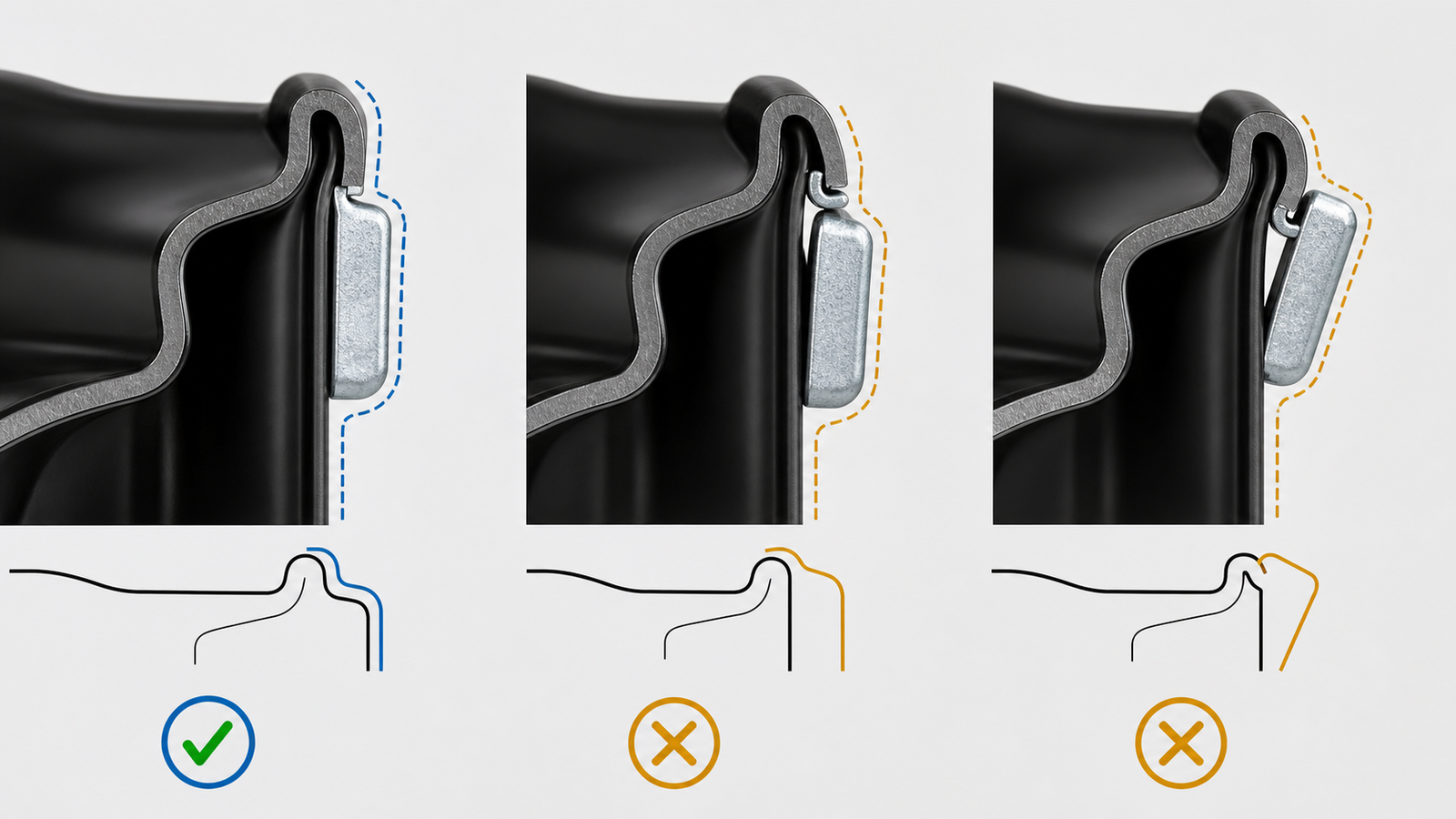
For nonstandard, painted, corroded, or damaged flanges, do not turn a visual resemblance into a compatibility claim. The safest outcome may be to hold the sample, confirm the wheel maker’s approved position, or evaluate another attachment method rather than force a questionable clip.
What wheel weights fit steel wheels?
No single clip-on weight fits every steel wheel: manufacturers define each series for particular rim flanges and vehicle classes. Use published applications to narrow the options, then confirm the exact wheel with a gauge or representative-rim sample before placing a repeat order. 1 2
| Published example | What the source specifies | What a buyer should take from it |
|---|---|---|
| Passenger-car steel wheel | Perfect Equipment’s 2022 U.S. catalog lists its PFE series for passenger-car steel wheels with standard-width rim flanges on 13–17-inch wheels, with listed sizes from 0.25 to 2.50 oz. 1 | This describes that catalog’s PFE range. It does not approve every 13–17-inch steel wheel or every similarly named profile. |
| Full-size pickup or van | Plombco lists PFe steel weights for passenger vehicles with steel wheels, but also advises TPS or TFe light-truck weights for full-size pickup and van applications because PFe may overstress the clip and fail. 2 | Read the maker’s application notes and service-class limits together; do not select from the broad vehicle label alone. |
| Clip-on weight field losses | An SAE paper reported a field rate of 0.0044 clip-on weight failures per vehicle per year, based on weights collected over two years in three ZIP-code areas. The abstract attributed most failures to “controlled drift into terrain” and a smaller fraction to faulty installation. It does not isolate steel wheels or represent a current product failure rate. 3 | A missing weight does not by itself prove a clip mismatch. Record the wheel, fit, installation, and any relevant impact history before assigning a cause. |
What this means when you’re choosing a weight: If you’re fitting a passenger-car steel wheel, use the catalog range to narrow the candidates—not as proof that a particular clip fits your rim. For a full-size pickup or van, check the maker’s light-truck note before ordering; Plombco warns that a passenger-car PFe clip may overstress and fail in that application. 2 Then compare the candidate with the actual flange, trial-fit an unmodified sample, and record the wheel, part number, correction mass, and result on the approval card below. If a weight goes missing later, check for impact or installation issues before blaming the clip. 3
What should a steel-wheel sample approval card record?
Use one approval card for each sample profile and representative rim combination. The record should let a technician repeat the fit check and let a buyer tie the approved sample to the exact quoted part, finish, increment, and production lot.
Steel-wheel clip-on sample approval card
Sample identity
- Buyer, workshop, or project:
- Supplier and sample date:
- Sample part number / clip series / revision:
- Material and coating:
- Lot or sample-batch reference:
Reference wheel
- Wheel maker and model or part number:
- Wheel size and vehicle/service class:
- Wheel condition and finish:
- Flange photo or drawing attached:
- Flange measurements or gauge result:
- Approved weight location:
Correction and installation
- Balancer correction value and unit: ___ g / ___ oz
- Required mounting plane or position:
- Tool and installation method used:
- Did the clip seat naturally without bending or modification? Yes / No
- Does the clip engage the intended flange contact points? Yes / No
- Does the weight body sit in the intended orientation? Yes / No
- Brake, wheel-cover, and adjacent-part clearance checked? Yes / No
- Re-spin or specified retention check completed? Yes / No / N/A
- Test method and result, if a documented method applies:
Part and finish checks
- Marked mass matches the agreed specification? Yes / No
- Coating intact after installation? Yes / No
- Burrs, sharp edges, or visible damage found? Yes / No
- Sample SKU, label, and packaging match the quotation? Yes / No
Disposition
- Decision: PASS / HOLD / REJECT
- Approved wheel applications and known exclusions:
- Open issue or reason for rejection:
- Evidence attached: photos / drawing / gauge result / test record
- Reviewed by and date:
Approve only the wheel applications actually represented by the rim sample or reliable application data. A pass on one rim should not be expanded to every steel wheel in the vehicle category. If the sample will not seat as designed, mark it HOLD or REJECT and record why; do not alter the clip to make the sample appear to fit.
What should buyers include in a steel-wheel weight specification?
A useful specification separates fitment, correction mass, material, and packing so each can be checked independently. For a sample request or repeat order, include:
| Specification field | What to provide |
|---|---|
| Application scope | Representative wheel IDs, passenger or light-truck use, and known exclusions |
| Clip profile | Supplier series or part number, plus the flange chart, gauge result, or approved rim sample |
| Correction range | Grams or ounces, increments, individual piece sizes, and the balancer output used by the shops |
| Material and finish | Steel or other approved material, coating or color, and any customer-specific corrosion or finish requirement |
| Sample acceptance | Required seating, contact, clearance, mass, finish, and retention checks, using a documented method where one applies |
| Packaging and traceability | Part-number separation, quantity per tray or box, label details, and lot identification |
If the purchase decision is mainly about grams, ounces, or stock increments, continue with the wheel weight size chart. If the open question is whether steel, zinc, or lead better fits a destination market and product program, use the lead, steel, and zinc comparison. Material choice belongs in the specification, but it does not replace flange approval.
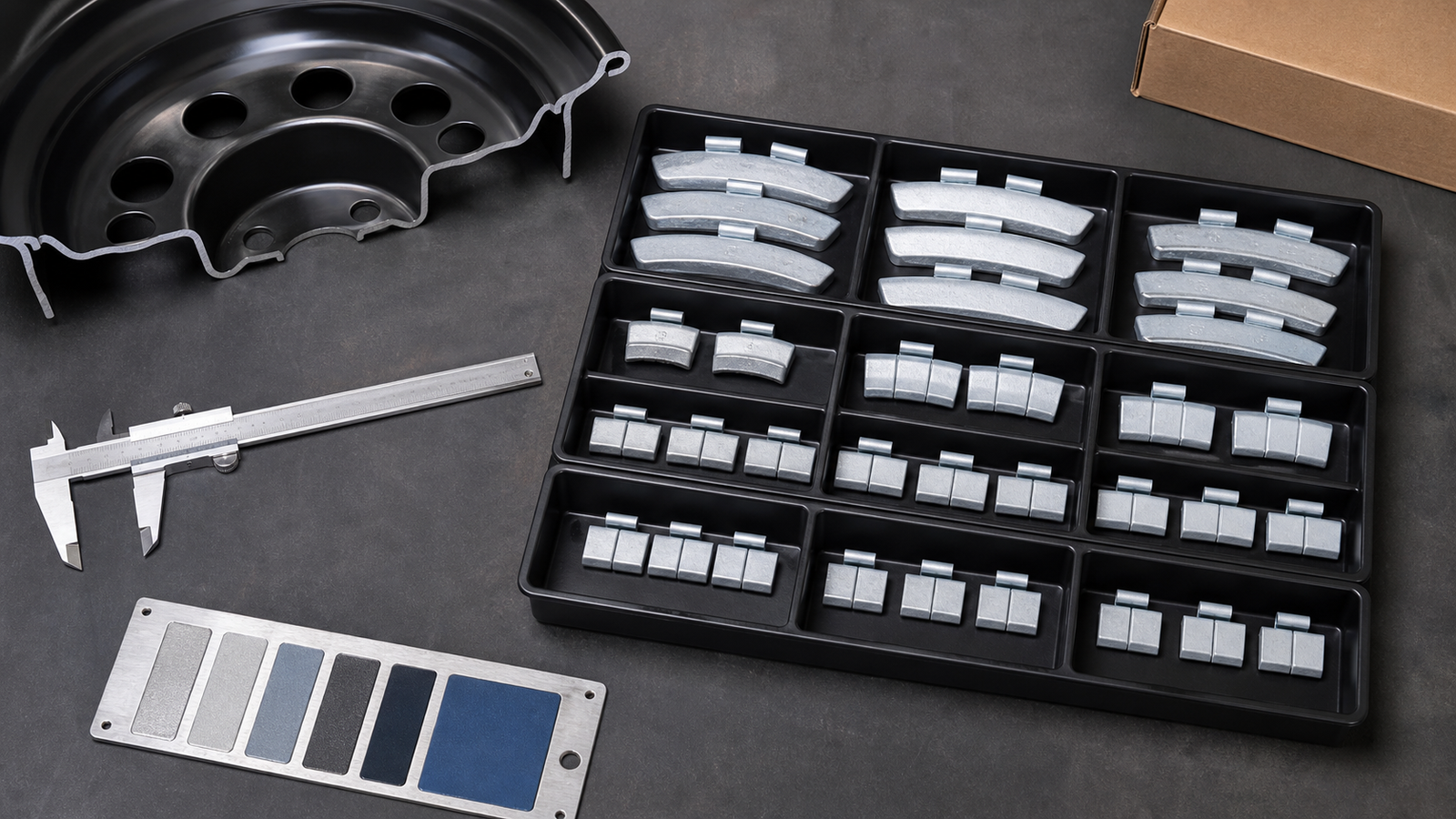
For shops serving mixed vehicle populations, keep the inventory logic separate by clip profile and mass. A tray sorted only by weight can still lead to a wrong-profile installation. The tire-shop stocking guide covers the broader assortment and replenishment question.
How should a clip-on weight be installed and checked?
Install the approved weight at the position indicated by the balancing machine, using the relevant wheel and weight instructions. Before installation, check the flange for bends, heavy corrosion, old damage, or coatings that could affect seating.
Use the product maker’s recommended installation tool and strike location. Plombco advises using its application chart or rim gauge to select the profile and warns not to bend a clip when a weight does not fit. 4 After fitting, check engagement, orientation, finish condition, and clearance, then follow the balancer’s recheck procedure.
If the weight needs repeated force to sit, rocks on the flange, or touches a component it should clear, stop. Recheck the rim profile, selected series, and approved weight position instead of trying to reshape the clip. Professional installation and the wheel maker’s instructions take precedence over a generic article or catalog description.
Which wheel-weight reference should you use next?
Use the reference that matches the unresolved decision rather than expecting one page to answer every wheel-weight question.
| If you need to… | Use this related resource |
|---|---|
| Compare clip profiles with flange geometry and measurement points | Wheel weight application chart |
| Convert grams and ounces or plan correction increments | Wheel weight size chart |
| Compare clip-on, adhesive, and other wheel-balancing formats | Wheel-balancing weights overview |
| Compare lead, steel, and zinc material trade-offs | Lead, steel, and zinc comparison |
| Plan a tire-shop assortment and replenishment system | Tire-shop stocking guide |
This steel-wheel page stays focused on clip selection, the real application boundaries, and a repeatable sample approval record. For available formats, continue to the wheel-balancing weights range.
Conclusion: Verify the clip, then approve the SKU
Steel wheels often use clip-on weights, but the rim material does not define the clip profile. Public application examples show that flange width and vehicle service class can change the appropriate series, while field research shows that a lost weight does not automatically identify the cause.
Record the reference wheel, profile, correction value, installation result, finish, and decision on a sample approval card. Then tie the approved fitment scope to the part number and packing label. For a new or replacement range, request a wheel-weight sample and fitment review before committing to a broad steel-wheel claim.
Frequently Asked Questions
Are all steel wheels compatible with the same clip-on weight?
No. Steel wheels can have different flange widths, shapes, finishes, and clearance conditions. Confirm the specific profile using the weight maker’s chart or gauge and a representative wheel sample.
Can I select a steel-wheel weight by vehicle model alone?
A vehicle model can help narrow the application, but wheel options and service classes may differ. Record the actual wheel or rim-flange information and verify the candidate weight before approving it.
What is the difference between PFE and TFE wheel weights?
PFE and TFE are product-series names used by particular manufacturers, not universal codes that guarantee cross-brand fitment. Published catalogs describe them for different application ranges; use the relevant manufacturer’s current chart and verify the actual rim.
What should I do if a clip-on weight does not fit?
Stop and check the rim flange, application chart, and selected profile. Do not bend or modify the clip to force a fit; use the manufacturer’s instructions and an appropriate rim gauge.
Does a lost wheel weight prove the clip was the wrong size?
No. Fitment is one possible cause, but field-loss data have also examined other causes. Inspect the wheel and clip, review installation and retention evidence, and record any relevant impact or wheel damage rather than assigning a cause from the missing part alone.
References
[1] Perfect Equipment. “Product Catalog.” 2022.
[2] Plombco. “Steel Passenger Car Clip-On Wheel Weights.”
[3] SAE International. “Field Reliability of Wheel Balance Weights.” 1999.
[4] Plombco. “Installation Instructions.”