



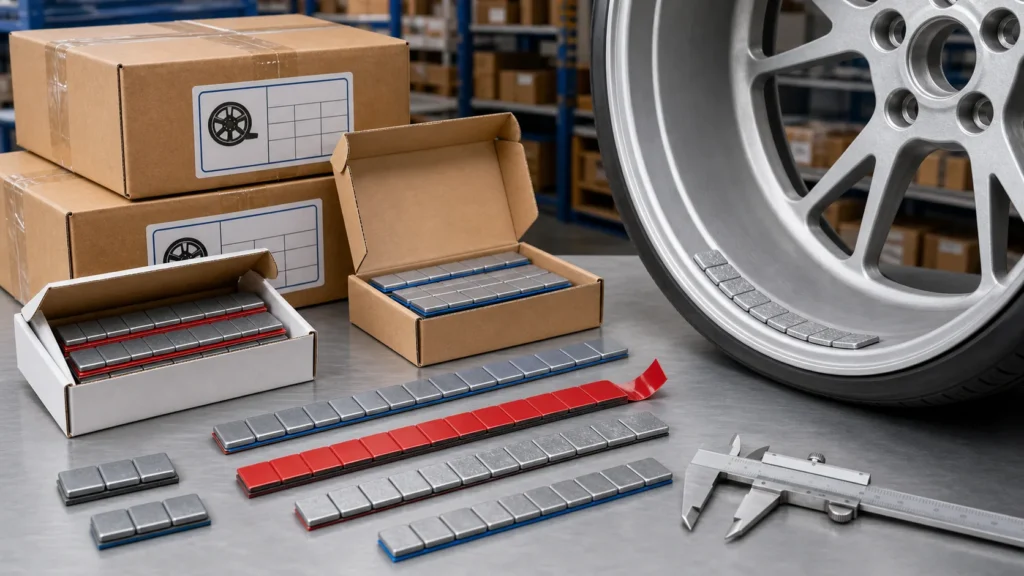
Wheel weight strips are segmented adhesive balancing weights supplied in strip, roll, tray, or boxed formats. Buyers should evaluate segment size, total strip mass, tape option, liner behavior, material, coating, and bulk packaging together because the strip must match both the balancing-machine correction value and the installer's workflow.
For distributors, tire-service chains, and importers, wheel weight strips are not simply a lower-cost adhesive product. A good strip range lets technicians build common correction masses quickly, keeps SKUs understandable, protects tape during storage, and makes repeat orders easier to control. The buying decision should start with strip format and use case before moving to carton price.
Table of Contents
- What are wheel weight strips?
- Which wheel applications use weight strips?
- Should I choose pre-segmented wheel weight strips or a roll?
- How do tape and liner options affect strip performance?
- What packaging formats work for bulk wheel weight strips?
- What should buyers confirm before bulk ordering wheel weight strips?
- How do I approve a wheel weight strip sample?
- How should buyers compare price, MOQ, and repeat-order risk?
- Conclusion: buy the strip system, not only the strip weight
- Frequently Asked Questions
- References
What are wheel weight strips?
Wheel weight strips are adhesive-backed balancing weights made from repeated segments arranged on a tape backing. The technician separates the needed number of segments and applies the strip inside the wheel barrel at the position indicated by the balancing machine.
The strip format is common because it turns many correction values into one flexible product family. Instead of stocking every adhesive weight as an individual piece, a shop can use segmented strips to build the requested mass. That makes strip design especially important for buyers who serve many workshops or resell wheel weights in bulk.
A strip normally includes several linked choices: the mass of each segment, segment spacing, strip length, metal material, coating, tape construction, liner, and packaging. If any one of those choices is wrong, the strip may still look acceptable in a product photo but create problems during installation, storage, or repeat ordering.
Buyers planning a full product range can use range planning across wheel-weight formats and applications to decide where strips belong beside clip-on weights, individual adhesive weights, steel options, zinc options, and market-specific size systems.
Which wheel applications use weight strips?
Wheel weight strips are mostly used for adhesive balancing applications, especially alloy wheels and appearance-sensitive passenger-car wheels. They are also useful for service channels that need flexible correction masses without carrying many separate adhesive SKUs.
The usual application is the inner wheel barrel. A strip can sit behind the wheel face, helping preserve the visible finish. This makes it practical for alloy wheels, premium vehicles, EVs with clean wheel designs, and workshops that prefer hidden correction weights.
Application fit still depends on the wheel. The strip must sit flat enough for good tape contact, clear nearby components, and match the available barrel space. Segment thickness, strip flexibility, and total strip length are not cosmetic details; they decide whether the technician can install the correction neatly.
For buyers serving alloy-heavy accounts, alloy-wheel strip fit and barrel clearance helps connect strip dimensions with the real wheel surface. That step matters before deciding whether a compact segment, longer strip, or different tape option should be sampled.
Wheel weight strips may also be part of a mixed-market range. A distributor might sell clip-on weights for steel wheels and adhesive strips for alloy wheels, with both lines using grams or ounces depending on the local balancer population. The order plan should follow the customer's wheel mix, not a generic catalog list.
Should I choose pre-segmented wheel weight strips or a roll?
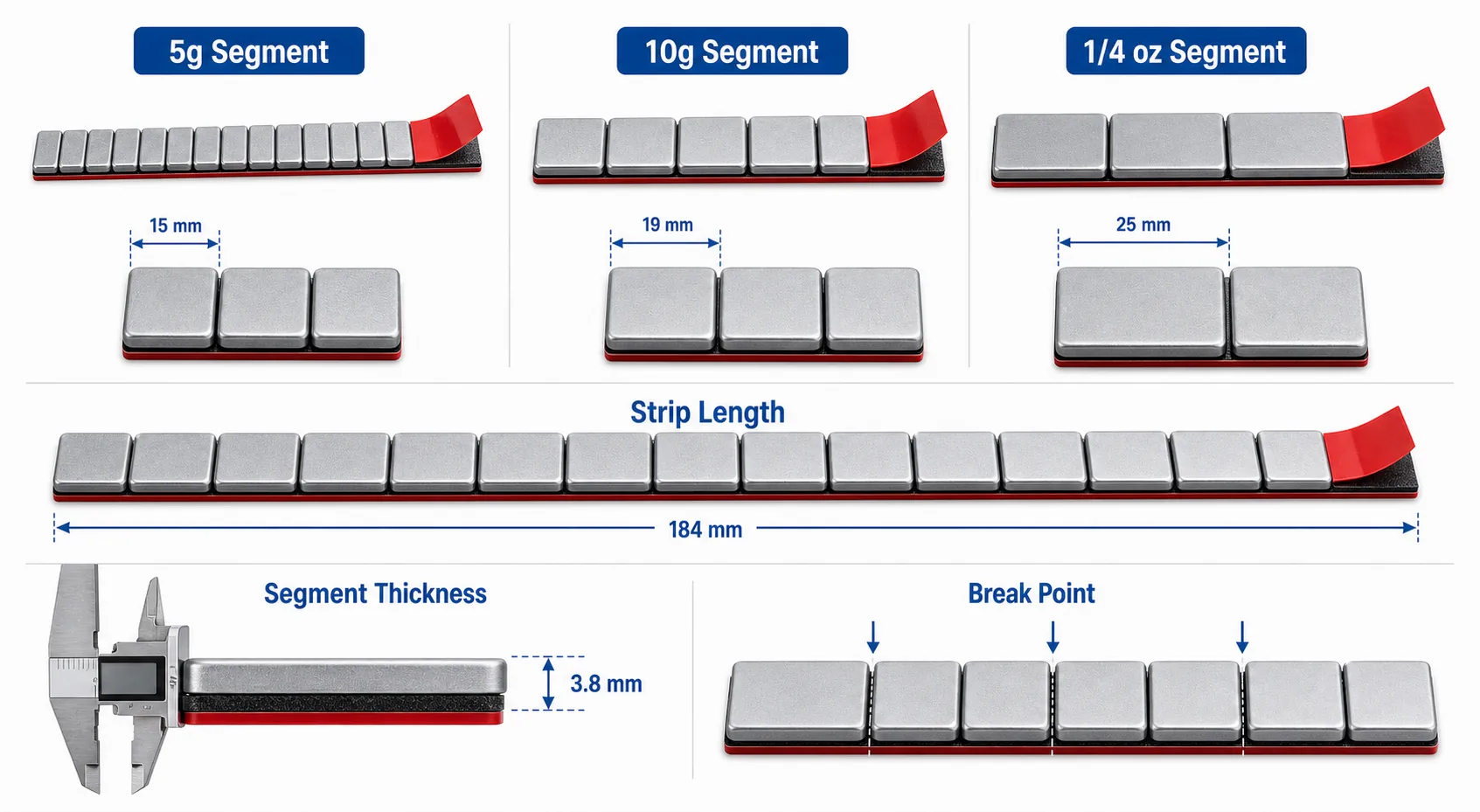
Pre-segmented strips suit shops that use familiar correction increments and want quick, countable pieces. Rolls suit variable corrections only when the supplier specifies a verified mass-per-length value and a repeatable cutting method. Without those details, roll yield and cost per correction cannot be calculated reliably.
| Format | How it is used | Works well when | Confirm before ordering |
|---|---|---|---|
| Pre-segmented strip | Select or break fixed-mass pieces | Common correction values repeat and fast counting matters | Mass per segment, count per strip, nominal strip mass, break design, and tolerance |
| Roll | Cut a measured length using an agreed scale or calibrated cutter | Corrections vary and the shop can control and verify each cut | Net roll length and mass, mass per unit length, cutter method, and tolerance |
A roll can be a complete cut-to-weight system, not just continuous stock. 3M’s 2026 technical data sheet lists roll lengths and specifies compatible cutting equipment for its wheel-weight products [3]. Use that as an example of the information to request, not as a specification for Yirox products.
The three Yirox examples below illustrate what a useful specification comparison looks like: one clearly countable strip, one mixed-increment option that needs clarification, and one roll that lacks the data needed for yield calculations.
| Product | Listed configuration | What you can conclude | Confirm before order |
|---|---|---|---|
| YX-WW-076 zinc adhesive strip, 5 g x 12 | 12 segments at 5 g each; blue tape; zinc-plated finish | Segment count and nominal full-strip mass can be calculated. | Current drawing, dimensions, tolerances, and sample conformity. |
| YX-WW-075 zinc strip with mixed 5 g and 10 g increments | A 5 g + 10 g configuration marked x 4, with blue tape | The mixed increments are indicated, but the notation does not make the total piece count unambiguous. | Exact sequence and count, total nominal mass, dimensions, and approved drawing. |
| YX-WW-055 grey steel adhesive roll | Identified as a 5 g roll; roll length and mass-per-length are not stated with that configuration. | It is a roll-format option, but the available details are insufficient to calculate yield or cut length. | What the 5 g value represents, net roll length and mass, mass per metre, and cutter method. |
Worked example: YX-WW-076 is listed as 12 segments at 5 g each. For a 40 g balancer correction, divide 40 by 5: use 8 segments.
Four segments remain, or 20 g nominal. The full strip adds up to 60 g nominal (12 x 5 g).
This is planning arithmetic from the listed values, not a tolerance guarantee or installation instruction. Confirm the approved drawing and sample, and follow the balancer’s procedure. If the requested correction is not divisible by 5 g, choose a finer increment or an approved mixed-size option instead of rounding.
For a roll, calculate cut length only after the supplier verifies mass per unit length. Divide the required correction mass by that value, then validate the cutter with sample pieces. Without the conversion value, cost per correction and usable yield remain unknown.
For gram-to-ounce range planning, use the wheel-weight size chart; confirm physical dimensions and tolerances on the product drawing and approved sample.
How do tape and liner options affect strip performance?
Tape and liner options affect how the strip is stored, handled, applied, and retained on the wheel. The tape must bond to a properly prepared surface, while the liner must protect the adhesive and release cleanly at the moment of installation.
General tape guidance emphasizes clean surfaces, suitable application conditions, and pressure because pressure-sensitive adhesives need intimate surface contact.1 That principle applies directly to wheel weight strips. A tape name or color is not enough; buyers need to know how the tape behaves on the intended wheel surface and under target shop conditions.
The liner is equally practical. In a busy tire shop, technicians may wear gloves, work quickly, and handle strips near brake dust, tire lubricant, and moisture. If the liner is difficult to remove, tears easily, lifts the tape, or exposes adhesive during storage, the strip can fail at the workflow level even before adhesion is tested.
For buyers comparing tape systems, adhesive tape and installation requirements provide the installation-side checks that should sit beside the strip RFQ. After reading that, a buyer can better define sample conditions before approving a bulk strip order.
Useful tape and liner questions include:
- What tape construction is supplied with the strip?
- What surface preparation and application temperature does the supplier recommend?
- Does the liner remove cleanly with gloves?
- Does the tape stay bonded to the metal segment when the liner is peeled?
- Does the strip remain flat after storage in the intended inner pack?
- Are different tape options available for different climates or customer requirements?
Do not treat tape upgrades as a universal answer. Stronger tape may not fix a dirty wheel surface, an overly stiff strip, or a storage problem that crushes the liner. Tape, segment geometry, packaging, and installation conditions need to be tested together.
What packaging formats work for bulk wheel weight strips?
Bulk wheel weight strip packaging should protect the tape and liner, keep increments identifiable, and match the customer's warehouse and workshop workflow. A low carton price can become expensive if strips arrive curled, crushed, mixed, mislabeled, or hard to dispense.
Common options include loose strips in inner boxes, tray packs, rolls, dispenser boxes, sample kits, and larger cartons for distribution. The best option depends on how the buyer sells or consumes the product. A tire-shop chain may care about dispenser speed and point-of-use labeling; an importer may care more about carton cube, pallet stability, barcode requirements, and lot traceability.
| Packaging item | What to specify | Buying value |
|---|---|---|
| Inner box | Strip count, orientation, liner protection, and label | Protects the product and supports shop selection |
| Outer carton | Quantity, gross weight, dimensions, and carton strength | Helps freight planning and warehouse receiving |
| Labeling | Unit system, material, strip mass, product code, barcode, lot | Reduces picking and replenishment mistakes |
| Sample kit | Representative sizes, tape option, and approved packaging | Lets installers test real product, not only loose samples |
| Pallet plan | Cartons per pallet, export mark, and handling requirement | Supports bulk import and storage control |
| Traceability | Lot/date code and retained sample reference | Makes repeat-order checks and complaint handling easier |
For private-label programs, packaging is part of the product. The buyer should approve the carton label, inner-box layout, and any retail-facing artwork before mass production. A correct strip in the wrong box can still create receiving errors, shelf confusion, or customer complaints.
Bulk orders should also account for storage. Adhesive products need protection from dust, moisture, excessive heat, crushed liners, and uncontrolled compression. Ask how the supplier packs strips to maintain tape condition until installation, not just how many kilograms fit into a carton.
What should buyers confirm before bulk ordering wheel weight strips?
Before bulk ordering wheel weight strips, buyers should confirm segment layout, tape option, liner behavior, material, coating, inner-box format, carton quantity, and lot traceability. These details define whether the approved sample can become a repeatable order.
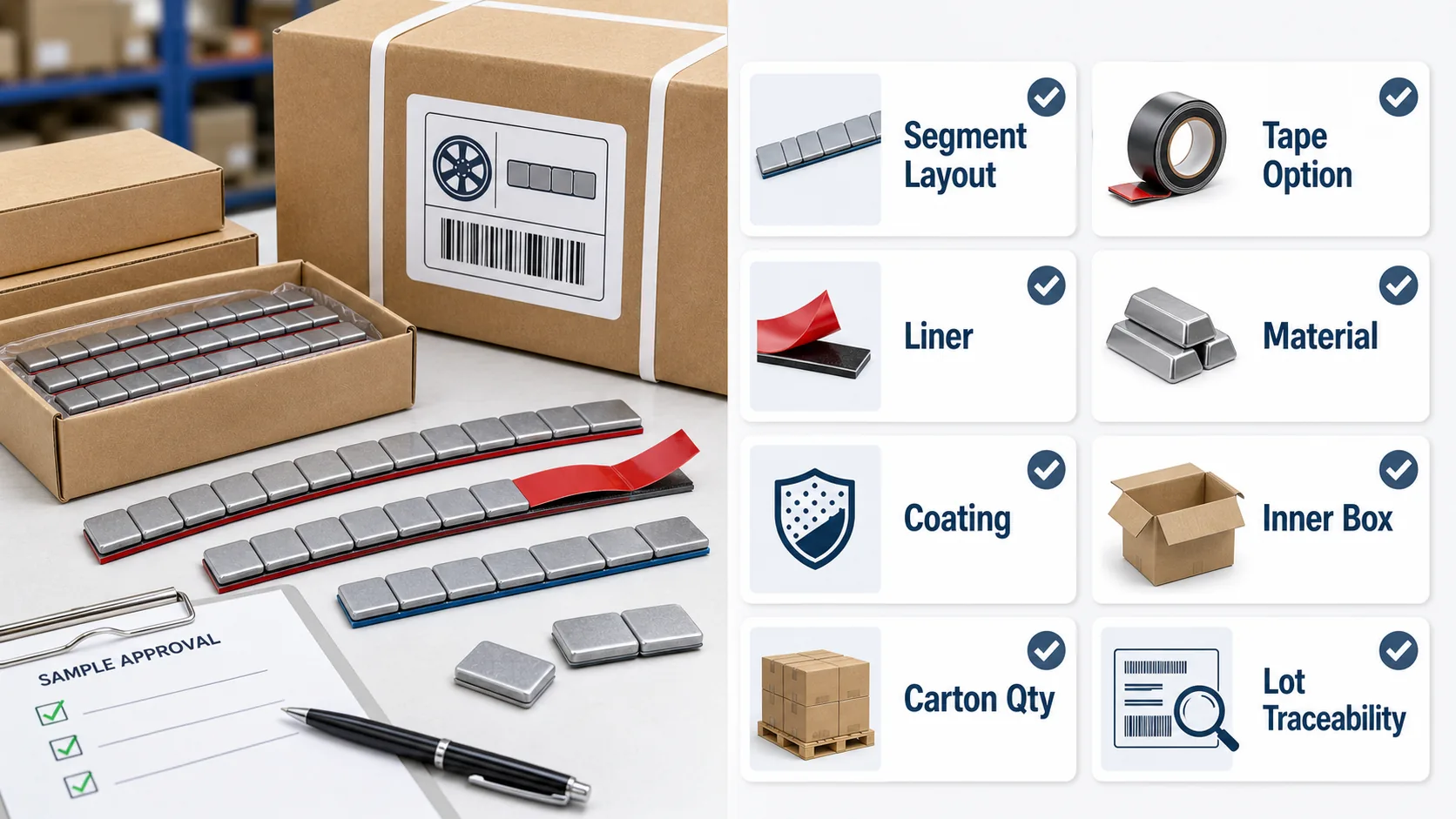
Use this RFQ checklist:
| RFQ item | What to write in the inquiry | Why it matters |
|---|---|---|
| Target market | Country, workshop type, grams/ounces, and wheel mix | Shapes labeling, range depth, and compliance expectations |
| Strip layout | Segment mass, segments per strip, total strip mass, dimensions | Defines the real product, not only the nominal weight |
| Tape option | Tape construction, liner, and installation guidance | Controls handling and retention risk |
| Material and coating | Steel, zinc, lead-free requirement, coating color or finish | Affects density, appearance, declarations, and storage life |
| Sample test | Wheel surface, temperature, dwell time, and approval method | Makes sample approval meaningful for bulk orders |
| Inner pack | Box, tray, roll, dispenser, strip count, and label | Determines workshop usability and resale format |
| Carton and pallet | Carton quantity, dimensions, weight, marks, pallet plan | Supports freight quoting and receiving |
| Lot control | Lot code, retained sample, inspection record, and complaint path | Protects repeat-order consistency |
Once these details are fixed, buyers can compare wheel weight strip samples that match the approved segment and tape specification. The category page then becomes useful for choosing the right product family, rather than a place to guess from photos.
For export markets, material declarations may matter before the order is even sampled. The U.S. Environmental Protection Agency has documented concerns around lost lead wheel weights, and many buyers now prefer lead-free wheel-weight programs or request non-lead documentation.2 State those requirements early so the quoted strip material, finish, and documents match the destination market.
How do I approve a wheel weight strip sample?
Complete this card against the approved drawing and written test limits before assessing the sample. Agree those limits in advance; mass, tape, wheel finish, and application conditions vary by product.
Sample record: Buyer/project __________ Supplier __________ Product code/revision __________ Sample lot/date __________ Wheel/application __________
| Check | Record | Pass when |
|---|---|---|
| Format and mass basis | Strip or roll; unit; segment mass/count and nominal strip mass; for a roll, net length/mass, mass per length, and cutter | Required fields are stated and agree with the drawing. Hold if the roll conversion or cut scale is missing. |
| Mass and dimensions | Agreed sample quantity; measured mass; width, thickness, segment length, break geometry, and tool | Recorded values fall within the written drawing tolerances. |
| Tape and liner | Tape/liner identification, storage condition, release behavior, and tape-to-weight condition | The liner releases by the agreed method without tearing or lifting the tape. |
| Wheel trial | Wheel/finish, cleaning method, supplier-stated temperature, pressure and dwell, result/photos | The agreed test is repeatable on the intended surface and meets its written limits. |
| Pack and traceability | Inner-pack/carton count, labels, unit, lot/batch, retained sample | Pack details match the order and the sample is traceable to its revision and lot. |
If a peel-adhesion result is part of the approval, specify the method and pass limit first. ASTM D3330/D3330M covers several pressure-sensitive-tape peel methods; results depend on tape construction and test setup, and the standard does not set a universal wheel-weight acceptance value [4].
Decision: Mark one status and record the reviewer and date.
- PASS: Required values are recorded and all checks meet the agreed specification.
- HOLD: A drawing, tolerance, roll conversion, or test condition is missing. Do not release bulk production.
- REJECT: A measured result is outside the agreed limit.
Reviewer __________ Date __________ Open issue/owner __________
Keep the card, measurements, photos, and retained sample together. If the supplier changes segment geometry, tape, liner, finish, roll scale, or packaging, compare the change with the approved record before accepting it. For repeat-order process and packing controls, see the wheel-weight manufacturing overview.
How should buyers compare price, MOQ, and repeat-order risk?
Buyers should compare wheel weight strip offers by landed value and repeat-order risk, not only unit price. The cheapest quote may cost more if tape performance is weak, carton counts are confusing, samples do not match bulk production, or the order requires rework after arrival.
Price comparison should include:
- quoted unit price and currency
- strip mass and number of segments per strip
- material and coating route
- tape option and liner quality
- inner-box and carton quantity
- carton dimensions and gross weight
- MOQ by size, tape option, and packaging style
- sample cost and sample lead time
- artwork, barcode, or private-label cost
- inspection, documents, and freight impact
MOQ should be checked at the configuration level. A supplier may offer a general MOQ for wheel weight strips, but the actual minimum can change by segment size, tape option, coating, carton design, or private label. Clarify whether mixed sizes can share a production lot, whether cartons can be combined, and which changes trigger a separate MOQ.
Repeat-order risk is often where the difference appears. If an approved sample uses one tape but the bulk order uses another, the initial price comparison becomes meaningless. If carton labels change, a distributor may face warehouse errors. If strip layout changes, installers may need to adjust habits. Put the approved configuration in writing and ask how future changes will be controlled.
Conclusion: buy the strip system, not only the strip weight
Wheel weight strips are practical because they let technicians build correction masses from a flexible segmented format. Their real value depends on more than nominal grams or ounces. Segment layout, tape option, liner behavior, material, coating, packaging, and lot control all decide whether the strip works in a real shop and repeats cleanly in bulk orders.
Before requesting a bulk quote, define the target market, unit system, strip layout, tape option, material, coating, inner pack, carton quantity, and sample test. Then approve a production-representative sample and keep it as the reference for repeat orders. That turns a wheel weight strip inquiry into a controlled buying decision instead of a price-only comparison.
Frequently Asked Questions
Are wheel weight strips the same as adhesive wheel weights?
Wheel weight strips are a common form of adhesive wheel weight. They are supplied as segmented strips that can be separated or cut to create the required correction mass before being bonded to the wheel barrel.
What segment size is best for wheel weight strips?
The best segment size depends on the balancer units, common correction values, and target wheel applications. Smaller increments give more flexibility, while larger increments can simplify handling. Buyers should match segment size to the workshops they serve.
What tape option should buyers choose for wheel weight strips?
Choose tape based on the wheel surface, installation conditions, temperature range, liner behavior, and sample test results. Do not approve tape only by color or thickness; test production-representative strips on realistic wheel surfaces.
What should be checked before a bulk wheel weight strip order?
Check segment layout, total strip mass, tape option, liner release, material, coating, packaging format, carton quantity, lot mark, and sample performance. These fields should appear in the RFQ and in the approved sample record.
Can wheel weight strips be private labeled?
Yes, when the supplier supports custom inner boxes, carton labels, barcodes, or retail-facing packaging. Buyers should approve artwork, product code, unit system, carton quantity, and lot-marking rules before bulk production.
Why do wheel weight strips fail in storage?
Common storage problems include crushed liners, dust contamination, moisture exposure, high heat, carton compression, and poor tape protection. Bulk packaging should protect adhesive surfaces and keep strip identity clear until installation.
References
Reference 1
[1] 3M. "Surface Preparation for 3M VHB Tape Applications." 2019.
Reference 2
[2] United States Environmental Protection Agency. "Best Management Practices for Lead Wheel Weights." 2015.
Reference 3
[3] 3M. “3M Wheel Weights Technical Data Sheet.” 2026.
Reference 4
[4] ASTM International. “ASTM D3330/D3330M-04(2025), Standard Test Method for Peel Adhesion of Pressure-Sensitive Tape.” 2025.