


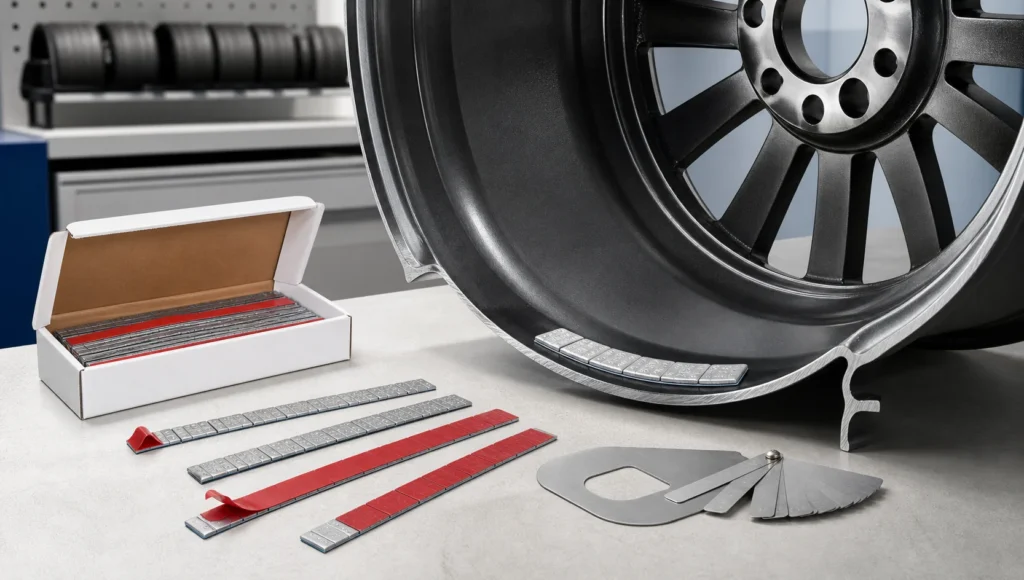
Low profile wheel weights are thin adhesive balancing weights designed for wheel barrels where a standard stick-on strip may be too tall or difficult to hide. They matter when brake clearance, spoke shape, barrel curvature, appearance, or installation space limits the height and shape of the adhesive weight that can be used safely.
For buyers, “low profile” should not be treated as a vague style claim. It is a specification question: installed height, segment mass, strip flexibility, tape thickness, liner behavior, material density, and packaging all decide whether a thinner adhesive weight actually solves the wheel application.
This guide covers when thin adhesive weights are needed and how to specify them. For full size tables, see the wheel weight size chart; for positions on the rim, see the wheel weight placement guide.
Table of Contents
- What are low-profile wheel weights?
- When do low-profile wheel weights matter?
- How does thin profile affect tape and installation?
- Which sizes and strip formats should buyers compare?
- What should buyers confirm before ordering low-profile adhesive weights?
- What quality checks reduce low-profile wheel weight problems?
- How should buyers compare cost, material, and clearance risk?
- Conclusion: specify the installed profile, not just the word thin
- Frequently Asked Questions
- References
What are low-profile wheel weights?
Low-profile wheel weights are adhesive-backed balancing weights with a reduced installed height compared with standard stick-on strips. They are usually placed inside the wheel barrel, where the balancing machine calls for correction mass but the available clearance may be limited.
The term can describe several design choices. A low-profile strip may use a thinner metal segment, a wider or longer segment to preserve mass, a different tape thickness, a flatter edge shape, or a more compact overall construction. The visible result is a lower strip, but the functional result depends on whether the strip still supplies accurate correction mass and reliable adhesion.
This is why buyers should ask for dimensions, not adjectives. The useful data includes segment height, full installed height including tape, segment length and width, strip flexibility, tape construction, and material. A supplier’s low-profile option may fit one alloy wheel barrel well but still be unsuitable for another if the strip is too stiff or too long for the available contact area.
Low-profile products belong inside the broader wheel-weight assortment. Buyers planning a service range can use range planning across adhesive formats, materials, and wheel applications to decide whether thin adhesive strips should be stocked beside standard adhesive strips, clip-on weights, steel options, zinc options, and market-specific size systems.
In practice, the low-profile decision usually appears after the attachment method is already clear. The wheel calls for adhesive placement, but the buyer or installer needs a thinner strip because standard adhesive weights may interfere with wheel clearance, sit too visibly, or fail to contact the barrel neatly.
When do low-profile wheel weights matter?
Low-profile wheel weights matter when the installed strip must fit a tight inner-barrel space without contacting the brake caliper, suspension components, spokes, or other nearby structures. They are also useful when appearance-sensitive wheels need a more discreet correction weight.
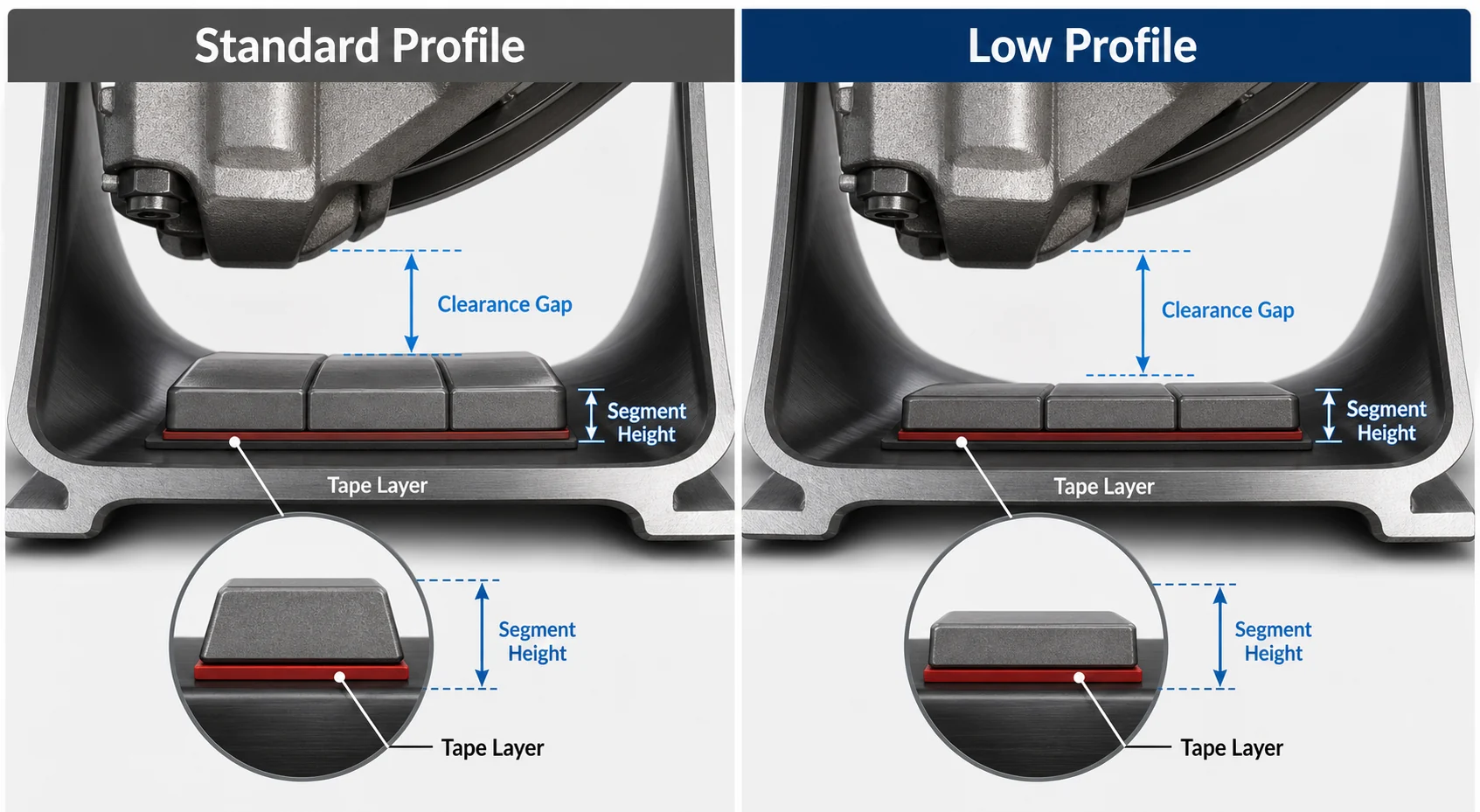
The most common use case is alloy wheels with limited barrel clearance. A standard adhesive strip may be technically strong enough, but its height can reduce the safety margin between the wheel barrel and surrounding components. A thinner strip can create more clearance, provided the installer confirms the chosen position is still valid for balancing and contact.
Low-profile weights can also help where the wheel barrel is curved or visually exposed through open spokes. A lower strip may sit more neatly, reduce edge visibility, and make the finished wheel look cleaner. This matters for premium passenger cars, performance wheels, EV wheel designs, and customers who pay close attention to wheel appearance.
The decision still belongs to the wheel. Buyers serving alloy-heavy accounts can use alloy-wheel barrel fit and adhesive placement checks to connect thin-strip selection with the actual inner-barrel surface, not only the catalog term. After clicking, the buyer can better judge where adhesive placement is appropriate before approving a low-profile strip.
Low profile does not automatically mean better. A very thin strip may need more length or width to provide the same mass, and that can create a different fit issue. If the strip becomes too long for the flat mounting area, edges may lift. If the tape is too narrow for the segment shape, contact may be less stable. Clearance, contact area, and correction mass must be checked together.
How does thin profile affect tape and installation?
Thin profile changes how the strip contacts the wheel, how the tape is loaded, and how easily the technician can apply pressure across the full strip. The tape still needs a clean, dry surface and firm pressure; reduced height alone cannot compensate for poor surface preparation.
Pressure-sensitive adhesive performance depends heavily on surface contact, cleanliness, temperature, and application pressure. General tape guidance from 3M emphasizes preparing the surface and applying pressure so the adhesive can wet out properly.1 For wheel weights, that means a low-profile strip still needs a clean barrel, suitable installation conditions, and even pressure across each segment.
Thin strips may feel easier to apply because they sit closer to the barrel and can appear less bulky. That advantage only helps if the strip can follow the barrel shape without twisting or bridging over curved areas. If the metal segment is too stiff, the tape may contact at the center while the edges remain weak. If the liner is hard to peel, technicians may touch or contaminate the adhesive before placement.
Buyers comparing tape options should review tape and installation conditions for adhesive wheel weights before finalizing a low-profile program. The page helps buyers decide what surface-preparation, temperature, pressure, and dwell-time checks should be included before sample approval.
Installation should include a dry-fit step before the liner is removed. The technician should place the strip at the intended barrel location, rotate or inspect the wheel for clearance, and confirm that the full strip sits flat. Only then should the liner be removed and the strip pressed firmly into place.
Avoid treating a thinner strip as permission to stack weights. Stacking increases installed height, changes the load on the tape, and may remove the clearance advantage that justified low-profile weights in the first place. If the balancer requires a larger correction than the selected position can carry cleanly, the installer should reassess placement, wheel condition, or tire condition rather than forcing a poor fit.
Which sizes and strip formats should buyers compare?
Buyers should compare low-profile adhesive weights by installed height, segment mass, total strip mass, unit system, dimensions, tape thickness, material, and packaging format. A useful low-profile range must still match the balancing-machine correction values used in the target service market.
| Specification field | What to confirm | Why it matters |
|---|---|---|
| Installed height | Metal height plus tape layer after application | Confirms whether the strip solves the clearance problem |
| Segment mass | Grams or ounces per segment | Determines correction flexibility and balancer compatibility |
| Segment dimensions | Length, width, edge shape, and break points | Affects barrel contact, strip length, and handling |
| Tape system | Tape thickness, liner release, and application guidance | Controls retention and real installed profile |
| Material | Steel, zinc, or approved lead-free option | Changes density, volume, coating need, and document expectations |
| Packaging | Strip count, tray or box layout, carton labels, and lot mark | Supports shop selection, warehouse receiving, and repeat orders |
The segment decision is often a tradeoff. Reducing height may require a longer or wider segment if the material stays the same. Using a denser material can reduce volume, but the buyer still has to consider cost, coating, compliance expectations, and destination-market preference.
For strip-based programs, strip segment layout and bulk packout planning helps buyers see how segment size, liner, box format, and carton quantity affect real ordering. After clicking, a buyer can better define whether the low-profile requirement belongs in an individual strip, tray, roll, dispenser box, or bulk carton plan.
Unit planning also matters. Buyers who serve gram-based workshops should not approve ounce-only markings unless the service process supports them, and the same is true in the other direction. The gram and ounce size planning for thin adhesive strips helps connect correction values with practical increments before a low-profile sample set is requested.
Do not compare low-profile options by one dimension only. A strip with a lower metal segment but thicker tape may not reduce installed height as much as expected. A strip with a compact height but poor liner behavior may slow the shop down. A product with a low quoted price but unclear carton labeling may create receiving errors in distribution.
What should buyers confirm before ordering low-profile adhesive weights?
Before ordering low-profile adhesive weights, buyers should confirm the installed height, wheel application, tape system, segment size, material, coating, packaging, and sample test method. The RFQ should describe the clearance problem and the intended wheel surface, not only ask for a thinner stick-on weight.
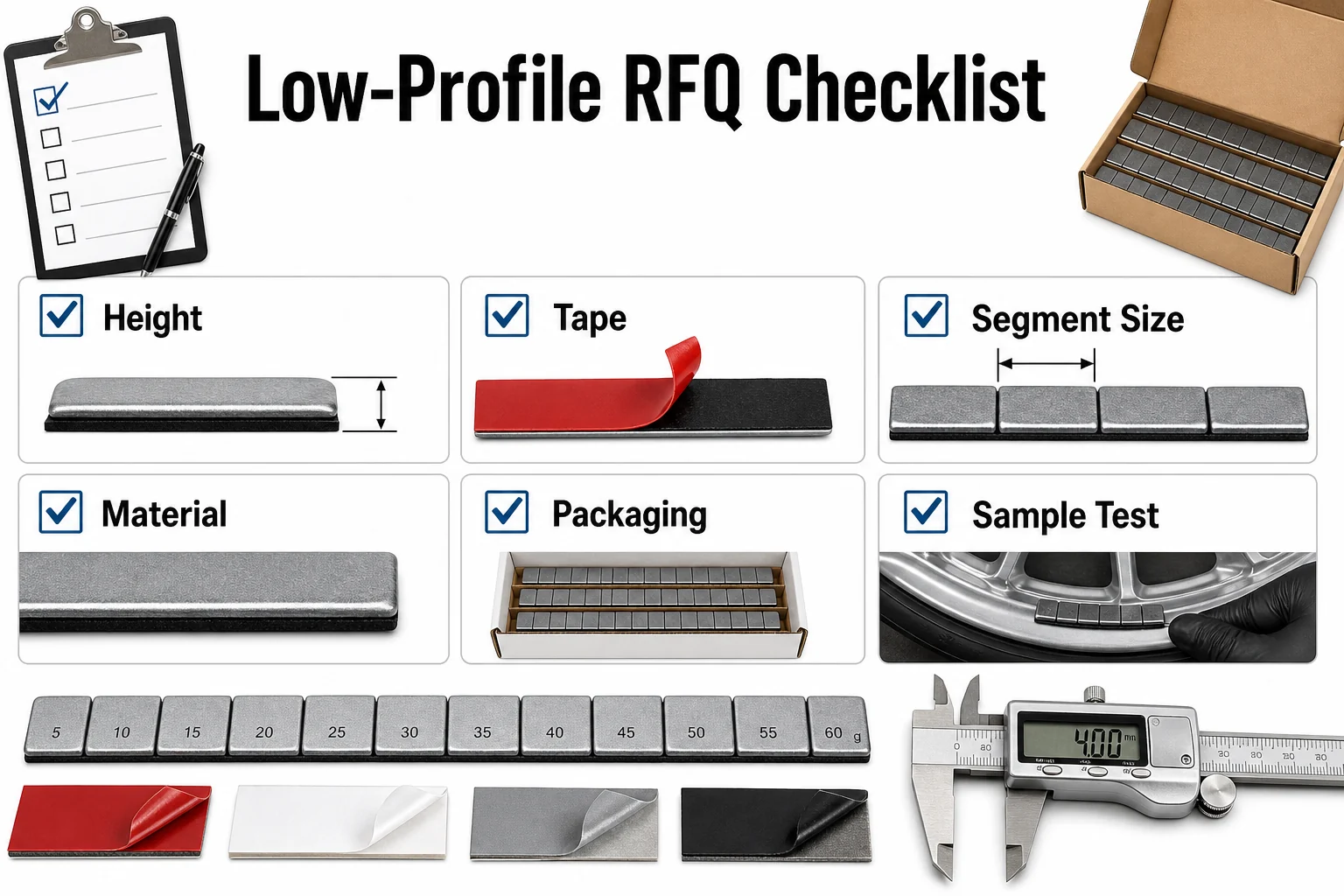
Use this RFQ checklist:
| RFQ item | What to write in the inquiry | Buyer benefit |
|---|---|---|
| Wheel application | Alloy wheels, performance wheels, EV wheels, premium passenger cars, or mixed service | Connects the product to the real clearance and appearance need |
| Clearance target | Maximum installed height, available barrel space, or sample wheel photos | Prevents “low profile” from staying undefined |
| Segment size | Unit system, mass per segment, full strip mass, dimensions, and break points | Makes the balancing-machine correction range usable |
| Tape and liner | Tape construction, tape thickness, liner release, and application guidance | Controls installed profile and adhesion behavior |
| Material and coating | Steel, zinc, lead-free expectation, finish color, and corrosion requirement | Affects density, appearance, documents, and storage life |
| Packaging | Strip format, inner box, carton quantity, barcode, private label, lot mark | Supports warehouse receiving and shop selection |
| Sample test | Wheel surface, cleaning method, temperature, pressure, dwell period, and clearance check | Turns sample approval into a repeatable decision |
Once these fields are clear, buyers can compare low-profile adhesive wheel weight samples that match the approved height and tape specification. The product category then becomes useful for selecting a defined adhesive product family, rather than guessing from photos or generic strip names.
For export or distributor programs, material declarations should be discussed early. Environmental concerns around lost lead wheel weights have been documented by the U.S. Environmental Protection Agency, and many buyers now request lead-free options or non-lead documentation for their wheel-weight programs.2 Low profile should be specified together with the approved material route, not as a separate afterthought.
Sample testing should include the exact wheels or representative wheel surfaces that created the clearance concern. If the buyer cannot provide a wheel sample, photos, measured barrel space, or a target maximum height are still useful. The more specific the clearance requirement, the less likely the first sample round will miss the application.
What quality checks reduce low-profile wheel weight problems?
Quality checks should confirm that the low-profile strip matches the approved height, mass, tape placement, liner behavior, coating, packaging, and lot identification. The goal is to protect both clearance performance and repeat-order consistency.
Start with dimensional checks. Measure installed height, metal segment height, width, length, tape thickness, and total strip length. Compare these values with the approved sample and the RFQ. A small height change can matter if the application is already clearance-sensitive.
Then check correction mass. Weigh segments and full strips against the stated unit. Low-profile geometry should not create inconsistent segment mass, unclear break points, or labels that do not match the actual strip. If technicians need to build correction mass quickly, segment markings and break behavior must be obvious.
Tape and liner checks are equally important. Inspect whether tape is centered and continuous, whether liner edges are protected, and whether the liner peels cleanly without lifting adhesive from the segment. Apply samples to a cleaned wheel surface under agreed conditions and inspect whether edges lift after the chosen dwell period.
Packaging checks prevent many repeat-order problems. Confirm inner-box quantity, strip orientation, product code, unit system, material description, carton mark, barcode if required, and lot code. Low-profile strips can look similar to standard strips in storage, so labels must make the distinction clear.
Buyers defining repeat inspections can use tape, coating, and packout controls behind repeatable adhesive weights to connect field complaints with production variables. After clicking, a buyer can better decide which manufacturing and packaging checks belong in the purchase specification before repeat orders.
How should buyers compare cost, material, and clearance risk?
Buyers should compare low-profile wheel weights by total application value, not only by unit price. The lowest quote may be more expensive if the strip does not clear the wheel, loses adhesion, arrives with unclear labels, or requires extra sample rounds before approval.
Material is a major reason prices differ. Steel and zinc options may create different dimensions for the same correction mass because density and production route affect segment volume. Coating and finish also add cost but can be important for appearance, corrosion resistance, and customer acceptance.
Tape can change the price as well. A higher-performing tape or better liner may be worthwhile when the target wheel application is sensitive, but buyers should avoid paying for a tape upgrade without testing it on the intended surface. The value is proven in sample behavior, not in the tape name alone.
Freight and packaging should be included in the comparison. A compact strip may reduce some handling concerns, but carton count, gross weight, pallet plan, inner-box structure, and private-label requirements can still affect landed cost. Ask whether MOQ changes by height, tape option, segment size, coating, or packaging format.
The clearest buying sequence is:
- Define the wheel application and clearance target.
- Choose the unit system and segment range.
- Compare material and installed profile.
- Select tape and liner options for sample testing.
- Approve packaging, labels, and lot traceability.
- Test samples on representative wheels before bulk ordering.
This sequence keeps the decision practical. It prevents a buyer from approving a thin strip that meets a drawing but fails in the workshop, or approving a strong adhesive product that is too tall for the application.
Conclusion: specify the installed profile, not just the word thin
Low-profile wheel weights matter when wheel-barrel clearance, brake proximity, spoke visibility, or premium wheel appearance makes a standard adhesive strip unsuitable. The buyer’s job is to turn “thin” into a measurable specification: installed height, segment mass, tape thickness, strip geometry, material, packaging, and sample test conditions.
Before placing a bulk order, request samples that match the intended height, tape system, segment size, material, coating, and packaging. Test them on representative wheel surfaces, inspect clearance, confirm adhesion, and keep the approved sample as the repeat-order reference. That is how a low-profile wheel weight becomes a controlled sourcing decision instead of a catalog description.
Frequently Asked Questions
What does low profile mean for wheel weights?
Low profile means the adhesive wheel weight has a reduced installed height compared with a standard stick-on strip. Buyers should confirm the actual metal height and tape thickness because the useful measurement is the installed profile on the wheel.
When should a shop use low-profile adhesive wheel weights?
A shop should consider low-profile adhesive weights when standard strips may interfere with brake clearance, sit poorly in a narrow barrel, appear too visible through open spokes, or fail to fit the available flat mounting area.
Are low-profile wheel weights only for alloy wheels?
They are most common on alloy wheels because adhesive placement and appearance often matter there. They can be used in other wheel applications when the surface, clearance, balancing position, and tape system are suitable.
Do thin wheel weights have weaker adhesion?
Not automatically. Adhesion depends on tape construction, surface preparation, pressure, temperature, liner condition, and contact area. A thin strip can perform well when the tape and installation conditions are correct.
What should buyers ask for in a low-profile wheel weight sample?
Ask for installed height, segment mass, dimensions, tape type, liner behavior, material, coating, packaging format, and sample test guidance. Test the samples on representative wheels before approving bulk production.
Can low-profile wheel weights replace standard adhesive strips?
They can replace standard strips in clearance-sensitive applications, but they are not always necessary. Standard adhesive strips may still be more economical or easier to stock when wheel clearance and appearance are not limiting factors.
References
[1] 3M. “Surface Preparation for 3M VHB Tape Applications.” 2019.
[2] United States Environmental Protection Agency. “Best Management Practices for Lead Wheel Weights.” 2015.