



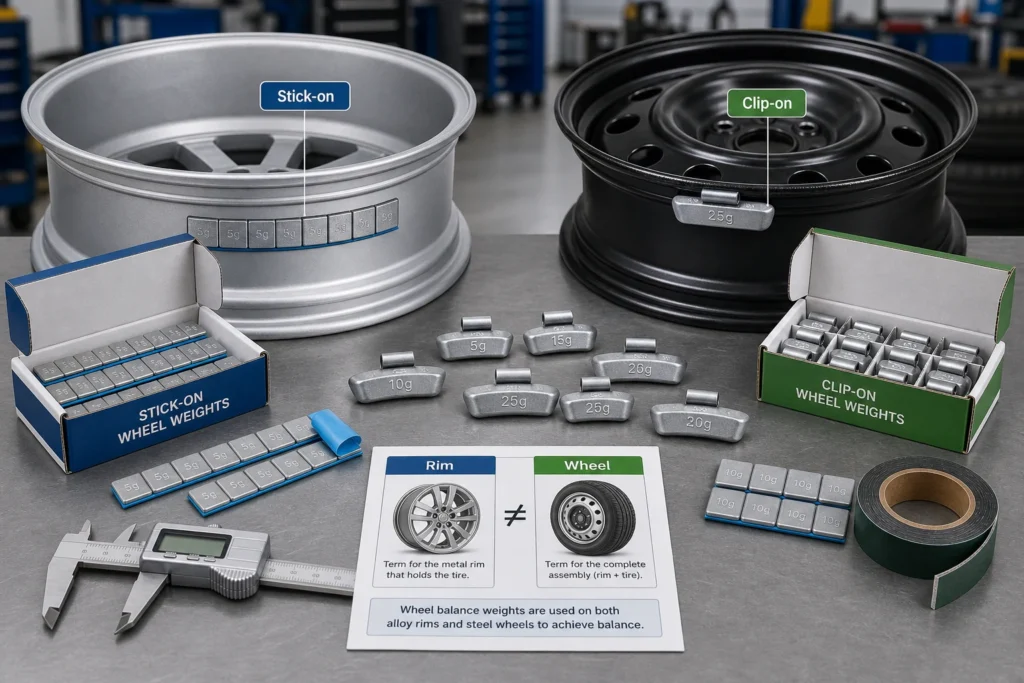
Rim weights are small balancing weights attached to a wheel, either clipped to a rim flange or stuck to a suitable wheel surface. In tire service, “rim weights” usually means wheel balance weights, not the weight of the rim itself. Their purpose is to correct uneven mass distribution in the tire-and-wheel assembly [1].
A row of small metal blocks inside a wheel is usually an adhesive weight strip; a compact weight hooked over the rim edge is a clip-on type. The amount and position are chosen for that assembly. Keep installed weights in place and have suspected missing or loose weights checked rather than copying the arrangement from another wheel.
Table of Contents
- What are rim weights, and how do you recognize them?
- Are rim weights the same as wheel balance weights?
- Why are weights attached to the rim?
- Where do clip-on and stick-on rim weights fit?
- How many rim weights are normal?
- What if rim weights seem to have fallen off?
- What should buyers clarify before ordering rim weights?
- Conclusion: identify the weight, then confirm the application
- Frequently Asked Questions
- References
What are rim weights, and how do you recognize them?
Look for an attached balancing component rather than part of the wheel casting. Adhesive weights typically appear as a short row of marked metal segments on the inner barrel. Clip-on weights have a metal clip that grips a rim flange.
| What you see | Likely part | What the appearance cannot prove |
|---|---|---|
| A row of small blocks with an adhesive backing | Stick-on or adhesive balancing weights | The required correction mass or whether the wheel is currently balanced |
| A compact block with a clip at the rim edge | Clip-on balancing weight | Whether its clip profile is suitable for another wheel |
| An empty rectangular residue patch | Possible former adhesive-weight location | Whether a weight recently fell off or was removed at earlier tire service |
| A gram or ounce marking on a fitted weight | The mass designation of that component | The total correction needed elsewhere on the wheel |
Photograph the part and its location if you are asking a shop to identify it. Include the whole wheel as well as the close-up; an isolated picture of adhesive residue provides less context than the current arrangement.
If you need a broader explanation of balancing products, the related wheel weight basics covers their function. Rim weights describe the same service component in everyday language.
Are rim weights the same as wheel balance weights?
Usually, yes. “Wheel balance weight” describes the function; “rim weight” describes where people see it attached. Neither phrase alone specifies the attachment method, mass, dimensions, material, or wheel fit.
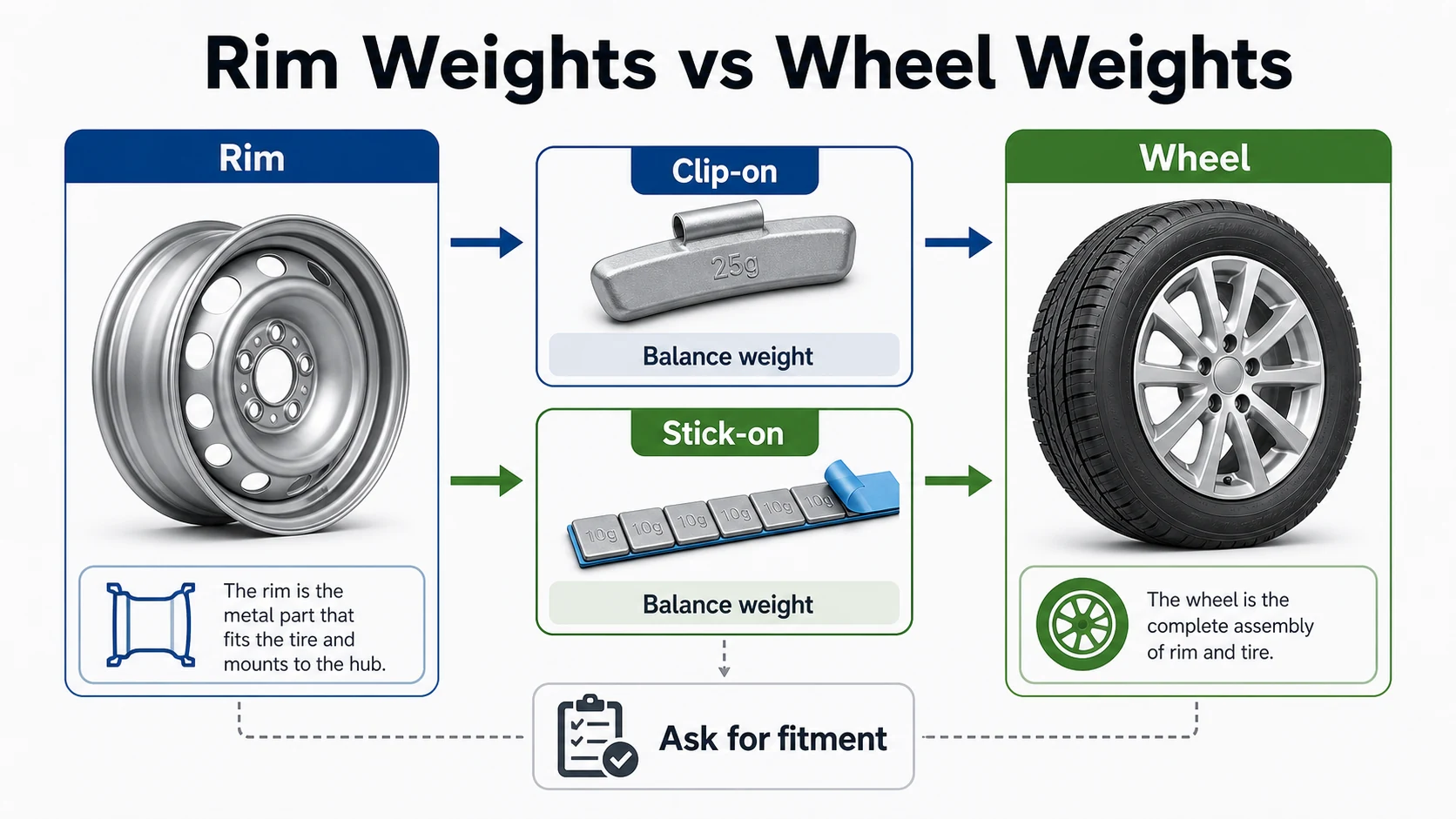
Keep three meanings distinct:
- Rim weight: in a tire-service conversation, usually an added balancing component.
- Weight of a rim: the mass of the wheel or rim being compared as a product, often stated in kilograms or pounds.
- Rim versus wheel: the rim is the portion that supports the tire; everyday use of “wheel” may refer to the metal wheel or the tire-and-wheel assembly.
When ordering, describe the actual product. “Adhesive wheel balance weights, 5 g segments” is a clearer starting point than “rim weights,” but it still needs dimensions, material, tape, and packing details. For a clip-on item, add the identified clip profile and intended wheel application.
Why are weights attached to the rim?
The fitted tire and wheel can have uneven mass distribution. A balancer measures the assembly and identifies the correction amount and position; a technician fits the weights and checks the result [2].
Weights fitted for a previous tire do not establish the correct arrangement after a tire change. Ask the shop to balance the assembled wheel using the intended equipment and procedure. A visibly symmetrical arrangement is not the objective.
Balancing and alignment also solve different problems. Balancing addresses mass distribution; alignment adjusts wheel angles to the vehicle’s specifications [2]. Adding weights does not replace an alignment check, and an alignment alone does not determine balancing mass.
If vibration remains after service, tell the shop when it happens and what changed. Ask for inspection instead of assuming every vibration can be fixed by adding more weights.
Where do clip-on and stick-on rim weights fit?
Clip-on weights grip a compatible rim flange. Adhesive weights bond to a suitable prepared wheel surface. Choose the attachment for the actual wheel and the balancing position, not from the informal product name.
| Type | Fitment check | What to avoid assuming |
|---|---|---|
| Clip-on | Approved clip profile, flange shape, seating, finish protection, and retention | Every clip fits every steel wheel, or all alloy wheels exclude clips |
| Adhesive | Suitable bonding surface, strip dimensions, installation conditions, and clearance | All strips fit the available space or can be moved to any convenient location |
Steel versus alloy is useful background, but it is not a complete fitment specification. A technician or buyer still needs the compatible weight design for the particular wheel. A correct gram marking does not make an unsuitable clip or oversized strip acceptable.
The related clip-on versus stick-on comparison explains attachment choice. For clip-on applications, use the steel-wheel fitment guide. For adhesive strips, the alloy-wheel adhesive weight guide covers the placement and clearance checks.
Keep the correction at the position required by the balancing setup. If a strip interferes with a brake component or cannot fit the available surface, ask the installer to select a compatible arrangement and recheck the assembly.
How many rim weights are normal?
There is no single block count that proves a good or bad balance job. Compare the marked mass, placement, attachment, and verified result rather than counting visible segments.
For example, six segments marked 5 g total 30 g, while three segments marked 10 g also total 30 g. This arithmetic illustration is not a recommended correction for your wheel. It shows why two rows can look different without having different total mass.
Four wheels on the same vehicle need not carry identical correction weights. Their fitted tire-and-wheel assemblies are assessed individually. Copying a neighboring wheel’s block count or placement does not reproduce its measured correction.
If an arrangement looks unusual, or the vehicle vibrates after balancing, ask the shop:
- What correction mass was requested at each balancing position?
- Was the assembly mounted correctly and checked again after installation?
- Are the weights secure and clear of nearby components?
- If the result remains unsatisfactory, what wheel or tire condition needs further diagnosis?
Do not impose a universal gram limit from a photograph or use extra weights to avoid investigating an unresolved problem. If you are comparing replacement products, the wheel weight size and unit guide helps distinguish the marked mass from segment count and physical size.
What if rim weights seem to have fallen off?
Arrange a wheel-balance and attachment check if you find a loose weight or suspect one is missing. An empty adhesive patch alone does not establish when the weight was removed; it could be residue from earlier service.
- Record what you found. Photograph the residue or loose component, identify the wheel if possible, and note any recent tire service.
- Describe the symptoms. Tell the shop whether there is new vibration, when it occurs, and whether it started after the service or suspected loss.
- Have the assembly checked. Ask the shop to establish the current correction and inspect the attachment instead of guessing the missing mass from the old glue outline.
- Confirm the replacement result. A replacement needs both a suitable attachment and the correct position. The assembly should be checked after the work.
Do not simply re-stick a fallen strip, shift remaining weights, or add matching blocks by eye. That leaves the actual correction unverified. If the same attachment keeps failing, request a check of the surface, selected weight, fit, and installation method.
During cleaning or refinishing, leave fitted weights in place unless their removal is part of an agreed service that includes a subsequent balance check. This also prevents a cosmetic cleanup from changing an established correction unnoticed.
What should buyers clarify before ordering rim weights?
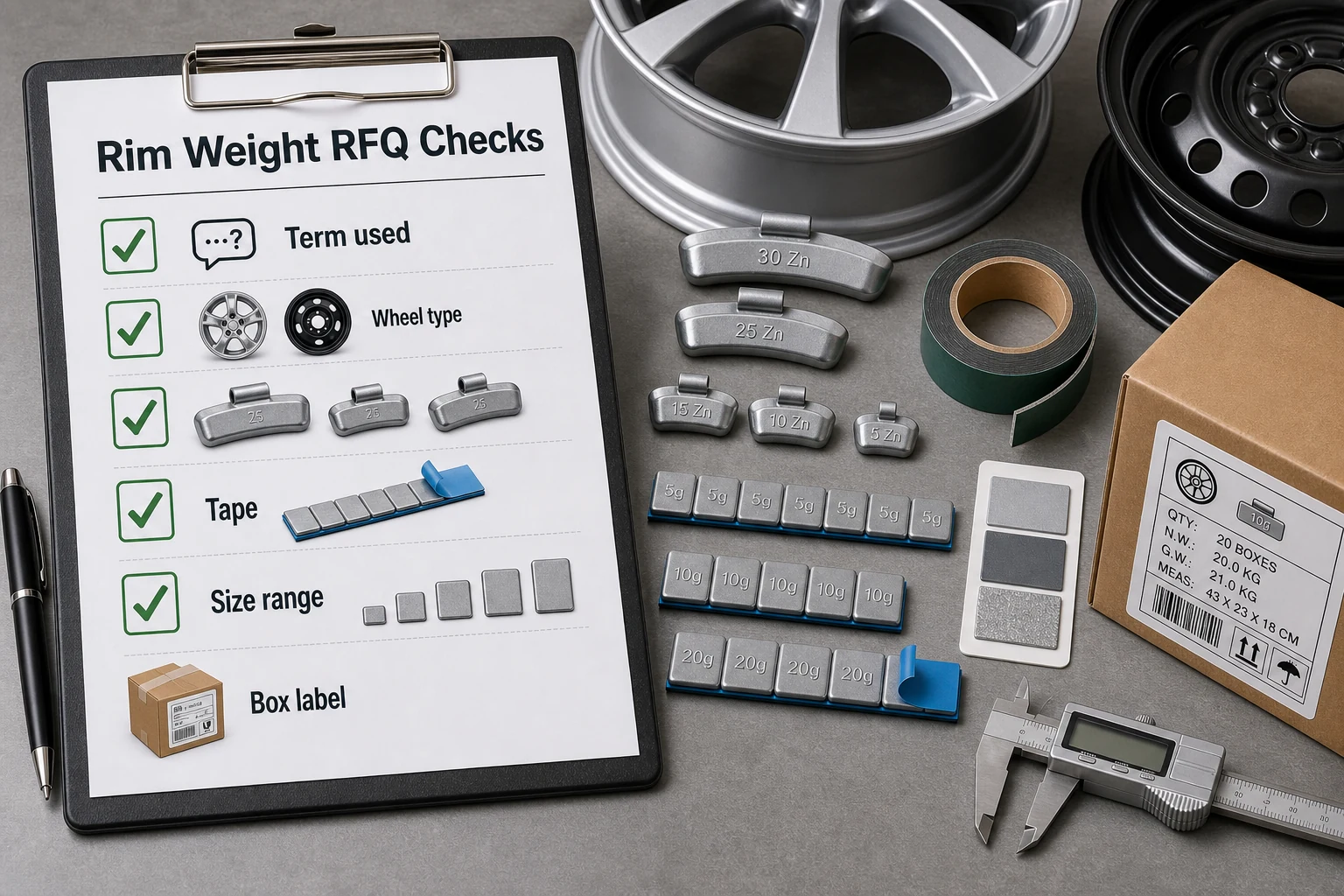
Turn “rim weights” into an identified product before comparing quotes. Specify attachment, wheel application, mass unit, dimensions, material, finish, and packing, then approve the actual configuration.
| Order field | Useful detail |
|---|---|
| Product and application | Clip-on or adhesive, intended wheel types, and identified product code |
| Fitment | Clip profile and flange information, or adhesive-strip width, height, and length |
| Mass and unit | Grams or ounces; for strips, segment mass and number of segments |
| Construction | Body material, finish, and tape/liner identity where applicable |
| Packing and approval | Pieces or strips per pack, label wording, sample reference, and accepted configuration |
A request such as “clip-on wheel balance weights for this identified rim flange” should include a wheel or profile reference. “Adhesive steel wheel balance weights, 5 g segments” should include the available placement space and required strip format. These are specification examples, not claims that one product fits every wheel.
A photograph is useful for identification but does not establish clip retention, tape performance, material compliance, or the mass needed on a vehicle. Confirm the product on the intended wheel and keep the accepted sample and packing record linked to the quoted item.
For a distributor building a wider range, use the wheel-weight range planning guide for the broader assortment decision. Keep each quotation line specific even if the retail label also uses the phrase “rim weights.”
Conclusion: identify the weight, then confirm the application
Rim weights usually means wheel balance weights attached to a rim flange or wheel surface. Identify whether the part is clip-on or adhesive, and judge the installed arrangement by its fit and checked balance result rather than the number of visible blocks.
If a weight seems missing or the vehicle vibrates after service, have the wheel checked. For an order, turn the informal name into a specification before comparing prices. The wheel balancing weight range is a starting point for discussing an identified attachment, mass range, wheel application, and packing requirement.
Frequently Asked Questions
Are rim weights and wheel weights the same thing?
They often refer to the same general product category, but they are not always the same specification. Rim weights usually describe balancing weights attached to or near the rim area, while wheel weights or wheel balance weights describe the function of correcting wheel and tire imbalance.
What is the difference between a rim and a wheel?
More precisely, the rim is the portion of the wheel that supports the tire. The metal wheel also includes its center or mounting structure, while a tire-and-wheel assembly includes the fitted tire. In everyday language, people may use “rim” for the whole metal wheel or “wheel” for the assembly. Because these uses are loose, define the actual wheel application and attachment style when ordering balancing weights.
Are clip-on weights rim weights?
Clip-on weights are often called rim weights because they attach to a rim or wheel flange. However, buyers should still specify the clip profile, wheel type, material, coating, and size range before ordering because not every clip fits every rim flange.
Are stick-on weights rim weights?
Stick-on weights can be called rim weights when they are installed on the inner rim barrel or wheel surface. For purchasing, it is clearer to call them adhesive or stick-on wheel balance weights and specify tape, segment size, strip height, and intended wheel application.
What should I write in an RFQ for rim weights?
Write the exact product type: clip-on or stick-on wheel balance weights. Then include wheel type, rim flange or adhesive surface, gram or ounce range, material, coating, tape, pieces per box, carton label, and sample testing requirements.
What are the small metal blocks inside my rim?
They are usually adhesive wheel balance weights. A strip may be divided into several segments so the installer can build the required correction mass. Leave installed weights in place. If you cannot identify the part, send a tire shop a close-up and a wider photo of its position; do not remove it just because the row looks unusual.
Is it normal for one wheel to have more weights than another?
It can be. Each tire-and-wheel assembly is assessed separately, and different segment sizes also change the visible block count. Compare marked mass and the checked result rather than expecting all four wheels to look identical. If a wheel carries an unusual arrangement and the vehicle still vibrates, ask for the balance, attachment, and wheel/tire condition to be checked instead of adding more weights by eye.
Does old adhesive mean a rim weight has fallen off?
Not necessarily. The residue may be from weights removed at a previous tire change, or it may mark a missing weight. A photo alone does not settle when it happened. If you find a loose strip, notice new vibration, or are unsure whether the current arrangement is complete, arrange a balance check and explain the recent service history. Do not guess the replacement mass from the outline.
References
- Firestone Tires. Tire Terminology: Balance and Wheel Weight.
- Continental Tires. Balancing Tires: Correction Placement and Balancing versus Alignment.