



A front lip is a thin add-on that follows the bottom edge of the front bumper, a front splitter is a flatter plate that sticks out forward like a shelf, and a rear diffuser is the shaped section under the rear bumper where underbody air leaves the car. Here is what each part does and which one fits your car.
Scope: this guide covers bolt-on aero styling parts for road cars: front lips, front splitters, rear diffusers and, for comparison, air dams. Motorsport underbody design is mentioned only where it explains how the street parts work. Fitment always depends on the exact model, year and bumper version.
What is a front lip?
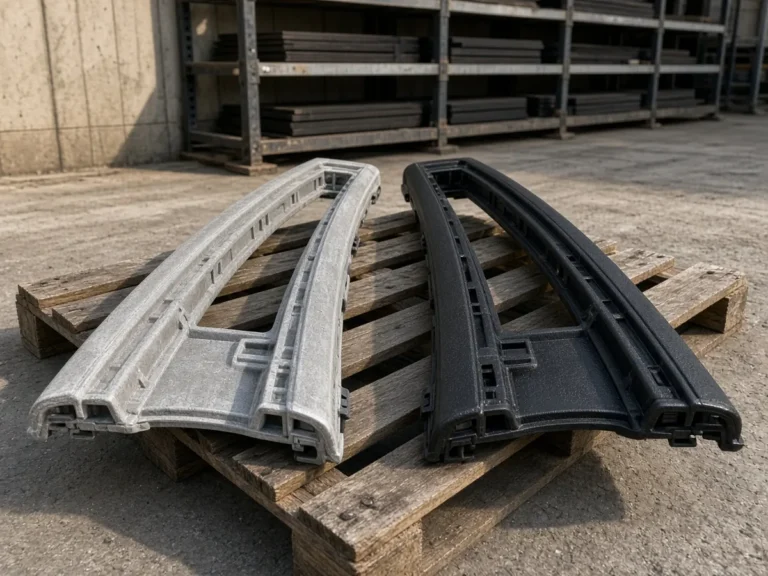
A front lip is a narrow extension that follows the lower edge of the factory bumper. It adds a small amount of depth, follows the curve of the bumper and ends close to the bumper face rather than sticking out past it. Most lips sold today are one-piece or three-piece injection-molded parts in ABS or PP. They come in gloss black, matte black, carbon look or paint-ready.
The job of a lip is mostly visual. It makes the nose look lower and wider, it hides the gap between bumper and ground, and it gives a plain bumper a sportier edge. Because it sits right at the bottom of the bumper, a lip can slightly reduce the amount of air that goes under the car. On most road cars that effect is small and hard to measure without a wind tunnel or a coast-down test. Sellers that promise a big gain in grip from a lip alone are overselling.

Lips are also called front spoilers, chin spoilers or lip spoilers. Many catalogs use “lip” and “splitter” for the same part, which is the main reason buyers get confused. A quick test works better than the product name: if the part is mostly vertical or angled and follows the bumper curve, it is a lip. If it has a flat, horizontal surface that extends forward of the bumper face, it is a splitter, whatever the listing says.
What is a front splitter?
A front splitter is a flat, roughly horizontal plate that extends forward of the bumper near ground level. The name comes from what it does to the airflow: it “splits” the air that hits the nose. Air above the plate meets the bumper face and slows down, which raises pressure on top of the plate. Air below the plate is guided into the gap under the car, where pressure is lower. That pressure difference pushes down on the front axle.
On race cars, the splitter is part of a system with the underfloor, the diffuser and often canards and a rear wing, and it is supported by rods or brackets because the load can be large. On road cars, most “splitters” are a compromise. They are usually shorter, made of molded plastic or composite, and mounted with screws and tape. They still change how the air meets the nose, but a short street splitter on a stock floor will not behave like a motorsport splitter on a flat floor.
The part that most buyers forget is the splitter edge. A plate that sticks out forward is the first thing to touch a curb stop, a parking block or the top of a steep ramp. That is the real trade-off, and it is covered with numbers in the ground clearance section below.
What does a rear diffuser do?
A rear diffuser is the upward-sloping section at the back of the underbody, usually with vertical fins (strakes). Its purpose is to slow the air coming out from under the car gradually, so it can rejoin the slower air behind the car. Because the air at the diffuser exit is slowed down, the air further forward under the car can move faster, and faster air means lower pressure under the car. That suction is what produces downforce 1.
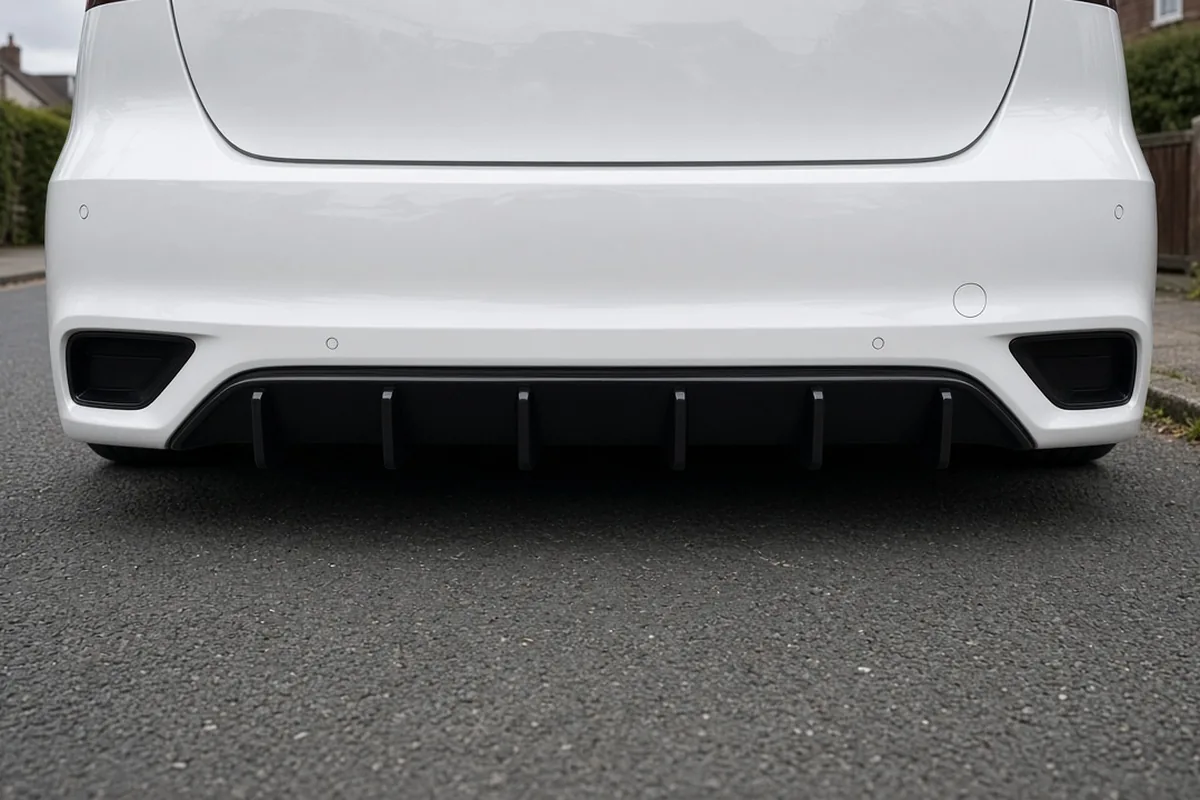
Research on race-car ground effect shows two things that matter for street buyers. First, the effect depends strongly on how close the underbody is to the road: downforce rises as the car gets lower, peaks at a certain ride height and then drops off sharply when the flow under the car breaks down 1. Second, a diffuser works together with the floor in front of it. Engineers who design these parts note that a diffuser is often misunderstood as something that works on its own, when its effect depends on the underbody and the edges around it 2.
That is why most rear “diffusers” sold for road cars are styling parts. They are plastic panels that clip or screw onto the lower rear bumper, with fins that look like a race diffuser. They do not change the floor of the car, so they cannot create real ground-effect downforce on their own. They change the look of the rear, they may clean up the airflow behind the bumper a little, and on some cars they frame the exhaust tips.
How do a lip, splitter, diffuser and air dam compare?
The four parts are often sold together in a “body kit”, but they sit in different places and do different jobs. The table below sums up the differences in plain terms. For kits that also widen the fenders, see what a widebody kit is.
| Part | Where it sits | Main job | Typical street effect | Main trade-off |
|---|---|---|---|---|
| Front lip | Follows the bottom edge of the front bumper | Styling, lower look | Mostly visual | Some loss of clearance |
| Front splitter | Flat plate forward of the bumper, near the ground | Front downforce on track cars | Small unless paired with a flat floor | Most exposed to curbs and ramps |
| Air dam | Vertical panel below the bumper | Cuts air going under the car, cooling and drag control | Often factory-fitted for drag reduction | Lowest point of the nose |
| Rear diffuser | Upward slope at the rear underbody exit | Lets underbody air slow down, which lowers pressure under the car | Mostly visual on a stock floor | Can hide the tow-hook or sensor areas |
The comparison also shows why “lip or splitter” is the wrong first question. Start with what you want from the car. If it is the look, a lip and a matching rear diffuser give the most visual change for the least risk. If the car does track days and already has a flat floor, a real splitter with support rods makes sense, together with a matching rear wing for balance. For more on the rear end, see our guide to spoilers vs wings.
Do they do anything at street speeds?
Aerodynamic forces grow with the square of speed. Double the speed and the force from the same part is about four times larger. So a part that does something useful at 160 km/h on a track does much less at 50 km/h in town, and it is close to zero in a parking lot, which is where most street cars spend a lot of time.
At highway speeds, a well-designed front lip or short splitter can change the front-to-rear balance a little. Owners on enthusiast forums often report that the car “feels more planted” after fitting a lip. That may be true, but it is hard to separate from other changes such as new tires or an alignment, and few of those reports include measurements. A sensible approach is to treat any change in handling as a bonus, not as the reason to buy.
One thing worth checking is balance. Adding front downforce without matching rear downforce moves the balance forward. On a track car this can make the rear feel light in fast corners. That is why race teams tune the splitter and rear wing together. For a street car with a short lip, the effect is too small to matter.
How much ground clearance will you lose?
The number that decides whether a part scrapes is the approach angle. SAE J1100 defines it as the smallest angle, seen from the side, between the ground and a line touching the front tire and the lowest part of the vehicle in front of it 3. U.S. federal rules use the same idea 4. Every part you add below or in front of the bumper makes that angle smaller.
Here is a simple worked example (example figures, not a measured vehicle). The method ignores tire curvature and suspension travel, so it gives a slightly cautious result.
- Stock car: lowest point of the bumper 120 mm above the ground, 850 mm ahead of the front tire contact point. Approach angle is about arctan(120/850) = 8.0°.
- With a splitter that sits 25 mm lower and extends 35 mm further forward: 95 mm high, 885 mm ahead. Approach angle is about arctan(95/885) = 6.1°.
- A ramp with a 12% grade has an angle of about 6.8°. The stock car clears the transition. The car with the splitter does not.
Measure your own car before ordering: put the car on level ground, measure the height of the lowest point at the front and its distance from the front tire, then subtract the thickness and forward reach given on the product drawing. If the new angle is below the steepest driveway or ramp you use every day, choose a slimmer lip or plan to take that ramp at an angle.
How do lips, splitters and diffusers mount?
Most street lips and diffusers use a mix of screws, plastic clips and automotive double-sided tape. Screws or self-tapping fasteners go into the underside of the bumper, where the holes are hidden. Tape along the visible edge keeps the part tight to the bumper and stops it from fluttering at speed. Some vehicle-specific parts are designed to use existing holes, which means no drilling.
Tape alone is not enough for a part that can be hit from the front. A lip held only by tape tends to peel back at the ends after a few curb contacts. A real splitter should also have support rods or brackets that tie it to a solid point behind the bumper, because the plate can carry a real load at speed. Diffusers are usually the easiest to fit: they hang under the rear bumper and are mostly protected from impacts.
Before drilling, check what is behind the bumper skin. Front and rear bumpers on modern cars can hide parking sensors, radar units, wiring and the energy absorber. A screw in the wrong place can damage them. Vehicle-specific parts help here because the mounting points are fixed by the design.
Which materials are used, and how are they made?
Most street lips and diffusers are injection-molded thermoplastics. The main options are listed below. Carbon fiber and fiberglass are also common for low-volume and custom parts; our carbon fiber vs ABS vs fiberglass guide compares them in detail.
| Material | Strengths | Watch out for | Typical use |
|---|---|---|---|
| ABS | Stiff, good surface for paint and gloss black | Can crack in cold impacts if the wall is thin | Lips, diffusers, canards |
| PP / TPO | Flexible, survives scrapes, same family as many bumper covers | Needs adhesion promoter before paint | Low lips that touch the ground often |
| ASA | Better UV resistance than ABS for unpainted finishes | Higher material cost | Textured or molded-in-color parts |
| Carbon fiber | Very stiff and light | High cost, brittle edge damage | Track splitters, premium styling |
| Fiberglass | Low tooling cost for small runs | Heavier, more finishing work | Custom and replica parts |
Typical production for injection-molded exterior parts like these involves molding in ABS, PP or ASA, removing the flash, surface finishing, and then painting or applying a piano black or carbon-look finish before a test fit on the vehicle. The checks that matter most are color difference, gloss, sink marks, the position of mounting holes and the gap to the bumper. You can see how finishes compare on our painting and surface finishing page.
What are the risks and common fitment mistakes?
These are the most common fitment problems. Most of them come from choosing a part before measuring the car.
- Buying by name, not by shape. A part listed as a “splitter” may be a lip, and the other way around. Compare the side profile on the product drawing.
- Ignoring the bumper version. Many models have a base bumper and a sport bumper with a different lower edge. A lip made for one will not sit flush on the other.
- Using tape only. Tape alone lets the ends peel back after the first curb contact.
- Drilling blind. Screws placed without checking what is behind the bumper can hit sensors or wiring.
- Sharp edges. In markets that follow UN Regulation No. 26, external projections facing outward generally need a minimum edge radius of 2.5 mm, unless the material is soft (60 Shore A or less) 5. A splitter with a sharp cut edge can be a legal problem as well as a safety one.
- Covering openings. A diffuser or lip must not block tow-hook covers, air intakes or the view of parking sensors.
There are exceptions. Some cars have a factory air dam that helps control drag or guide cooling air, and removing it can change how the front end behaves. If in doubt, choose a part that adds to the factory lower edge rather than replacing it.
What should buyers specify when sourcing these parts?
For distributors, body shops and brands buying in volume, the questions are less about aerodynamics and more about fit, finish and return rate. A clear specification at the start saves a lot of returns later. This checklist covers the details a supplier needs to quote and build the part correctly: For lips built to your own design or brand, see our OEM auto parts service.
- Vehicle model, year range and bumper version (base, sport, facelift), plus photos of the lower bumper.
- Part type and profile: lip, splitter or diffuser, one-piece or three-piece, forward reach and thickness in mm.
- Material (ABS, PP or ASA) and finish: gloss black, matte, carbon look or primed for paint.
- Mounting method: existing holes only, or screws plus tape; whether support rods are needed.
- Edge radius and any market rules the part must meet, such as UN R26 in Europe.
- Inspection points: color and gloss limits, sink marks, hole position and gap to the bumper.
- Packaging that protects the visible edges, because most transit damage is at the ends.
You can browse finished examples in our body kits and aero parts range, including a universal three-piece ABS front lip and a universal shark-fin rear diffuser in PP. For side profiles that match a lip, see our side skirts. For types, materials and fitment checks, read what side skirts are on a car. Low MOQ is available on selected items; for new tooling, MOQ is discussed per project.
Conclusion
A front lip, a front splitter and a rear diffuser are three different parts. The lip follows the bumper and is mostly about looks. The splitter is a flat plate that sticks out forward and only does real aerodynamic work on fast cars, ideally with a flat floor and a rear wing to balance it. The diffuser shapes the exit of the underbody, and on a stock car the bolt-on version is mainly a styling part.
For most street cars, the best choice is the part that gives the look you want without losing too much clearance. Measure the approach angle, check the bumper version and choose a material that can take the scrapes your daily roads will give it. That way the part still looks right after a year of driveways and parking lots.
Next step
If you are planning a lip, splitter or diffuser line for a specific model, send us the vehicle, bumper version and the finish you need. We can review the fitment and suggest a material for your market.
Frequently asked questions
Is a front splitter the same as a front lip?
No. A front lip follows the lower edge of the bumper and is mostly for looks. A front splitter is a flatter plate that extends forward of the bumper to change airflow. Many listings mix up the names, so check the side profile.
Does a front lip improve performance?
On most road cars the effect is small. A lip can slightly reduce the air going under the car at highway speeds, but the main benefit is visual. Real downforce needs higher speeds and a matched setup.
Does a rear diffuser do anything on a street car?
A bolt-on diffuser on a stock underbody is mainly a styling part. A working diffuser needs a smooth underbody and a low ride height, because its effect depends on the airflow under the whole car.
Can I run a front lip and a splitter together?
Yes, some kits combine a lip shape with a short splitter edge. Check the total forward reach and height, because together they reduce the approach angle more than either part alone.
Will a front lip scrape on driveways?
It can. Every millimeter lower or further forward reduces the approach angle. Measure your current clearance and compare it with the steepest ramp you use before you buy.
References
[1] Zhang, X., Toet, W. and Zerihan, J. “Ground Effect Aerodynamics of Race Cars.” Applied Mechanics Reviews 59(1), 2006, pp. 33–49.
[2] Verus Engineering. “Diffusers – How They Work.” Engineering blog.
[3] SAE International. “J1100: Motor Vehicle Dimensions.” Revised November 2009.
[4] U.S. Code of Federal Regulations. “49 CFR § 523.2 – Definitions” (approach angle). Legal Information Institute.
[5] UNECE. “UN Regulation No. 26: Uniform provisions concerning the approval of vehicles with regard to their external projections.”