



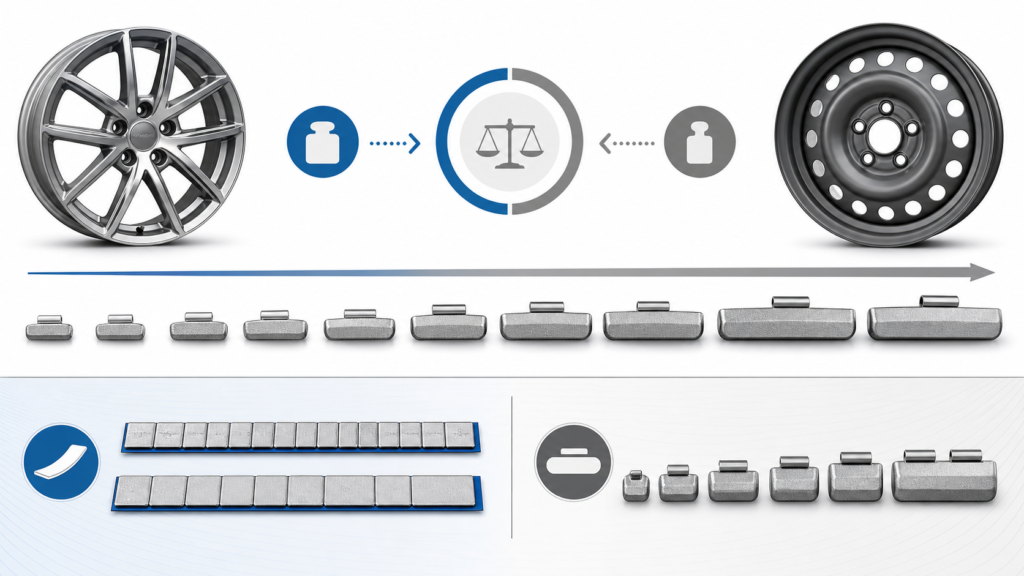
Wheel weight size charts convert a balancer’s correction request into the grams, ounces, increments, and attachment formats a technician can install. Buyers should use the chart to plan usable coverage, not to select mass in isolation: the correct range also depends on clip profile or adhesive strip format, wheel type, and the unit system used by target workshops.
This page is the size reference: grams, ounces and common increments. For thin adhesive weights in tight spaces, see low-profile wheel weights; for choosing types and materials, see the wheel balance weights guide.
Table of Contents
- What does a wheel weight size chart show?
- How do grams and ounces compare?
- Which specifications matter beyond mass?
- How should buyers use a size chart?
- What should a size specification include?
- What should buyers check before ordering?
- Conclusion: Build the range around real correction work
- Frequently Asked Questions
- References
What does a wheel weight size chart show?
A size chart shows the correction-mass options available in a wheel-weight range. It normally identifies the unit system, increments, attachment type, and package format. Tire balancing is the process that identifies the needed correction; the chart helps a technician or buyer select a product that can deliver it.1
The chart should not imply that one weight fits every wheel. Clip-on weights must match the rim flange, while adhesive weights need a suitable inner-barrel location and tape system. A 25 g clip-on part and a 25 g adhesive segment may provide the same mass but solve different fitment problems.
How do grams and ounces compare?
One ounce equals approximately 28.35 grams. This conversion is useful for planning, but a workshop should work in the same unit system as its balancing machine and product labels whenever possible. Mixed labels increase selection mistakes during busy service work.
| Common reference | Approximate equivalent | Buying use |
|---|---|---|
| 5 g | 0.18 oz | Fine gram-based correction increment |
| 10 g | 0.35 oz | Common small segment or clip-on option |
| 15 g | 0.53 oz | Mid-range correction option |
| 20 g | 0.71 oz | Common workshop increment |
| 25 g | 0.88 oz | Frequently used correction size |
| 30 g | 1.06 oz | Approximately one ounce plus a small increment |
| 1 oz | 28.35 g | Common ounce-based reference point |
These values are planning references, not a license to substitute random pieces. The selected product must still match the balancer value, the attachment method, and the wheel application.
Which specifications matter beyond mass?
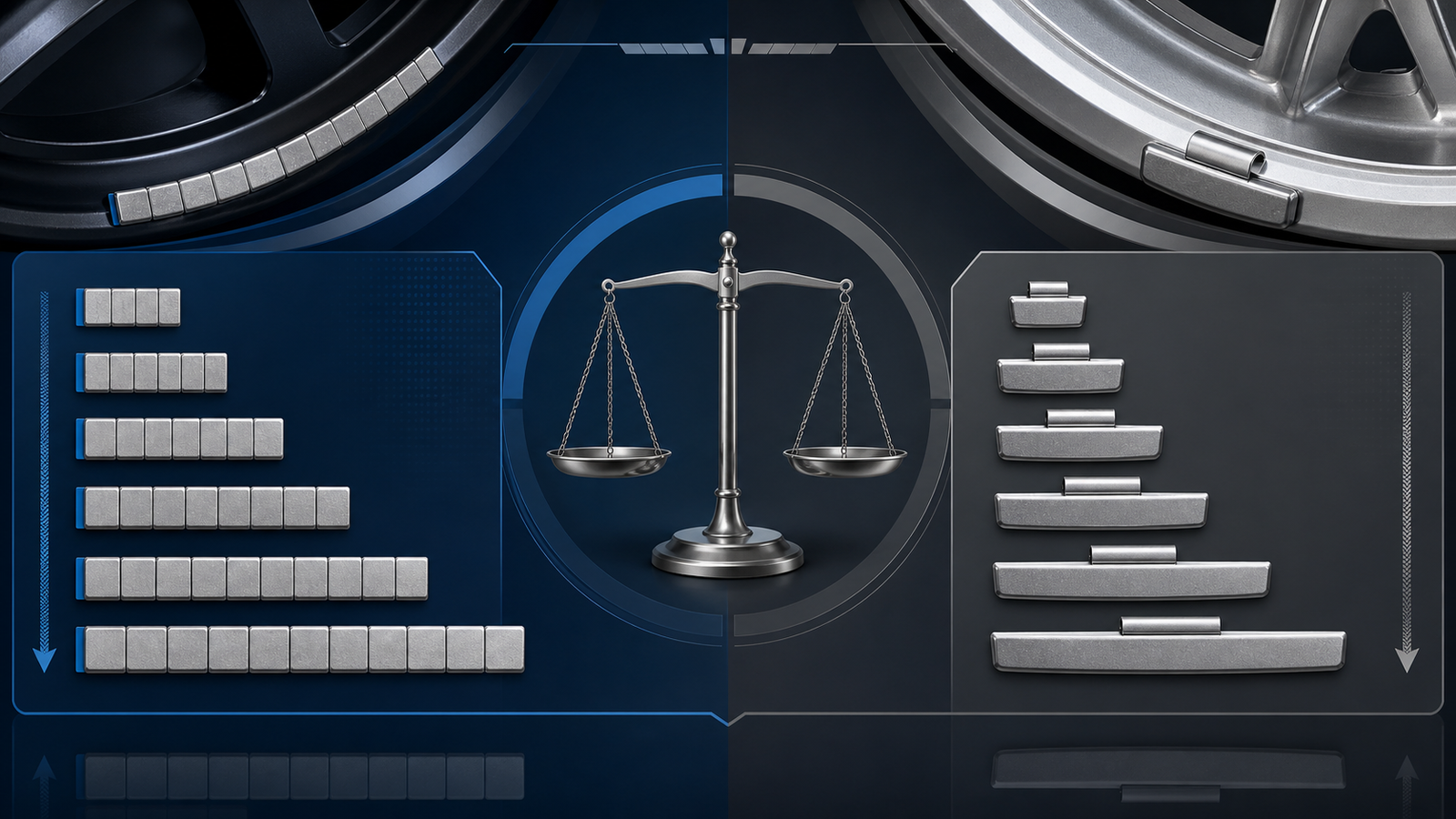
Mass is only the beginning. For adhesive strips, buyers need segment layout, strip length, tape behavior, liner handling, material, and profile thickness. For clip-on products, the essential additional item is rim-flange fitment, followed by clip profile, coating, and clearance.
The practical questions are: can the technician assemble the requested mass quickly, will the installed weight fit the wheel, and can the warehouse distinguish similar part numbers? A range with many masses but unclear labels or mismatched profiles creates more service friction than a smaller, disciplined assortment.
A nominal weight is only usable when it fits the attachment method. Why attachment choice changes the usable size range helps buyers see why clip profile and adhesive segment layout belong in the same specification.
How should buyers use a size chart?
Start with the balancer units and the wheels target shops service. Then define the smallest useful increment, upper correction range, and attachment formats needed for alloy and steel wheels. Buyers planning stock can use unit and format coverage for a wheel-weight range to connect those choices before turning them into a purchase list.
For example, an alloy-wheel program may require adhesive segments that build common gram values cleanly, while a steel-wheel program may need a smaller number of proven clip profiles with the same or different mass increments. The correct assortment follows the work, not a generic list of sizes.
What should a size specification include?
State the unit system, individual increments, total range, attachment style, material, and packaging. Include whether labels must show grams, ounces, part numbers, or multiple units. For adhesive products, specify segment mass and strip format; for clip-on products, specify the approved rim-flange profile.
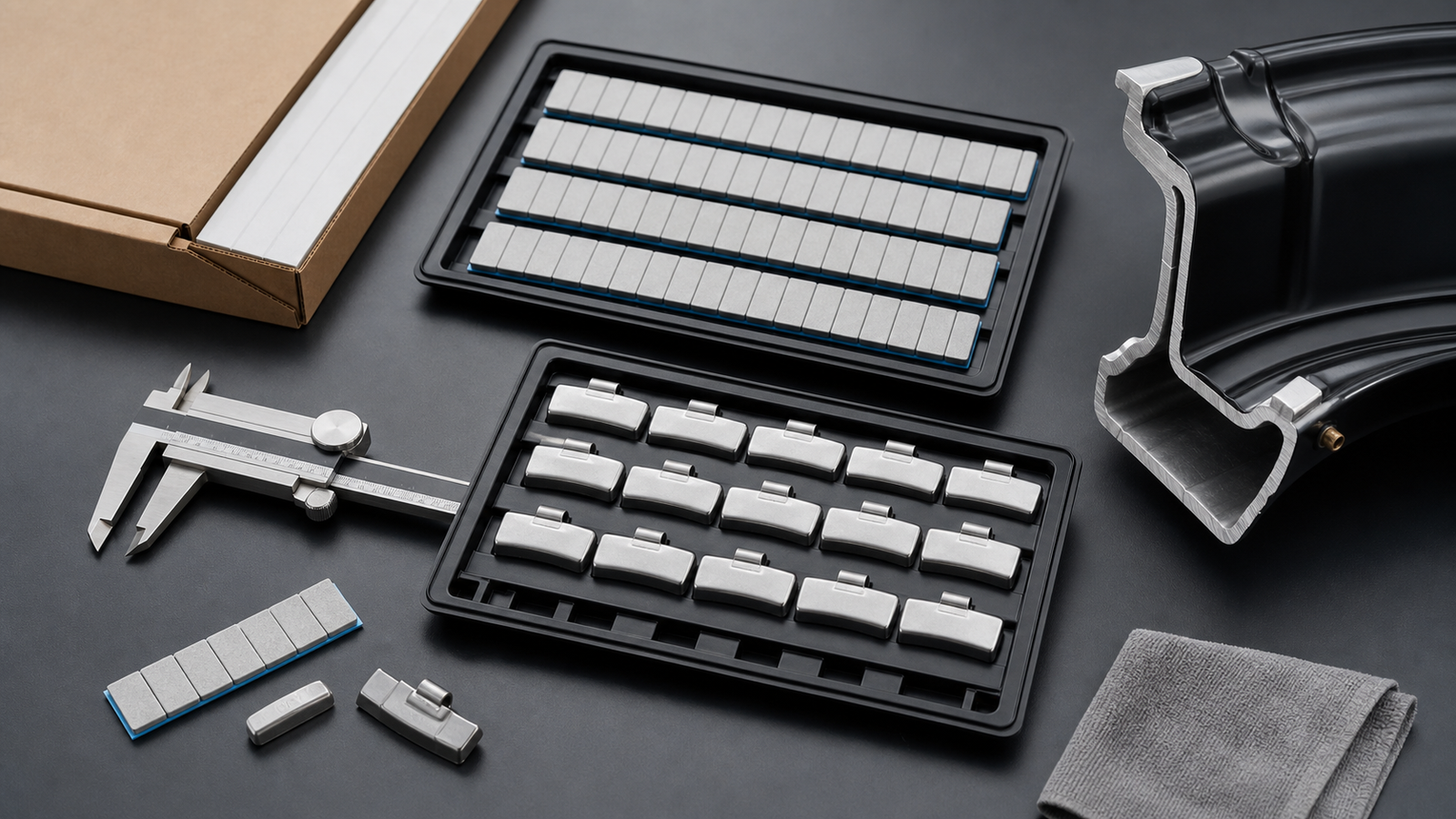
Buyers should also specify the decision behind each number. A narrow 5 g increment can be useful when the service channel needs fine correction, but it adds stock lines and label complexity. A broader interval can simplify a fleet or basic tire-shop range, but only if it still lets technicians reach common balancer values without awkward combinations. The correct answer comes from actual service records and test orders, not from copying another distributor’s carton list. For passenger-car programs, use passenger-car range planning and a fillable sample approval card to turn those records into a range tested on a representative wheel.
For adhesive strips, include the number of segments per strip, break points, strip length, weight per segment, tape construction, liner handling, and the intended inner-barrel clearance. For clip-on products, include mass, clip profile, body shape, flange application, coating, and the wheel samples used for approval. These fields stop a supplier from quoting a mathematically correct but physically unsuitable part.
Packaging is part of the size specification as well. Trays should keep similar increments from being mixed; outer cartons should identify units, material, attachment type, part numbers, quantity, and lot. A warehouse team needs to distinguish a 0.5 oz clip-on line from a 15 g adhesive strip before either product reaches a balancing machine.
For clip-on orders, rim-flange dimensions that belong beside clip-on mass data help prevent a correct nominal weight from being paired with the wrong clip.
What range logic helps a distributor avoid overstock?
A useful range begins with the wheel mix and the balancer outputs seen by target shops. Group accounts into alloy-wheel, steel-wheel, mixed, light-commercial, or fleet channels. Then identify the attachment type and the correction intervals that recur. This reveals whether a buyer needs a wide adhesive strip program, a few reliable clip-on profiles, or both.
Avoid treating grams and ounces as separate product families until the market requires it. A buyer may carry one primary unit system and use clearly controlled conversions in catalog material, while another market needs both package markings because workshops use different balancers. The decision should reduce technician mistakes and receiving errors, not merely add SKUs.
Before the first repeat order, test the proposed range with representative installers. Check whether common correction values can be assembled quickly, whether labels are clear at the point of use, and whether tray quantities match consumption. That small sample exercise often identifies unnecessary increments or missing high-use values before they become slow-moving inventory.
Inventory logic also changes when the material changes. Material decisions that change stock and segment planning help buyers avoid treating lead, steel, and zinc as interchangeable SKUs.
What should buyers check before ordering?
Buyers should confirm unit system, attachment format, increment coverage, fitment, material, labeling, and packaging before ordering. The goal is a range that lets technicians complete common corrections quickly, while the warehouse can receive, identify, and replenish it without mixing similar-looking parts.
| Buyer check | What to ask | Why it matters |
|---|---|---|
| Balancer units | Are target accounts using grams, ounces, or both? | The product markings must match how technicians receive correction values. |
| Range coverage | Which small, medium, and higher corrections recur? | Stops a catalog range from becoming slow-moving inventory. |
| Attachment | Is the weight clip-on, adhesive, or mixed? | Mass alone does not determine rim fit or installation method. |
| Samples | Can the proposed increments be installed on representative wheels? | Confirms both correction logic and physical fit before bulk approval. |
| Labels and cartons | Are material, unit, part number, quantity, and lot clear? | Supports receiving, replenishment, and complaint traceability. |
For a mixed service market, do not force one universal assortment across alloy and steel wheels. Use adhesive strips where barrel clearance and tape installation are appropriate; use verified clip profiles where steel-wheel flanges recur. Request samples in the exact units and packaging intended for the order, then record the accepted range as the repeat-order reference.
Once units, increments, and fitment requirements are approved, wheel-weight formats to compare after unit and increment approval can be reviewed against the RFQ.
If you need to turn these wheel-weight sizes into a practical stock or purchasing plan, tell us your vehicle mix, attachment formats, increments, packaging, and expected usage. We can help you identify the range that should be sampled and quoted.
Conclusion: Build the range around real correction work
A wheel weight size chart is most useful when it turns balancer output into a practical stock decision. Grams and ounces are only the starting point. Buyers also need the right increments, attachment formats, material options, rim fitment, labels, and carton logic for the wheels their customers actually service.
Request a size-range chart and representative samples before placing a bulk order. That lets the buyer verify the unit system, check common correction combinations, and approve a range that technicians can use without unnecessary cutting, mixing, or stock complexity.
Once the workshop units and product formats are clear, buyers can compare wheel-weight increments and strip formats against their required material, fitment, packaging, and sample-check needs. The objective is a repeatable stock list, not simply the longest possible chart.
Frequently Asked Questions
How many grams are in one ounce of wheel weight?
One ounce is approximately 28.35 grams. Use the balancer’s native unit and product markings for final selection.
What is the most common wheel-weight increment?
Common increments vary by market and attachment format. Buyers should select the increments that let target workshops complete their usual correction values without excessive combining or cutting.
Do adhesive and clip-on weights use the same size chart?
They can share mass units, but the product specification differs. Adhesive weights need segment and tape details; clip-on weights need verified flange fitment.
References
[1] Wikipedia. “Tire balance.” 2025.