



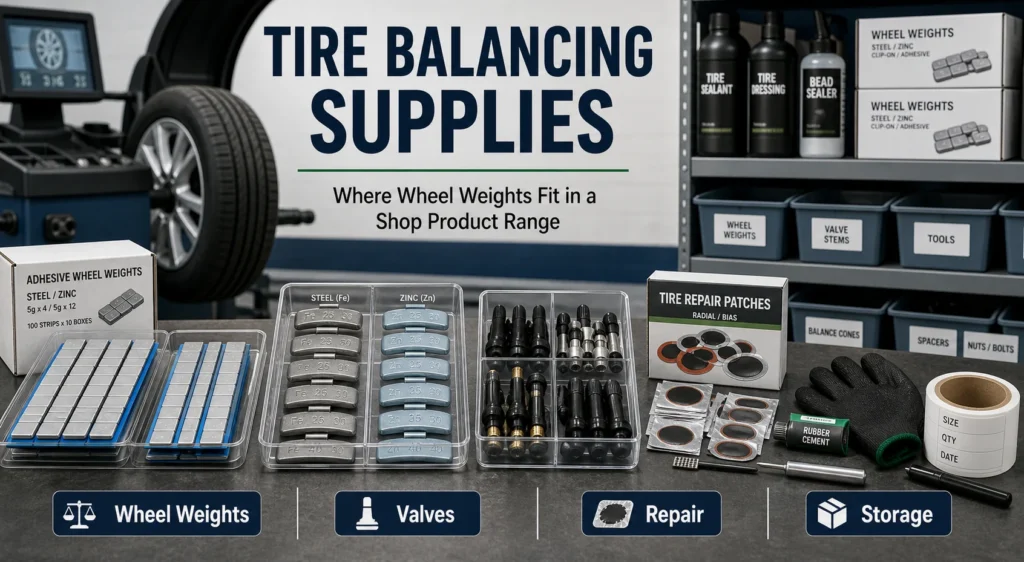
Tire balancing supplies include the consumables and tools shops use to correct wheel imbalance, organize service work, and keep tire jobs moving. Wheel weights are the core consumable in that range because every balance job may require adhesive or clip-on weights matched by wheel type, material, size, and installation method.
For tire shops, distributors, and shop-supply buyers, wheel weights should not be planned as a loose box of metal parts. They sit beside valve stems, balancing tools, tire repair products, labels, bins, and reorder systems. A good product range helps technicians work faster and helps buyers avoid stock gaps, mixed sizes, and slow-moving inventory.
Table of Contents
- What are tire balancing supplies?
- Where do wheel weights fit in the supply range?
- What wheel weights should a tire shop keep in stock?
- How should shops separate adhesive and clip-on inventory?
- What related supplies should be stocked with wheel weights?
- How should shops manage bins, labels, and reorder points?
- What should distributors and shop suppliers include in an RFQ?
- What mistakes create slow-moving or unreliable stock?
- Conclusion: build the shelf around real balancing work
- Frequently Asked Questions
- References
What are tire balancing supplies?
Tire balancing supplies are the items a shop uses during wheel balancing and related tire service: wheel weights, valve stems, balancing cones or adapters, cleaning tools, storage labels, tire repair products, and shop consumables. Wheel weights are usually the most frequently consumed balancing item.
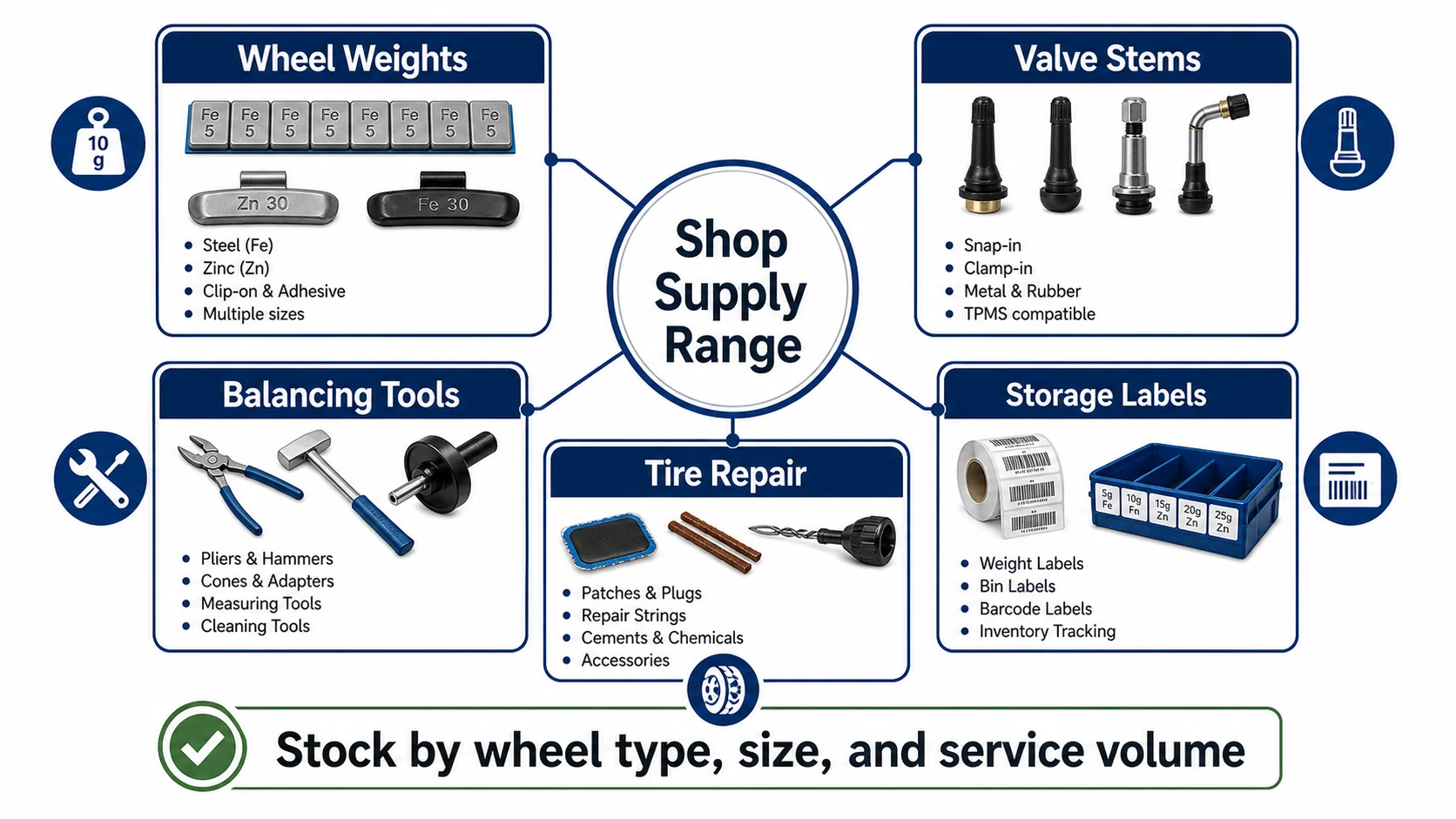
Wheel balancing is part of the wider tire-service workflow. A technician mounts the wheel assembly on a balancer, measures imbalance, then corrects that imbalance by adding weight at the correct position. The National Highway Traffic Safety Administration provides general tire safety information for consumers, including the importance of tire condition and proper service attention 1. For shop buyers, the supply question is more operational: which items must be near the balancer so technicians can complete the job without searching through unrelated stock?
Typical tire balancing supplies include:
| Supply category | Examples | Why shops stock it |
|---|---|---|
| Wheel weights | Adhesive strips, clip-on weights, steel, zinc, coated options | Correct wheel imbalance during service. |
| Valve supplies | Snap-in valves, clamp-in valves, valve cores, caps | Support tire replacement and maintenance. |
| Balancing tools | Weight pliers, scrapers, rim cleaning tools, cones, adapters | Help technicians install and remove weights correctly. |
| Tire repair | Patches, plugs, repair strings, cement, buffing items | Support puncture repair when the shop offers it. |
| Storage and labels | Bins, barcode labels, size labels, reorder cards | Reduce wrong-size use and stock confusion. |
Wheel weights are the part of the range that directly changes the balance correction. A shop may carry many useful supplies, but if the right size or attachment type of weight is missing, the balancing job slows down. Buyers who need to explain the operational difference between the balancing service and the weights themselves can use the role of wheel weights in tire balancing to train sales teams or purchasing staff before they build a shop range.
Where do wheel weights fit in the supply range?
Wheel weights fit at the center of a tire balancing supply range because they are consumed repeatedly and must match the wheel application. They connect the technical balancing result to the physical products a technician uses every day.
The balancer tells the technician how much correction is needed and where it should be placed. The shop then needs the right wheel weight format to complete that correction. If the wheel has an alloy rim with limited visible edge use, an adhesive weight may be preferred. If the job involves a steel wheel with a suitable rim flange, a clip-on weight may be faster and familiar. If the shop services both passenger cars and light commercial vehicles, the size range must cover more than one easy SKU.
That is why wheel weights should be planned by service mix:
- Wheel type: alloy wheels, steel wheels, trucks, commercial vehicles, or mixed passenger-car service
- Attachment type: adhesive, clip-on, or both
- Unit system: grams, ounces, or a market-specific mix
- Material: steel, zinc, or non-lead requirement
- Storage method: bins, boxes, rolls, labels, barcode system, and reorder points
- Technician habit: how weights are selected, cut, installed, and recorded during a busy day
Before buyers decide the shelf layout, they need to know which wheel applications the shop actually serves. The wheel weight range planning framework helps connect material, attachment format, size coverage, and wheel type before a buyer turns tire balancing supplies into a purchase list.
The wider supply range should support the balancing station instead of competing with it. Put wheel weights close to the balancer, group sizes logically, keep valve and repair items separate enough to avoid mix-ups, and label bins by type and unit. A tidy shelf is not just a visual preference; it protects technician speed.
What wheel weights should a tire shop keep in stock?
A tire shop should stock the adhesive and clip-on wheel weights that match its common wheel applications, plus enough gram or ounce sizes to cover everyday balancing corrections. The best assortment depends on service volume, local vehicles, wheel type, and whether the shop sells retail, fleet, or mixed service.
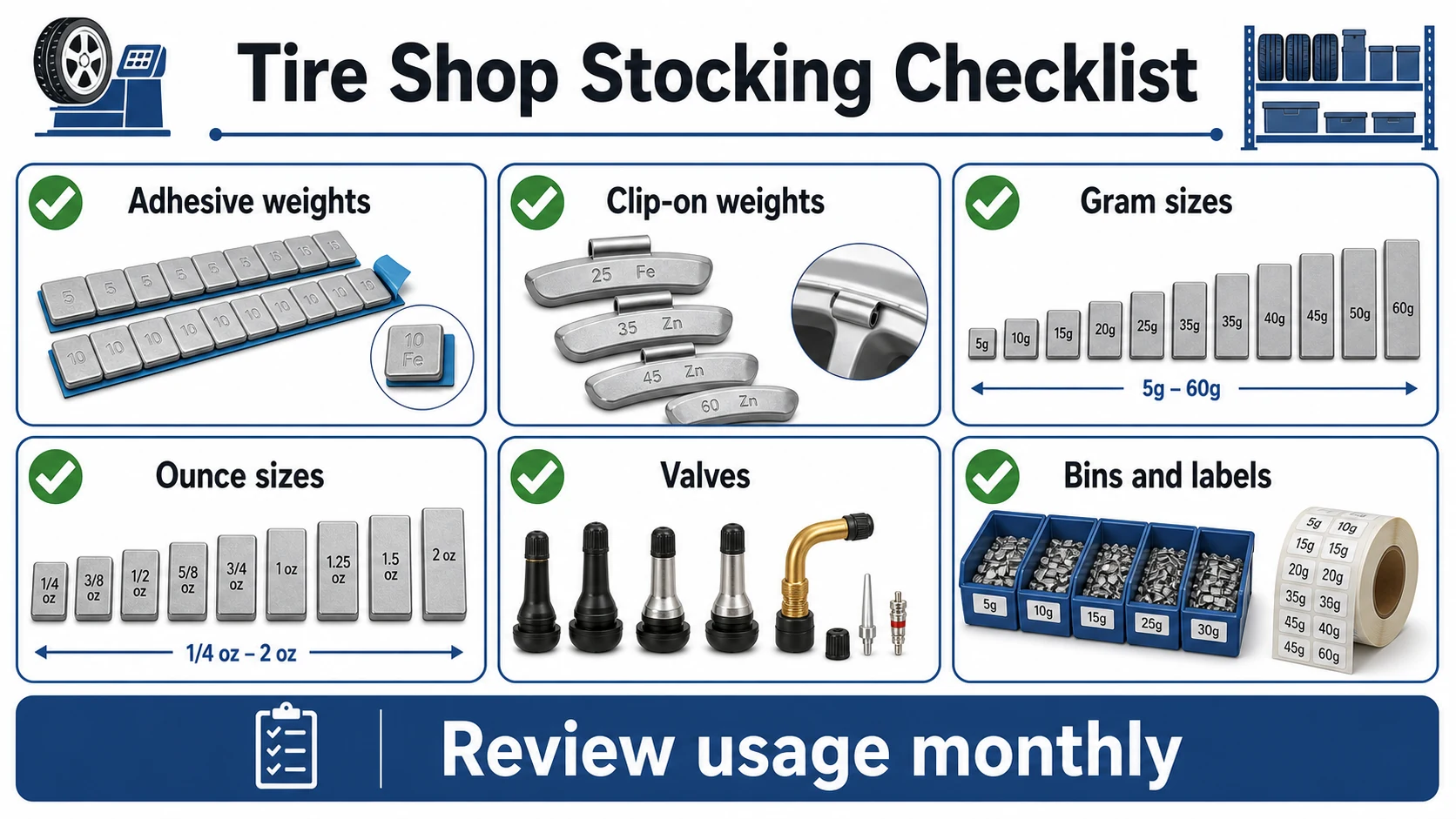
Most general tire shops need a practical mix rather than every possible SKU. A starter range often includes adhesive strips for alloy wheels, clip-on weights for steel wheels, common small increments, and a few larger sizes for heavier corrections. Shops that service trucks, fleets, or specialty wheels may need deeper inventory.
Use this planning table:
| Shop profile | Wheel weight priority | Stocking note |
|---|---|---|
| Passenger car tire shop | Adhesive strips and common clip-on sizes | Keep fast-moving gram or ounce sizes close to the balancer. |
| Alloy-wheel focused shop | Adhesive strips, low-profile options, strong tape | Check spoke clearance and tape reliability. |
| Steel-wheel service shop | Clip-on weights by rim profile and size | Separate clip profiles and label bins clearly. |
| Fleet or light commercial shop | Larger sizes, durable coatings, organized bulk cartons | Review usage by vehicle type and service interval. |
| Retail supply distributor | Boxed assortments, barcode labels, shelf-ready packaging | Balance variety with manageable SKU depth. |
Buyers looking at shop inventory can use a tire shop wheel weight stocking plan to decide which types and sizes belong in daily-use bins before they add slower-moving backup stock.
Size planning is where many shops either overbuy or underbuy. Too few sizes force technicians to stack awkward combinations. Too many rarely used sizes create slow-moving stock and confusing bins. A buyer comparing gram and ounce coverage can use gram and ounce size planning for wheel weights to align increments with the local unit system and common service applications.
For most shops, the range should be reviewed after one or two ordering cycles. Actual usage will show which sizes move quickly, which boxes stay full, and which tire jobs cause technicians to improvise. That usage data is more valuable than copying another shop's shelf.
How should shops separate adhesive and clip-on inventory?
Shops should separate adhesive and clip-on wheel weights by wheel application, storage method, and technician workflow. Adhesive weights are usually planned around strips, tape, liner, and clearance, while clip-on weights are planned around rim flange fit and size markings.
Adhesive weights need clean storage. Dust, oil, moisture, and heat can affect tape handling and technician confidence. Surface preparation also matters during installation. 3M's VHB tape preparation guidance emphasizes clean, dry surfaces and proper preparation for bond performance 3. Wheel weight buyers should translate that into practical shop behavior: keep adhesive weights sealed, clean the wheel surface, apply enough pressure, and avoid storing tape products in harsh conditions.
Clip-on weights need profile discipline. A shop should not mix similar-looking clip profiles in the same bin unless technicians are trained to identify them quickly. A wrong clip may install poorly, scratch the wheel, loosen, or waste time. For steel-wheel service, clip-on weights remain useful because they are fast and familiar when the rim flange is correct.
For shops that are still deciding how much shelf space to assign to each format, the clip-on and adhesive wheel weight decision helps separate attachment choice from material choice. That distinction matters because a buyer may choose steel or zinc material separately from adhesive or clip-on format.
Adhesive products also have their own details. Segment size, strip length, tape grade, liner behavior, coating, and box layout all affect installation speed. Buyers comparing alloy-wheel service supplies can use adhesive wheel weight tape and strip checks to decide what should be tested before a shop commits to a standard adhesive range.
The shop shelf should make the choice obvious:
- Adhesive strips in one labeled section, grouped by unit system and segment layout
- Clip-on weights in bins or trays, grouped by clip profile and size
- Low-profile adhesive options kept separate for clearance-sensitive wheels
- Returns or damaged weights kept out of live stock
- A small "verify fit" note near clip-on bins when multiple rim profiles are stocked
Good separation reduces wrong installation, wrong-size use, and wasted technician time.
What related supplies should be stocked with wheel weights?
Related tire balancing supplies should support the service steps around wheel weights: removing old weights, cleaning the rim, replacing valves when needed, mounting the assembly correctly, repairing tires when the shop offers repair service, and labeling inventory so technicians can find the right item.
A useful shop range usually includes:
| Related supply | Why it belongs near the range | Buying caution |
|---|---|---|
| Weight removal tools | Technicians remove old adhesive or clip-on weights before balancing | Avoid tools that damage rim finish. |
| Rim cleaning items | Adhesive weights need clean mounting surfaces | Keep cleaners compatible with wheel finishes. |
| Valve stems and cores | Tire service often includes valve replacement or inspection | Separate snap-in, clamp-in, and TPMS-related items. |
| Balancer cones and adapters | Help mount wheels correctly on the machine | Fit the shop's balancer and vehicle mix. |
| Tire repair consumables | Useful when tire repair is part of service | Follow local repair practice and safety guidance. |
| Gloves and wipes | Keep hands and wheel surfaces cleaner | Stock near service area, not hidden in general storage. |
| Bin labels and barcodes | Reduce picking mistakes | Update labels when SKU or size range changes. |
Safety-sensitive service items should be handled according to proper training and applicable workplace rules. OSHA's rim wheel servicing standard covers U.S. workplace requirements for servicing single-piece and multi-piece rim wheels 2. A product range cannot replace technician training, but a clear supply system can reduce avoidable confusion during service.
The key is not to make the balancing shelf a dumping ground for every tire-related item. Keep the items that technicians need during balancing close to the station. Keep repair, valve, and general shop supplies organized nearby but not mixed into wheel weight bins.
How should shops manage bins, labels, and reorder points?
Shops should manage wheel weight bins by type, size, unit system, and reorder point. Good labeling prevents wrong-size use, and monthly usage review helps the buyer adjust stock before busy seasons or slow-moving inventory becomes a cash drain.
A practical bin system includes:
- Separate bins for adhesive, clip-on, and special low-profile items
- Clear labels showing size, unit, material, and SKU code
- First-in, first-out handling for boxed adhesive products
- Minimum stock cards or reorder marks for fast-moving sizes
- Damaged or questionable weights separated from active stock
- Monthly usage tracking for the top sizes
If a shop uses both grams and ounces, do not store the two systems casually beside each other without clear labels. The same technician may work quickly during a busy service window, and a small labeling error can waste time. Different colors, bin rows, or shelf zones can help.
Distributors supplying multiple shops should think one step further. They need carton quantities that match shop usage, not only factory convenience. A shop that consumes many 5 g and 10 g adhesive segments may reorder those more often than larger sizes. A fleet shop may need heavier sizes and more durable packaging. Buyers planning cartons and replenishment can use bulk wheel weight replenishment and packaging checks to connect MOQ, SKU mix, carton labels, and reorder logic before buying too much of the wrong stock.
The simplest rule is to review actual usage every month. If the top five sizes are always low, increase reorder quantities. If a box does not move for several months, move it out of the main work zone or reduce future buying. Stock should follow service reality.
What should distributors and shop suppliers include in an RFQ?
Distributors and shop suppliers should include wheel weight format, size range, material, coating, tape, clip profile, packaging, label style, sample requirements, and carton quantities in an RFQ. A clear RFQ helps the supplier quote a usable shop assortment instead of isolated SKUs.
For tire balancing supplies, the RFQ should be organized by use case:
| RFQ area | What to specify | Why it helps |
|---|---|---|
| Shop profile | Passenger car, alloy-wheel, steel-wheel, fleet, retail, or mixed shop | Lets the supplier recommend a usable assortment. |
| Adhesive range | Segment size, strip layout, tape, liner, box quantity | Controls installation speed and shelf quality. |
| Clip-on range | Material, clip profile, size range, coating | Supports correct wheel fitment. |
| Unit system | Grams, ounces, or both | Prevents mixed-label confusion. |
| Packaging | Inner box, carton quantity, bin label, barcode, private label | Helps shops receive and store the range. |
| Samples | Sample quantity, packaging mockup, tape and fitment test | Lets the buyer approve the real working product. |
| Reorder plan | Fast-moving sizes, monthly volume, mixed carton needs | Helps avoid stockouts and excess slow stock. |
Once the buyer has defined shop type, adhesive or clip-on needs, gram or ounce coverage, packaging, and sample-testing expectations, it is easier to compare shop-ready wheel weight assortment samples against real shelf needs instead of treating every SKU as an equal priority.
The RFQ should also ask the supplier to identify regular production items. A distributor does not want to build a shop range around a size or package that requires high MOQ every time. Regular production, stable carton labels, and repeatable samples matter more than a one-time low price.
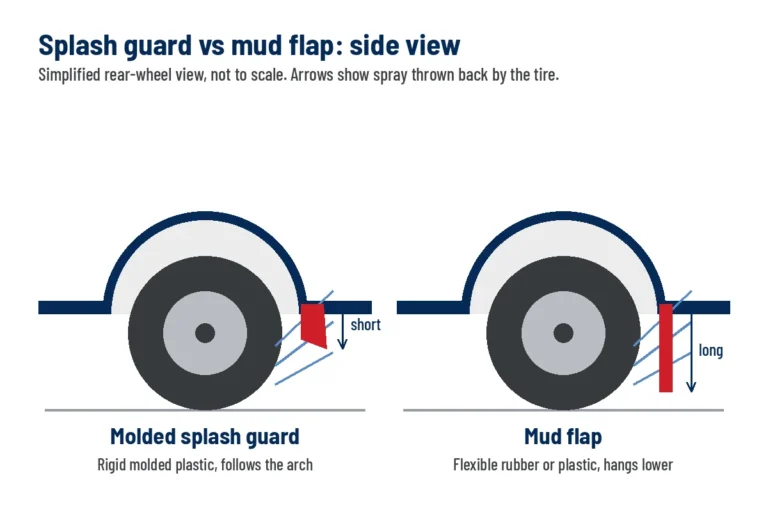
Tire shops often sell more than balancing supplies. Many also fit wheel covers, mud flaps and exterior trim. Our parts supply for tire, truck and EV service providers explains how those lines can be added to the same reorder cycle.
What mistakes create slow-moving or unreliable stock?
Slow-moving or unreliable tire balancing stock usually comes from buying by catalog breadth instead of shop usage. Too many similar SKUs, unclear labels, wrong unit systems, weak adhesive storage, and poor size planning all create avoidable inventory problems.
Common mistakes include:
| Mistake | What happens | Better approach |
|---|---|---|
| Buying every size at once | Cash is tied up in slow-moving boxes | Start with fast-moving sizes and expand from usage data. |
| Mixing grams and ounces poorly | Technicians pick the wrong unit | Use separate shelf zones and clear labels. |
| Treating adhesive tape as generic | Weights may not stick reliably | Test tape, storage, and installation conditions. |
| Keeping all clip profiles together | Wrong fitment or installation delays | Separate bins by profile and size. |
| Ignoring carton labels | Receiving and reorder errors increase | Match carton, bin, invoice, and SKU codes. |
| Buying only by low price | Poor coating, weak tape, or inaccurate counts may appear | Compare samples and packing records before bulk orders. |
Another mistake is treating wheel weights as a one-time purchase. They are consumables. The shop's vehicle mix changes, wheel designs change, non-lead preferences may increase, and technicians develop preferences based on real installation experience. A product range should be reviewed, not frozen.
Lead-related material decisions can also affect stock planning. EPA best-practice guidance has encouraged reducing or eliminating lead wheel weights because of environmental concerns 4. Shops and distributors should verify local market expectations and customer requirements before choosing lead, steel, zinc, or lead-free language for labels and product descriptions.
If you are building a tire-balancing supply range, share the vehicle mix, wheel-weight formats, size coverage, shop usage, packaging, and reorder needs you want to support. We can help you connect the broader supply plan to a focused wheel-weight sample and quotation request.
Conclusion: build the shelf around real balancing work
Wheel weights are the core consumable in tire balancing supplies because they directly complete the correction shown by the balancing machine. But they work best when planned with the full shop product range: adhesive and clip-on formats, gram or ounce sizes, valves, tools, repair items, bins, labels, cartons, and reorder points.
For shops, the right range reduces technician delays. For distributors, it creates a clearer assortment to quote, package, and replenish. Before placing a bulk order, define the shop profile, test the key wheel weight formats, confirm size coverage, and request samples that match the shelf layout the customer will actually use.
Frequently Asked Questions
Are wheel weights considered tire balancing supplies?
Yes. Wheel weights are one of the main tire balancing supplies because they are used to correct imbalance during wheel balancing. Shops usually stock them alongside valves, balancing tools, rim cleaning items, storage labels, and other tire service consumables.
What wheel weights should a tire shop stock first?
A tire shop should usually start with fast-moving adhesive strips, common clip-on sizes, and the gram or ounce system used in its market. The exact range should reflect the shop's wheel types, service volume, and whether it handles passenger cars, fleets, or specialty wheels.
Should adhesive and clip-on wheel weights be stored together?
They should be stored near the same balancing station but separated by type, size, unit system, and clip profile. Adhesive weights need clean, protected storage for tape performance, while clip-on weights need clear bins to avoid fitment mistakes.
How often should shops review tire balancing supply inventory?
Monthly review is practical for most shops. Buyers should check fast-moving sizes, slow-moving boxes, damaged stock, label accuracy, and reorder points. Busy shops or multi-branch distributors may need weekly checks for their top sizes.
What should distributors ask suppliers before buying shop assortments?
Distributors should ask for adhesive and clip-on formats, size range, material, coating, tape, clip profile, packaging, carton labels, sample testing, and regular-production availability. This makes it easier to compare suppliers and build a range that shops can actually use.
References
[1] National Highway Traffic Safety Administration. “Tires.” 2026.
[2] Occupational Safety and Health Administration. “Servicing Multi-Piece and Single Piece Rim Wheels.” 2026.
[3] 3M. “VHB Tape Surface Preparation Technical Bulletin.” 2019.
[4] United States Environmental Protection Agency. “Best Management Practices for Lead Wheel Weights.” 2015.