



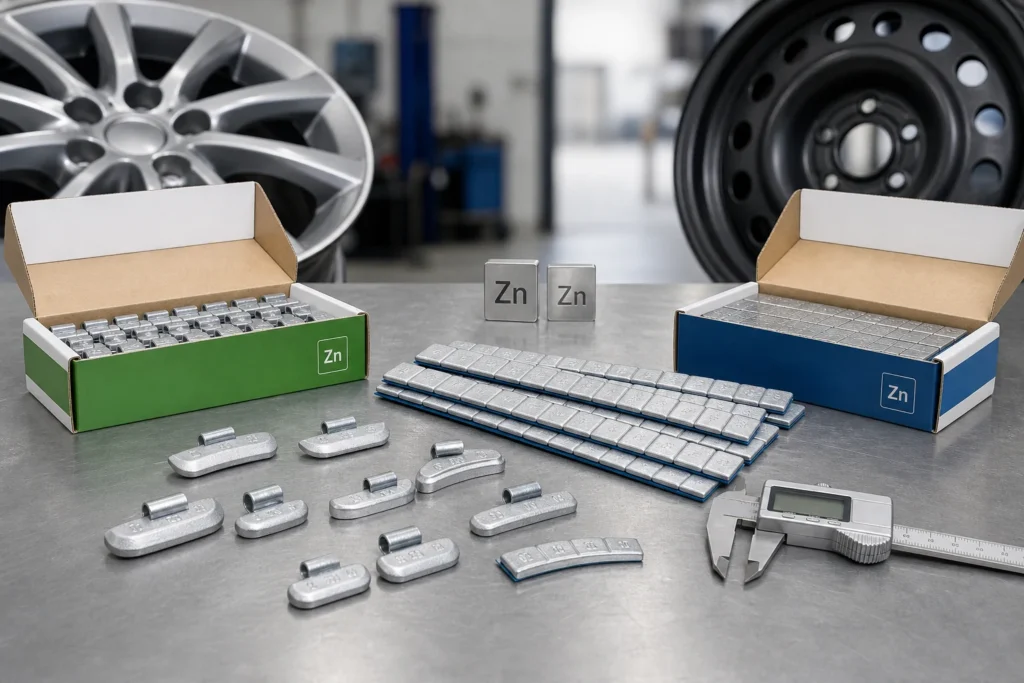
Zinc wheel weights are lead-free balancing weights made from zinc or zinc alloy for correcting tire and wheel imbalance. They work best when buyers need a clearly identified non-lead material with compact appearance, good formability, and reliable fitment, but they still require checks for density, coating, wheel type, size range, tape, packaging, and local market acceptance.
For importers, distributors, and service-channel buyers, zinc is usually not chosen in isolation. It sits between three practical questions: Which markets are moving away from lead? Which wheel applications need clip-on or adhesive formats? Which material gives the best mix of compliance positioning, cost, corrosion control, and stock efficiency? The wheel-weight range planning framework helps buyers connect zinc with the rest of the range instead of treating material choice as a one-line specification.
Table of Contents
- What are zinc wheel weights?
- What benefits make zinc wheel weights useful?
- What limits should buyers understand before choosing zinc?
- When do zinc wheel weights fit best?
- How do zinc weights compare with steel and lead?
- What should buyers check before ordering zinc wheel weights?
- Which applications are not ideal for zinc wheel weights?
- Conclusion: choose zinc when the material fits the program
- Frequently Asked Questions
- References
What are zinc wheel weights?
Zinc wheel weights are balancing weights made from zinc-based material and formed into clip-on or adhesive shapes. Zinc is the chemical element Zn, and buyers often use the Zn marking to separate zinc weights from steel, lead, or mixed-material alternatives in quotations and carton labels 1.
In practice, zinc wheel weights are used for the same balancing purpose as other wheel weights: a technician adds the required mass to the wheel assembly so the tire and wheel rotate more smoothly. The difference is the material choice. Zinc gives buyers a lead-free option that has a metal feel and a compact profile, while still requiring a clear view of attachment style, coating, and size availability.
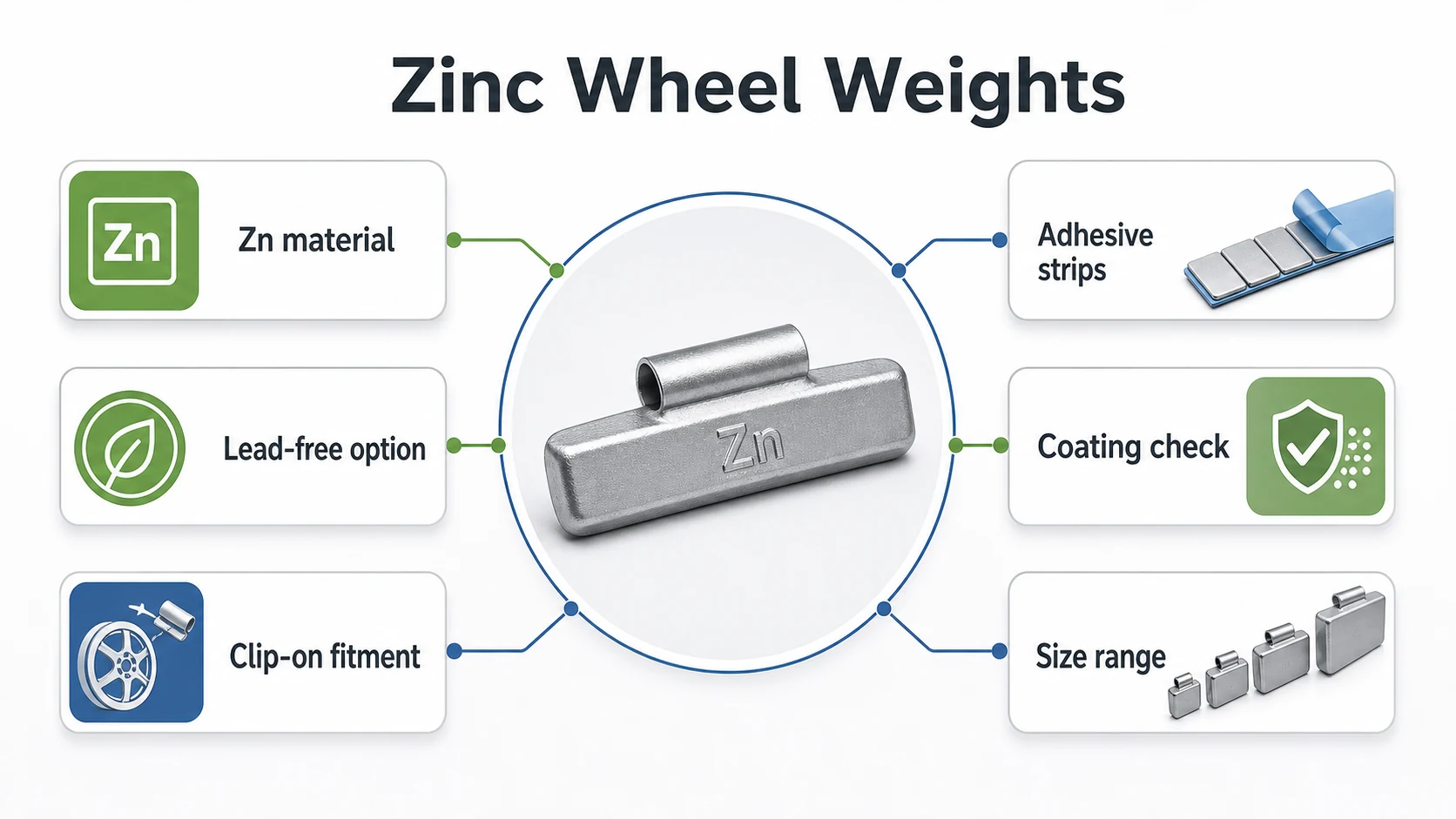
The first decision is not simply "zinc or not zinc." Buyers need to decide whether the zinc program will cover clip-on weights for steel wheels, adhesive strip weights for alloy wheels, or both. They also need to know whether local repair channels expect gram sizes, ounce sizes, pre-cut strips, roll format, coated clips, plain finish, or private-label cartons.
| Zinc wheel weight decision | Why it matters before an RFQ | What to ask the supplier |
|---|---|---|
| Material identity | Avoids confusion between Zn, Fe, and lead-free mixed claims | Confirm zinc or zinc alloy marking, declaration, and sample labeling |
| Attachment format | Determines wheel application and installation workflow | Ask for clip-on profiles, adhesive strip formats, or both |
| Size range | Affects service coverage and inventory planning | Confirm grams, ounces, segment sizes, and carton quantity |
| Surface finish | Influences corrosion appearance and customer complaints | Ask for coating, plating, paint, and salt spray expectations |
| Packaging | Controls distributor handling, warehouse picking, and resale presentation | Confirm box weight, inner boxes, labels, barcode, and export carton |
What benefits make zinc wheel weights useful?
Zinc wheel weights are useful because they give buyers a non-lead balancing option with clear material identity and practical product formats. They can support lead-reduction programs, clean product labeling, and familiar metal-weight handling when the selected design matches the wheel application.
The most obvious benefit is lead-free positioning. Lead wheel weights have been targeted by environmental programs because lost or discarded lead weights can enter the environment. The U.S. EPA's best management guidance encouraged voluntary steps to reduce lead wheel weight use and promote alternatives 2. That does not mean every market has the same legal rule, but it does explain why buyers often evaluate zinc and steel when replacing lead. The article on why steel and zinc are considered in lead-free programs is useful when a purchasing team is separating environmental pressure from day-to-day product fit.
Zinc also has a clear identity in buyer communication. Carton labels, product marks, and quotations can use "Zn" to distinguish the material from Fe steel weights or Pb lead weights. This matters when a distributor carries several materials in the same warehouse. If the receiving team, sales team, and end customer all use the same material code, fewer mistakes occur in picking, replenishment, and complaint handling.
Another benefit is that zinc can feel closer to traditional metal balancing weights than some buyers expect from a lead-free replacement. For clip-on weights, a well-made zinc part can provide a familiar installation experience when the clip profile fits the rim flange. For adhesive weights, zinc strips can be supplied in segment layouts that resemble other stick-on formats, making them easier to integrate into existing shop routines.
The buyer benefit is strongest when zinc is specified as part of a complete product program:
| Benefit | What it helps with | Buyer caution |
|---|---|---|
| Lead-free material identity | Environmental positioning, customer requirements, material labeling | Confirm the market's actual legal requirement; do not assume one rule applies globally |
| Recognizable Zn marking | Warehouse sorting, quotations, packaging, and sales communication | Keep material codes consistent across product, box, carton, and invoice |
| Metal product feel | Familiar handling for installers used to metal wheel weights | Check actual shape, clip spring behavior, and adhesive performance |
| Suitable for selected formats | Clip-on and adhesive programs can both be developed | Do not assume every zinc size is available in every profile |
| Useful in material comparison | Gives buyers another option besides lead and steel | Compare cost, density, coating, and market acceptance before switching |
What limits should buyers understand before choosing zinc?
Zinc wheel weights have limits in density, cost, size availability, corrosion appearance, and market preference. They are not automatically better than steel or lead-free alternatives, so buyers should treat zinc as a fit-for-purpose material rather than a universal replacement.
Density is the first practical issue. Zinc is less dense than lead, so a zinc weight normally needs more volume than an equivalent lead weight. That does not make zinc unsuitable, but it affects part shape, strip length, and the space available behind spokes or along a rim flange. In tight applications, especially low-clearance alloy wheel areas, buyers must check whether the weight height and length will interfere with calipers or wheel styling.
Cost and supply strategy are also important. In many programs, steel weights are chosen because they are widely accepted, cost-efficient, and easy to source in large ranges. Zinc may be selected for certain customers or markets, but it can be less attractive where the buyer's main goal is low unit cost across a high-volume assortment. When a project is cost-sensitive or needs a very wide replacement range, the steel Fe alternative to zinc wheel weights can help buyers decide whether Fe material is a better baseline.
Zinc also needs realistic corrosion expectations. Zinc itself is commonly associated with corrosion protection in many industrial uses, but a wheel weight is still a working automotive part exposed to moisture, salt, brake dust, installation abrasion, and storage conditions. A poor coating, damaged clip, weak plating process, or damp carton can still create visible finish complaints. Buyers should ask how the supplier evaluates coating consistency and whether any salt spray test is used as a comparative quality control method; ASTM B117 describes a standard salt spray apparatus practice often referenced for this type of corrosion exposure testing 3.
Finally, market acceptance matters. Some shops are familiar with steel weights, some still know older lead formats, and some customers request zinc for specific programs. If installers dislike the clip profile, if adhesive strips are hard to remove from the liner, or if the cartons do not match local size conventions, the material advantage will not save the program.
When do zinc wheel weights fit best?
Zinc wheel weights fit best when a buyer needs a lead-free material, clear Zn labeling, controlled product appearance, and a manageable size range for a defined service channel. They are especially suitable when the purchasing team can test samples before committing to a full assortment.
A strong zinc program usually starts with a defined application rather than a broad replacement promise. For example, a distributor may introduce zinc adhesive strips for alloy wheel service in a market where lead-free positioning matters to retailers. A repair network may use zinc clip-on weights for selected passenger-car steel wheel applications where the profile and coating have already passed shop testing. An importer may carry zinc beside Fe steel weights so customers can choose by market requirement and price point.
| Best-fit application | Why zinc can work | What to verify |
|---|---|---|
| Passenger car service ranges | Common balancing sizes can be covered without excessive assortment complexity | Gram or ounce coverage, popular increments, and packaging count |
| Lead-free retail programs | Zn labeling supports a clear non-lead material message | Local compliance expectations and customer documentation needs |
| Alloy wheel adhesive strips | Zinc can be supplied in familiar segmented stick-on formats | Tape grade, liner release, strip height, and surface preparation |
| Selected steel-wheel clip-on programs | Zinc clip-on parts can match common rim flange profiles when tooled correctly | Clip profile, retention, coating, and installation force |
| Distributor mixed-material catalogs | Zinc gives customers a material option beside steel | SKU naming, carton labels, and sales training |
Zinc is less attractive when the buyer has no defined market reason for it. If the only goal is to replace lead at the lowest possible total cost, steel may win. If the shop needs extremely thin adhesive profiles behind tight wheels, the buyer should compare actual sample height and tape thickness rather than relying on material name. If the channel needs dozens of niche clip profiles, zinc availability may be narrower than the broader steel range.
How do zinc weights compare with steel and lead?
Zinc sits between lead and steel in many buyer discussions: it is lead-free like steel, more compact than many steel shapes at the same mass, and more acceptable than lead where lead reduction is a priority. The right choice depends on market rules, wheel application, price target, and supplier capability.
Lead is dense and easy to form, which is why it was historically common. The problem is environmental pressure and regulatory or voluntary phase-out activity in many markets. Buyers who still see lead in older product lines should verify whether it can be sold, installed, transported, or promoted in their target markets before placing any repeat order.
Steel, often labeled Fe, has become a mainstream lead-free material because it is cost-effective, widely available, and familiar in large-volume replacement programs. Its lower density compared with lead can require larger physical shapes, but good design and coating can make steel a practical everyday choice. Zinc offers another lead-free option with a different cost, appearance, density, and market-positioning profile.
For buyers comparing all three, the material comparison behind zinc wheel weight choices helps separate the basic material trade-offs before a team locks a catalog strategy. The real decision is not which material sounds best on paper; it is which material can be supplied consistently in the sizes, profiles, coatings, and cartons your customers will actually use.
| Material | Main advantage | Main limit | Best buyer use |
|---|---|---|---|
| Lead | High density and traditional handling | Environmental and regulatory pressure in many markets | Legacy comparison only unless verified as acceptable |
| Steel / Fe | Cost-effective lead-free replacement with broad supply | Larger volume for same mass, coating quality matters | High-volume lead-free programs and broad service assortments |
| Zinc / Zn | Lead-free identity, compact metal appearance, clear material marking | Cost, availability, and coating expectations must be checked | Defined lead-free programs where Zn is requested or preferred |
What should buyers check before ordering zinc wheel weights?
Buyers should check the material declaration, attachment format, size range, coating, tape, clip fit, carton labels, and sample performance before ordering zinc wheel weights. A good RFQ makes these details visible before price comparison, because the cheapest zinc quote may not match the application.
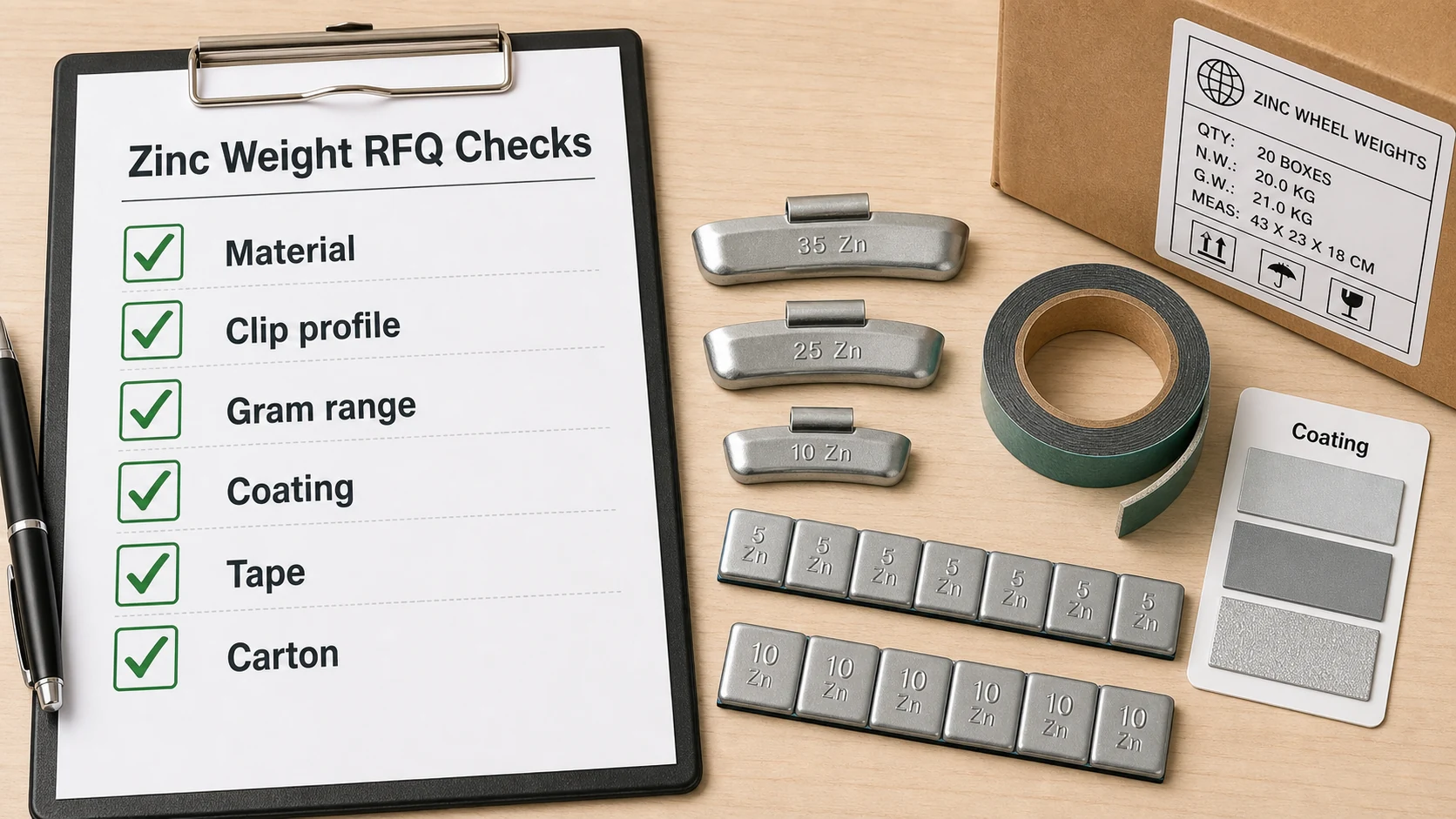
Start with material and labeling. Ask whether the product is zinc or zinc alloy, how it is marked, and whether the supplier can keep Zn visible on samples, inner boxes, export cartons, and invoices. If your customers compare Fe and Zn options side by side, inconsistent labeling can create unnecessary complaints even when the parts themselves are correct.
Next, define the attachment format. For clip-on zinc wheel weights, request the rim flange profile, intended wheel type, coating, clip material if separate, installation force expectations, and retention testing method. For adhesive zinc wheel weights, request the segment size, total strip weight, tape type, liner behavior, shelf-life guidance, and recommended surface preparation. Tape performance depends heavily on clean, dry, prepared surfaces; 3M's surface preparation guidance for VHB tapes is a useful reminder that bonding depends on surface condition, contamination control, and pressure, not tape brand alone 4.
Size planning deserves its own line in the RFQ. A buyer building a zinc assortment should not simply ask for "all common sizes." Instead, list gram or ounce increments, strip layout, pieces per box, box weight, carton quantity, and barcode requirements. The size coverage for zinc wheel weight programs can help a purchasing team connect common mass increments with the wheel applications and service channels they intend to cover.
Coating should also be handled as a buyer requirement, not a vague promise. Ask for the finish type, color, visual standard, corrosion-test target if applicable, and acceptable appearance after storage. Buyers who already receive complaints about rust, white corrosion, peeling paint, or chipped surfaces can use coating and corrosion checks for zinc wheel weights to turn those complaints into clearer inspection points before the next sample round.
| RFQ item | Zinc-specific question | Why it protects the buyer |
|---|---|---|
| Material | Is it Zn or zinc alloy, and how is it declared? | Prevents wrong-material substitution and unclear claims |
| Clip profile | Which rim flange or wheel type is it designed for? | Reduces installer rejection and poor retention |
| Adhesive tape | What tape construction and liner are supplied? | Helps avoid lift, hard removal, or poor bonding |
| Size range | Which grams, ounces, strip lengths, and carton counts are available? | Keeps the range practical for real inventory |
| Coating | What finish, color, and corrosion expectation are offered? | Reduces visible finish complaints |
| Packaging | What inner box, export carton, label, and barcode are included? | Makes warehouse and resale handling easier |
| Samples | Can samples be tested before bulk order confirmation? | Finds fitment and handling issues before MOQ commitment |
Which applications are not ideal for zinc wheel weights?
Zinc wheel weights are not ideal when the buyer needs the lowest possible cost, the broadest commodity range, extremely thin clearance, or a market that already prefers steel. They may also be a poor fit when the supplier cannot document material, coating, tape, and packaging consistently.
The first weak fit is a purely price-driven program. If the distributor's customers buy only by lowest cost per box, zinc may be difficult to position unless the market specifically requests Zn material. In that case, steel weights often provide a more practical lead-free baseline, especially for high-turnover service sizes.
The second weak fit is a channel with unclear wheel applications. Clip-on weights are profile-sensitive. If the buyer cannot identify the rim flange, wheel type, or target vehicle mix, any material can fail in the field. Zinc does not remove the need for fitment testing. It only changes the material and product behavior.
The third weak fit is uncontrolled adhesive installation. Stick-on weights depend on wheel surface cleaning, temperature, pressure, and tape quality. A zinc adhesive strip with poor surface preparation can still lift. Before blaming the material, shops should check whether wheels are clean and dry, whether the tape liner releases properly, and whether the installer applies enough pressure after placement.
The fourth weak fit is an order placed without supplier review. Buyers comparing zinc quotations should ask about tooling, inspection, sample approval, packaging control, and batch consistency. When a purchasing team is qualifying a new source, the manufacturer checks before sourcing zinc wheel weights provide a useful way to evaluate whether the factory can support repeated shipments, not just a single attractive sample.
If you are evaluating zinc for a real wheel-weight program, share your target material, attachment format, size range, coating, and packaging requirements. We can help you turn those checks into a sample request before you commit to an order.
Conclusion: choose zinc when the material fits the program
Zinc wheel weights are a useful lead-free option when the buyer has a clear reason to specify Zn, a defined wheel application, and enough sample testing to confirm fitment, coating, tape, size range, and packaging. They are not a universal upgrade over steel or a simple one-for-one replacement for lead.
For a practical sourcing decision, treat zinc as part of a complete balancing-weight program. Compare the material against steel and legacy lead expectations, confirm the intended wheel applications, then request samples before finalizing cartons and labels. Buyers preparing a zinc range can review zinc wheel weight samples for material and fitment checks once the required material, size range, attachment format, coating, and packaging details are clear enough for a meaningful sample discussion.
Frequently Asked Questions
Are zinc wheel weights lead-free?
Zinc wheel weights are generally used as a lead-free alternative, but buyers should still confirm the exact material declaration with the supplier. Ask whether the product is zinc or zinc alloy, how it is marked, and whether the material statement matches carton labels, invoices, and any customer documentation.
Are zinc wheel weights better than steel wheel weights?
Zinc is not automatically better than steel. Zinc may offer a compact metal appearance and clear Zn material identity, while steel often wins on cost, range breadth, and broad lead-free availability. The better choice depends on market requirements, wheel application, size coverage, coating quality, and target price.
Can zinc wheel weights be used on alloy wheels?
Yes, zinc adhesive wheel weights can be used on alloy wheels when the strip height, segment size, tape, and installation process match the application. Buyers should test clearance behind spokes and confirm that installers clean and prepare the wheel surface before applying adhesive weights.
Can zinc wheel weights be used on steel wheels?
Zinc clip-on wheel weights can fit steel wheels when the clip profile matches the rim flange. Buyers should not order by material only. They need to confirm wheel type, rim flange style, clip retention, coating, and size range before approving bulk production.
What should be included in a zinc wheel weight RFQ?
A zinc wheel weight RFQ should include material identity, attachment format, gram or ounce range, clip profile or tape details, coating, carton quantity, label format, sample requirements, and any market documentation needs. Clear RFQs reduce mismatched samples and make supplier quotations easier to compare.
References
[1] Royal Society of Chemistry. “Zinc.” 2026.
[2] United States Environmental Protection Agency. “Best Management Practices for Lead Wheel Weights.” 2015.
[3] ASTM International. “ASTM B117-19 Standard Practice for Operating Salt Spray Apparatus.” 2019.
[4] 3M. “3M VHB Tape Surface Preparation Technical Bulletin.” 2019.