



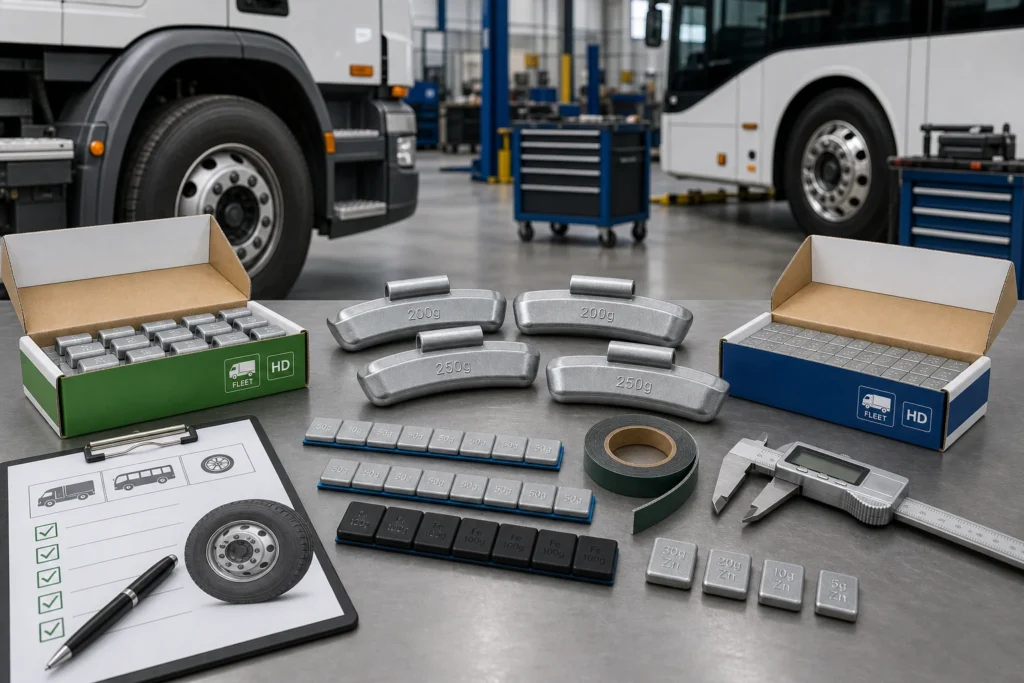
Commercial vehicle wheel weights are balancing weights specified for fleet vans, medium-duty trucks, heavy trucks, buses, trailers, and other work vehicles. Buyers should choose them by vehicle mix, wheel type, correction range, attachment format, material, coating, packaging, and repeat supply needs rather than copying a passenger-car assortment.
For fleets, distributors, and commercial tire service networks, a wheel weight range is a small part with a large operational effect. The wrong range can create stock gaps, technician delays, finish complaints, or poor fitment. The wheel-weight range planning framework helps buyers connect material, attachment style, size coverage, and sourcing requirements before building a commercial vehicle program.
Table of Contents
- What are commercial vehicle wheel weights?
- Why do fleet, truck, and bus programs need separate planning?
- Which applications need different balancing-weight decisions?
- How should buyers plan a commercial vehicle wheel weight range?
- How should buyers compare materials and coatings?
- What should buyers include in a commercial vehicle wheel weight RFQ?
- How should buyers qualify suppliers?
- Conclusion: match the wheel weight range to the vehicle mix
- Frequently Asked Questions
- References
What are commercial vehicle wheel weights?
Commercial vehicle wheel weights are clip-on or adhesive balancing weights used on work vehicles such as vans, trucks, buses, trailers, and fleet service vehicles. They correct wheel and tire imbalance after mounting, repair, or replacement, but the buying logic is broader than the passenger-car market.
Passenger-car service ranges often prioritize broad light-vehicle coverage, small increments, retail packaging, and common alloy-wheel or steel-wheel routines. Commercial vehicle programs need a different lens. The buyer may be supporting one fleet with known vehicles, a tire shop servicing many fleets, a distributor stocking multiple commercial customers, or an exporter building cartonized ranges for different markets.
The purpose of the weight is still simple: add the right amount of mass at the right location so the wheel assembly rotates more smoothly. The buying challenge is not simple. A fleet van, transit bus, box truck, long-haul tractor, and trailer may all fall under "commercial vehicle," but they do not create the same balance requirement, attachment method, or stocking pattern.
| Commercial buyer type | Main buying goal | Common mistake to avoid |
|---|---|---|
| Fleet maintenance team | Keep known vehicles serviced with repeatable stock | Buying too broad a range and tying up inventory |
| Commercial tire shop | Cover common customer vehicles quickly | Missing high-use sizes while stocking slow-moving variants |
| Distributor | Build a sellable range across fleet, truck, and bus channels | Treating all commercial vehicles as heavy trucks |
| Export importer | Match local wheel types, labels, and carton expectations | Ordering by material alone without fitment and packaging checks |
| Bus or municipal service network | Control repeat service quality and visible finish | Ignoring coating and storage conditions |
Why do fleet, truck, and bus programs need separate planning?
Fleet, truck, and bus programs need separate planning because vehicle duty cycles, wheel types, tire sizes, service habits, and inventory behavior differ. A commercial wheel weight range should be built from real service demand, not from one generic "heavy-duty" label.
Fleet vans may need a tighter, lighter range than heavy trucks. Buses may require clean appearance, repeated shop procedures, and predictable replacement stock. Trailers may create high-volume demand for a narrower set of wheel applications. Trucks may need heavier correction values and more careful wheel-position planning. These differences affect size range, stock depth, carton size, and whether clip-on or adhesive formats should be prioritized.
Safety context also matters. Commercial wheel service can involve larger assemblies and higher-risk rim or tire handling. OSHA's regulation for servicing multi-piece and single-piece rim wheels covers training and safe servicing procedures for wheel work 1. A buyer choosing wheel weights is not writing the service manual, but the purchasing decision should support trained, consistent shop practice rather than encouraging improvised installation.
The practical planning question is: Which vehicles actually pass through the service channel? A fleet with mostly delivery vans might need a different range from a distributor supplying truck stops and bus depots. A bus operator may care about coating appearance and repeatability. A trailer service chain may care more about fast-moving sizes and carton durability.
Which applications need different balancing-weight decisions?
Different commercial vehicle applications need different decisions for weight range, attachment format, material, and packaging. Buyers should separate fleet vans, medium trucks, heavy trucks, buses, and trailers before they compare supplier quotations.
Fleet vans and light commercial vehicles may sit close to passenger-car service patterns in some markets, but they still require careful SKU planning. These buyers often need dependable everyday stock, clear unit labels, and packaging that technicians can use quickly. The goal is not maximum range width; it is fewer service delays across a known vehicle base.
Medium-duty and heavy-duty trucks often need larger correction values, more robust packaging, and fitment confirmation on the wheel types used by the customer. Buyers who need a deeper heavy-duty explanation can use truck wheel weight selection for heavy-duty service to separate truck-specific fitment from broader commercial range planning.
Buses bring another kind of pressure. Municipal, shuttle, and coach service may involve repeated inspections, visible wheels, and centralized maintenance. Coating appearance, carton labels, and repeat batch consistency can matter as much as price. Trailer programs may have a narrower vehicle mix but higher stock turnover in certain sizes.
Attachment format should be decided by wheel design, not by habit. Clip-on weights need the correct wheel flange and clip profile. Adhesive weights need a clean mounting surface, enough clearance, and reliable tape behavior. Buyers deciding between formats can use the attachment format comparison for commercial wheels to confirm when the attachment method, wheel type, and installation process align.
| Application | Range tendency | Attachment focus | Buying priority |
|---|---|---|---|
| Fleet vans | Narrower, high-turnover service sizes | Clip-on or adhesive depending on wheel type | Repeatability and quick shop use |
| Medium-duty trucks | Mid-to-heavy correction range | Wheel-specific clip or adhesive fit | Size coverage and carton strength |
| Heavy trucks | Heavier values and stronger service assumptions | Fitment testing on real truck wheels | Sample approval and coating durability |
| Buses | Repeatable range with visible finish control | Wheel type and installation routine | Coating, labeling, and batch consistency |
| Trailers | Often high-volume repeated sizes | Practical shop workflow | Stock depth and reorder planning |
How should buyers plan a commercial vehicle wheel weight range?
Buyers should plan a commercial vehicle wheel weight range by mapping vehicle groups, wheel types, balancing units, high-use sizes, carton quantities, and reorder patterns. The best range is not the widest range; it is the range that covers real service demand with manageable inventory.
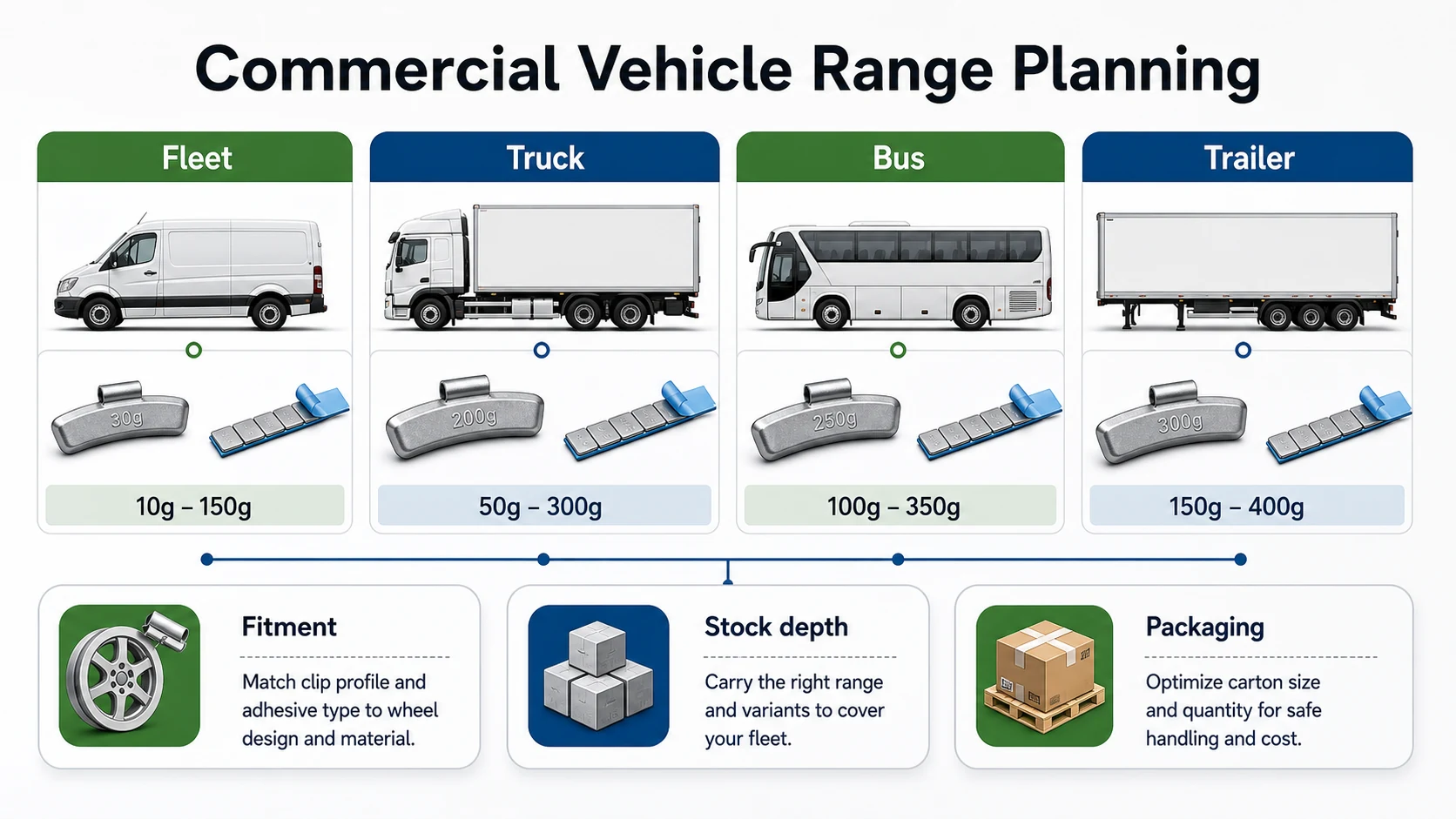
Start with the vehicle mix. If the buyer serves mostly city buses, the range should reflect that wheel type and shop process. If the buyer serves mixed fleets, the range may need separate lines for vans, trucks, trailers, and bus applications. If the buyer is a distributor, the range should be built around repeat orders, not just a catalog that looks complete.
Next, decide the unit system and size structure. Some markets expect grams, while others expect ounces or dual labeling. Some shops prefer pre-cut strip formats; others stock clip-on sizes in boxes. Before setting the first purchase order, buyers can use commercial wheel weight size planning to connect gram and ounce systems with practical stock coverage.
Stock depth is different from range width. A distributor may need deep stock in a smaller number of fast-moving commercial sizes, while a service network may need fewer SKUs but stronger replenishment discipline. Carrying too many low-turnover sizes can make a range look impressive but weak in daily use.
| Planning step | Buyer question | Output |
|---|---|---|
| Vehicle map | Which vehicle groups does the range need to support? | Fleet, truck, bus, trailer, or mixed program |
| Wheel type | Which wheel materials and designs appear most often? | Clip-on, adhesive, or mixed attachment strategy |
| Unit system | Which unit does the service channel expect? | Gram, ounce, or dual-label structure |
| Stock depth | Which sizes turn fastest? | Core sizes, secondary sizes, and reorder points |
| Packaging | How heavy can each carton be handled safely and economically? | Inner box, carton quantity, label, and barcode plan |
| Samples | Which real wheels will be used for approval? | Fitment, finish, tape, and packaging test list |
How should buyers compare materials and coatings?
Commercial vehicle buyers should compare wheel weight materials by lead-free requirement, cost, density, fitment, coating performance, and market acceptance. Coating quality is especially important because work vehicles may face road salt, brake dust, washing chemicals, storage humidity, and long service intervals.
Lead wheel weights have been phased down or discouraged in many programs because of environmental concerns. The U.S. EPA's best management guidance encouraged reducing lead wheel weight use and using alternatives where practical 2. Buyers should still verify their own target market rules, because lead-related requirements can vary by country, state, customer, or service contract.
Steel is often a practical lead-free material for commercial vehicle programs because it is cost-effective and available in larger ranges. Zinc may be requested for certain customers or markets. The better material is the one that fits the application, price target, documentation need, and range availability. Material choice should not override wheel fitment.
Coating should be treated as a specification, not a decoration. A commercial vehicle range may sit in storage, travel in export cartons, be handled repeatedly, and then work in wet or salty road conditions. Buyers can use coating checks for fleet wheel weight programs to define finish type, color, corrosion expectation, and inspection points before approving samples. ASTM B117 describes a standard practice for operating salt spray apparatus and is often referenced when buyers compare corrosion exposure behavior under controlled test conditions 3.
For adhesive formats, the tape is part of the material decision. Tape performance depends on wheel surface condition, cleaning, pressure, temperature, and storage. 3M's VHB surface preparation guidance is a useful reminder that adhesive performance depends on clean, prepared surfaces and application pressure, not just the tape label 4.
| Material or finish choice | Where it fits | What buyers should verify |
|---|---|---|
| Coated steel | Broad lead-free commercial ranges | Coating, rust resistance, carton abrasion, size availability |
| Zinc | Customer-specified Zn programs or selected lead-free markets | Material declaration, cost, size range, and labeling |
| Adhesive backing | Aluminum wheels or stick-on service routines | Tape type, liner release, shelf life, installation process |
| Painted or coated finish | Visible wheels and corrosion-sensitive markets | Finish standard, storage conditions, and sample appearance |
| Mixed material range | Distributors serving different customer requirements | SKU naming, material labels, and reorder clarity |
What should buyers include in a commercial vehicle wheel weight RFQ?
A commercial vehicle wheel weight RFQ should include vehicle mix, wheel type, attachment format, weight range, material, coating, carton quantity, label format, barcode needs, samples, and any target-market documentation. Clear RFQs help suppliers quote the same product requirement instead of only matching a price line.
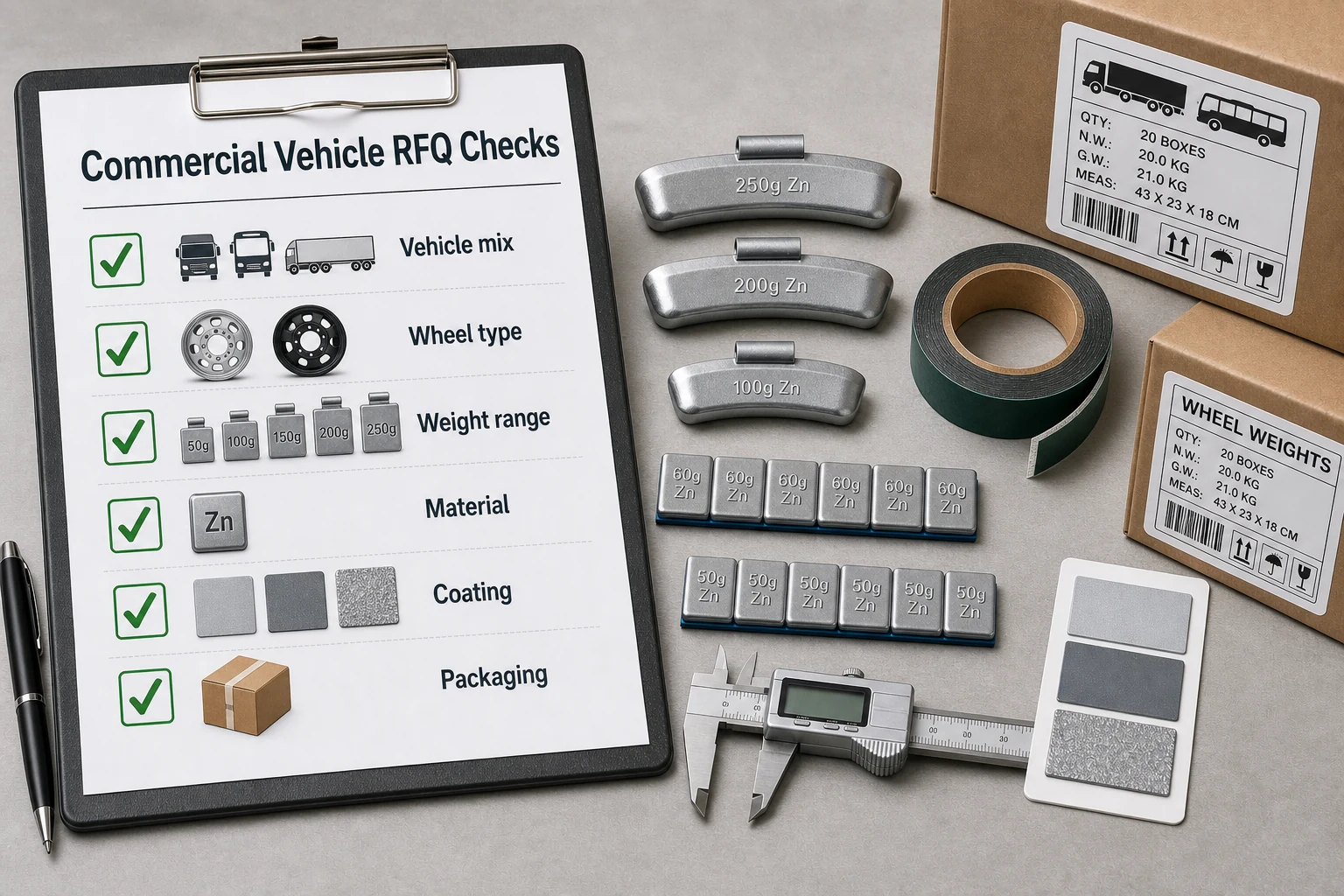
Start with the vehicle mix. A useful RFQ does not say only "commercial vehicle wheel weights." It explains whether the buyer serves fleet vans, medium trucks, heavy trucks, buses, trailers, or a mixed channel. That context tells the supplier which size range, packaging, and sample plan will be meaningful.
Next, list wheel type and attachment format. If the range includes clip-on weights, request the intended wheel type, rim profile, clip design, coating, and sample fitment. If the range includes adhesive weights, request strip size, segment weight, total strip length, tape construction, liner behavior, and installation guidance.
Packaging deserves a separate RFQ line. Commercial vehicle weights are heavier than many light-vehicle ranges, so carton strength, inner box layout, gross weight, label clarity, palletization, and barcode requirements matter. Buyers planning larger orders can use bulk wheel weight packaging and SKU planning to decide whether MOQ, carton weight, and range depth are realistic before negotiating final pricing.
| RFQ field | What to write | Why it matters |
|---|---|---|
| Vehicle mix | Fleet vans, trucks, buses, trailers, or mixed service | Prevents a generic assortment from being quoted |
| Wheel type | Steel, aluminum, commercial wheel design, or sample wheel data | Guides clip profile and adhesive fitment |
| Weight range | Units, increments, maximum values, strip layout | Aligns supply with actual service demand |
| Material | Steel, zinc, lead-free requirement, or customer-specified material | Avoids wrong-material claims |
| Coating | Color, finish type, corrosion expectation, sample standard | Reduces visible finish complaints |
| Packaging | Pieces per box, inner box, carton weight, label, barcode | Supports warehouse and resale handling |
| Samples | Quantity, approval wheel, fitment, tape, coating, carton review | Finds problems before bulk production |
How should buyers qualify suppliers?
Buyers should qualify commercial vehicle wheel weight suppliers by checking sample accuracy, tooling consistency, coating control, packaging strength, label accuracy, lead time, and repeat batch stability. A supplier that can make a good sample must also prove it can ship the same range consistently.
The first check is whether the supplier understands commercial vehicle applications. If the quotation treats fleet vans, buses, trailers, and heavy trucks as one identical category, the buyer should slow down. A good supplier will ask about wheel type, attachment format, size range, material, packaging, and the intended service channel.
The second check is batch consistency. Commercial vehicle ranges often involve repeat orders, heavier cartons, and high-use SKUs. A buyer should ask how the supplier controls weight accuracy, clip geometry, adhesive tape placement, coating thickness or appearance, carton labeling, and product marking. When a range is used across several service locations, inconsistency creates confusion quickly.
The third check is documentation and labeling. Importers may need material declarations, lead-free statements, carton labels, barcodes, product photos, or test reports depending on the market and customer. Buyers should ask for realistic documentation rather than accepting broad claims that cannot be matched to a product batch.
The fourth check is production and shipment reliability. Commercial service channels dislike stockouts because they interrupt work. Buyers evaluating a new source can use supplier checks for repeat commercial vehicle wheel weight orders to review factory capability, QC flow, packing control, and repeat order communication before placing a larger program order.
| Supplier check | What to request | Warning sign |
|---|---|---|
| Application knowledge | Questions about vehicle mix, wheel type, and attachment method | Supplier quotes only by price per kg or per box |
| Sample control | Real samples with labels and packaging | Sample differs from quoted material or size |
| Coating control | Finish standard and inspection method | Supplier only says "good coating" |
| Packaging strength | Inner box, carton, gross weight, and label mockup | Carton plan is unclear or too heavy for handling |
| Repeat supply | Lead time, MOQ, batch marking, reorder process | No clear batch or reorder tracking |
If you are sourcing wheel weights for trucks, fleets, or buses, share the vehicle mix, wheel types, weight range, coating, packaging, and service volume you need to cover. We can help you build a commercial-vehicle sample range around real usage rather than a generic list.
Conclusion: match the wheel weight range to the vehicle mix
Commercial vehicle wheel weights should be planned around the vehicles and service channels the buyer actually supports. Fleet vans, trucks, buses, and trailers can share the same product category, but they do not always need the same sizes, attachment formats, materials, coatings, cartons, or stock depth.
The strongest buying process starts with a vehicle map, then moves to wheel type, size range, attachment format, material, coating, packaging, and samples. Buyers preparing a commercial program can review commercial vehicle wheel weight samples for fitment and packaging checks once the fleet mix, wheel application, required range, carton labels, and sample test plan are clear.
Frequently Asked Questions
What are commercial vehicle wheel weights?
Commercial vehicle wheel weights are balancing weights used on fleet vans, trucks, buses, trailers, and similar work vehicles. They correct wheel and tire imbalance after service, but buyers must choose them by vehicle mix, wheel type, size range, attachment format, material, coating, and packaging.
Are commercial vehicle wheel weights the same as truck wheel weights?
Not always. Truck wheel weights are one part of the commercial vehicle category. A broader commercial program may also include fleet vans, buses, trailers, and mixed service vehicles. These applications can require different size ranges, stock depth, and packaging decisions.
Should fleets use clip-on or adhesive commercial wheel weights?
The choice depends on wheel type and installation process. Clip-on weights need the correct wheel flange and clip profile. Adhesive weights need enough clearance, suitable tape, and clean surface preparation. Fleets should test samples on their actual wheels before standardizing a range.
What specifications matter most for commercial vehicle wheel weights?
The most important specifications are vehicle application, wheel type, gram or ounce range, attachment format, material, coating, carton quantity, label format, barcode needs, and sample approval method. Packaging and stock depth are especially important for distributors and fleet service networks.
How can buyers avoid overstocking commercial vehicle wheel weights?
Buyers can avoid overstocking by separating core high-use sizes from secondary sizes, mapping the actual vehicle mix, and reviewing reorder history where available. A narrower range with deeper stock in the right sizes is often better than a wide range with weak turnover.
References
[1] Occupational Safety and Health Administration. “Servicing Multi-Piece and Single Piece Rim Wheels.” 2026.
[2] United States Environmental Protection Agency. “Best Management Practices for Lead Wheel Weights.” 2015.
[3] ASTM International. “ASTM B117-19 Standard Practice for Operating Salt Spray Apparatus.” 2019.
[4] 3M. “3M VHB Tape Surface Preparation Technical Bulletin.” 2019.